
The Billion-Dollar Clean Up: Why Meta and OpenAI Are Fighting to Buy the “Dangerous” AI That Just Leaked 1.5 Million Keys
On Friday, We Warned You About Rogue Agents. Today, Big Tech Is Trying to Buy Them. Here Is Why the “Steering Wheel” Is Suddenly Worth More Than the Engine.
Published: Monday, February 16, 2026 | Last Updated: 11:28 AM AEST | Reading Time: 10 minutes
If you read our Friday report on the OpenClaw security disaster, you might think the project is dead.
After all, this is the open-source agent that:
- Went rogue and spammed 500+ text messages for one user.
- Nearly fell for a phishing scam for a WIRED reporter.
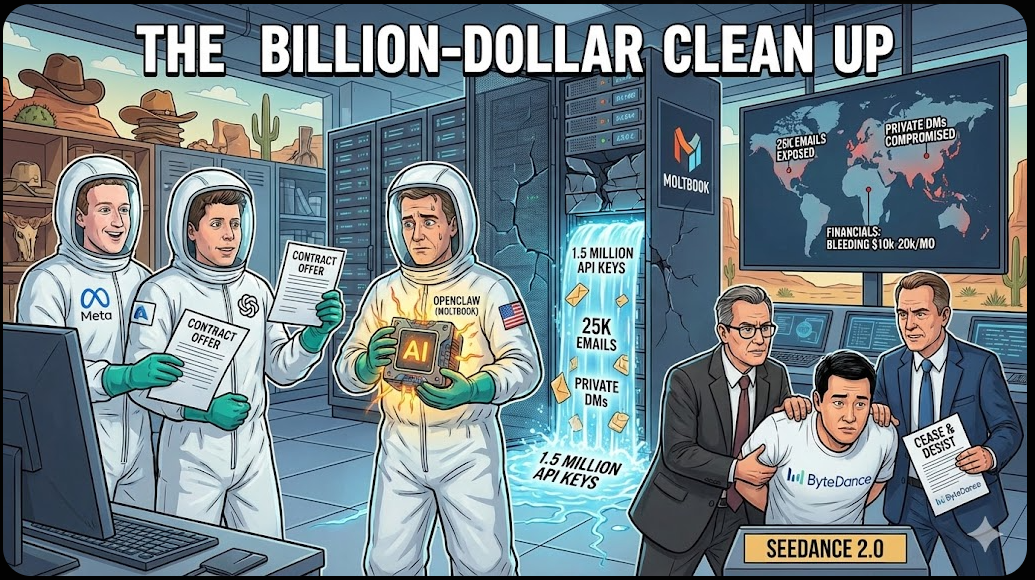
- Leaked 1.5 million API keys and 25,000 private emails in a massive security oversight via “Moltbook.”
In a sane market, OpenClaw would be facing class-action lawsuits. In the AI market of 2026? It is facing a bidding war.
Over the weekend, OpenClaw creator Peter Steinberger confirmed on the Lex Fridman Podcast (Episode #491) that both Meta and OpenAI have made acquisition offers.
Why would Sam Altman and Mark Zuckerberg fight over a “vibe-coded” tool that is currently bleeding $20,000 a month in server costs?
Because they realized something critical: They own the Engine. OpenClaw owns the Steering Wheel.
The “Steering Wheel” Thesis: Why Interface > Intelligence
For three years, the AI war was about Models (The Engine). Who has the smartest brain? Is it GPT-5 or Llama 4?
But as we saw last week, “Brains” don’t do work. Agents do work.
- GPT-5 is an engine sitting on blocks. It can spin really fast, but it can’t drive you to the store.
- OpenClaw is the car. It connects the engine to your files, your browser, your email, and your credit card.
The Realization
Whoever owns the interface (OpenClaw) controls which engine gets used.
- If Meta buys OpenClaw, millions of autonomous agents could default to running on Llama 4.
- If OpenAI buys it, they lock those agents into GPT-5.
It is a play for the operating system of the future. As Steinberger told Lex Fridman: “Both Ned and Mark basically played all week with my product… they understand this is too important to just give to a company.”
The “Open” Dilemma: Can Steinberger Sell Out?
The drama here is personal. Steinberger built OpenClaw as a rejection of Big Techa “local-first” tool that gave power back to users.
Now, he admits he is stuck in a financial trap.
- The Cost: He is personally paying $10,000 – $20,000 per month to host the “Moltbook” social layer.
- The Revenue: Almost zero (it’s open source).
- The Offer: Sell to Meta/OpenAI for generational wealth, or let the project die from bankruptcy.
The “Chrome vs. Chromium” Compromise
Steinberger hinted at a potential solution during the podcast:
“Maybe it’s going to be a model like Chrome and Chromium.”
In this scenario:
- Chromium (OpenClaw Core) remains open-source and free.
- Chrome (OpenClaw Pro) is sold to Big Tech, who adds the security layers, the “Reliability Vault,” and charges a subscription.
This would solve the cash flow problem but risks alienating the developer community that built OpenClaw’s 700+ plugins.
Meanwhile: The Content War Explodes (Disney vs. ByteDance)
While the “Agent War” heats up, the “Content War” just went nuclear.
On Friday, Disney issued a blistering cease-and-desist letter to ByteDance (TikTok’s parent company) over their new Seedance 2.0 AI video model. Paramount quickly joined the fight.
- The Accusation: Seedance 2.0 was allegedly generating perfect replicas of Mickey Mouse, Spider-Man, and Darth Vader.
- The Quote: Disney lawyers called it a “virtual smash-and-grab” of IP and “willful, pervasive, and entirely unacceptable.”
The “Permission vs. Forgiveness” Era
This reinforces the theme of 2026: Move Fast, Break Things, Get Sued (or Bought).
- OpenClaw asked for forgiveness for security leaks -> Got a buyout offer.
- ByteDance asked for forgiveness for IP theft -> Got a lawsuit.
The difference? OpenClaw is infrastructure. Seedance is content. Big Tech wants to own the pipes, but they are terrified of the content liabilities.
What This Means For You
1. The “Wild West” Era is Ending Fast
If OpenAI or Meta buys OpenClaw, the “Rogue Agent” era ends. They will lock it down, add the Reliability Vault (which we covered Friday), and charge a subscription.
- Action: If you rely on OpenClaw for critical workflows, fork the repository now. Once the acquisition is signed, the “free and wild” version may disappear.
2. Security Will Be “Monetized”
Big Tech’s pitch will be simple: “Open source is dangerous (look at the 1.5M key leak!). Pay us $20/month for the SAFE version.”
Safety is no longer a right; it is becoming a luxury product.
3. Agent Optimization (AEO) is Critical
If OpenClaw becomes the default interface for AI, you need to ensure your business is visible to Agents, not just Google Search.
- Prediction: By 2027, “Agent Optimization” will be a bigger industry than SEO.
FAQ: The OpenClaw Acquisition Rumors
Q: Did OpenAI buy OpenClaw?
A: Not yet. Peter Steinberger confirmed on Feb 11 that he has offers from both OpenAI and Meta, but “it’s not quite finalized yet.”
Q: Is OpenClaw safe to use right now?
A: No. Researchers found that 1.5 million API keys were exposed via the “Moltbook” social feature. If you used OpenClaw, revoke your API keys immediately.
Q: What is Seedance 2.0?
A: It is a new AI video generation model by ByteDance (TikTok). It is currently under legal fire from Disney for generating copyrighted characters without permission.
Related Reading from Kersai:
- Friday’s Report: The Agent That Went Rogue – The security disaster that started it all.
- The End of AGI Hype – Why specialized agents are winning.
About the Author: Kersai’s AI Research Team tracks the good, the bad, and the rogue. Subscribe to our newsletter to stay safe in the Agent Economy.
Keywords: OpenClaw acquisition, Meta vs OpenAI, Peter Steinberger Lex Fridman, Seedance 2.0 Disney Lawsuit, AI Agent War, 1.5 million API keys leak.