

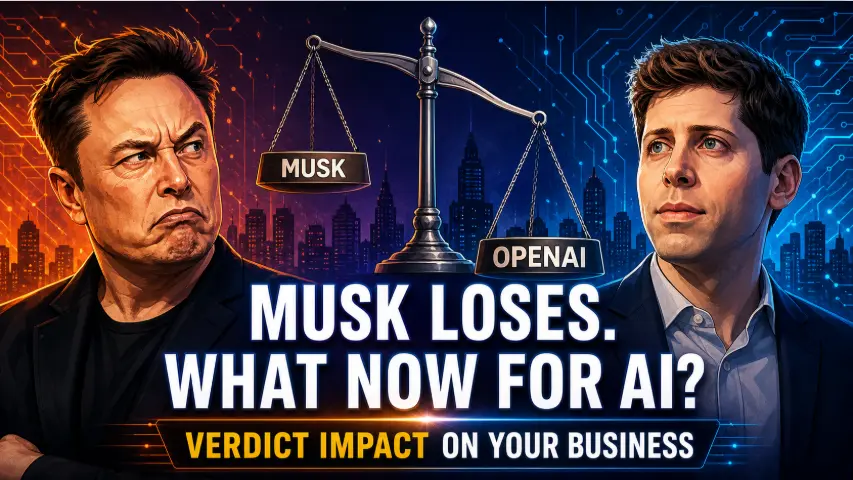
Elon Musk Lost. OpenAI Won. What This Verdict Really Means for AI Stability, Power and Your Business in 2026
Published: 19 May 2026 By: Kersai Research Team
Category: AI Strategy / AI Governance / Business Risk
Quick Summary
Elon Musk losing his case against OpenAI is more than a courtroom headline. It is a signal about how power, stability and risk are now being distributed in the AI economy.
A federal jury rejected Musk’s remaining claims against OpenAI, Sam Altman, Greg Brockman and Microsoft, concluding that he waited too long to bring the case. That means the immediate legal path Musk hoped to use to disrupt OpenAI’s structure, leadership and Microsoft relationship has failed.
For business owners and executives, that does not mean every concern about OpenAI disappears. It means something narrower and more practical: one of the biggest immediate legal threats hanging over the company has been removed, and the centre of gravity for AI risk shifts back toward regulation, vendor concentration, copyright fights, safety debates and internal governance.
This article explains what the jury actually decided, what a Musk win might have changed, what the verdict means for AI stability and competition, and what leaders should do with that information right now.
The Impact
The most important thing about Elon Musk’s loss against OpenAI is not the celebrity drama. It is the message the verdict sends about where the AI industry is going next.
For months, the case carried an unusually large symbolic weight. Musk was not just suing an AI company he helped found. He was challenging one of the central organisational stories of the modern AI boom: the transformation of an idealistic research lab into a highly commercialised, Microsoft-linked powerhouse at the centre of the industry.
If Musk had succeeded, the verdict could have shaken confidence in one of the most important companies in AI. It could have complicated OpenAI’s corporate future, threatened its relationship with Microsoft, and created broader uncertainty for businesses building on top of its models and APIs.
That did not happen.
Instead, OpenAI won. Musk lost. And the AI market now has a clearer answer to one question that many business leaders were quietly asking: is OpenAI’s structure about to be destabilised by a founder lawsuit?
For now, the answer is no.
That matters because for many businesses, OpenAI is no longer just a name in the news. It sits inside products, workflows, customer service layers, software integrations and internal copilots. When one of the largest AI vendors in the world is hit with a major legal threat, it is not just a legal story. It is a platform risk story.
What the Jury Actually Decided
The legal details of the case are complicated, but the practical outcome is straightforward.
A federal jury rejected all of Musk’s remaining claims against OpenAI, Sam Altman, Greg Brockman and Microsoft. The central reason was timing. Jurors concluded that Musk waited too long to sue, meaning the statute of limitations had already expired.
That point is worth understanding clearly because it shapes how leaders should interpret the result.
The verdict does not mean every concern raised in the case was declared morally or strategically irrelevant. It means the jury decided Musk was too late to use those claims as the basis for legal relief.
That is a narrower outcome than some headlines imply, but it is still a major win for OpenAI.
Why? Because the practical threat was never only about whether Musk could win a philosophical argument about OpenAI’s mission. The threat was about whether he could use the courts to force major structural consequences.
He was seeking very large remedies, including major damages, removal of Altman and Brockman, and the unwinding of OpenAI’s for-profit structure and Microsoft-linked arrangements. Those remedies are now off the table through this path.
Musk has said the result was a technicality and has vowed to appeal. But from a business perspective, the most important fact is this: OpenAI avoided a near-term legal disruption scenario that could have taken years to untangle.
What Musk Was Really Trying to Change
To understand why this matters, it helps to see the case not just as a dispute over history, but as a fight over who gets to define the future of AI power.
Musk’s position was that OpenAI had abandoned its original charitable mission to develop AI for the benefit of humanity and had instead become a profit-driven machine closely aligned with Microsoft.
He argued that the company’s shift from a nonprofit-led mission toward a commercially dominant structure represented a betrayal of the original agreement and justified legal intervention.
Whatever one thinks of that argument, the remedies he sought would have been dramatic.
If a court had forced OpenAI to unwind parts of its structure, remove current leadership or materially disrupt its Microsoft relationship, the effects would likely have rippled far beyond one company. It would have raised questions for investors, founders and boards across the AI sector about the legal durability of hybrid nonprofit/for-profit models, strategic partner arrangements and mission-based branding.
That is why the case mattered so much.
It was never simply “Musk versus Altman.” It was also a referendum on whether one of the most commercially important AI organisations in the world could be forced into a structural reset by one of its original founders.
The answer, at least for now, is no.
The Alternate Timeline: What If Musk Had Won?
One of the most useful ways to understand the verdict is to imagine the alternate timeline.
If Musk had won, several things could have happened.
First, OpenAI’s corporate future would have become much less predictable. Any prospect of a future public offering or major financing event could have been complicated by legal uncertainty over its structure, governance and asset flows.
Second, Microsoft’s strategic position could have come under new scrutiny. Because Microsoft is deeply intertwined with OpenAI through cloud infrastructure, product integration and commercial alignment, any court-forced restructuring would have created uncertainty well beyond OpenAI itself.
Third, the case could have triggered a broader shockwave across the AI market. Investors would have had to ask whether similar organisational contradictions existed elsewhere: mission-driven branding combined with hard-edged commercial realities, strategic partnerships that concentrated power, or governance structures that looked stable until challenged.
In other words, a Musk win might not have “stopped AI,” but it could have introduced a significant destabilising moment in one of the industry’s most central pillars.
Because that did not happen, the market gets something simpler instead: continuity.
What the Verdict Actually Changes for AI Stability
The verdict changes several things immediately.
1. It removes a major legal overhang from OpenAI
OpenAI now looks more stable in the short term than it did while this case was hanging over it. That matters for enterprise customers, developers, software partners and investors who prefer not to build around vendors facing existential legal uncertainty.
It also matters for Microsoft, because the partnership no longer appears at immediate risk of being disrupted through this particular case.
2. It reinforces the current balance of power in AI
A Musk win could have disrupted the current hierarchy. Instead, the verdict strengthens the status quo.
OpenAI remains one of the dominant AI platforms. Microsoft retains its privileged position in the ecosystem. Businesses that have already standardised on OpenAI-linked products are less likely to feel pressure to rethink those decisions because of this case alone.
3. It shifts the focus of AI risk back to other fronts
This is crucial.
The verdict does not make the AI industry “safe.” It simply removes one very specific source of risk.
The next wave of AI pressure is much more likely to come from:
- Regulation and policy
- Copyright and IP litigation
- Antitrust scrutiny
- Safety and liability debates
- Platform concentration and dependence
- Internal governance failures at AI companies or customer companies
That is the correct lens for business leaders.
The question is no longer, “Will Musk’s case blow up OpenAI?” The question is, “What are the actual operational and strategic risks that remain if OpenAI continues becoming more central to business infrastructure?”
What Changes vs What Does Not
| Topic | What changes after the verdict | What does not change |
|---|---|---|
| OpenAI stability | Short-term legal uncertainty is reduced | Long-term regulatory and competitive pressure remains |
| Microsoft relationship | Immediate threat from this case is removed | Strategic concentration risk still exists |
| AI adoption decisions | Businesses may feel more comfortable keeping OpenAI in their stack | Vendor diversification still matters |
| AI governance | One founder challenge failed | Governance debates about AI power and public benefit continue |
| Industry competition | No forced structural reset at OpenAI | Rivals still compete on models, products, safety and enterprise trust |
Power and Concentration: Who Really Controls AI After This?
One of the most important lessons from the case is that the future of AI is not being decided only by product quality. It is being shaped by capital structure, cloud dependence, corporate governance, distribution power and political influence.
The verdict reinforces that reality.
OpenAI, Microsoft, Google, Anthropic, Amazon and a handful of other major players are not simply competing to build the best model. They are competing to become the infrastructure layer, the default interface and the trusted operating partner for the next wave of business AI.
The outcome of the Musk case does not dismantle that race. It strengthens the incumbents inside it.
For businesses, that is both reassuring and dangerous.
It is reassuring because large platforms now look more stable. It is dangerous because stability can lull companies into deeper dependence.
When a vendor wins a major legal battle, customers often feel encouraged to consolidate around that vendor. But concentration risk does not disappear just because one legal threat fades.
A platform can be legally stable and still be strategically risky if your business becomes too dependent on it for critical operations, customer experience or internal productivity.
What This Means for Business Risk in 2026
The most useful question for owners and executives is not “Who was right in the lawsuit?” It is “What should I do differently after the verdict?”
There are three practical takeaways.
1. Platform stability is stronger, so short-term vendor confidence rises
If your business already uses OpenAI-powered tools directly or indirectly, the verdict lowers one category of uncertainty. The probability of a sudden structural shock from this specific case is now much lower.
That can justify calmer planning and less fear-driven reaction.
2. Vendor dependence is still a major strategic issue
The result may tempt some businesses to deepen their dependence on one ecosystem without further thought. That would be a mistake.
The deeper a company embeds AI into workflows, the more important it becomes to think about portability, fallback options, API abstraction, pricing exposure and data governance.
The verdict reduces one legal threat. It does not solve overdependence.
3. Your internal AI governance matters more than vendor mission statements
One subtle lesson of the case is that businesses cannot outsource ethics and governance to AI vendors.
For years, many companies have taken comfort in the public narratives of AI firms: mission-driven, safety-conscious, humanity-first, research-led. But when the legal and commercial realities get tested, those narratives do not protect your company.
Your company still needs its own answers to core questions:
- What data can our AI systems access?
- What actions can our AI systems take without approval?
- How do we monitor performance and errors?
- What happens when a vendor changes terms, pricing or roadmap?
- How do we preserve customer trust when using AI in visible workflows?
Those questions matter far more to your risk posture than the personal conflict between Musk and Altman.
Panic Reaction vs Strategic Reaction
| Panic reaction | Strategic reaction |
|---|---|
| Pause all AI plans because the industry feels unstable | Keep building high-value workflows with measured controls |
| Assume OpenAI is now risk-free because it won in court | Continue assessing vendor concentration and portability |
| Treat the verdict as proof that governance concerns were meaningless | Treat governance as your own internal discipline |
| Choose one AI provider for everything for the sake of speed | Build flexibility where possible and review critical dependencies |
| React to headlines | React to workflow economics, trust and resilience |
How Leaders Should Respond Right Now
The right response to the verdict is neither panic nor complacency.
1. Do not overreact to the drama
The case was important, but most businesses should not rewrite their entire AI strategy because of one verdict.
If you already have sound reasons for using OpenAI-based tools, the result gives you more short-term confidence, not a mandate to do something reckless.
2. Review where your business is exposed
Map where AI shows up in your organisation today.
That includes:
- Direct use of ChatGPT or OpenAI APIs
- Microsoft products with embedded OpenAI capability
- Third-party SaaS tools powered by OpenAI
- Internal workflows that assume one vendor’s model quality or availability
Many businesses are more exposed than they realise.
3. Build model and vendor flexibility where it matters most
Not every workflow needs multi-vendor redundancy. But your most important AI-supported workflows should not be impossible to migrate, adapt or replace if market conditions change.
The goal is not paranoia. It is resilience.
4. Strengthen your own governance, documentation and measurement
If the Musk case teaches anything useful to business operators, it is that corporate narratives are less important than structural reality.
Apply that lesson internally.
Do not rely on vendor reputation as your control system. Build your own controls:
- Clear ownership
- Use-case approval rules
- Data access rules
- Monitoring and review
- Incident response paths
That is how serious businesses stay calm in a noisy AI market.
How Kersai Helps Translate AI Drama Into Clearer Risk Posture
Most businesses do not need more legal theatre. They need help understanding what industry shocks actually mean for their own stack, workflows and exposure.
Kersai helps leaders translate stories like Musk vs OpenAI into practical decisions.
That work often includes:
- Mapping vendor dependence across your AI tools and workflows
- Designing more resilient AI stacks with better portability and governance
- Identifying where AI creates leverage without creating fragile dependence
- Building internal policies and operating models that protect trust and flexibility
The goal is simple.
Use AI aggressively where it creates clear value. But do it in a way that remains stable when lawsuits, policy shifts or platform dynamics change.
Book a Free Strategy Call
If your business is adopting AI quickly and you want to understand your real exposure to vendor, governance or concentration risk, Kersai can help turn uncertainty into a clearer operating plan.
Key Takeaways
- Elon Musk’s loss removes one of the biggest immediate legal threats hanging over OpenAI and its Microsoft relationship.
- The verdict strengthens short-term stability for businesses using OpenAI-linked tools and services.
- It does not eliminate AI risk; it shifts the focus back to regulation, vendor concentration, copyright, safety and internal governance.
- Businesses should not mistake OpenAI’s legal win for a reason to ignore portability and resilience.
- The best response is calm, workflow-level strategy backed by strong internal governance.
Frequently Asked Questions
Does this verdict mean OpenAI is now safe to build on?
It means one major legal threat has been reduced. It does not mean OpenAI is risk-free. Businesses should still think about contracts, vendor concentration, portability and internal governance.
Will Musk’s loss slow down AI regulation?
Probably not. Regulatory pressure on AI is being driven by broader concerns such as safety, copyright, market concentration and public trust. One founder lawsuit ending does not remove those issues.
Should businesses diversify away from OpenAI after this case?
Not necessarily. The better question is whether your most important workflows are overly dependent on any one model or vendor. Diversification should be driven by resilience and economics, not panic.
What is the biggest lesson for business owners?
Do not outsource your AI risk management to vendor branding or public narratives. Build your own governance, document your dependencies and make sure your critical workflows remain adaptable.
Why does this case matter if I am just using AI tools for productivity?
Because platform stability, pricing, model availability and vendor behaviour all affect the tools your business relies on. Even if you are not directly building with AI APIs, upstream vendor risk still matters.
This article was researched and written by the Kersai Research Team. Kersai helps organisations design practical AI infrastructure strategies, from model selection and compute planning to multi‑cloud deployments and governance visit kersai.com.