

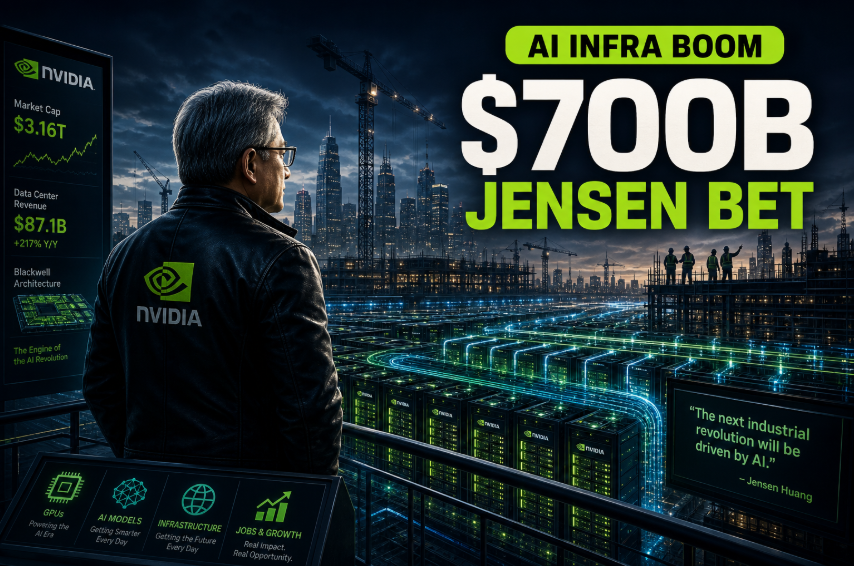
Jensen Huang’s $700 Billion AI Bet: What It Really Means for Your Business and Jobs in 2026
Published: 14 May 2026 By: Kersai Research Team
Category: AI Strategy / Business Growth / AI Infrastructure
Quick Summary
Jensen Huang is trending because he is not just talking about Nvidia anymore. He is talking about the shape of the next economy.
In early 2026, Nvidia’s CEO argued that the technology industry’s roughly $700 billion AI infrastructure buildout is “just the beginning.” He reinforced the message with a now widely repeated line: in the new AI economy, “compute equals revenues.” At the same time, he has been telling workers, tradespeople and graduates that AI is not only about software jobs. In his view, the next AI boom will create work across construction, power, data centers, networks and industrial buildout.
That combination is why this matters so much to business owners and executives. Huang is not making a narrow stock market claim. He is effectively arguing that AI infrastructure is the foundation of a new industrial cycle.
If he is right, businesses that understand the AI buildout early will have a major advantage in cost, speed, hiring and market positioning. If he is wrong, many companies could over-invest, over-build and over-expose themselves to a hype cycle that does not turn into durable returns.
This article explains what Huang is actually betting on, why markets are listening, what it means for normal businesses in 2026, and how leaders should respond without getting swept up in the noise.
Jensen Huang’s $700 Billion AI Bet
The reason Jensen Huang is trending is not just that Nvidia remains the dominant company in the AI hardware stack. It is that Huang has become one of the clearest public voices defining what the next phase of the AI economy is supposed to look like.
That matters because leaders listen when the person selling the picks and shovels starts describing the size of the gold rush.
In 2026, Huang is making a very specific argument. Big Tech’s massive AI infrastructure spending is not a temporary bubble at the edge of the market. It is the beginning of a new economic era in which compute becomes a core input to revenue generation across industries.
That is the core of his message. And whether or not you believe the full scale of it, it has huge implications for how businesses think about AI costs, workforce planning, competitive advantage and risk.
What Jensen Huang Is Actually Betting On
To understand the moment, it helps to separate the headlines from the substance.
The headline is simple: Huang says the technology sector’s roughly $700 billion AI infrastructure buildout is only the beginning. He has argued that trillions of dollars of AI infrastructure still need to be built and that this new computing paradigm is not going away.
But the deeper bet underneath that headline is even more important.
Huang is not simply saying demand for GPUs will remain strong. He is saying that AI compute itself is becoming a direct engine of economic activity. That is why he keeps repeating the phrase “compute equals revenues.” In his view, inference, token generation and accelerated computing are not just support functions for digital products. They are becoming the production layer of a new economy.
That is a major conceptual shift.
In the old software model, infrastructure supported the application. In Huang’s framing, infrastructure increasingly is the business advantage. The more efficiently a company can generate, move and apply AI compute, the more effectively it can create products, automate operations, personalise services and capture new revenue.
This logic helps explain why the capex numbers being discussed are so large. If AI is merely another enterprise feature, spending hundreds of billions on infrastructure looks excessive. If AI is the new production system for entire industries, the spend starts to look more plausible.
Why Markets Are Taking Him Seriously
Part of the reason markets keep listening to Huang is simple: Nvidia’s financial performance has given him extraordinary credibility.
Nvidia has continued to post remarkable results through early 2026, with revenue and data center growth still running at levels that would be almost impossible for most large companies. Margins remain exceptionally high, demand from hyperscalers remains strong, and investor appetite for the company’s role in the AI stack has not disappeared.
When a CEO talks about a new economic cycle while their company is producing the numbers Nvidia is producing, people pay attention.
There is also a second reason. Huang’s thesis fits what many businesses are already experiencing. AI is moving from novelty to infrastructure. Cloud providers, model companies, enterprise software vendors and data center operators are all reorganising around the assumption that AI demand will keep rising. In that context, Huang’s comments do not feel isolated. They feel like a public version of what many industry leaders already believe privately.
Is This the Start of a New Economic Cycle or the Peak of the Bubble?
This is the central question.
Huang’s message is compelling, but it also invites skepticism. When a market leader tells investors that a $700 billion buildout is only the beginning and that trillions more need to be spent, the obvious concern is whether this is the kind of narrative that appears near the top of a hype cycle.
Some analysts and commentators are already asking exactly that. The concern is not that AI is fake or that Nvidia is weak. The concern is that infrastructure spending may be outrunning the pace at which normal businesses can convert AI capability into durable, profitable demand.
That distinction matters.
It is entirely possible for AI to be genuinely transformative and still have an overheated capex cycle. Those two things are not mutually exclusive. A technology can change the world and still be overbuilt, mispriced or temporarily overhyped on the way there.
So there are really two versions of the future being debated.
The bull case
The bull case says Huang is broadly right. AI agents, inference workloads, enterprise automation, coding systems, industrial AI and multimodal interfaces are all still early. If that is true, today’s spending wave is laying the groundwork for a much larger transformation that will justify the investment over time.
In this view, businesses that hesitate too long will miss a fundamental platform shift. They will find themselves trying to catch up later when competitors already have cheaper access, better workflows, stronger internal capability and larger data advantages.
The bear case
The bear case says the infrastructure buildout is moving faster than the revenue reality. Yes, AI demand is real. But real demand does not necessarily justify permanent exponential capex. If enterprise adoption lags, if margins tighten, if regulation slows deployments or if customers prove less willing to pay for AI features than expected, parts of the market could discover they built too much too soon.
This is especially relevant for business leaders outside Big Tech. The fact that hyperscalers and chip companies are spending at unprecedented levels does not automatically mean every business should rush into large AI bets of its own.
What This Means for Normal Businesses in 2026
For most companies, Huang’s $700 billion argument matters less as a market forecast and more as a signal about the environment they are operating in.
Even if you are not building data centers or buying GPU clusters, this infrastructure cycle shapes the tools you can access, the prices you pay, the capabilities you can deploy and the skills your organisation will need.
1. Better AI capability is becoming more available
As the infrastructure race intensifies, businesses are getting access to increasingly powerful AI systems. Better reasoning, lower latency, richer multimodal capabilities and more agentic workflows are all downstream effects of this infrastructure boom.
That is good news for businesses because it means capabilities that were once limited to top-tier labs and hyperscalers are gradually becoming available through mainstream tools and platforms.
2. AI costs may fall in some areas and rise in others
One of the trickiest parts of the current moment is that AI economics are not moving in one direction.
On one hand, more infrastructure and more competition can push down the unit cost of many common AI tasks over time. On the other hand, businesses are also asking AI systems to do far more complex work, which can increase total spending even if unit prices improve.
In practice, many businesses may experience a paradox: AI becomes cheaper per unit, but more expensive in total because usage expands so quickly.
3. Vendor dependence becomes more dangerous
When one company becomes central to the infrastructure layer of a major technology cycle, dependence risk rises.
This does not mean businesses should avoid Nvidia-linked ecosystems. That would be unrealistic. But it does mean leaders should think seriously about platform concentration, model portability, cloud dependence and what happens if supply, regulation or pricing dynamics change.
4. Timing matters more than excitement
The right response to a large infrastructure cycle is not panic or blind enthusiasm. It is timing.
Some businesses should move faster because the workflows and economics already support it. Others should move carefully, building internal capability and testing specific use cases instead of assuming the macro narrative automatically applies to them.
If Jensen Huang Is Right vs If He Is Wrong
| Scenario | What it means for business leaders | Best response |
|---|---|---|
| Huang is broadly right and AI becomes a long multi-year infrastructure cycle | AI tools improve fast, compute becomes core to competitive advantage, AI-native businesses widen the gap | Move early on high-value workflows, build internal capability, avoid waiting for total certainty |
| Huang is directionally right but the capex cycle overshoots in the short term | Great AI tools still emerge, but pricing, vendor stability and market narratives become volatile | Stay practical, avoid vanity AI spend, choose flexible tools and measured pilots |
| Huang is overstating the pace and scale of demand | Many companies overbuild, parts of the ecosystem correct hard, some AI features underperform expectations | Focus only on use cases with clear ROI, avoid overcommitting to hype-driven roadmaps |
The Jobs Story Behind the AI Buildout
One of the most interesting parts of Huang’s recent public messaging is that he is not only talking to engineers, investors and software founders.
He has also been speaking directly to workers in the physical economy electricians, plumbers, construction workers, ironworkers, technicians and other skilled trades. His message has been simple: this is your time.
That line matters because it reveals how he sees the AI economy.
Many people still talk about AI as though it is mainly a software story. Huang is framing it as both a software story and an infrastructure story. And infrastructure requires people who can build, power, cool, maintain and expand the physical systems that AI depends on.
That means the AI jobs story in 2026 is much broader than “learn prompting” or “become an ML engineer.”
The jobs likely to grow in relevance over the next phase of the cycle include:
- Data center construction and operations
- Electrical, cooling and power systems work
- Networking and infrastructure engineering
- AI operations and model governance
- Data engineering and workflow design
- Security, compliance and runtime monitoring
For business owners, this matters in two ways.
First, the AI economy may intensify competition for technical and operational talent well beyond software roles. Second, businesses that ignore these shifts may underestimate the real workforce changes needed to support their own AI ambitions.
What Business Leaders Should Actually Do in Response
When a figure like Jensen Huang dominates headlines, it is easy to feel pressure to “do something big” in AI.
That is usually the wrong instinct.
The smarter response is not to mirror the scale of the narrative. It is to translate the narrative into disciplined action that makes sense for your company.
1. Build around workflows, not headlines
Do not invest in AI because Nvidia, Wall Street or social media says the future is accelerating. Invest because a specific workflow in your business can be improved in a measurable way.
The question is never “Should we invest because AI infrastructure is booming?” The question is “Which business process becomes faster, cheaper, more reliable or more scalable because AI is now good enough to help us?”
2. Assume capability will improve faster than organisational readiness
One of the biggest traps in 2026 is that the tools are improving faster than most companies can absorb them.
That means the main bottleneck is often not raw model capability. It is your data quality, process maturity, governance and ability to redesign workflows around new tools.
3. Avoid single-vendor strategic blindness
The infrastructure buildout is real, but concentration risk is real too.
Where possible, choose workflows and tools that reduce deep lock-in. You may not be able to avoid the biggest ecosystems, but you can often preserve more flexibility than you think by designing around portability, governance and API abstraction.
4. Treat talent strategy as part of AI strategy
If Huang is right, the AI era will create pressure not just on software teams but on operations, infrastructure, power, networking and compliance functions too.
Business leaders should start asking now which skills they will need more of over the next two to three years and how those skills will be sourced, trained or partnered in.
5. Focus on resilience, not just speed
Many companies are still pursuing AI as though the goal is to move fastest. In reality, the businesses that will benefit most are likely to be the ones that combine speed with resilience.
That means choosing AI investments that still make sense if prices shift, vendors change, regulation tightens or the capex cycle cools.
A Simple AI Investment Checklist for the Jensen Era
Before making any major AI investment in 2026, ask the following:
- What exact workflow are we improving?
- What business metric should change if this works?
- Does this use case still make sense if AI costs do not fall as quickly as expected?
- Are we depending too heavily on one vendor, model or cloud pathway?
- Do we have the internal capability to supervise, improve and govern this system?
- Are we building something durable or just reacting to market excitement?
- If the AI capex cycle cools in 12 to 24 months, will this investment still look smart?
- Does this project improve trust, service quality or productivity in a way customers and staff will actually feel?
If a project cannot survive that checklist, it probably is not ready.
How Kersai Helps Leaders Translate Trillion-Dollar Narratives Into Practical Plans
Most business owners and executives do not need another dramatic AI headline. They need help translating macro narratives into decisions that fit their own economics, workflows and team realities.
That is where Kersai fits.
Kersai helps businesses:
- Identify the AI use cases that create real leverage instead of vanity experimentation
- Design workflows that benefit from stronger AI capability without depending on hype
- Build governance, measurement and internal capability around the right tools
- Navigate AI infrastructure narratives with a practical eye on cost, vendor dependence and long-term value
The goal is not to predict whether Jensen Huang is perfectly right about every number.
The goal is to make sure your business is prepared if the AI buildout continues and protected if parts of the narrative prove overextended.
Book a Free Strategy Call
If you want help turning the AI infrastructure boom into a grounded plan for your business, Kersai can help you assess where AI creates real value, where the risks sit, and how to act without being dragged around by hype cycles.
Key Takeaways
- Jensen Huang’s $700 billion AI buildout thesis is really a claim about a new economic cycle, not just Nvidia’s growth.
- His phrase “compute equals revenues” reflects a view that AI infrastructure is becoming a direct engine of business value.
- Even if normal businesses are not buying GPUs, this infrastructure race still affects AI capabilities, pricing, vendor dependence and workforce planning.
- The AI jobs story is not just about coders. It increasingly includes trades, infrastructure, operations, governance and data roles.
- Business leaders should respond to the AI boom with workflow-based strategy, talent planning and resilience, not hype-driven spending.
Frequently Asked Questions
Why is Jensen Huang trending in May 2026?
He is trending because his comments on AI infrastructure, jobs and geopolitics are colliding with broader market interest in Nvidia, the AI capex cycle and the future of work. His public message is shaping how investors and business leaders think about the next phase of AI.
What does Jensen Huang mean by “compute equals revenues”?
He means that in an AI-driven economy, compute is no longer just a backend cost. It becomes a production engine that directly enables products, automation, token generation and new revenue opportunities.
Does the $700 billion AI buildout matter to small businesses?
Yes. Even if smaller businesses are not buying infrastructure directly, the buildout affects the capabilities, costs and platforms they rely on. It also changes which skills become valuable and which AI tools become accessible.
Is Jensen Huang right about AI jobs?
He may be directionally right that AI creates jobs as well as displacing some tasks, especially in infrastructure, trades, operations and data-related roles. But the impact will vary by industry, region and time horizon.
What should business owners do with this information?
Use it to improve timing and strategy, not to chase hype. Focus on AI use cases with clear ROI, build internal capability, watch vendor dependence and think seriously about how workforce needs are changing.
This article was researched and written by the Kersai Research Team. Kersai helps organisations design practical AI infrastructure strategies, from model selection and compute planning to multi‑cloud deployments and governance visit kersai.com.