

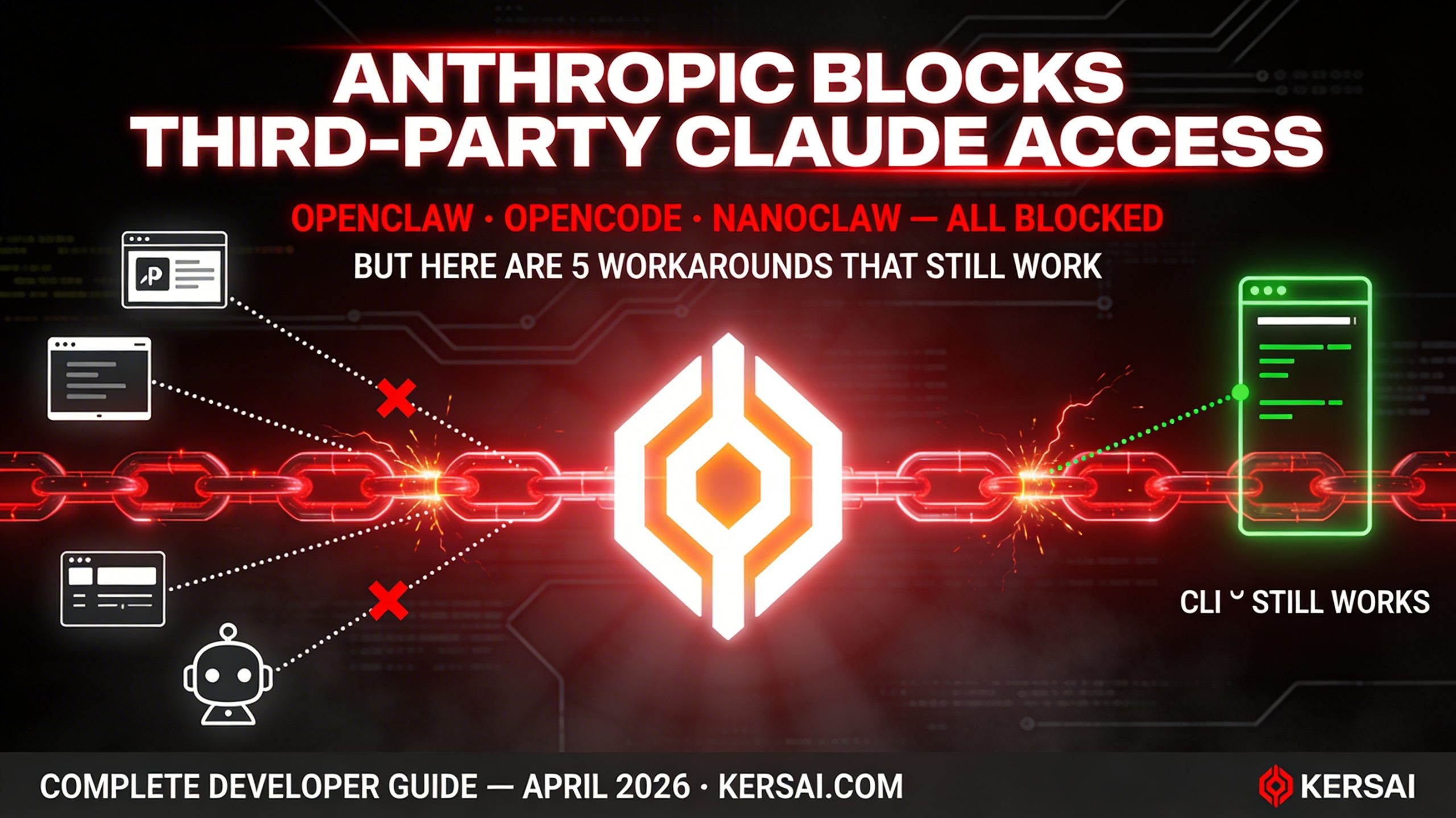
Anthropic Killed Third-Party Claude Access. Here’s Every Workaround That Still Works.
OpenClaw, OpenCode, NanoClaw All Blocked From Your Claude Subscription as of April 4. But the CLI Still Works, the API Still Works, and Peter Steinberger Already Moved On. Here’s Your Complete Playbook.
Published: April 7, 2026 | By the Kersai Research Team | Reading Time: ~18 minutes
Last Updated: April 7, 2026
Quick Summary: On April 4, 2026 at 3PM ET, Anthropic enforced a policy that had been building since January: Claude Pro, Max, and Team subscriptions no longer cover usage through third-party tools including OpenClaw, OpenCode, NanoClaw, and any other external “harness” that routes requests through Claude via OAuth. Affected users received a Friday evening email announcing the change. Anthropic offered a one-time credit equal to one month’s subscription cost and optional discounted “extra usage bundles” as compensation. The move effectively killed the most popular use case for tools like OpenClaw running autonomous AI agent workflows on a flat $200/month Max subscription rather than paying $1,000+/month in API costs. The good news: the official Claude Code CLI is still fully supported. API key authentication still works in every third-party tool. And OpenClaw’s creator Peter Steinberger who joined OpenAI and now runs a 12-agent development team on OpenAI’s Codex for $200/month gave developers the playbook for moving forward. This guide covers everything: the full story, the economics, the developer backlash, and every workaround available today.
⚠️ If You’re in a Hurry The One-Minute Version
What broke: Using your Claude Pro ($20), Max ($100/$200) subscription through OpenClaw, OpenCode, NanoClaw, or any other third-party tool.
What still works:
- Official Claude Code CLI fully supported, same subscription, no change
- Claude API key in any third-party tool pay-as-you-go, separate billing
- Extra usage bundles Anthropic’s new discounted add-on for third-party use
- Switch model providers in your tool OpenClaw and OpenCode both support OpenAI, Gemini, DeepSeek, Mistral, and local models
- Your $20$200 subscription refund or credit claim it via the link in your April 4 email
Peter Steinberger’s move: Switched OpenClaw to run on OpenAI Codex OAuth now running 12 parallel AI agents for $200/month on Codex instead of Claude.
Table of Contents
- What Happened: The Full Timeline From January to April 4
- What Actually Got Blocked and What Didn’t
- Why Anthropic Did This: The Subscription Arbitrage Economics
- The Developer Community’s Reaction: DHH, George Hotz, and 2,238 Upvotes on Reddit
- What Peter Steinberger Did and What It Means
- Workaround 1: Keep Using Claude Code CLI (Officially Supported)
- Workaround 2: Switch to API Key Authentication
- Workaround 3: Use Anthropic’s Extra Usage Bundles
- Workaround 4: Switch Your Tool to a Different Model Provider
- Workaround 5: Run Claude Code on a Remote Server via SSH
- Claim Your Refund or Credit Before It Expires
- The Bigger Picture: Is Anthropic Building a Walled Garden?
- What This Means for Businesses Using Claude
- FAQ
1. What Happened: The Full Timeline From January to April 4
The April 4 enforcement was not a sudden decision. It was the final step in a three-month crackdown that began with silent server-side blocks and culminated in a policy change that affected tens of thousands of developers worldwide.
| Date | Event |
|---|---|
| January 9, 2026 | Anthropic deploys server-side checks blocking third-party tools from authenticating via Claude subscription OAuth. Tools like OpenCode (56,000+ GitHub stars) and Clawdbot stop working overnight. Error message: “This credential is only authorized for use with Claude Code and cannot be used for other API requests.” |
| January 915, 2026 | Automated account bans begin triggering. Some users report being banned within 20 minutes of starting a task on the $200/month Max plan. Anthropic later reverses erroneous bans. |
| January 15, 2026 | George Hotz publishes blog post: “Anthropic is making a huge mistake.” Developer backlash spreads across Hacker News, Reddit, and X. |
| February 18, 2026 | Anthropic updates Claude Code legal documentation to explicitly state: “Using OAuth tokens obtained through Claude Free, Pro, or Max accounts in any other product, tool, or service including the Agent SDK is not permitted and constitutes a violation of the Consumer Terms of Service.” |
| February 19, 2026 | The Register and other outlets confirm the formal policy update. Developer Rob Zolkos surfaces the explicit documentation language on X. |
| Late March 2026 | Peter Steinberger joins OpenAI. OpenClaw’s board and Steinberger attempt to negotiate with Anthropic. “We tried to talk sense into Anthropic, best we managed was delaying this for a week,” Steinberger later tweeted. |
| April 4, 2026 (Friday evening) | Emails sent to all affected users. Enforcement goes live at 3PM ET. Claude subscriptions no longer cover third-party tool usage. One-time credit equal to one month’s plan cost offered to all affected users. |
| April 47, 2026 | Developer community reacts. Steinberger tweets that he switched OpenClaw to Codex OAuth and is running 12 agents for $200/month. Peter notes Claude Code CLI via SSH still works. |
The Friday evening email timing was not accidental it is a classic “bad news dump,” designed to let a story dissipate over a weekend rather than land in the middle of a working week. The Verge noted this explicitly, categorising the announcement in its regular “Friday news dumps: all the news companies hoped you wouldn’t notice” series.
2. What Actually Got Blocked and What Didn’t
There is significant confusion in developer communities about exactly what is and is not blocked. Let’s be precise.
What is blocked ❌
Using your Claude Pro, Max, or Team subscription OAuth token in:
- OpenClaw AI agent platform for productivity tasks (inbox, calendar, flights)
- OpenCode AI coding tool (56,000+ GitHub stars)
- NanoClaw lightweight OpenClaw alternative
- Clawdbot AI agent tool
- Any custom tool or script that used Claude subscription OAuth authentication
- The Anthropic Agent SDK explicitly called out in the ToS documentation
- Any third-party harness that spoofed the Claude Code client identity
The key technical mechanism: these tools worked by sending HTTP headers that convinced Anthropic’s servers the request came from the official Claude Code binary. Anthropic deployed checks to verify actual client identity and now rejects anything that is not the genuine Claude Code binary authenticating with an approved OAuth session.
What is NOT blocked ✅
- Official Claude Code CLI fully supported, uses your subscription exactly as intended
- Claude.ai web interface no change
- Claude Desktop app no change
- Claude Cowork no change (this is Anthropic’s own product)
- Cursor IDE with Claude available via Cursor’s own $20/month plan, not your Claude subscription
- Third-party tools using API key authentication completely fine, as long as you pay Anthropic via the API rather than OAuth
- Running Claude Code on a remote server via SSH using the official CLI remotely is supported
The grey area that’s confusing users
Some Claude Max users received the April 4 email even though they were only using Claude Code in the official, supported way running the CLI on a separate machine via SSH with OAuth authentication. Reddit threads show widespread confusion about this.
The clarification from the community: if you are using the official Claude Code binary even on a remote server, even over SSH you are fine. The ban is specifically on third-party tools that bypassed the official client. Running the official CLI on a server you SSH into is entirely within the ToS. This is the “CLI workaround” Peter Steinberger referred to it’s not a workaround at all, it’s the intended use.
3. Why Anthropic Did This: The Subscription Arbitrage Economics
To understand Anthropic’s decision, you need to understand the economics that made third-party tool usage untenable for them.
The pricing gap that created the problem
| Channel | Monthly Cost | Effective Token Access |
|---|---|---|
| Claude Pro subscription | $20/month | Rate-limited Claude usage via Claude Code |
| Claude Max subscription | $100$200/month | Higher rate-limited Claude usage via Claude Code |
| Claude API (pay-as-you-go) | Variable | Unlimited, pay per token Opus 4.5 at $5/M input, $25/M output |
| API cost for heavy agent use | $1,000+/month | Same token volume as heavy third-party tool use |
Claude Code’s subscription model includes built-in rate limiting call it a “speed limit.” When you use Claude Code directly, the rate limiting prevents you from consuming tokens faster than the subscription price justifies.
Third-party tools like OpenClaw removed that speed limit. They ran autonomous overnight loops AI agents processing emails, managing calendars, executing multi-step tasks that consumed tokens continuously at a rate that would have cost $1,000 or more per month via the API. They accessed all of this through a flat $20$200 subscription.
As Boris Cherny, Anthropic’s Claude Code exec, stated plainly: “These tools put an outsized strain on our systems. Subscriptions were not designed to handle the usage patterns of these third-party tools. Capacity is a resource we manage thoughtfully and we are prioritising our customers using our products and API.”
The maths from one developer summed it up: “In a month of Claude Code, it’s easy to use so many LLM tokens that it would have cost more than $1,000 via API.” That gap $200 subscription vs $1,000+ equivalent API cost is what Anthropic closed.
Three reasons beyond pure economics
Beyond the subscription arbitrage, Anthropic had three additional motivations that the documentation makes explicit:
Protecting its own products from subsidised competition. OpenClaw and OpenCode are direct competitors to Claude Code and Claude Cowork Anthropic’s own products. Allowing third-party tools to authenticate via Claude subscriptions meant Anthropic was financially subsidising tools that competed directly with its own. No rational business allows this indefinitely.
Infrastructure stability. Third-party tools bypass rate limiting and the safeguards Anthropic uses to manage capacity. Dozens of different client tools, each with different usage patterns, makes capacity planning and quality-of-service management significantly harder. The January server-side blocks were implemented precisely because uncontrolled third-party usage was degrading service for legitimate users.
Data and product improvement. Claude Code sends usage telemetry back to Anthropic usage patterns, error rates, feature adoption that the team uses to improve the product. Third-party tools break this feedback loop, depriving Anthropic of the data that shapes its product roadmap.
4. The Developer Community’s Reaction: DHH, George Hotz, and 2,238 Upvotes on Reddit
The reaction from the developer community was immediate, loud, and in some cases influential. Understanding what prominent developers said is useful context for evaluating whether Anthropic’s position is defensible.
David Heinemeier Hansson (DHH) Creator of Ruby on Rails
DHH called the policy “very customer hostile” and said he “seriously hoped it’s a mistake that they’re blocking alternative harness providers.”
DHH’s perspective represents a significant portion of senior developers: the value of a platform comes partly from its ecosystem, and locking down the ecosystem trades long-term developer loyalty for short-term margin protection.
George Hotz Founder of comma.ai and tinygrad
Hotz published a blog post titled “Anthropic is making a huge mistake” on January 15, 2026, warning: “You will not convert people back to Claude Code, you will convert people to other model providers.”
Hotz’s prediction has partially come true the speed with which OpenClaw switched to Codex OAuth and the developer community’s willingness to follow suggests he was not wrong about the conversion effect.
Armin Ronacher Creator of Flask
Ronacher asked Anthropic to at least allow non-commercial community harnesses and questioned the pricing gap between subscriptions and API access. His framing: the subscription is expensive enough that developers reasonably expect broad usage rights and the surprise restriction feels like bait-and-switch.
Reddit r/ClaudeAI: 2,238 upvotes on the announcement thread
A Reddit post about the OAuth ban in the r/ClaudeAI community accumulated 2,238 upvotes extraordinary for a developer community thread. Multiple users reported immediately downgrading or cancelling their $200/month Max subscriptions. One wrote: “Using CC is like going back to stone age” referring to Claude Code’s more limited interface compared to OpenCode’s.
What the backlash actually tells us
The developer community’s reaction reveals a genuine tension in how AI companies monetise their products. Anthropic is correct that the subscription economics were unsustainable. But the manner of enforcement silent server-side blocks in January, formal policy in February, enforcement on a Friday evening in April created a trust deficit that will take time to rebuild.
The most significant consequence: Peter Steinberger’s migration of OpenClaw to OpenAI’s Codex is not just one tool moving. Every OpenClaw user who follows Steinberger has been introduced to Codex as a Claude alternative and some percentage will not come back.
5. What Peter Steinberger Did and What It Means
Peter Steinberger is the creator of OpenClaw and, as of his recent hire, an OpenAI employee. His response to the Claude OAuth ban is the most practically useful single data point for developers trying to figure out what to do next.
The OpenAI hire that changes everything
Steinberger joined OpenAI in late March 2026 just days before the April 4 enforcement date. He and OpenClaw board member Dave Morin had been in discussions with Anthropic, attempting to negotiate an arrangement that preserved third-party tool access. “We tried to talk sense into Anthropic, best we managed was delaying this for a week,” Steinberger tweeted after the enforcement announcement.
The context of his OpenAI hire makes the migration that followed almost inevitable. OpenAI had been the direct beneficiary of Anthropic’s developer lockdown since January when Anthropic first blocked third-party tools, OpenCode shipped ChatGPT Plus support within hours, reportedly in collaboration with OpenAI. Steinberger joining OpenAI completed the strategic picture.
The Codex OAuth switch
After the April 4 enforcement, Steinberger tweeted that he had switched OpenClaw to run on OpenAI’s Codex OAuth meaning OpenClaw users can now authenticate with their OpenAI subscriptions (ChatGPT Plus, Pro, Team) instead of their Claude subscriptions.
The result he reported: running a 12-agent parallel development team for $200/month on OpenAI Codex the same economics that OpenClaw users had with Claude, but now on OpenAI’s platform with OpenAI’s explicit blessing.
The CLI tweet what he actually said
Steinberger also specifically noted in a post on X: “this is what the claude-cli mode is for” referring to running the official Claude Code CLI in terminal environments, including remote servers accessed via SSH.
This is not a workaround or a hack. It is confirmation from OpenClaw’s creator that the official Claude Code CLI running on a server you connect to via SSH is a fully supported use case and that it provides much of the same functionality that third-party harnesses offered, just through Anthropic’s approved channel.
What this means for OpenClaw users
If you were using OpenClaw primarily for the Claude model specifically, your options are:
- Continue with Claude via API key authentication (see Workaround 2 below)
- Use Anthropic’s extra usage bundles for occasional third-party use (Workaround 3)
- Use the official Claude Code CLI on your machine or a remote server (Workaround 1)
If you were using OpenClaw primarily for its agent workflow features and Claude was the model underneath, switching to OpenClaw with Codex OAuth is a clean migration that preserves your workflow with comparable model performance at similar economics.
6. Workaround 1: Keep Using Claude Code CLI (Officially Supported)
This is the cleanest solution and the one Anthropic explicitly supports and Steinberger confirmed it covers the primary remote-server use case.
What it does
The official Claude Code CLI (@anthropic-ai/claude-code npm package) can be installed on any machine your local computer, a cloud VM, a home server, a remote development box and run via terminal. If you were using OpenClaw or a similar tool to run AI agents on a remote machine, you can replace that workflow with the official CLI running on that same machine, accessed via SSH.
How to set it up on a remote server
# On your remote server (Ubuntu/Debian example)
# Step 1: Install Node.js if not present
curl -fsSL https://deb.nodesource.com/setup_20.x | sudo -E bash -
sudo apt-get install -y nodejs

# Step 2: Install Claude Code globally
npm install -g @anthropic-ai/claude-code

# Step 3: Authenticate with your Claude subscription
claude login
# This opens an OAuth flow complete in your browser, return to terminal

# Step 4: Verify you're authenticated
claude --version
claude "Hello confirm you can see this"

# Step 5: Run in your project directory
cd /your/project
claude

# Optional: Run in a tmux or screen session to keep alive after SSH disconnect
tmux new-session -s claude
claude
# Ctrl+B then D to detach session stays running
Running multiple sessions with tmux
For users who want to run parallel Claude Code sessions similar to the multi-agent workflows that made OpenClaw popular tmux allows multiple simultaneous terminal sessions on a single server:
# Create a new named tmux session for each project/agent
tmux new-session -s project1
claude # Start Claude Code in this session
# Ctrl+B, D to detach

tmux new-session -s project2
claude # Start Claude Code in this session
# Ctrl+B, D to detach

# List all sessions
tmux list-sessions

# Attach to a specific session
tmux attach-session -t project1
Each Claude Code session uses your Max subscription’s allocation. Multiple simultaneous sessions work within your plan’s rate limits.
Why this is a legitimate full replacement for many use cases
The official Claude Code CLI supports:
- Full file system access (read, write, execute)
- Bash command execution
- Web browsing and research
- Multi-file codebase context
- MCP (Model Context Protocol) tool integrations
- Extended context window for long sessions
- All Claude models available on your subscription tier
For most workflows that previously used OpenClaw or OpenCode as a Claude harness, the official CLI provides equivalent capability through the approved channel.
7. Workaround 2: Switch to API Key Authentication
If you want to keep using your preferred third-party tool OpenClaw, OpenCode, Cline, Continue.dev, or any other the cleanest path is to switch from OAuth subscription authentication to API key authentication.
What changes
Instead of your Claude subscription covering the usage (as it did before April 4), you pay separately via the Anthropic Console on a pay-as-you-go basis. Your third-party tool sends an API key with each request rather than an OAuth token, and Anthropic bills you per token consumed.
Step 1: Get an API key
- Go to console.anthropic.com
- Sign in with your Anthropic account
- Navigate to API Keys → Create Key
- Name it (e.g., “OpenCode-key”) and copy the generated key you will only see it once
- Set a monthly spend limit to avoid unexpected bills
Step 2: Add credits to your Console account
API access requires prepaid credits in your Console account:
- In the Console, go to Billing → Add Credits
- Add an amount you’re comfortable with start with $20$50 to test
- Credits roll over month to month they do not expire
Step 3: Configure your tool to use the API key
In OpenCode:
Settings → Model Provider → Anthropic API
API Key: [paste your key]
Model: claude-opus-4-5 (or sonnet-4 for lower cost)
text
In Cline (VS Code extension):
Cline Settings → API Provider → Anthropic
API Key: [paste your key]
text
In Continue.dev:
// ~/.continue/config.json
{
 "models": [{
 "title": "Claude via API",
 "provider": "anthropic",
 "model": "claude-sonnet-4",
 "apiKey": "sk-ant-..."
 }]
}
In any custom script or tool:
export ANTHROPIC_API_KEY="sk-ant-your-key-here"
# Most tools that support Anthropic will pick this up automatically
The real cost of API key access
This is where many developers get surprised. API pricing is pay-per-token with no rate limiting which means heavy agentic use can become expensive quickly.
| Model | Input (per 1M tokens) | Output (per 1M tokens) | Typical monthly cost for heavy use |
|---|---|---|---|
| Claude Opus 4.5 | $5.00 | $25.00 | $500$2,000+ |
| Claude Sonnet 4 | $0.80 | $4.00 | $80$400 |
| Claude Haiku | $0.25 | $1.25 | $25$100 |
For most developer workflows light to moderate daily coding assistance Claude Sonnet 4 via API will cost $20$80 per month. For heavy autonomous agent workflows running overnight or continuously, Opus 4.5 can reach hundreds or thousands of dollars per month which is precisely the subscription arbitrage problem Anthropic was trying to close.
Practical recommendation: Use Claude Sonnet 4 (not Opus) for most coding and productivity tasks via API. It delivers 8090% of Opus quality at approximately 6% of the cost. Reserve Opus for genuinely complex tasks where quality matters most.
8. Workaround 3: Use Anthropic’s Extra Usage Bundles
Anthropic introduced discounted “extra usage bundles” specifically as a middle path for users who want to use Claude via third-party tools occasionally, without committing to full API pay-as-you-go pricing.
What they are
Extra usage bundles are prepaid token packages that attach to your subscription account and can be consumed by third-party tool usage. Unlike API keys (which require a separate Console account and pay-per-token billing), extra usage bundles are purchased through your existing Claude subscription dashboard.
Anthropic described them as available “at a discount” versus standard API rates specific pricing tiers were not published at the time of this article, but Anthropic’s support page has current bundle options.
How to access them
- Log in to claude.ai
- Go to Account Settings → Billing
- Look for Extra Usage Bundles or Add-On Usage
- Select your preferred bundle size
Is this the right option for you?
Extra usage bundles make sense if:
- You use third-party Claude tools occasionally (a few hours per week, not continuous)
- You prefer to keep everything on one bill (Claude subscription + bundles)
- You do not want to manage a separate API Console account
They likely do not make sense if:
- You run continuous or overnight autonomous agent workflows API key pricing will be cleaner
- You primarily use the official Claude Code CLI your subscription already covers this
- You are switching model providers in your tool no Claude credits needed at all
9. Workaround 4: Switch Your Tool to a Different Model Provider
The most liberating response to Anthropic’s policy change and the one Steinberger himself took is to simply configure your preferred tool to use a different AI model provider. Most major third-party tools support multiple providers, and several offer better economics than Claude API for agentic workloads.
OpenAI Codex (Steinberger’s choice for OpenClaw)
The Steinberger endorsement: After switching OpenClaw from Claude OAuth to Codex OAuth, Steinberger reported running 12 parallel AI agents for $200/month the same economics OpenClaw users had with Claude Max.
OpenAI’s Codex supports:
- ChatGPT Plus/Pro/Team OAuth similar to how Claude Max worked with OpenClaw before the ban
- GPT-4.1 and o4-mini models optimised for coding tasks
- The same agent workflow patterns that OpenClaw users relied on
To switch OpenClaw to Codex:
- In OpenClaw settings, navigate to Model Provider
- Select OpenAI Codex
- Authenticate with your ChatGPT subscription (Plus, Pro, Team) or API key
- Test with a simple task to confirm working
Google Gemini (API or subscription)
Google offers extremely competitive pricing for AI coding and productivity tasks, with Gemini 2.5 Pro performing exceptionally well on coding benchmarks. OpenCode, Continue.dev, and most modern AI tools support Gemini.
# Set Gemini API key in your environment
export GEMINI_API_KEY="your-key-here"
Gemini 2.5 Pro pricing: $1.25/M input tokens, $10/M output tokens significantly cheaper than Claude Opus for most use cases.
DeepSeek (cheapest option for high-volume use)
For developers running high-volume agent workflows where cost is the primary concern, DeepSeek-V3 offers competitive coding performance at a fraction of the cost of any western frontier model:
- DeepSeek-V3: $0.27/M input, $1.10/M output (8x context cache discount available)
- Available via API and supported by most third-party tools
Note: DeepSeek is a Chinese AI company. For workflows involving sensitive business data, assess your data residency and privacy requirements before using.
Local models (free, private, no usage limits)
For developers with capable hardware (16GB+ RAM, recent GPU recommended), running a local model via Ollama is the ultimate escape from subscription restrictions:
# Install Ollama
curl -fsSL https://ollama.com/install.sh | sh

# Pull a capable coding model
ollama pull qwen2.5-coder:32b # Strong coding performance
# or
ollama pull deepseek-coder-v2 # Excellent for code

# Most tools that support Ollama can be configured with:
# Base URL: http://localhost:11434
# Model: qwen2.5-coder:32b (or whatever you pulled)
Local models have no usage limits, no API costs, and complete data privacy your code never leaves your machine. Quality is below frontier models like Claude Opus or GPT-4, but for many routine coding tasks the gap is smaller than it was six months ago.
10. Workaround 5: Run Claude Code on a Remote Server via SSH
This is the “CLI workaround” that Peter Steinberger specifically confirmed still works and it is worth understanding precisely because it enables the same remote-server agentic workflows that made OpenClaw valuable.
Why this matters
Many OpenClaw users were not using it on their local machine. They were running AI agents on a remote cloud server a small VPS, an AWS EC2 instance, a home server and using OpenClaw as the interface that connected to Claude via OAuth. This setup allowed:
- AI agents to run 24/7 without your local machine being on
- Multiple simultaneous agent sessions from a single server
- Code agents to access server-side resources directly
All of this is still possible with the official Claude Code CLI on the same remote server. The key distinction: it must be the official CLI binary, not a third-party harness.
Setting up a dedicated Claude Code server
# Step 1: Provision a small cloud server
# AWS EC2 t3.medium (~$30/month) or equivalent Linode/DigitalOcean/Hetzner instance
# Ubuntu 24.04 LTS recommended

# Step 2: SSH into your server
ssh ubuntu@your-server-ip

# Step 3: Install Node.js 20+
curl -fsSL https://deb.nodesource.com/setup_20.x | sudo -E bash -
sudo apt-get install -y nodejs

# Step 4: Install Claude Code
npm install -g @anthropic-ai/claude-code

# Step 5: Install tmux for persistent sessions
sudo apt-get install -y tmux

# Step 6: Authenticate Claude Code
claude login
# This will provide a URL open it in your local browser, complete auth, return to terminal

# Step 7: Verify authentication
claude "Hello from my remote server"

# Step 8: Create project directories
mkdir -p ~/projects/project1 ~/projects/project2

# Step 9: Start named tmux sessions for each project
tmux new-session -d -s project1 -c ~/projects/project1
tmux send-keys -t project1 'claude' Enter

tmux new-session -d -s project2 -c ~/projects/project2
tmux send-keys -t project2 'claude' Enter
Accessing your remote Claude sessions from anywhere
# From your local machine
ssh ubuntu@your-server-ip
tmux attach-session -t project1 # Jump straight into your Claude session
Or use a terminal with SSH profile saved (VS Code Remote SSH, JetBrains Gateway, iTerm2 profiles) to make connecting seamless.
Cost
A small cloud server capable of running multiple Claude Code sessions costs $5$30/month depending on provider and specs. Combined with your Claude Max subscription ($200/month), this gives you the remote 24/7 AI agent capability that previously required OpenClaw at Anthropic-approved terms.
11. Claim Your Refund or Credit Before It Expires
Anthropic committed to providing affected users a one-time credit equal to their monthly plan cost. Boris Cherny confirmed: “Subscribers get a one-time credit equal to your monthly plan cost. If you need more, you can now buy discounted usage bundles. To request a full refund, look for a link in your email tomorrow.”
How to claim
- Check your email from April 4, 2026 look for an email from Anthropic about the policy change. It should contain a link for refund or credit.
- If you want a full refund (cash back, not credit): use the refund link in the email. This typically processes within 510 business days to your original payment method.
- If you want to keep your subscription and receive the credit as extra usage: the credit should appear automatically in your account check your billing dashboard at claude.ai.
- If you cannot find the email: check spam, then contact Anthropic support directly at support.anthropic.com with your account email.
Deadlines
Anthropic has not published an explicit deadline for claiming the refund/credit. Based on typical SaaS refund policies, do not delay beyond 30 days from April 4. Claim it this week to be safe.
12. The Bigger Picture: Is Anthropic Building a Walled Garden?
The OAuth ban is the latest in a series of moves that suggest Anthropic is deliberately tightening control over how Claude is accessed and the pattern is worth understanding if you are making infrastructure decisions based on Claude’s capabilities.
The pattern of restrictions
- January 2026: Server-side blocks on third-party OAuth (silent, no announcement)
- February 2026: Formal ToS update banning OAuth in third-party tools
- February 2026: Explicit block on xAI employees using Claude via Cursor (competitor employee restriction)
- April 4, 2026: Full enforcement on subscription-based third-party access
- Ongoing: Account bans for users triggering usage patterns inconsistent with direct use
At the same time, Anthropic has been aggressively building its own competitive tools:
- Claude Code coding AI tool (direct OpenClaw/OpenCode competitor)
- Claude Cowork agentic productivity platform (direct OpenClaw competitor)
- Claude Desktop dedicated app (reduces reliance on web interface)
The picture that emerges: Anthropic is restricting the third-party tool ecosystem precisely as it ships its own tools that compete with those third-party products. This is the same strategic logic Microsoft used when it began restricting third-party Windows customisation as it developed its own competing features and it generates the same developer resentment.
Anthropic’s defensible position
To be fair to Anthropic: the subscription arbitrage was real and unsustainable. Paying $200/month for $1,000+ of API compute is a structural problem, not a policy disagreement. Any business in Anthropic’s position would have been forced to close this gap eventually.
The question is not whether the restriction was justified it was but whether the manner of implementation (silent blocks, account bans, Friday evening announcement) was the best available approach. An earlier, more transparent migration path with better developer communication would have generated less lasting damage to developer trust.
What this means for your infrastructure decisions
If your business is building workflows that depend on Claude via third-party tools, the OAuth ban is a warning signal about platform dependency. Anthropic has demonstrated willingness to change access rules with limited notice in ways that break existing workflows.
The risk mitigation principle: build your Claude integrations on the API with API key authentication rather than OAuth wherever possible. API access is a clean commercial relationship you pay for what you use, and the terms are stable. OAuth subscription access was always implicit, undocumented, and it turns out revocable.
13. What This Means for Businesses Using Claude
If your business uses Claude via Claude.ai, Claude Code, or Claude Cowork
No change. These are Anthropic’s own products and are fully supported by all subscription tiers. Continue using them as normal.
If your business built internal tools that authenticated with Claude via OAuth
You are in the most urgent position especially if those tools are now broken. Immediate actions:
- Audit your internal Claude integrations to identify which use OAuth vs API key authentication
- Migrate OAuth-authenticated tools to API key authentication see Workaround 2 above for the technical steps
- Review your Anthropic API spend projections the per-token API cost for the same volume of usage your subscription covered may be significantly higher. Model down to Sonnet where Opus is not required.
If your business procures Claude through a third-party tool (OpenClaw, OpenCode, etc.)
Evaluate which workaround fits your use pattern:
- Light, occasional use: Extra usage bundles (Workaround 3)
- Regular developer use: Official Claude Code CLI (Workaround 1)
- Heavy autonomous agent workflows: API key access with Sonnet (Workaround 2) or switch provider to Codex/Gemini (Workaround 4)
The vendor lock-in lesson for Australian businesses
This situation is a live case study in AI platform vendor lock-in risk. Anthropic made a business decision that broke workflows for thousands of users with limited notice. The businesses most disrupted were those most deeply integrated into the OAuth authentication path the path of least resistance that Anthropic later closed.
For any new Claude integration your business builds: use the API with API key authentication. Set up model-agnostic abstraction where possible (tools that can switch between Claude, GPT-4, and Gemini via configuration) so that future policy changes do not create the same emergency.
14. FAQ
Why did Anthropic ban third-party Claude tools?
The primary reason is subscription arbitrage: tools like OpenClaw used Claude Pro/Max subscriptions ($20$200/month) to access token volumes that would cost $1,000+ per month via the API. Third-party tools bypassed Claude Code’s built-in rate limiting, enabling continuous autonomous agent workflows that put significant strain on Anthropic’s infrastructure at below-cost pricing. Additionally, these tools competed directly with Anthropic’s own products (Claude Code, Claude Cowork) while being subsidised by Claude subscriptions.
Does Claude Code CLI still work after the OAuth ban?
Yes, completely. The official Claude Code CLI (@anthropic-ai/claude-code npm package) continues to use your subscription as intended. You can run it on your local machine, on a remote server you SSH into, or in tmux sessions for persistent operation. The ban is specifically on third-party harnesses tools that are not Claude Code using subscription OAuth tokens. Running the official CLI remotely via SSH is explicitly supported.
Can I still use OpenClaw with Claude?
Not via your Claude subscription. As of April 4, 2026, OpenClaw can no longer draw from your Claude Pro or Max subscription. You have two Claude-specific options: (1) use an Anthropic API key in OpenClaw and pay separately per token, or (2) buy Anthropic’s discounted extra usage bundles. Alternatively, OpenClaw creator Peter Steinberger has switched OpenClaw to support Codex OAuth meaning you can use OpenClaw with your OpenAI ChatGPT subscription instead of your Claude subscription, preserving the same economics.
What did Peter Steinberger say about the Claude CLI?
Steinberger tweeted on April 4: “but why make this a new feature? this is what the claude-cli mode is for” confirming that running the official Claude Code CLI in terminal environments, including remote servers accessed via SSH, is the supported path for the workflows that OpenClaw provided. He also confirmed he switched OpenClaw to Codex OAuth and is running 12 parallel AI agents for $200/month on OpenAI Codex.
Can I get a refund for my Claude subscription?
Yes. Anthropic committed to a one-time credit equal to your monthly plan cost for all affected users. For a full cash refund, check your email from April 4, 2026 for the refund link. For account credit, it should appear automatically in your billing dashboard. Contact support.anthropic.com if you cannot locate the email.
What is the best alternative to OpenClaw now?
It depends on your use case. For Claude specifically: use the official Claude Code CLI on a remote server via SSH (free with your subscription) or use an API key for third-party tools. For model-agnostic agent workflows: configure OpenClaw, OpenCode, or Cline with OpenAI Codex OAuth (Steinberger’s recommendation), Gemini API, or a local model via Ollama. For businesses that need the most capable model at minimum cost: Claude Sonnet 4 via API key at $0.80/M input tokens offers strong performance at manageable cost.
Is using Claude Code on a remote server via SSH against the ToS?
No. Running the official Claude Code binary on any machine local or remote, accessed directly or via SSH is fully within the terms of service. The restriction is specifically on third-party tools that are not Claude Code using subscription OAuth tokens. SSH is just a connection method; what matters is whether the software making the requests is the official Claude Code binary.
The Bottom Line
Anthropic’s decision to cut off third-party OAuth access was economically rational and structurally necessary but the execution damaged developer trust in ways that will take time to rebuild. Some of those developers, following Peter Steinberger’s lead, have already moved to Codex and will not come back. Others will migrate to API key access and discover that the economics of heavy agentic use are not what they expected.
For the majority of developers using Claude Code in the intended way coding assistance, document analysis, complex reasoning tasks through the official CLI nothing has changed. For the minority who were running $1,000-worth of API compute through a $200 subscription via third-party tools: the free lunch is over.
The practical path forward is clear. Use the official Claude Code CLI for the workflows it was designed for. Use API keys for third-party tool integration. Consider alternative model providers for workflows where cost efficiency matters more than having Claude specifically. And build every new Claude integration with the assumption that the access terms may change because now you have the data to know they will.
Kersai works with Australian businesses to design AI workflows and tool architectures that are resilient to vendor policy changes including the growing number of Claude, OpenAI, and Google policy updates affecting developer integrations. To discuss your AI tool strategy, visit kersai.com.
This article was researched and written by the Kersai Research Team. Kersai is a global AI consultancy firm dedicated to helping enterprises confidently navigate the rapidly evolving artificial intelligence landscape. To learn more, visit kersai.com.