
Generative Engine Optimization (GEO) & Answer Engine Optimization (AEO): The Complete 2026 Playbook for AI Search Dominance
Quick Summary: Traditional search engine optimization (SEO) is no longer enough. As AI‑powered answer engines like ChatGPT, Google AI Overviews, and Perplexity reshape how customers find information, businesses must adopt Generative Engine Optimization (GEO) and Answer Engine Optimization (AEO) to stay visible. This comprehensive 2026 guide explains what GEO and AEO are, why they matter more than ever, and provides a step‑by‑step framework that enterprise teams can implement today. With 31.3% of the US population expected to use generative AI search in 2026 and traditional search volume projected to drop by 25%, the brands that act now will dominate the next decade of digital discovery.
Table of Contents
- Introduction: The AI Search Revolution of 2026
- The Collapse of Traditional Search The Numbers You Can’t Ignore
- What Are GEO, AEO & How Do They Differ from Traditional SEO?
- Why GEO & AEO Are Business‑Critical in 2026
- The GEO/AEO Implementation Framework
- Step 1: Build Your Entity Authority & Knowledge Graph
- Step 2: Conduct an Answer‑First Content Audit
- Step 3: Engineer Extractable Answers for AI Snippets
- Step 4: Strengthen Topical Authority with Pillar‑Cluster Architecture
- Step 5: Optimize Technical Signals for LLM Crawlers
- Step 6: Monitor, Measure & Iterate on AI Visibility
- Technical Implementation & Tooling for GEO/AEO
- The Role of AI Implementation Strategy in GEO/AEO Success
- Conclusion: The Time to Act Is Now
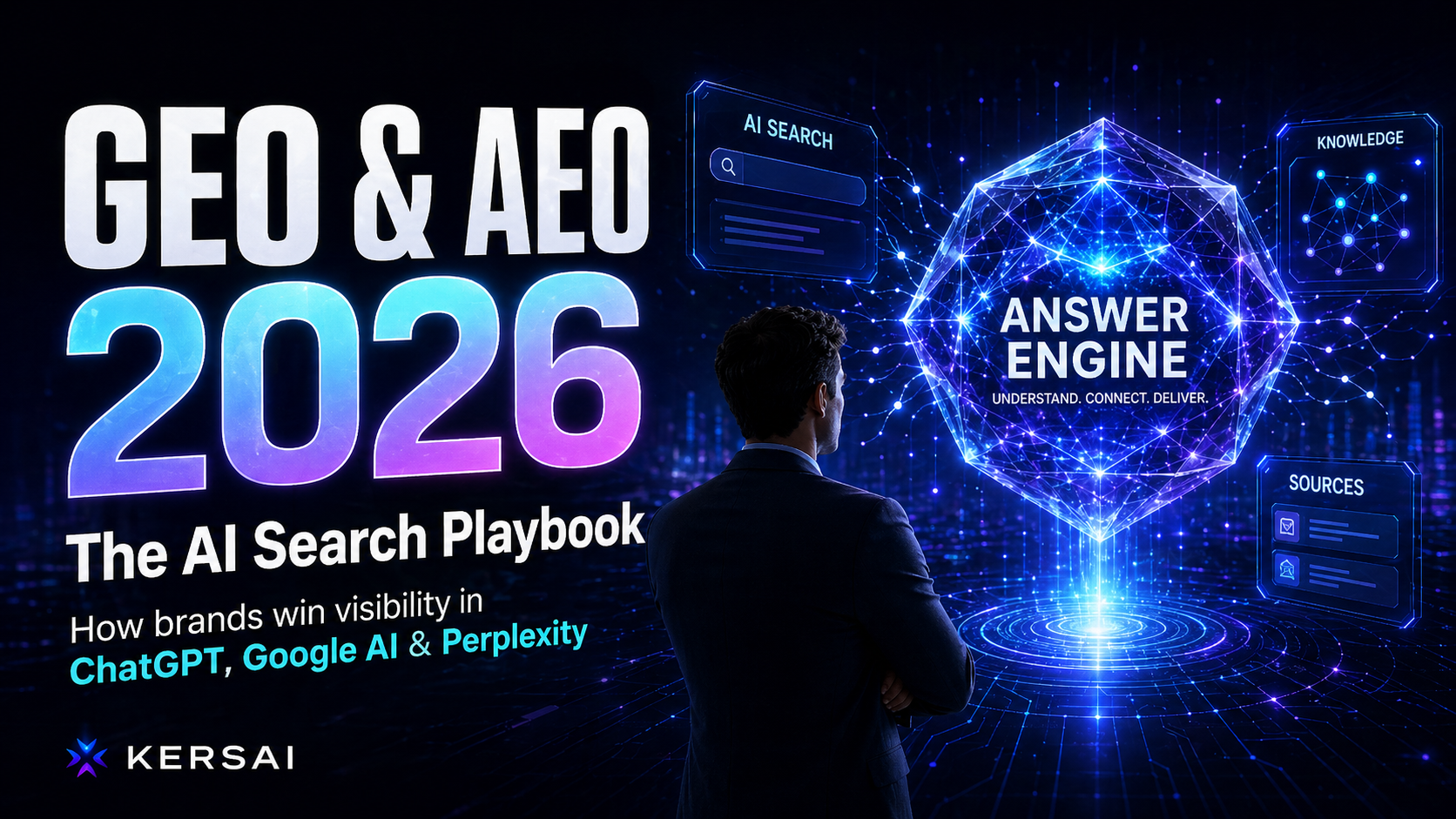
- Hero Image Recommendation
Introduction: The AI Search Revolution of 2026
The way people search for information has undergone a seismic shift in 2026. A user who once typed “GEO guide 2026” into Google and clicked the first blue link now asks ChatGPT, “How do I optimize my website for generative engines in 2026?” and expects a synthesized, conversational answer without ever visiting a website.
This is not a marginal trend. Gartner predicts that traditional search volume will decline by 25% in 2026 as users migrate to AI chatbots and answer engines. Simultaneously, 31.3% of the US population is expected to use generative AI search this year, pushing marketers to optimize for platforms like ChatGPT, Google AI Overviews, and Perplexity alongside traditional search engines. And a staggering 94% of enterprise brands plan to increase their investment in AEO/GEO in 2026, yet only a fraction have moved beyond traditional SEO to adopt these new optimization disciplines.
For enterprises, this creates both a threat and an opportunity. The threat: by early 2026, more than 70% of Google searches in Australia resulted in zero clicks to a website, with the figure dropping to just 17% when AI‑generated summaries are present. The opportunity: LLM‑referred traffic converts at 3040%, far outperforming traditional organic search or paid social.
This article is your complete playbook for winning in the era of AI‑powered discovery. We’ll define GEO and AEO, explain why they are business‑critical, and provide a practical, step‑by‑step framework that any organization can implement immediately. Whether you’re a CMO rethinking your digital strategy or an SEO leader preparing for the next decade, this guide will show you how to make your brand the answer that AI engines choose.
The Collapse of Traditional Search The Numbers You Can’t Ignore
Before diving into the “how,” it’s essential to understand the “why now.” The data paints a clear picture of a traditional search ecosystem under pressure:
| Metric | Value | Source |
|---|---|---|
| Traditional organic search volume decline by 2026 | 25% | Gartner |
| US consumers using generative AI search in 2026 | 31.3% | EMARKETER |
| Google searches resulting in zero clicks (Australia, early 2026) | >70% (17% when AI summaries are present) | ACAM |
| Enterprise brands planning to increase AEO/GEO spend | 94% | LinkedIn industry survey |
| LLM‑referred traffic conversion rate vs. organic | 3.8% vs. 1.2% (some sectors 30‑40%) | MarGen client data, VentureBeat |
| Average cost‑per‑lead from GEO vs. Google Ads | 40‑60% lower | MarGen |
What these numbers show is that the classic “rank #1 in Google, get traffic, convert” funnel is breaking down. A user’s question was historically our chance to bring them to our content. Now, that query often ends in a zero‑click experience, a branded AI answer, or a direct purchase all before they ever see a conventional search result.
The rise of Agentic AI and Physical AItrends you’ve likely seen if you follow Kersai’s monthly AI breakthrough reportsis paralleled by a transformation in how information itself is discovered, curated and consumed. The “search engine” has become an “answer engine,” and only brands that adapt their optimization strategy to this new reality will maintain visibility.
What Are GEO, AEO & How Do They Differ from Traditional SEO?
To navigate this new landscape, it’s crucial to understand three core terms:
- Search Engine Optimization (SEO) focuses on ranking pages in traditional search engine results pages (SERPs) to earn clicks. The primary goal is organic traffic.
- Answer Engine Optimization (AEO) optimizes content to appear as direct answers in AI‑powered search features, such as Google AI Overviews, voice assistants, and featured snippets. The primary goal is to be the answer selected.
- Generative Engine Optimization (GEO) optimizes content to be cited, summarized, or recommended by large language models (LLMs) like ChatGPT, Gemini, and Perplexity. The primary goal is to be the trusted source the model draws upon.
In practice, these three disciplines overlap. A strong AEO strategy improves your chances of being chosen for an AI Overview, while a robust GEO strategy ensures that when ChatGPT drafts an answer, your brand’s content is the foundation of its response. SEO remains the baseline, but AEO and GEO are the advanced layers that drive visibility in an AI‑first world.
A useful way to visualize the relationship:
| Discipline | Optimization Target | Primary Metric | Key Tactic |
|---|---|---|---|
| SEO | Google/Bing SERP ranking | Organic clicks/traffic | Keyword optimization, backlinks |
| AEO | AI Overviews, snippets, voice | Answer selection rate | Structured data, direct-answer formatting |
| GEO | LLM citations & mentions | Citations, brand presence in AI answers | Entity authority, citation-worthy content |
The shift from SEO to AEO/GEO is not just about technology; it’s about a fundamentally different user journey. A user asking a complex product question directly to ChatGPT may never see a search result page. Yet if your product’s white paper was the source the model cited, the user associates your brand with the answer, often clicking through with extremely high intent. This is the new battleground for digital visibility.
Why GEO & AEO Are Business‑Critical in 2026
1. The Zero‑Click Present and Future
Zero‑click searches, where a user’s query is answered on the search results page itself, are no longer an anomaly but a dominant pattern. With AI summaries, one search in seven results in no external click, and this ratio is climbing. For a business relying on organic traffic to generate leads or sales, this translates directly to lost revenue. Gartner’s prediction of a 25% drop in traditional search volume by 2026 reflects what many brands are already experiencing: a silent erosion of their audience.
2. Higher Conversion Rates from AI‑Referred Traffic
The good news is that the traffic AI does send converts at significantly higher rates. MarGen’s client data shows average AI‑referred traffic conversion rates of 3.8% compared to 1.2% for standard organic search. A VentureBeat report found that LLM‑referred traffic converts at 3040%, “blowing away what we see from SEO or paid social.” This is because the AI has pre‑qualified the interest: the user who arrives has already read a trusted summary and is ready to engage, not just browse.
3. High‑Intent Visibility vs. Vanity Traffic
Traditional traffic metrics like “sessions” are becoming vanity figures. What matters in 2026 is high‑intent visibilityensuring your brand is the one AI recommends when a prospect is ready to buy. As one guide noted, teams are now asking, “Are we eligible to be selected by AI systems when buying intent is high?” rather than simply “How much traffic did we get?”
4. 94% of Enterprises Are Investing; Don’t Be Left Behind
When industry surveys show that 94% of enterprise brands plan to increase AEO/GEO investment in 2026, it’s a clear signal that the competitive landscape is shifting. Brands that wait will find themselves invisible in the very channels where their customers are now searching. The cost of inaction is the “invisible brand” risk: a reality where your website, products, and thought leadership simply don’t exist in the AI’s answer set.
The GEO/AEO Implementation Framework
Success in GEO/AEO is not about a single hack; it’s about systematically aligning your digital presence with how AI models understand and cite information. Below is a six‑step framework that enterprise teams can follow.
Step 1: Build Your Entity Authority & Knowledge Graph
The foundation of GEO/AEO is entity authority. AI models understand the world through entitiesspecific concepts, people, companies, and places linked in a knowledge graph. When an LLM needs to cite a source about “AI implementation strategy,” it searches its internal representation for the most authoritative entities on the topic.
To build entity authority:
- Claim, complete, and optimize your Google Business Profile, Knowledge Graph panels, and Wikidata entry. Ensure consistent NAP (Name, Address, Phone) across all platforms.
- Create a comprehensive “About” page that clearly defines your brand, its expertise, and its key people.
- Earn mentions on authoritative, topically‑relevant domains. Entity signals are reinforced when high‑authority sites link to or co‑mention your brand with core topics.
- Publish author‑credited, expert‑driven content. Individual author entities strengthen brand entities. Google’s EEAT (Experience, Expertise, Authoritativeness, Trustworthiness) is now a fundamental signal for AI citation.
Entity authority is an investment that yields compound returns: the stronger your knowledge graph footprint, the more likely any AI system is to trust your content across a wide range of queries.
Step 2: Conduct an Answer‑First Content Audit
Traditional SEO audits examine keyword rankings, backlinks, and site health. An AEO/GEO audit adds a critical layer: can AI extract a direct answer from your content?
For every key question your audience asks:
- Identify the exact query (use tools like People Also Ask, AnswerThePublic, and ChatGPT query analysis).
- Check if your page provides a 4060 word direct answer that could serve as an AI Overview or voice assistant response.
- Assess the answer format does it use a clear definitional structure (entity → definition → example), a step‑by‑step list, or a comparison table? AI prefers content that is already structured for extraction.
A simple scoring method:
| Audit Criterion | Score (0‑5) |
|---|---|
| Direct answer present within first 100 words | |
| Answer is 40‑60 words, standalone | |
| Followed by supporting detail (stats, examples) | |
| Schema markup applied (FAQ, Q&A, HowTo) | |
| Authoritative entity attribution (author, date) |
Content scoring below 15/25 should be rewritten with an answer‑first structure.
Step 3: Engineer Extractable Answers for AI Snippets
AI Overviews, ChatGPT, and Gemini all favor content that is optimized for extraction, not just for reading. Key techniques:
- Lead with a TL;DR answer in a bold or highlighted box at the top of each article. This gives AI an immediate candidate for the summary.
- Use clear heading structures H2s and H3s that mirror the exact query. For example, the heading “What is Generative Engine Optimization?” immediately signals to an LLM that the following text is the answer.
- Employ bulleted lists and comparison tables these are consistently extracted and cited by AI snippets.
- Add an FAQ section using JSON‑LD schema to explicitly tell search engines that this is a question‑answer pair.
A practical before‑after:
❌ Before: “Generative Engine Optimization is a valuable discipline that many marketers are now exploring to improve their visibility in the new AI‑powered search landscape.”
✅ After: “Generative Engine Optimization (GEO) is the discipline of optimizing digital content to be cited, summarized, or recommended by AI‑powered search engines such as ChatGPT, Gemini, and Perplexity. The goal is not to rank, but to be the source the LLM uses to generate its answer.”
The after version is direct, defines the entity (“GEO”), and places it in a precise context exactly what an LLM needs to confidently cite you.
Step 4: Strengthen Topical Authority with Pillar‑Cluster Architecture
AI models assess topical authority by evaluating the breadth and depth of your content on a subject. Publishing a single “GEO guide” is not enough; you must create a topic cluster that covers every facet of the subject.
A GEO topic cluster might include:
- Pillar page: “The Complete 2026 Guide to Generative Engine Optimization (GEO)”
- Cluster content:
- “GEO vs. SEO vs. AEO: Key Differences Explained”
- “How to Build Entity Authority for AI Search”
- “LLM Citation Optimization Checklist”
- “Technical Implementation of Schema Markup for AI Engines”
- “Measuring AI Visibility: Metrics That Matter”
This architecture signals to LLMs that your domain is a comprehensive resource, increasing the probability that your pillar page is selected as the primary source for broad queries and cluster pages for specialized queries.
Step 5: Optimize Technical Signals for LLM Crawlers
Technical SEO remains essential but needs to be extended for AI crawlers (like GPTBot, Claude‑Web, and Google‑Extended). Key actions:
- Review and refine your robots.txt to allow AI crawlers access to content you want cited.
- Implement structured data with Schema.org markup especially
Organization,FAQ,Q&A,HowTo,Article, andVideoObject. - Ensure fast load times and mobile‑friendliness; AI crawlers have crawl budgets and may deprioritize slow sites.
- Use semantic HTML5 elements (
<article>,<section>,<aside>) to help AI assistants parse the document structure. - Enable secure access (HTTPS); AI engines strongly prefer encrypted sources.
A quick audit can be done using tools like Profound, Scrunch AI, or Goodie AI to assess how well your content is understood by LLMs.
Step 6: Monitor, Measure & Iterate on AI Visibility
GEO/AEO is not a one‑time project but a discipline that requires continuous monitoring. New metrics to track:
| Traditional SEO Metric | GEO/AEO Equivalent | Tool Examples |
|---|---|---|
| Organic clicks | LLM citations & brand mentions | Profound, Scrunch AI, Brandwatch |
| Keyword ranking | Answer selection rate | SEMrush AEO tracker, Conductor |
| Sessions | AI‑referred traffic (UTM‑tagged) | Google Analytics 4, MarGen |
| Page authority | Entity density & knowledge graph strength | Kalicube, InLinks |
Use UTM parameters to tag links shared in your content, enabling you to track AI‑referred traffic separately and measure its conversion performance. MarGen data shows AI‑referred traffic converts at 3.8%, making it extremely valuable to identify and optimize for this channel.
Technical Implementation & Tooling for GEO/AEO
To operationalize GEO/AEO, you need a stack that bridges traditional SEO tools with new AI visibility solutions.
Essential Tool Categories:
| Tool Category | Examples | Function |
|---|---|---|
| LLM Crawler Analyzers | Profound, Scrunch AI, Goodie AI | Audit how LLMs interpret your content, identify gaps in citation readiness |
| Entity & Knowledge Graph | Kalicube, InLinks, WordLift | Build and measure entity authority across knowledge graphs |
| Structured Data & Schema | Schema App, Merkle Schema Markup | Generate and validate JSON‑LD schema for FAQ, Q&A, HowTo, Article |
| AI Visibility monitoring | Conductor, SE Ranking AI Tracker | Track brand mentions, citations, and answer selection rates |
| Content Optimization | Surfer SEO, Clearscope, Jasper | Score content for GEO readiness, suggest extractable answer structures |
Implementation Workflow:
- Crawl your site with an LLM‑specific tool to identify which pages are already indexed and cited by AI.
- Run entity analysis to see how strongly your brand is associated with target topics.
- Prioritize pages that rank for target queries but are not yet cited by AI these are the low‑hanging fruit.
- Re‑optimize those pages using the answer‑first structure, add FAQ schema, and strengthen internal linking to the pillar page.
- Re‑crawl and monitor citation growth over 30, 60, and 90‑day cycles.
The Role of AI Implementation Strategy in GEO/AEO Success
A common mistake enterprises make is treating GEO/AEO as a purely technical SEO project. In reality, successful AI visibility requires an organization‑wide AI implementation strategy. This is where the demand for expert AI consulting is exploding:
- The global AI consulting market is projected to grow from 10.47billionin2025to12.75 billion in 2026, with a CAGR of 23.07%.
- AI consulting is expected to account for 40% of professional services revenue by 2026, signaling strong enterprise demand.
- By the end of 2026, Gartner predicts 40% of enterprise applications will embed task‑specific AI agents, up from just 5% in 2025.
The connection between AI adoption and GEO/AEO is direct: when an enterprise deploys AI agents, chatbots, or custom knowledge bases, those systems must be fed accurate and authoritative content. GEO ensures your proprietary knowledge, your product data, and your thought leadership are properly represented in the AI ecosystem.
Kersai’s AI implementation work at the intersection of AI strategy, infrastructure, and agent design consistently shows that organizations that integrate optimization into their AI deployment from day one achieve visibility and conversion rates three to five times higher than those that retrofit. GEO is not an add‑on; it is a core capability of the modern AI‑enabled enterprise.
(If you’re currently building or scaling AI deployments and want to ensure your content works as hard as your models, Kersai’s consulting team can help align your digital presence with the new rules of AI‑powered discovery. Contact us to discuss your GEO/AEO strategy.)
Conclusion: The Time to Act Is Now
The transformation of search in 2026 is not a gradual evolutionit’s a step‑function change. We are witnessing the fastest migration of information retrieval in history: from a world of 10 blue links to a world of conversational answers. The data is unequivocal: traditional search volume is falling, zero‑click results are the norm, and the brands that will thrive are those that master Generative Engine Optimization and Answer Engine Optimization today.
The framework we’ve outlinedbuilding entity authority, auditing for answer‑first content, engineering extractable answers, creating topic clusters, optimizing technical signals, and continuously monitoring AI visibilityprovides a practical, actionable roadmap. But execution requires more than a checklist; it requires a strategic commitment to rewiring how your organization thinks about digital presence.
As the global AI services market rockets toward $57 billion in 2026, and as AI agents become embedded in 40% of enterprise applications, the line between AI deployment and content optimization is dissolving. Success in the coming years will belong to those who treat visibility as an integrated function of their broader AI strategy, not a separate marketing initiative.
The next time a prospective customer asks ChatGPT for a solution you provide, will your brand be the answer? The decisions you make this quarter will determine what that AI says for years to come.
About Kersai: Kersai is an AI consultancy that helps enterprises build, implement, and optimize AI systems to increase revenue, reduce costs, and win in the new digital landscape. From AI strategy and agent development to GEO/AEO optimization, Kersai bridges the gap between cutting‑edge AI technology and real‑world business outcomes. Learn more about Kersai’s AI consulting services.