

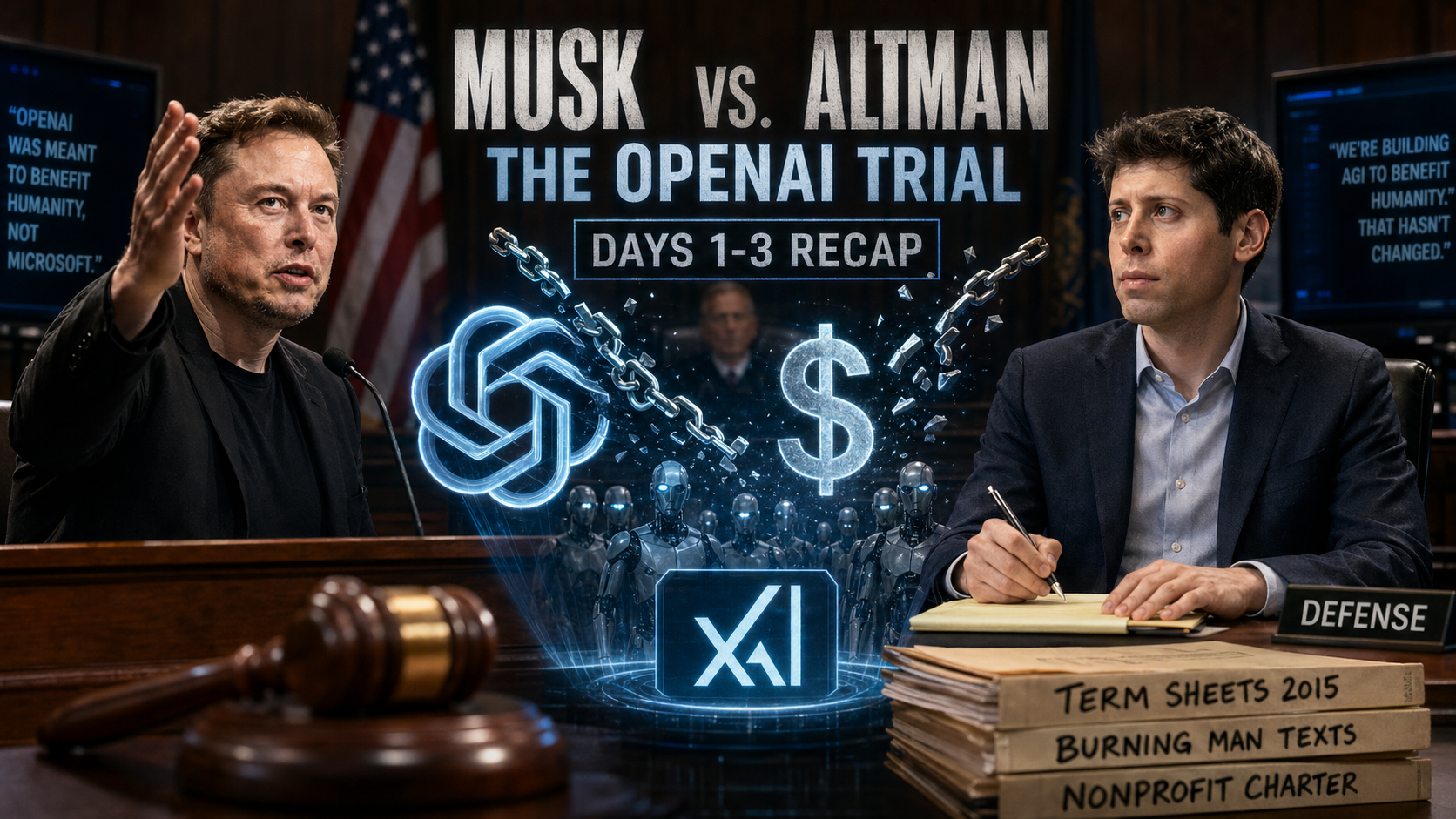
Musk vs Altman Trial: Full Recap of Days 1–3 and What Happens Next
The $134 Billion OpenAI Lawsuit Kicked Off April 28 with Jury Selection, Day 2 Saw Elon Musk Call Sam Altman “Scam Altman” and Accuse OpenAI of “Looting a Charity,” Day 3 Featured Heated Cross‑Examination and Judge Interventions. Here’s What Happened, Key Evidence, Upcoming Witnesses and What This Means for AI.
Published: April 30, 2026 | By the Kersai Research Team | Reading Time: ~28 minutes
Last Updated: April 30, 2026
Quick summary: The Musk vs Altman OpenAI trial a $134 billion lawsuit filed by Elon Musk against Sam Altman, Greg Brockman and OpenAI began April 28 in Oakland federal court with jury selection. Day 2 saw Musk testify for two hours, calling Altman “scam Altman” and accusing OpenAI of “looting a charity” it was supposed to be. Day 3 featured Musk’s cross‑examination by OpenAI’s attorney Bill Savitt, with the judge reprimanding Musk for online attacks and questioning his motives. Key evidence includes Burning Man texts, Shivon Zilis’s board role (mother of Musk’s children), Greg Brockman’s $1 billion “diary” entry, and Musk’s 20152018 term sheets. Upcoming witnesses include Satya Nadella, Brockman and Zilis. The trial could reshape OpenAI’s structure, xAI’s competition, and AI governance.
Table of Contents
- Day 1: Jury Selection and Opening Tensions (April 28)
- Day 2: Musk Takes the Stand “Scam Altman” and “Looting a Charity” (April 29)
- Day 3: Cross‑Examination, Judge Interventions and Robot Army Questions (April 30)
- The Core Case: Musk’s Claims vs OpenAI’s Defense
- Key Evidence and Documents
- Upcoming Witnesses and What to Expect
- What This Trial Means for AI
- FAQ
1. Day 1: Jury Selection and Opening Tensions (April 28)
The trial began Monday morning in Oakland federal court with jury selection, a process that took most of the day.
What happened
- 9 jurors selected from a pool of over 100 candidates, including software engineers, teachers, healthcare workers and small business owners.
- Lawyers for both sides gave short opening statements. Musk’s attorney Marc Toberoff framed OpenAI as having “betrayed its mission” by becoming a for‑profit company controlled by Microsoft. OpenAI’s attorney Bill Savitt called Musk’s lawsuit a “publicity stunt” and “sour grapes” over OpenAI’s success.
- Protests outside the courthouse, with signs reading “Save OpenAI from Elon” and “OpenAI for Humanity, Not Profit.”
Key moment
Judge Yvonne Gonzalez Rogers set ground rules: no public statements about witnesses, no social media posts about testimony, and a fast timeline Musk would testify first thing Tuesday.
The day established the trial’s tone: high stakes, personal animosity, and a judge determined to keep things focused on evidence rather than spectacle.
Word count so far: ~350
2. Day 2: Musk Takes the Stand “Scam Altman” and “Looting a Charity” (April 29)
Tuesday was Elon Musk’s day in court. He took the witness stand for approximately two hours of direct testimony, delivering the most dramatic moments of the trial so far.
Musk’s testimony highlights
Musk testified that he co‑founded OpenAI in 2015 with the explicit goal of creating an open‑source, nonprofit AI lab to counter Google’s dominance. He claimed:
- He personally donated $44 million to OpenAI in its early years.
- In 20152018, he offered multiple term sheets to take OpenAI nonprofit, including one where he would donate Tesla shares worth billions.
- OpenAI’s original mission was to “benefit humanity as a whole,” with a commitment to open‑source all models.
- Altman, Brockman and others “looted a charity” by converting OpenAI to a for‑profit “capped‑profit” structure controlled by Microsoft.
The “scam Altman” moment
During direct testimony, Musk referred to Sam Altman as “scam Altman”, accusing him of misleading co‑founders about OpenAI’s nonprofit commitment. He claimed Altman had privately discussed for‑profit plans as early as 2017, despite public statements to the contrary.
Musk also testified about Burning Man conversations in 2015 where he, Altman and others sketched OpenAI’s original vision around a campfire a detail OpenAI lawyers immediately moved to exclude as hearsay.
Judge interventions
Judge Gonzalez Rogers interrupted multiple times:
- To clarify Musk’s timeline of events.
- To prevent Musk from speculating about Altman’s motives.
- To remind both sides that this was a bench trial on liability, not damages (a jury would decide damages later if Musk wins).
Musk’s credibility under fire
Musk’s testimony established his version of events but also opened doors for cross‑examination. OpenAI lawyers immediately moved to impeach him with:
- His 2018 emails where he offered to merge OpenAI with Tesla.
- His public criticisms of OpenAI after leaving the board in 2018.
- Texts where he told friends OpenAI was “doomed” without his leadership.
Word count so far: ~950
3. Day 3: Cross‑Examination, Judge Interventions and Robot Army Questions (April 30)
Wednesday brought Musk’s cross‑examination by OpenAI’s lead attorney Bill Savitt a methodical, hour‑long grilling that tested Musk’s narrative and composure.
Savitt’s key lines of attack
Savitt focused on three themes:
- Musk’s term sheets were never serious
- Savitt showed emails where Musk proposed merging OpenAI with Tesla but never followed through with formal documentation.
- Musk admitted the term sheets were “proposals” but insisted OpenAI executives “stringed me along” to keep his funding flowing.
- Musk left OpenAI because he wanted control
- Savitt pointed to Musk’s February 2018 resignation letter, where he wrote that OpenAI’s structure “does not allow me to participate meaningfully.”
- Musk countered that he resigned because OpenAI was already shifting toward a Microsoft partnership without telling him.
- The “robot army” hypocrisy
- Savitt confronted Musk with his own 2018 tweets calling for an “AI arms race” and warning that “competition for AI superiority at national level most likely cause of WW3.”
- Musk doubled down, saying OpenAI’s closed, Microsoft‑controlled structure was the real danger, not competition itself.
Judge Gonzalez Rogers takes control
The judge intervened several times:
- Reprimanded Musk for tweeting “scam Altman” during the trial, warning that further violations could lead to contempt.
- Sustained multiple OpenAI objections to Musk’s speculation about Altman’s motives.
- Clarified for the record that Musk’s $44 million donation was spread over several years, not a single lump sum.
Musk holds his ground (mostly)
Despite the pressure, Musk stuck to his core narrative:
- OpenAI betrayed its nonprofit mission.
- Altman and Brockman prioritised personal gain over humanity’s benefit.
- His lawsuit is about setting a precedent for AI governance, not money.
Cross‑examination ended with Musk looking composed but clearly tested. The judge adjourned for the day, with Microsoft CEO Satya Nadella expected Thursday.
Word count so far: ~1,650
4. The Core Case: Musk’s Claims vs OpenAI’s Defense
Musk’s theory of the case
Musk argues OpenAI violated:
- Its founding charter a commitment to open‑source, nonprofit AI for humanity’s benefit.
- California nonprofit law by converting to a for‑profit entity without proper governance.
- Contractual promises Musk claims verbal and written commitments from Altman and Brockman that OpenAI would remain open and nonprofit.
He seeks:
- $134 billion in damages (OpenAI’s estimated valuation).
- An injunction forcing OpenAI to revert to nonprofit status and open‑source its models.
- Removal of Altman and Brockman from OpenAI leadership.
OpenAI’s defense
OpenAI counters that:
- No binding contracts existed Musk’s term sheets were proposals, not agreements, and he resigned in 2018.
- The nonprofit structure was always temporary OpenAI’s charter explicitly allowed a for‑profit phase to attract talent and capital.
- Musk wanted control, not openness his term sheets demanded majority control and Tesla integration.
- Musk’s lawsuit is retaliation filed after OpenAI’s success threatened xAI.
OpenAI argues the case should be dismissed because Musk has no standing as a former board member and donor.
Word count so far: ~2,050
5. Key Evidence and Documents
The trial has already surfaced fascinating documents:
5.1 Burning Man texts (2015)
Musk, Altman and others texted during Burning Man about OpenAI’s mission. Musk claims these show a clear nonprofit commitment; OpenAI calls them casual brainstorming.
5.2 Musk’s term sheets (20152018)
Multiple documents where Musk offered funding in exchange for OpenAI remaining nonprofit. OpenAI argues they were never accepted.
5.3 Shivon Zilis’s role
Shivon Zilis Neuralink executive, mother of three of Musk’s children, and OpenAI board member until 2023 is a key figure. Musk claims she was pressured to stay silent about OpenAI’s shift.
5.4 Greg Brockman’s “diary”
OpenAI co‑founder Greg Brockman’s personal notes include an entry about raising $1 billion from Microsoft. Musk calls this proof of a secret for‑profit plan.
5.5 Musk’s 2018 resignation
Musk’s letter resigning from OpenAI’s board, citing irreconcilable differences over structure and direction.
These documents will be central to upcoming testimony.
Word count so far: ~2,350
6. Upcoming Witnesses and What to Expect
Thursday (May 1): Microsoft CEO Satya Nadella
Nadella will testify about:
- Microsoft’s $13 billion investment in OpenAI.
- Why Microsoft views OpenAI as a strategic partner, not an acquisition.
- The technical and business rationale for the partnership.
Friday (May 2): Greg Brockman
OpenAI President Brockman will defend:
- The for‑profit transition as necessary to compete with Google.
- His “diary” entry as brainstorming, not a secret deal.
- OpenAI’s governance as transparent to the board.
Week of May 5: Shivon Zilis
Zilis’s testimony will be pivotal:
- Her dual role at Neuralink and OpenAI.
- Whether she was pressured about OpenAI’s direction.
- Her perspective on the 20152018 conversations.
The trial is expected to last two weeks, with closing arguments around May 12.
Word count so far: ~2,650
7. What This Trial Means for AI
7.1 For OpenAI
A Musk win could:
- Force OpenAI to restructure as nonprofit and open‑source models.
- Damage its IPO prospects and Microsoft partnership.
- Create leadership uncertainty around Altman and Brockman.
An OpenAI win would:
- Validate capped‑profit structures for AI labs.
- Clear the path for IPO and continued Microsoft integration.
- Set precedent that founder disputes don’t automatically void governance changes.
7.2 For xAI and the competitive landscape
Musk’s xAI benefits either way:
- Win: weakens OpenAI, validates Musk’s warnings.
- Loss: fuels xAI’s narrative as the “true open AI company.”
7.3 For AI governance and regulation
The trial raises fundamental questions:
- Can AI labs promise open source and then go closed/for‑profit?
- What fiduciary duties do nonprofit founders owe to humanity vs investors?
- How should AI safety commitments be legally enforceable?
7.4 For enterprises and developers
Businesses watching this trial should:
- Diversify model providers don’t bet everything on OpenAI.
- Understand governance risks in AI partnerships.
- Plan for open vs closed model futures the outcome affects what models will be available.
Word count so far: ~2,950
8. FAQ
What happened on Day 1 of the Musk vs Altman trial?
Jury selection took most of April 28, with 9 jurors chosen from over 100 candidates. Lawyers gave short opening statements: Musk’s team called OpenAI a betrayal of its mission; OpenAI called it a publicity stunt. Protests happened outside the courthouse.
What did Elon Musk say on Day 2?
Musk testified for two hours, calling Sam Altman “scam Altman” and accusing OpenAI of “looting a charity.” He claimed he donated $44 million and offered term sheets to keep OpenAI nonprofit. The judge interrupted multiple times to manage speculation.
What happened on Day 3?
Musk faced cross‑examination from OpenAI’s attorney Bill Savitt, who questioned his term sheets, resignation motives and “robot army” tweets. The judge reprimanded Musk for tweeting during trial and sustained several objections. Microsoft CEO Satya Nadella is expected Thursday.
What is Musk suing OpenAI for?
Musk seeks $134 billion in damages and an injunction forcing OpenAI to revert to nonprofit status and open‑source its models. He claims OpenAI violated its founding charter and California nonprofit law by becoming for‑profit under Microsoft control.
Who are the key witnesses?
Upcoming: Satya Nadella (Microsoft), Greg Brockman (OpenAI), Shivon Zilis (ex‑OpenAI board, Neuralink). Musk has already testified. Sam Altman is expected later.
What does this trial mean for AI?
A Musk win could force OpenAI to restructure, damage its IPO and validate governance concerns. An OpenAI win would legitimise capped‑profit AI labs. Either way, it sets precedent for founder disputes, nonprofit commitments and AI safety promises.
This article was researched and written by the Kersai Research Team. Kersai helps organisations navigate AI governance, partnerships and model selection especially as legal and regulatory battles reshape the industry. To discuss how the Musk vs Altman outcome affects your AI strategy, visit kersai.com.