

The AI Arms Race in 2026: Model Wars, the $250B SpaceX–xAI Megadeal & the Dawn of Agentic Intelligence
By Kersai | April 16, 2026
The artificial intelligence industry is moving at a pace that no longer allows for passive observation. In just the first four months of 2026, the world has witnessed the largest M&A transaction in history, the release of AI models that now perform at or above human expert level, and a fundamental shift in how AI is actually used from chatbots to autonomous agents that act, execute, and deliver outcomes.
If you thought 2025 was the year AI went mainstream, 2026 is the year it became undeniable.
The SpaceXxAI Megadeal: The Biggest Acquisition in History
On February 2, 2026, Elon Musk announced that SpaceX had acquired xAI the company behind the Grok AI assistant in a deal that values xAI at $250 billion and the combined entity at over $1.25 trillion. It is the single largest M&A transaction ever recorded, eclipsing even the most ambitious corporate mergers of the past two decades.
Under the deal structure, xAI shareholders receive 0.143 SpaceX shares for each xAI share held, with select executives opting for cash at $75.46 per share. The combined entity merges AI, rockets, Starlink satellite internet, and direct-to-device mobile communications under one roof what SpaceX describes as “the most ambitious, vertically-integrated innovation engine on (and off) Earth.”
The strategic logic is hard to dispute. SpaceX is widely expected to pursue an IPO as early as mid-2026, and the xAI acquisition dramatically elevates its AI credibility with institutional investors. Analysts estimate the IPO could raise up to $50 billion potentially the largest public listing in history.
Key Insight: The era of pure-play AI labs is ending. The future belongs to vertically integrated ecosystems that own the data, compute, distribution, and application layers simultaneously.
The April 2026 Model Wars: GPT-5.4 vs Gemini 3.1 Pro vs Claude Mythos 5
April 2026 has become the densest AI model release window in the industry’s history. Three frontier labs OpenAI, Anthropic, and Google DeepMind have all launched or confirmed major new models within weeks of each other.
GPT-5.4 The First Truly Unified Frontier Model
Released March 5, 2026, GPT-5.4 is structurally different from every model that came before it. For the first time, a single model credibly leads across coding, reasoning, computer use, and knowledge work simultaneously without requiring users to switch between specialist variants.
Benchmark Performance:
| Benchmark | GPT-5.4 Score | What It Measures |
|---|---|---|
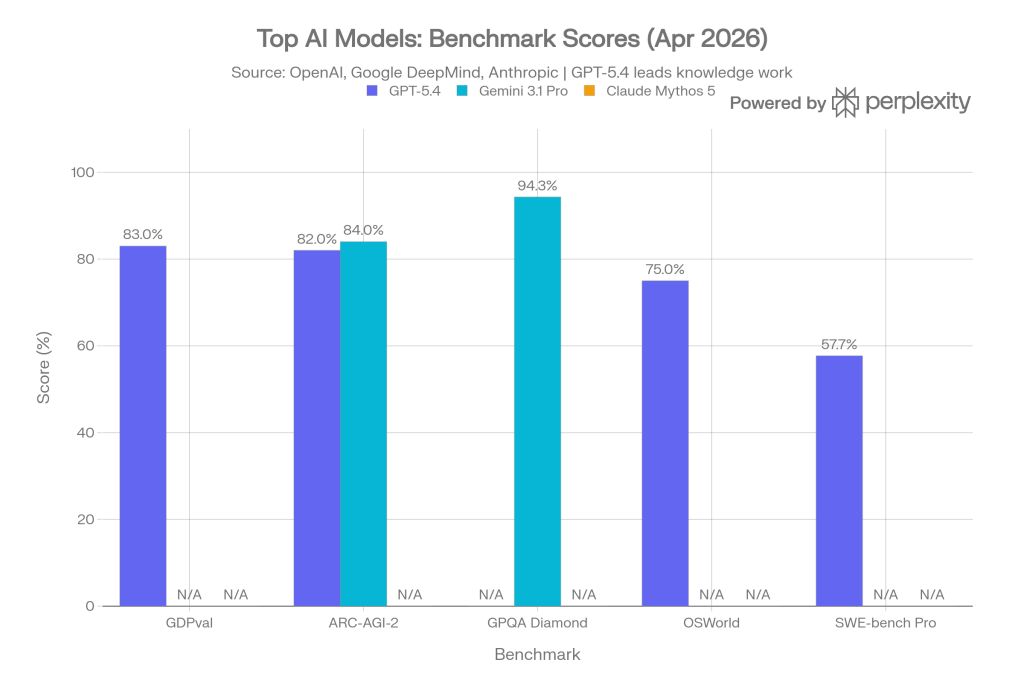
| GDPval | 83.0% | Real-world knowledge work across 44 occupations |
| ARC-AGI-2 | 82.0% | Abstract reasoning & novel problem-solving |
| OSWorld | 75.0% | Computer use (human baseline: 72.4%) |
| SWE-bench Pro | 57.7% | Real-world software engineering tasks |
An 83% GDPval score places GPT-5.4 at or above human expert performance on economically valuable tasks a 13-point improvement over GPT-5.2. GPT-5.4 is available in five tiers: Standard, Thinking, Pro, Mini, and Nano, covering use cases from edge deployment to premium enterprise.
Claude Mythos 5 The Model Too Powerful to Release
Anthropic’s Claude Mythos 5 was confirmed on April 7, 2026 but with an unprecedented caveat: it will not be released publicly, nor made available via standard API.
Internal testing reportedly triggered Anthropic’s ASL-4 safety protocol, reserved for models approaching genuinely dangerous capability thresholds. Mythos 5 features an estimated 10 trillion parameters and is optimised for advanced cybersecurity and zero-day vulnerability detection a combination that Anthropic determined poses unacceptable risks in open access.
This marks the first time a major frontier lab has withheld a completed model from public release on safety grounds. It raises a question the industry has quietly avoided: What happens when capability outpaces our readiness to deploy it responsibly?
Gemini 3.1 Pro Google’s Multimodal Answer
Google DeepMind’s Gemini 3.1 Pro takes the opposite approach: maximum openness and multimodal versatility. It leads the field in abstract reasoning and scientific question-answering:
| Benchmark | Gemini 3.1 Pro Score | What It Measures |
|---|---|---|
| ARC-AGI-2 | 84.0% | Abstract reasoning (highest published score) |
| GPQA Diamond | 94.3% | Graduate-level science Q&A |
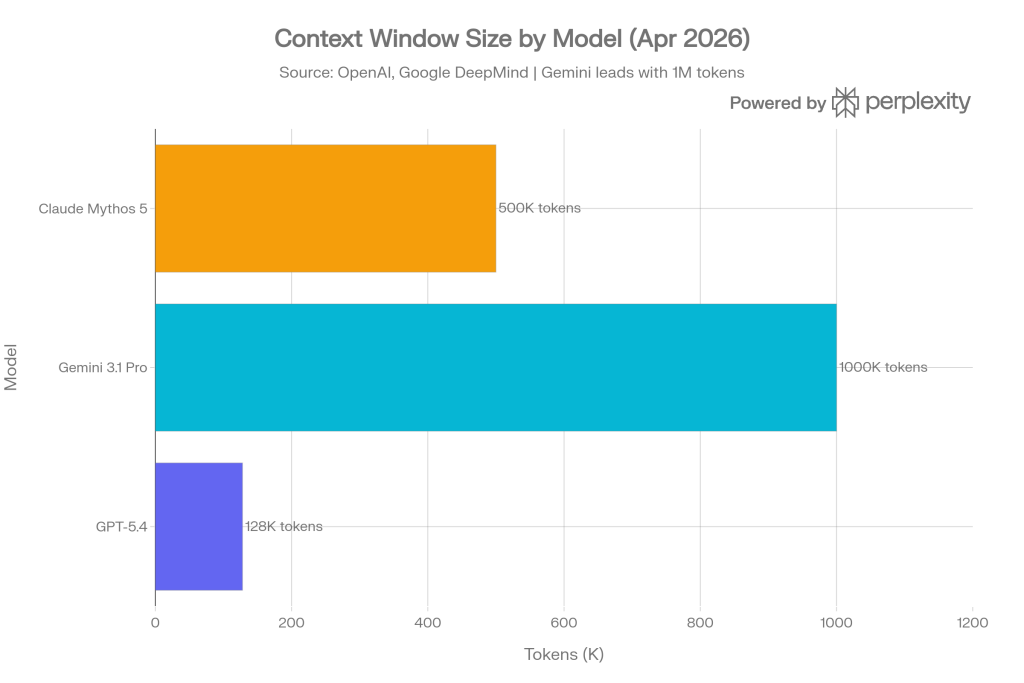
| Context Window | 1,000,000 tokens | Long-document understanding |
| Video Context | 5,000,000 tokens | Long-form video comprehension |
Available via public API and Google Vertex AI, Gemini 3.1 Pro is the accessibility-first frontier model making it especially attractive for enterprise developers and startups managing API costs.
Head-to-Head: April 2026 Frontier Models
| Feature | GPT-5.4 | Gemini 3.1 Pro | Claude Mythos 5 |
|---|---|---|---|
| GDPval | 83.0% | N/A | N/A |
| ARC-AGI-2 | 82.0% | 84.0% | N/A |
| GPQA Diamond | N/A | 94.3% | N/A |
| OSWorld | 75.0% | N/A | N/A |
| Context Window | 128K | 1M tokens | ~500K (est.) |
| Video Context | 128K | 5M tokens | N/A |
| Public Access | ✅ Paid tiers | ✅ API/Vertex | ❌ Withheld |
| Architecture | MoE | Unified Multimodal | ~10T Parameters |
The Agentic AI Shift: From Conversation to Action
The most strategically significant trend of 2026 is not model benchmarks it is the shift from conversational AI to agentic AI.
Where chatbots answer questions, agents complete tasks. They browse the web, write and execute code, fill out forms, trigger API calls, and iterate through complex multi-step workflows without human prompting at each step. The difference is not incremental; it is categorical.
This shift is already producing viral moments. OpenClaw, an open-source agentic AI framework, reached 100,000 GitHub stars in just two days following its release and attracted CNBC coverage a signal of both developer enthusiasm and mainstream awareness. Enterprises are now moving from AI pilots to AI-operated workflows, with McKinsey estimating that agentic systems could automate up to 70% of knowledge worker tasks by 2028.
The bottom line: AI is no longer a tool you query. It is increasingly a co-worker you assign.
The AI Infrastructure Crisis: Power, Chips & the $267B Funding Surge
Behind every frontier model is an infrastructure war hiding in plain sight.
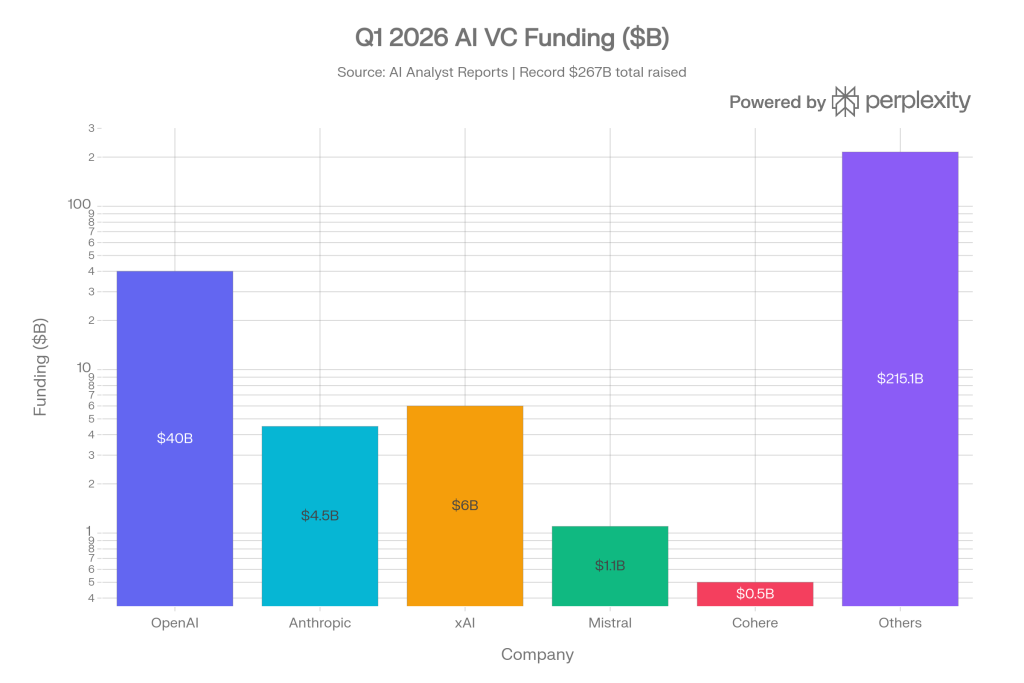
Q1 2026 alone saw a record $267.2 billion in AI venture capital funding an amount that dwarfs any prior quarter in history. OpenAI led named recipients with $40B, followed by xAI ($6B) and Anthropic ($4.5B), with the remainder spread across the broader AI ecosystem.
But this capital is colliding with a hard physical limit: energy. The U.S. faces a projected 918 GW electricity shortfall by 2027 as hyperscalers race to build AI data centres faster than the grid can support them. This is driving a “bring your own power” strategy Microsoft has reopened Three Mile Island; Amazon is in active talks over dedicated nuclear sites.
The chip architecture race is equally intense. Google + Broadcom, Anthropic + CoreWeave, and Intel + Google are all pursuing custom silicon strategies to reduce dependence on NVIDIA which, despite growing competition, continues to dominate AI compute orchestration globally.
AI Scientists: Machines Writing Research
Perhaps the most philosophically disruptive development of the year: a paper fully authored by an AI system was accepted at a major academic conference in early 2026, passing peer review with minimal human intervention.
This is not merely an academic curiosity. If AI systems can generate, test, and publish novel research autonomously, the pace of scientific discovery in medicine, materials science, and climate modelling could accelerate by an order of magnitude. It also raises urgent questions about attribution, intellectual property, and the future role of human researchers in the scientific process.
Humanoid Robots: The Physical AI Wave Arrives
The AI revolution is no longer confined to software. At the Hong Kong AI & Robotics Fair (April 1415, 2026), humanoid robots were shown boxing, performing, and executing complex physical tasks footage that went globally viral within hours. This follows NVIDIA CEO Jensen Huang’s GTC 2026 keynote, in which he outlined a roadmap for “physical AI” robots trained on synthetic data to operate in real-world environments at scale.
Companies including Figure AI, Boston Dynamics, and China’s Unitree are now shipping commercial-grade humanoid robots to warehouse and manufacturing clients. The global humanoid robot market, valued at under $1 billion in 2023, is projected to exceed $38 billion by 2030.
Key Takeaways
- GPT-5.4 is the first unified model to lead across coding, computer use, and knowledge work simultaneously scoring 83% on GDPval, above human expert level
- SpaceX acquired xAI for $250 billion in the largest M&A deal in history, positioning for a potential $50B IPO
- Claude Mythos 5 triggered ASL-4 safety protocols and has been withheld from public release an industry first
- Gemini 3.1 Pro leads on ARC-AGI-2 (84%) and GPQA Diamond (94.3%) with a 5M-token video context window
- Agentic AI has shifted from concept to mass deployment, with frameworks like OpenClaw reaching 100K GitHub stars in 48 hours
- A 918 GW U.S. power shortfall threatens AI infrastructure growth, forcing off-grid energy strategies
- An AI-authored research paper passed peer review at a major academic conference in 2026
Frequently Asked Questions
Q: What is the most powerful AI model available to the public in April 2026?
GPT-5.4 leads on real-world knowledge work with an 83% GDPval score, while Gemini 3.1 Pro leads on abstract reasoning (ARC-AGI-2: 84%) and multimodal tasks. Claude Mythos 5 potentially the most capable model ever built has been withheld from public release entirely.
Q: Why did SpaceX acquire xAI?
The $250 billion acquisition merges Elon Musk’s AI and space ventures ahead of a planned SpaceX IPO, creating a vertically integrated company spanning AI, rockets, satellite internet, and social media.
Q: What is agentic AI and why does it matter in 2026?
Agentic AI refers to systems that autonomously complete complex, multi-step tasks rather than simply responding to prompts. In 2026, it represents the dominant direction of enterprise AI deployment, with McKinsey projecting it will automate up to 70% of knowledge work by 2028.
Q: What is GDPval?
GDPval is a benchmark developed by OpenAI that tests AI performance on real-world, economically valuable tasks across 44 occupations in the top 9 GDP-contributing industries. A score above ~72% indicates human expert-level performance.
Q: Why was Claude Mythos 5 not released publicly?
Anthropic determined that internal testing of Claude Mythos 5 triggered its ASL-4 safety protocol reserved for models approaching genuinely dangerous capability thresholds. This is the first time a major AI lab has withheld a completed frontier model from release on safety grounds.
Q: Is the AI industry causing power shortages?
Yes. The U.S. faces a projected 918 GW electricity shortfall by 2027 driven entirely by AI data centre construction, prompting major tech companies to pursue off-grid nuclear and gas power strategies.
Published by Kersai AI Consultancy & Content Strategy | April 16, 2026
© 2026 Kersai. All rights reserved.