

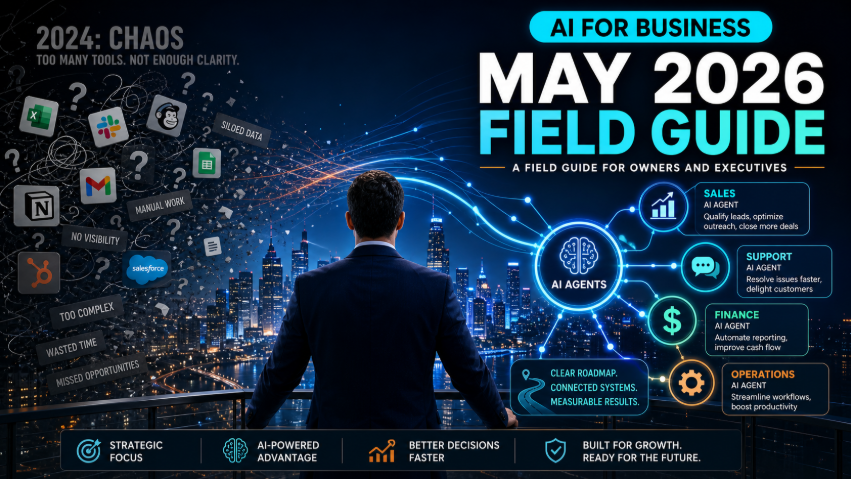
AI for Business in May 2026: A Field Guide for Owners, Founders and Executives
Published: 12 May 2026 By: Kersai Research Team
Category: AI Strategy / Business Growth / 2026 Guides
Quick Summary
AI has changed more between 2024 and May 2026 than it did in the five years before. Businesses are no longer asking whether AI matters. They are asking which AI to use, where it belongs in the business and how to get real value without losing control.
This guide explains what is genuinely new in 2026, how AI for business actually works now, where small and medium businesses should focus first, and what larger organisations need to prioritise to move from pilots to performance.
Most importantly, it gives you a practical 90‑day roadmap you can start from wherever you are today whether you’re a five‑person business or a multi‑team organisation.
1. What’s Actually New in AI for Business in 2026
A lot of articles talk about “AI trends.” This section focuses on what has really changed for businesses in 2026 compared with the early ChatGPT era.
There are three big shifts.
1.1 Specialised models are moving in next to general models
In 20232024, most businesses experimented with a handful of general-purpose large language models. In 2026, there is a clear shift toward:
- Specialised foundation models trained for particular domains, such as ERP automation, supply chain, financial analysis or sector‑specific software.
- Compact, faster models designed for specific tasks, like high‑throughput code generation or tabular forecasting.
These models are not just “smarter.” They are better fit for specific jobs, and often cheaper or more controllable for those jobs than a single giant model.
1.2 AI agents are moving from “demo” to “co‑worker”
Agentic AI was a buzzword in 2024. In 2026, it is becoming a real operating layer.
- Enterprises are rolling out multiple task‑specific agents across support, finance, IT, ops and internal tooling.
- Agents are starting to behave less like chatbots and more like virtual co‑workers that can log into systems, call APIs, update records and hand work off between steps.
This brings huge leverage and new complexity around infrastructure, governance and cost.
1.3 Non‑technical teams can now build AI workflows
Perhaps the biggest practical shift is who can build with AI.
- “Complete guide” content for 2026 now assumes that business managers, not just data scientists, will design AI workflows for their functions.
- Low‑code / no‑code platforms and templates let non‑technical teams set up automation for support, finance, marketing and HR with minimal scripting.
This is powerful, but also dangerous if there is no overarching strategy or guardrails.
2. The 2026 Business AI Stack in Plain English
Think of your AI capabilities as a stack. You do not need to be a technologist to understand it, but you do need to know roughly what sits where.
2.1 The four layers that matter
- Infrastructure
Cloud, compute, storage, networking and security the plumbing that makes AI possible. - Models
General models (for broad tasks) and specialised models (for specific domains like ERP, finance, logistics, coding). - Frameworks & orchestration
Tools that connect models to your data, applications and workflows, and that coordinate agents, logging and monitoring. - Applications & agents
The things your teams actually see and use: chat interfaces, copilots in tools, support bots, coding assistants, workflow agents.
Table: Old AI Stack vs 2026 AI Stack
| Layer | Old view (202324) | 2026 reality |
|---|---|---|
| Infrastructure | “Cloud is someone else’s problem.” | Compute, latency, data location and security all affect AI cost and feasibility. |
| Models | One big general model for everything. | Mix of general and specialised models, chosen per workload. |
| Orchestration | Ad‑hoc scripts and tools. | Intentional orchestration layer and control plane for agents and workflows. |
| Apps & agents | Single chatbot or assistant. | Multiple agents and copilots embedded into existing tools and processes. |
If you understand this stack, you can ask much better questions when vendors pitch you, and you can avoid paying for things you do not need.
3. AI for Small and Medium Businesses in 2026
For small and medium businesses (SMBs/SMEs), AI has moved from “optional experiment” to “quiet competitive advantage” in day‑to‑day operations.
The good news: you do not need your own model. You need clear problems, the right tools and basic guardrails.
3.1 The best starting points in 2026
Based on current guides and real deployments, these are the most reliable entry points for SMEs:
- Customer support and service
- AI triages emails and tickets, drafts responses and answers common questions.
- Humans handle complex and high‑value cases.
- Sales and marketing
- AI drafts outreach, social posts, landing page variants and follow‑up sequences.
- AI helps qualify leads and summarise calls; humans close deals.
- Finance and admin
- AI prepares recurring reports, flags anomalies and drafts variance explanations.
- Humans review, interpret and decide.
- Operations and internal coordination
Table: AI for SMEs Simple Use Cases That Work
| Area | AI job | Human job |
|---|---|---|
| Support | Triage, draft replies, answer FAQs | Approve replies, handle escalations |
| Sales | Draft outreach, qualify leads, summarise calls | Build relationships, close deals |
| Marketing | Draft posts, ads, blogs, variations | Set strategy, final edits and brand checks |
| Finance | Draft reports, highlight anomalies | Interpret numbers, decide actions |
| Ops/admin | Summarise messages, create tasks | Prioritise, manage people and processes |
3.2 What to watch out for as an SMB
Three big risks for smaller businesses in 2026:
- Tool sprawl signing up for many tools that do similar things without integration.
- Data exposure staff pasting sensitive customer or business data into tools with unclear policies.
- No owner nobody clearly accountable for how AI is used in the business.
You do not need a full “AI department.” You need one person who owns AI decisions and a simple policy about what data can and cannot go into external tools.
4. AI for Larger Organisations and Scale‑Ups
Larger companies and scale‑ups face a different problem set: not “how do we start?” but “how do we stop pilots turning into chaos?”
4.1 Moving from pilots to performance
Enterprise‑focused research in 2026 repeats the same pattern:
- 2025: pilot explosion, scattered experiments.
- 2026: governance as runtime discipline, not just policy PDF.
- Focus moves from “where can we try AI?” to “what is running where, on which data, with whose approval?”
Key shifts for larger organisations:
- Data products instead of raw data lakes well‑defined data sets that AI systems can depend on.
- Unified control and observability a clear view of which models and agents are running, who owns them and how they behave.
- Journey‑level thinking focusing on end‑to‑end customer or employee journeys, not isolated AI features.
4.2 Agents at scale: potential and problems
Enterprise analyses of 2026 see AI agents as a top trend transforming operations and customer experience.
Opportunities:
- Cross‑system workflows (e.g., support + billing + CRM).
- IT and developer productivity via coding agents.
- Internal knowledge agents for policy, product and process queries.
Problems:
- Agent sprawl multiple teams launching agents with no shared control.
- Unknown behaviour limited logging, unclear boundaries and failure modes.
- Fragmented ownership no single accountable owner per agent or per workflow.
The lesson: at scale, agents are less a “feature” and more a new class of distributed system. They need the same discipline as any other critical system.
5. A Practical 90‑Day AI Roadmap for 2026
Whether you are small or mid‑sized, this 90‑day roadmap will help you move from interest to value without over‑committing.
5.1 Days 130: Discover and clarify
For any business size:
- List where people already use AI (tools, manual use, unofficial habits).
- Identify 35 high‑friction workflows (slow, manual, error‑prone).
- Choose one or two workflows per function where AI could plausibly help.
- Appoint a single AI owner (or small steering group in bigger firms).
For SMEs, keep this very simple: one spreadsheet, one workshop, one owner.
5.2 Days 3160: Design and pilot
For each chosen workflow:
- Define a clear outcome metric (time saved, response time, error rate, revenue impact).
- Pick one tool per use case and avoid starting with custom models.
- Map the workflow: where AI drafts/acts, where humans review/decide.
- Implement basic guardrails (data policy, approval steps, logging).
Run a pilot with a small group and track the baseline vs new performance weekly.
5.3 Days 6190: Decide and scale (or stop)
At the end of 6090 days:
- Keep what works (based on metrics), scale cautiously.
- Kill what does not do not be sentimental about experiments that do not move numbers.
- Write down what you learned into a one‑page AI playbook for your business.
- Identify the next one or two workflows to tackle.
For larger organisations, this 90‑day loop will run inside a broader transformation programme, but the principle is the same: fewer, better pilots with clear ownership and metrics.
6. Risks and Traps to Avoid in 2026
6.1 Over‑relying on general models where specialised ones are better
Specialised models for coding, ERP, finance or vertical software can outperform general LLMs on those tasks and may be cheaper or easier to govern. It is a mistake to assume one model should do everything.
6.2 Confusing AI activity with AI value
Running many pilots, tools and experiments can look impressive, but the only thing that matters is whether AI improves meaningful metrics like cost, speed, quality, revenue or risk posture.
6.3 Ignoring governance and security
Regulators and cyber agencies now publish specific AI risk guidance, especially for small businesses. Ignoring this can create real exposure around privacy, IP, compliance and customer trust.
You do not need heavy bureaucracy. You do need:
- A simple AI use policy.
- Basic data classification.
- Clear approvals for high‑risk uses.
- Vendor due diligence for critical tools.
7. How Kersai Helps Turn This Into a Real Plan
Most businesses do not struggle for lack of AI tools. They struggle for lack of a coherent plan and someone to translate technology into business results.
Kersai focuses on that translation.
Typical work includes:
- Clarifying where AI can create the most leverage in your specific business model.
- Designing AI‑ready workflows and data foundations for those use cases.
- Choosing and integrating the right tools and models without locking you in unnecessarily.
- Setting up practical governance: ownership, logging, approval flows and simple policies.
- Building a 90‑day roadmap that your team can actually execute, with or without ongoing support.
The goal is not for you to “do AI” because everyone else is. The goal is to make AI part of how your business works in a way that is sustainable, auditable and commercially meaningful.
Frequently Asked Questions
Do I need my own AI model in 2026?
In almost every case, no. Most businesses can combine general‑purpose and specialised models from vendors and focus on workflows, data and governance instead of training their own model.
Do small businesses really benefit from AI, or is it just for big companies?
Small and medium businesses are already seeing meaningful benefits from AI in support, sales, content, admin and finance especially when they focus on a few high‑impact workflows instead of chasing every tool.
Are AI agents “too advanced” for smaller organisations?
Not necessarily. You probably do not need a complex multi‑agent system, but a few well‑designed agents or copilots embedded into your tools can be very effective if someone owns them and you have simple guardrails.
What is the biggest difference between 2024 and 2026 for AI in business?
The biggest difference is that AI is becoming an operational layer, not an experiment. Enterprises are moving from pilots to scaled deployment, and smaller businesses now have affordable tools that used to be enterprise‑only.
How do I know if my AI efforts are working?
You should be able to point to specific workflows and show how AI changed their numbers: time per task, cost per ticket, conversion rate, error rate or revenue per rep. If you cannot do that yet, you have experiments, not outcomes.
This article was researched and written by the Kersai Research Team. Kersai helps organisations design practical AI infrastructure strategies, from model selection and compute planning to multi‑cloud deployments and governance visit kersai.com.