
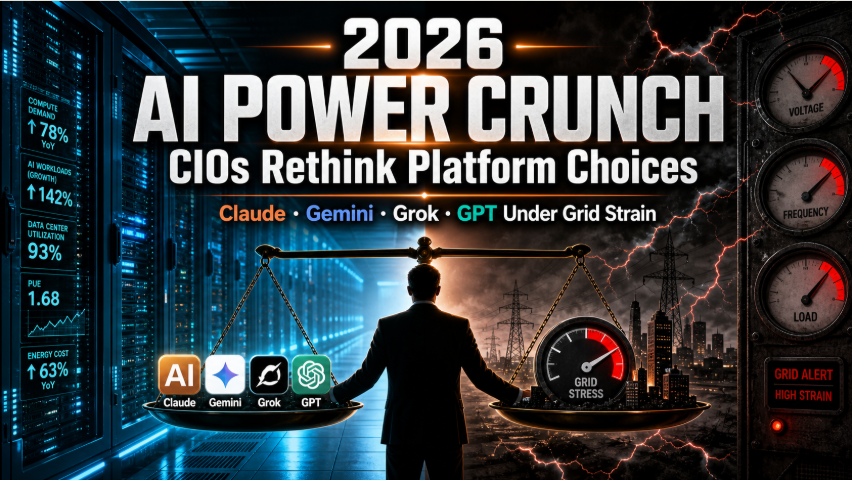
The 2026 AI Power Crunch: How Claude, Gemini, Grok and GPT Are Forcing CIOs to Rethink Platform Choices in May 2026
Published: 4 May 2026 By: Kersai Research Team
Category: AI Strategy / Enterprise AI / Infrastructure
Executive Summary
For most enterprises in May 2026, the most important AI question is no longer “Which model is smartest?” It is “Which model ecosystem can deliver reliable capability inside our budget, governance, infrastructure and risk constraints over the next three to five years?”
That shift matters because the AI market has changed. The story is no longer just about ever-bigger model launches or benchmark one-upmanship. It is about power availability, cooling limits, regional infrastructure bottlenecks, model efficiency, vendor concentration, and whether enterprise buyers can build an AI stack that remains usable and affordable as competition intensifies.
This is the real backdrop behind the current platform race between OpenAI, Anthropic, Google, xAI and the growing open-weight ecosystem. Each of these players is still chasing capability, but they are also adapting to a more constrained reality. The organisations that win in this environment will not be the ones that simply buy the most famous model. They will be the ones that choose a stack designed for resilience, optionality and long-term operational fit.
For CIOs, CTOs, heads of data, and engineering leaders, that means AI strategy in 2026 must be treated as an infrastructure strategy, a governance strategy and a procurement strategy all at once.
The Moment AI Hit the Power Wall
At some point between the early AI boom and the current May 2026 market, the conversation quietly changed. Enterprises began the journey asking how fast they could adopt frontier AI. Now they are asking something far more practical: how much AI they can actually run at scale without exposing themselves to runaway cost, delayed capacity, regional outages, or strategic dependence on a single provider.
This change did not happen because interest in AI cooled. If anything, demand got stronger. What changed is that AI moved from a software abstraction to a physical system with real-world limits. Data centres need electricity. GPU clusters need cooling. Model inference at enterprise scale is not just a software bill; it is a power and infrastructure problem. The more the market leaned into massive model training, multimodal inference, and always-on agents, the more obvious those physical limits became.
That is why 2026 feels different from 2024. In 2024, the dominant belief was that the largest companies would simply keep scaling upward and the rest of the market would rent access. In 2026, that assumption looks weaker. Grid constraints, construction delays, cooling requirements, and capital intensity are now affecting the speed and economics of AI expansion. For enterprise buyers, that means model selection cannot be separated from infrastructure reality.
The implication is profound. AI platform choice has become less like buying software and more like choosing a strategic operating environment. The wrong choice can create years of lock-in, volatile cost, limited sovereignty, and performance risk. The right choice can create flexibility, bargaining power, and a much more durable path to enterprise AI adoption.
Why This Matters to CIOs Right Now
Most boards still hear AI framed in terms of productivity, automation, growth, and competitive advantage. All of that remains true. But leadership teams are increasingly discovering that the real challenge begins after the pilot phase.
A small proof of concept can often absorb inefficiency. A company can run a few copilots, test a few automations, and tolerate inconsistent output or variable cost. But once AI becomes embedded into search, customer support, document workflows, engineering, analytics, and internal operations, the stack stops being an experiment. It becomes part of the organisation’s operating model.
That is when new questions emerge:
- What happens if the preferred model provider changes pricing or access rules?
- What happens if regional capacity tightens and performance becomes unpredictable?
- What happens if sensitive data cannot legally or strategically flow through a given platform?
- What happens if the organisation has built around one ecosystem and the market moves in another direction six months later?
These are not theoretical questions anymore. They are architecture, procurement and governance questions. The CIO of 2026 has to think beyond model quality and ask whether the stack is portable, observable, governed, regionally appropriate, and financially survivable.
In other words, enterprise AI is now entering the phase where discipline matters more than enthusiasm.
The New Constraints Enterprises Have to Design Around
There are four constraints that now shape serious enterprise AI strategy.
1. Power and physical infrastructure
AI capacity depends on electricity, cooling, and the ability of providers to deploy and operate dense compute environments. This means AI access is no longer an infinitely abstract cloud commodity. It depends on real sites, real grids, and real infrastructure lead times.
For enterprise buyers, the practical lesson is simple: a vendor’s infrastructure strategy now matters almost as much as its model strategy. If a provider cannot scale capacity smoothly in the regions that matter to your business, your roadmap inherits that risk.
2. Cost volatility
Enterprises often underestimate how quickly AI costs can expand once usage spreads beyond a few premium users. A model that seems affordable in a narrow productivity trial can become expensive when embedded into high-volume workflows, especially if retrieval, memory, agents and tool usage are layered on top.
The core issue is not just price per token or seat. It is volatility. In a constrained market, AI pricing can shift, usage caps can tighten, and previously acceptable workloads can become difficult to justify if they depend too heavily on frontier inference. CIOs now need stacks that let them reserve premium models for premium tasks.
3. Governance and sovereignty
The more strategic AI becomes, the less acceptable it is to wave away questions about data location, auditability, policy enforcement, model behaviour, and vendor dependence. Different sectors will weight these differently, but they all matter. A regulated bank, a health network, a public-sector department, and a regional retailer may not need the same controls, but each needs more than “the model is good.”
This is why governance is no longer a late-stage compliance add-on. It is becoming a selection criterion at the start.
4. Operational resilience
An enterprise AI stack has to do more than impress in demos. It has to route tasks consistently, fail gracefully, support observability, integrate with identity and security layers, and remain manageable as the vendor landscape changes.
That final point is crucial. Many enterprises are still acting as though today’s platform leaders will remain unchanged for the next five years. History suggests otherwise. The stack has to be designed for movement.
How the Major Platforms Are Positioning Themselves
The most useful way to think about the current market is not as a popularity contest, but as a set of different platform strategies.
OpenAI: The Broad Enterprise Default
OpenAI remains one of the most important reference points in the market because it helped define what enterprise generative AI looks like at scale. Its appeal is obvious: broad capability, strong ecosystem recognition, mature developer mindshare, and a central place in the modern AI narrative.
For enterprise buyers, OpenAI often appears as the default option because it is familiar. It is widely integrated, widely discussed, and easy to justify internally. Teams can point to market adoption, partner ecosystems and talent availability.
But familiarity is not the same as strategic fit. The more central OpenAI becomes to a company’s workflows, the more important it is to ask whether that dependency is acceptable over a multi-year horizon. For some organisations, it will be. For others, especially those with strong sovereignty, cost, or diversification concerns, OpenAI is best treated as part of a broader portfolio rather than the entire foundation.
The key enterprise question is not whether OpenAI is powerful. It is whether relying too heavily on one frontier ecosystem aligns with the organisation’s risk tolerance.
Anthropic: High-Trust Enterprise Reasoning
Anthropic has become increasingly attractive to organisations that want strong reasoning with an emphasis on safety, alignment and controlled enterprise behaviour. That matters because a growing share of enterprise AI demand is not about flashy generation; it is about dependable analysis, document interpretation, internal assistance and policy-sensitive workflows.
Claude’s positioning speaks directly to that market. It appeals to buyers who want an AI system that feels thoughtful, deliberate and less likely to create governance headaches in sensitive environments. This does not remove all risk, but it changes the conversation. Enterprises evaluating Anthropic are often not just asking “Can it do the task?” They are asking “Can it do the task in a way our legal, risk and policy teams can live with?”
In a market increasingly shaped by trust, that is a real differentiator.
Anthropic’s challenge is similar to every frontier provider’s challenge: proving that governance strength can coexist with scalable, cost-effective delivery. Still, for CIOs in regulated or risk-sensitive sectors, Anthropic often feels closer to the language of enterprise governance than some of its competitors.
Google Gemini: The Infrastructure and Workflow Integrator
Google’s real advantage is not only the model itself. It is the surrounding environment. Gemini becomes far more interesting when viewed as part of a broader Google stack that includes Workspace, Cloud, search infrastructure, productivity tools, and increasingly agentic workflows.
That makes Google particularly strong for enterprises that want AI embedded across day-to-day operations rather than isolated as a specialist tool. If the goal is to connect documents, email, meetings, knowledge retrieval, workflow automation and multimodal context into one operating layer, Google’s proposition becomes stronger.
For CIOs, this is the classic platform trade-off. Integration reduces friction. It can speed adoption dramatically. But it also increases ecosystem gravity. The more tightly AI is woven into one provider’s productivity and cloud environment, the more important it becomes to think about exit paths, portability and strategic dependence.
Gemini is not just competing as a model. It is competing as a workplace AI operating environment.
xAI Grok: Speed, Freshness and Edge Cases
xAI and Grok occupy a different position. They are not typically the first option for conservative enterprise standardisation, but they are increasingly relevant in high-tempo use cases where real-time context, rapid iteration, or less constrained outputs matter.
This makes Grok interesting for certain classes of work: market commentary, fast-moving signals, media monitoring, trading-oriented interpretation, social intelligence and some marketing use cases. It is not that Grok is necessarily the ideal enterprise backbone. It is that it reflects a different philosophy of usefulness.
That philosophy will appeal to some buyers and unsettle others. Enterprises with stronger governance requirements may see Grok as a specialist or supplementary platform rather than a core one. But ignoring it would be a mistake. In fast-changing categories, today’s edge case can become tomorrow’s mainstream feature set.
For buyers, the real issue is whether the organisation needs that speed and openness badly enough to justify the governance complexity that may come with it.
Open-Weight Models: From Cost Play to Strategic Necessity
The biggest strategic shift in 2026 may be the rise of open-weight and more controllable model ecosystems from “interesting alternative” to “serious enterprise option.”
That shift is not just about ideology or cost savings. It is about resilience. Open-weight models give enterprises more control over deployment, tuning, data boundaries and long-term portability. They allow organisations to create a stack that does not rely entirely on premium, externally controlled APIs.
This is increasingly important because many enterprise workloads do not need the absolute smartest model in the world. They need a reliable model that can classify, retrieve, summarise, route, extract and automate at predictable cost under strong organisational control.
That is where open-weight models become strategically powerful. They let enterprises build a layered stack in which frontier models are reserved for premium reasoning tasks while more routine workloads are handled in cheaper, more governable environments.
In 2026, open-weight is no longer a fringe technical preference. It is becoming one of the main tools for rebuilding balance in an AI market that otherwise pushes buyers toward concentration and dependency.
Three AI Stack Patterns That Make Sense in May 2026
Different organisations will still choose different strategies, but three patterns are emerging as the most sensible.
Pattern 1: Frontier-first, cloud-led
This pattern works best for companies that need speed, simplicity and top-tier capability now. They choose a major frontier platform, align closely with its cloud ecosystem, and aim to maximise adoption quickly.
The advantages are obvious. Fewer moving parts. Faster rollout. Easier internal messaging. Less engineering complexity.
The downside is equally clear. This is the highest-dependency path. It creates exposure to vendor concentration, pricing change, regional constraints and roadmap decisions outside the organisation’s control.
This pattern is still valid, especially for companies early in the journey. But in 2026 it is no longer the obviously safest route.
Pattern 2: Hybrid frontier plus controllable core
This is the pattern that increasingly makes the most sense for mature enterprise buyers. In this model, the organisation uses frontier platforms for the tasks that truly justify them, such as complex reasoning, premium copilots, advanced analytics or executive-facing workflows. Everything else is progressively shifted to more controllable environments, including open-weight models, regional deployments or provider-diverse architectures.
This approach is more complex, but it is also far more durable. It creates leverage. It reduces single-vendor risk. It makes it easier to manage cost. It also allows the enterprise to evolve as the model market changes.
For organisations thinking in three-year horizons rather than quarterly demos, this is often the strongest pattern.
Pattern 3: Sovereign and regulated by design
Some enterprises do not have the luxury of defaulting to global frontier infrastructure. Public sector, finance, healthcare, critical infrastructure, and certain multinational contexts often require more deliberate control over data, auditing, hosting and jurisdiction.
For these organisations, the best AI strategy is often one designed around compliance, explainability and resilience from the start. Frontier APIs may still play a role, but they are integrated carefully rather than treated as the universal answer.
This pattern tends to move slower at the beginning, but it can become a major competitive advantage once regulation tightens or cross-border model governance becomes more contested.
What CIOs Should Actually Do This Quarter
The temptation in AI strategy is always to overfocus on what the models can do. The more urgent question is what the organisation should do next. In May 2026, that means discipline.
1. Audit workload classes, not just vendor options
Do not start with vendors. Start with tasks.
Break the AI roadmap into workload classes such as:
- Knowledge retrieval and search
- Document extraction and summarisation
- Coding assistance
- Customer support automation
- Internal copilots
- High-risk decision support
- Executive analysis and strategic reasoning
Once those classes are clear, it becomes much easier to decide where frontier performance genuinely matters and where controllability matters more.
2. Separate premium reasoning from routine volume
Many enterprises make the mistake of assuming one model should serve everything. That is rarely the best design. The smarter approach is to protect premium models for tasks where reasoning quality creates outsized value, and route routine volume to more efficient layers.
This one decision can change the economics of the whole program.
3. Build a routing and observability layer early
If AI is going to become part of the core operating model, the business needs visibility and control. That means model routing, audit trails, usage monitoring, performance tracking, and policy enforcement should not be treated as later enhancements. They should be part of the architecture from the beginning.
The goal is not to make the stack complicated. It is to make it governable.
4. Design for vendor movement
The current AI leaders are powerful, but the market will keep moving. New models will rise. Pricing will shift. Some capabilities will commoditise. Others will become platform-locked.
A serious enterprise stack needs enough abstraction that it can change providers, add new model families, or rebalance workloads without a major rebuild.
5. Reframe the board conversation
If AI is still being discussed internally as a pure innovation topic, the framing is outdated. The board conversation should now include:
- AI as infrastructure
- AI as concentration risk
- AI as governance exposure
- AI as operational resilience
- AI as a competitive advantage that depends on disciplined architecture
That change in language helps leadership make better decisions.
The Kersai View for May 2026
The strongest enterprise AI strategy in May 2026 is not “pick the smartest model and scale everywhere.” It is “build a flexible stack that can use frontier intelligence where it matters, preserve control where it counts, and survive changes in infrastructure, regulation and vendor power.”
That is the lens Kersai recommends for enterprise buyers right now.
For most CIOs and heads of engineering, the practical direction is:
- Keep access to one or two leading frontier ecosystems.
- Do not build the entire roadmap around a single provider.
- Introduce controllable model layers for repeatable, lower-risk workloads.
- Treat observability, governance and model routing as foundational.
- Make AI platform choice part of enterprise architecture and risk planning, not just digital innovation.
In other words, the winners in 2026 will not just be the organisations with access to strong models. They will be the organisations that know how to combine capability, control and resilience into one operating strategy.
That is exactly where Kersai works best.
Kersai helps enterprise teams evaluate AI platforms, design vendor-neutral model strategies, assess governance and sovereignty exposure, and build stacks that match business reality rather than vendor hype. For leadership teams revisiting their AI roadmap this quarter, the goal should not be to chase every release. The goal should be to make smarter platform bets while the market is still fluid.
Final Thought
The AI industry still talks like the next leap will be won by whoever launches the biggest or boldest model. Enterprise buyers should be more careful than that.
The real winner in 2026 may not be the company with the loudest benchmark or the flashiest demo. It may be the company that quietly builds an AI stack it can actually afford, govern, move and trust.
That is the shift underway now. And it is exactly why platform choice in May 2026 deserves much deeper thinking than a simple model comparison chart.
This article was researched and written by the Kersai Research Team. Kersai helps organisations navigate AI governance, partnerships and model selection especially as legal and regulatory battles reshape the industry. visit kersai.com.