

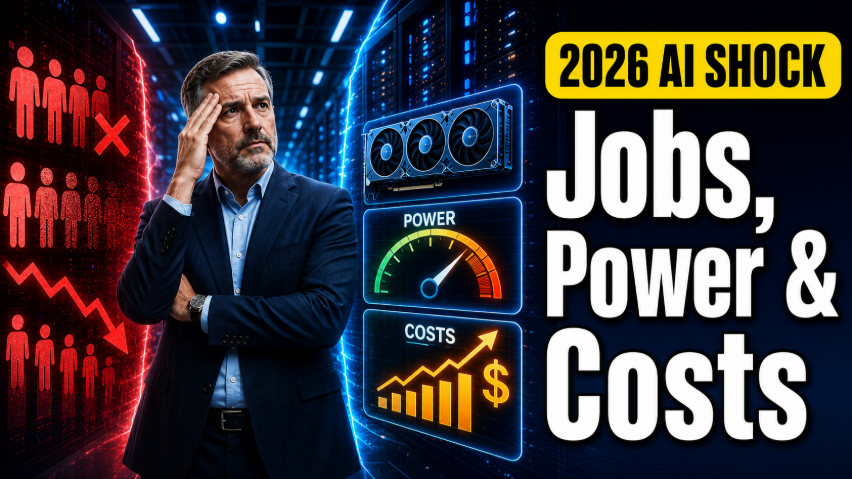
AI Jobs, Power and Costs in 2026: The Boardroom Reality Every CIO Must Now Confront
Published: 4 May 2026 By: Kersai Research Team
Category: AI Strategy / Enterprise AI / CIO Leadership
Excerpt
The biggest enterprise AI issue in 2026 is no longer model access. It is the collision between infrastructure spending, power constraints, inference economics and workforce pressure. CIOs now need a board-level playbook for all four.
Executive Summary
For most enterprises in May 2026, the central AI question is no longer which model is smartest. It is whether the organisation can scale AI in a way that is financially sustainable, operationally realistic and politically defensible inside the business.
That is the real shift underway now. In 2024 and even much of 2025, AI strategy was still framed mainly around access, experimentation and capability. Could the company get access to a frontier model? Could teams trial copilots? Could the organisation prove some early wins quickly enough to justify broader rollout?
In 2026, those questions still matter, but they are no longer the hardest ones. The harder questions arrive after the pilot succeeds. What happens when usage expands across business units? What happens when inference bills rise faster than expected? What happens when the board asks whether AI spend is producing measurable productivity, margin improvement or headcount leverage? What happens when infrastructure capacity and power availability start shaping the roadmap as much as the model vendor does?
This is why enterprise AI has entered a new phase. It is no longer just a model-selection problem. It is a management problem spanning jobs, power, costs, governance and capital allocation.
And this is exactly the point many companies are still underestimating.
Introduction: AI Has Moved From Innovation Story to Operating Model Decision
The public AI narrative remains obsessed with launches, benchmarks and demos. Every few weeks, another model appears with stronger reasoning, better coding performance, lower latency or more advanced agentic behaviour. That surface-level story is real, but it is incomplete.
Inside enterprises, the more consequential story is different. AI is beginning to change budget structures, infrastructure assumptions and workforce planning at the same time. In late April, reporting around Meta showed how direct this connection has become. The company moved toward cutting roughly 10 percent of its workforce, or about 8,000 jobs, while sharply increasing AI-related spending and forecasting capital expenditure of $115 billion to $135 billion for the fiscal year, much of it tied to infrastructure and superintelligence investment.
This matters beyond Meta itself. The point is not that every enterprise will imitate Meta’s labour decisions. The point is that AI spending is now large enough to compete with other strategic priorities inside real budgets. It is no longer a side innovation line item. It is increasingly a balance-sheet issue, an operating-expense issue and, in some organisations, a workforce issue.
For CIOs and CTOs, this changes the conversation with boards completely. They are no longer being asked only whether AI can improve productivity. They are being asked where the cost lands, how durable the ROI is, whether infrastructure can support scale, and what AI adoption implies for hiring, retention and organisational design.
That is why jobs, power and costs now belong in the same strategic frame.
Table: The 2026 Enterprise AI Cost Stack
| Cost layer | What it includes | Why it is rising in 2026 |
|---|---|---|
| Compute & cloud infrastructure | GPU/TPU instances, storage, networking, reserved/spot capacity, on‑prem hardware refresh | Heavier generative workloads, always‑on agents, larger context windows, multi‑region redundancy |
| Inference consumption | Per‑token/usage API fees, RAG queries, embedding calls, vector search, orchestration overhead | Shift from pilots to production, more users, more workflows, multi‑call chains and guardrails in each workflow |
| Model & platform licences | SaaS seats, enterprise tiers, add‑on AI features in existing SaaS, support & SLAs | AI features embedded into core SaaS tools, hybrid per‑seat + consumption pricing models |
| Data & integration | Data cleaning, labeling, ETL, connectors, MDM, integration engineering, observability & FinOps | More systems feeding AI, growing telemetry, need for end‑to‑end lineage and monitoring |
| Talent & operating model | AI platform teams, MLOps, prompt/UX engineers, governance, security, legal & compliance functions | Demand for specialised roles to run AI safely at scale, not just experimentation |
| Change & adoption | Training, enablement, playbooks, internal comms, process redesign, change management | Moving from “toy” usage to re‑engineered workflows across multiple business units |
Section 1 Why Jobs, Power and Costs Must Be Viewed Together
Many executive teams still discuss these issues separately. The CHRO talks about workforce redesign. The CIO talks about model vendors and architecture. The CFO talks about cloud spend and capital discipline. Facilities or procurement teams worry about infrastructure availability and regional constraints.
In 2026, that separation is breaking down.
AI affects all of those layers simultaneously. If an organisation deploys internal copilots, agentic workflows or customer-facing AI systems at scale, it does not just buy intelligence. It also buys inference demand, governance overhead, security review, integration complexity and long-tail operational cost. If those systems materially improve output, leadership then faces a second-order question: does the organisation reinvest the gains, redesign roles or reduce headcount?
This is why the enterprise AI debate is starting to resemble a systems problem rather than a software-procurement problem.
Jobs matter because AI changes the economics of knowledge work. Power matters because AI workloads are physically demanding and rely on constrained infrastructure. Costs matter because the bill does not stop at the pilot phase. It expands through usage, integration and always-on inference. Each of these variables interacts with the others.
A simple example makes this clear. Imagine an enterprise launches an AI service desk copilot, an AI coding assistant and an internal research agent across several departments. Productivity may improve. Ticket resolution may speed up. Fewer junior analysts may be required in some workflows. But the company may also see sharply higher platform spending, more GPU-intensive workloads, stricter governance burdens and new dependency on regional cloud availability. The organisation is not just adopting software. It is redesigning how work, infrastructure and cost structures interact.
That is why boards are becoming more interested in AI economics than AI hype.
How Jobs, Power and Costs Interact in Enterprise AI
| Dimension | Key CIO concern | Typical board question | 2026 pressure trend |
|---|---|---|---|
| Jobs | Where work will be automated vs augmented | “Are we reducing labour, increasing output or just adding spend?” | Rising, driven by visible AI layoffs |
| Power | Whether infra and regions can support growth | “Could power or data‑centre limits stall our AI roadmap?” | Rising, as AI data‑centre demand surges |
| Costs | Run‑rate of AI programmes and unit economics | “Is AI improving margin and ROI or eroding them?” | Rising, as inference outpaces pricing gains |
Section 2 The Jobs Question Is No Longer Theoretical
For much of the last two years, many executives preferred softer language around AI and work. The phrase augmentation was safer than automation. Leaders could say AI would help staff rather than replace them. In some cases that remains true. But in 2026, the question has become harder to avoid.
The reason is simple. Once AI spending becomes material, boards want to know what the organisation gets back. They ask whether AI reduces labour needs, improves throughput, lifts margin, expands revenue or all four at once. If leadership cannot answer that clearly, confidence in the AI roadmap starts to weaken.
Meta’s April decision is an unusually visible version of this broader pattern. BBC reporting said Meta planned to cut around 10 percent of its workforce after spending billions on AI, with expected annual expenditure on AI-related efforts reaching as much as $135 billion. ET CIO reported that quarterly costs rose 40 percent year over year to $35.15 billion, while quarterly capital expenditure reached $22.14 billion, much of it linked to infrastructure such as data centres powering AI.
The lesson for enterprise buyers is not “copy Meta.” It is that AI investment now changes the context in which labour decisions are made.
That means workforce strategy can no longer sit outside AI strategy. A serious enterprise AI plan in 2026 must classify work more precisely.
There is work that should be automated because it is repetitive, structured and low in strategic differentiation.
There is work that should be augmented because human judgement still matters, but speed, consistency or throughput can improve.
There is work that becomes more important as AI adoption increases, including AI governance, model risk review, vendor management, data engineering, workflow orchestration, security oversight and measurement.
Most enterprises become confused when they blur these categories. They may buy expensive AI systems without changing workflow design. Or they may start reducing roles before they have built the internal operating capabilities required to use AI safely and effectively. Either way, they underperform.
The strongest CIOs in 2026 are not those making the loudest automation claims. They are the ones presenting a credible workforce transition logic to the board.
Section 3 Power Has Become a Strategic Constraint, Not Just a Technical Detail
Power used to sound like someone else’s problem. It was a hyperscaler issue, a grid issue, or a data-centre issue. That view no longer holds.
AI is redefining what enterprises expect from infrastructure. AI workloads are increasing compute density and energy demand, creating new baseline expectations for higher rack densities, advanced cooling, workload balancing and energy strategies aligned with AI growth.
This is why the idea of the AI-ready data centre matters so much in 2026. It is not just a real-estate or facilities story. It is a signal that AI has become a physically intensive computing paradigm. Traditional enterprise software rarely forced boards to think about megawatts, thermal design or geographic concentration risk. AI does.
The numbers underline the scale. A single hyperscale AI campus can require 200 to 500 megawatts of capacity, and a 300MW campus operating at high utilisation can consume roughly 2.5 to 2.6 terawatt-hours per year. Large-scale AI-ready data centres typically operate in the 50MW to 500MW range, and access to power is becoming a direct growth constraint for AI expansion.
For CIOs, the practical implication is not that they suddenly need to become energy-market specialists. It is that AI scale now depends on infrastructure conditions that software teams do not fully control. Cloud region availability, latency requirements, sovereign deployment demands, cooling limitations and energy access can all shape what is possible.
That is why the boardroom discussion has changed. The issue is no longer just whether a model can perform a task. It is whether the organisation can sustain the infrastructure reality behind that performance.
AI‑Driven Data‑Centre Power Reality (Indicative 20242026)
| Metric | 2024 estimate | 2026 outlook (selected forecasts) | Why this matters for CIOs |
|---|---|---|---|
| Global data‑centre electricity use | ~415 TWh (~1.5% of global electricity) | 500+ TWh (~2% of global electricity) | AI is now a visible driver of national power demand |
| Typical traditional rack power (enterprise) | 515 kW | 515 kW | Legacy infra assumptions under‑state AI needs |
| AI‑optimised rack power | 4060+ kW, up to 100 kW in some designs | 40100+ kW becoming more common | Cooling, layout and grid capacity become constraints |
| Large AI‑focused campus load | 50500 MW | 200500 MW common for hyperscale AI sites | Single campuses can approach 1% of a country’s demand |
Section 4 The Inference Bill Is Becoming the Silent Killer of AI ROI
If power is one half of the infrastructure story, inference is the financial half.
A common misconception in the market is that AI should now be getting cheap enough to stop being a major concern. Token prices have come down. Open models have improved. Hardware efficiency is expected to improve materially through the rest of the decade.
But enterprises are not experiencing AI as “cheap.” In fact, many are finding the opposite.
The reason is that lower unit costs do not automatically mean lower total costs. Public cloud API pricing may be falling, but inference demand is expanding so quickly that overall AI spending is still surging.
That is the real enterprise trap. Organisations assume the economics will improve because the per-unit price falls. But their usage patterns become much heavier at the same time. They move from casual chatbot use to internal copilots, enterprise search, customer-service automation, research agents, coding systems, workflow orchestration and multimodal processing. Context windows get larger. Governance layers add extra calls. Agentic systems perform more steps per task. Total consumption climbs much faster than expected.
This is why the best way to describe the 2026 AI cost problem is not as a token-price problem, but as a volume and workflow-design problem.
The right response is outcome-based cost governance. Boards care more about efficiency ratios such as cost per resolved ticket, human-equivalent hourly rate and revenue per AI workflow than raw token charts.
Section 5 Why April’s Model Progress Actually Makes The CIO’s Job Harder
One reason enterprises are struggling is that model progress keeps encouraging the wrong instinct: capability chasing.
Every major model release makes it easier for teams to argue that they need access to the latest system. The argument sounds reasonable. Better reasoning, stronger coding, larger context windows, improved multimodal performance and more advanced agents can create real value.
But they also create procurement sprawl and architecture drift.
The deeper problem is that better models can make governance weaker if leadership has not already defined a portfolio strategy. Teams begin to assume frontier capability should be the default. Premium model usage spreads into workflows that do not actually require it. Multiple departments buy overlapping tools. Cost discipline weakens because “the best model” sounds like a strategic necessity rather than an architectural choice.
This is why the smartest enterprise response in 2026 is rarely model maximalism. It is model portfolio design.
In practice, that means using frontier systems only where performance differences materially affect business outcomes, such as complex coding, high-value research, executive analysis or nuanced reasoning workflows. Lighter, cheaper commercial models can handle routine classification, summarisation and internal support tasks. In some cases, open-weight systems may make more sense where predictability, sovereignty or custom deployment is more important than frontier capability.
That portfolio mindset is what separates enterprises that manage AI from enterprises that are managed by AI spend.
Model Portfolio Strategy for 2026 Enterprises
| Model class | Best‑fit use cases | Typical trade‑offs | When boards like this option |
|---|---|---|---|
| Frontier closed models | Complex coding, research, exec analysis, high‑stakes reasoning | Highest inference cost, strongest capability | When differentiation and quality matter most |
| Mid‑tier commercial | Internal copilots, service desk, summarisation, classification | Lower cost, good enough for many workflows | When scaling usage across many users |
| Open‑weight / self‑hosted | Sovereign workloads, regulated data, custom vertical agents | Higher setup/ops effort, more control, predictable cost | When sovereignty, control and predictability matter |
Section 6 The Five Questions Every Board Will Ask
As AI budgets rise, boards are becoming more demanding and more literate in how they question technology leadership. CIOs should expect these five questions to dominate discussions through the rest of 2026.
1. Where exactly is AI creating cost pressure?
Boards want a breakdown. They want to know whether pressure is coming from licences, cloud inference, infrastructure upgrades, consulting, data preparation, security review, compliance, new talent or failed pilots. A generic answer about innovation does not satisfy fiduciary scrutiny.
2. What is AI doing to the workforce model?
This is the uncomfortable but unavoidable question. Does AI reduce labour needs in certain workflows? Does it let the organisation grow without proportional hiring? Does it increase demand for higher-skill platform and governance roles? The board does not need oversimplified rhetoric. It needs a segmented answer.
3. How exposed are we to power and infrastructure constraints?
Even companies buying AI through cloud platforms are exposed to compute availability, regional deployment issues and vendor concentration risk. The board wants to know whether the roadmap depends too heavily on assumptions outside the organisation’s control.
4. Are we choosing the right model mix?
This is not just a procurement question. It is a capital-efficiency question. Boards want confidence that frontier models are being used where they generate differentiated value and that lower-cost options are being used where they are sufficient.
5. How are we measuring value, not just activity?
Usage metrics alone are weak. Number of prompts, number of seats and number of experiments do not prove a business case. Better measures include cost per resolved task, cycle-time reduction, margin improvement, revenue uplift, error reduction and risk mitigation.
Table: Translating Board Questions Into Concrete AI Metrics
| Board question | CIO metric to show | Example indicator |
|---|---|---|
| “Where is AI creating cost pressure?” | Spend by layer (compute, inference, licences, data, talent) | % of AI budget in inference vs licences |
| “What is AI doing to our workforce model?” | Automation/augmentation ratios by function | FTEs shifted, roles created in AI governance |
| “How exposed are we to infra and power constraints?” | Workload and region dependency profile | % of AI workloads in single region/vendor |
| “Do we have the right model mix?” | Cost‑per‑outcome by model class (frontier, mid‑tier, open) | Cost per resolved task per model type |
| “How are we measuring value, not just activity?” | Outcome metrics tied to revenue, margin, risk, cycle time | Hours saved, margin lift, risk incidents avoided |
Section 7 What A Stronger Enterprise AI Playbook Looks Like in May 2026
The answer to the jobs-power-costs challenge is not to stop AI adoption. It is to become far more disciplined about how adoption happens.
A stronger 2026 playbook has several parts.
Build a model portfolio, not a vendor obsession
Enterprises should categorise use cases by value, latency sensitivity, risk and cost tolerance. Frontier models belong in a narrow set of high-value workflows. Mid-tier commercial models should carry more of the routine workload. Open-weight or private deployments should be considered where compliance, sovereignty or predictable cost structures matter most.
Budget per outcome, not per token
This is one of the most important shifts. The budget conversation should move away from raw usage and toward business outcomes. If an AI workflow is expensive but meaningfully cuts analyst time, improves customer resolution or expands conversion rates, it may be justified. If it burns compute without changing outcomes, it should be redesigned, downgraded or shut down.
Treat infrastructure realism as strategy
Not every AI workload deserves premium latency or premium architecture. Workloads should be tiered. Some can tolerate delay. Some can use cheaper models. Some do not need 24/7 availability. Organisations that design around business criticality spend more intelligently than those that overengineer by default.
Make workforce positioning explicit
Employees should not learn the company’s AI strategy indirectly through budget cuts, hiring freezes or hallway rumours. Leadership should define where automation is intended, where augmentation is preferred and where new roles are being created. This reduces fear and improves managerial planning.
Use governance to scale, not to stall
Weak governance is chaotic. Overbuilt governance is paralysing. Effective governance gives teams clarity on what data can be used, which models are approved, how risks are escalated and how value is measured. That clarity reduces waste, duplication and compliance surprises.
Section 8 The Real Boardroom Message for CIOs
The CIO role is changing faster than many boards realise.
In the old framing, the CIO bought software, negotiated contracts and managed integration. In the emerging 2026 framing, the CIO has to explain the economic logic of AI to the board. That means translating technical possibility into financial reality, operational constraints and workforce consequences.
The board wants disciplined capital allocation.
Business units want faster AI deployment.
Employees want clarity on what AI means for their work.
Infrastructure and cost realities impose limits on all three.
That translation role is now one of the most valuable leadership functions in the enterprise.
The companies that win in AI over the next 18 months will probably not be those with the loudest pilots or the broadest set of vendor logos. They will be the ones that align model choice, infrastructure assumptions, workforce planning, governance and ROI measurement into a coherent operating model.
That is the real lesson of May 2026.
AI is no longer just a race for smarter models. It is a test of whether an enterprise can build a financially credible, infrastructure-aware and socially sustainable system for using them.
That is why jobs, power and costs now belong in the same board conversation.
Key Takeaways
- AI investment is now large enough to compete directly with headcount, hiring plans and other strategic budget priorities.
- Power and infrastructure constraints are no longer abstract hyperscaler issues; they increasingly shape what enterprise AI can scale and where.
- Falling token prices do not guarantee lower AI bills because inference volume, workflow complexity and agentic usage are rising quickly.
- CIOs need a model portfolio strategy, not a frontier-model default for every use case.
- Boards are increasingly asking for outcome-based AI measurement tied to cost, margin, productivity and risk.
- The best enterprise AI strategies in 2026 connect workforce planning, governance, infrastructure realism and ROI into one operating model.
Frequently Asked Questions
Why are jobs, power and costs linked in enterprise AI?
Because production AI changes more than software capability. It affects workforce design, cloud spend, infrastructure demand, risk review, procurement and margin structure at the same time.
Why does power matter if the enterprise uses cloud AI instead of owning data centres?
Because the enterprise still depends on the economics and availability of compute infrastructure underneath cloud services. Capacity limits, regional constraints and energy-intensive AI demand still affect price, latency and deployment flexibility.
If token prices are falling, why are enterprise AI bills still rising?
Because usage is expanding faster than unit pricing is falling. Larger context windows, more complex workflows, always-on agents and broader adoption all push total spend higher.
What should CIOs measure instead of prompt volume?
They should focus on outcome metrics such as cost per resolved task, cycle-time reduction, hours saved in high-value workflows, quality improvement, revenue impact and risk reduction.
What is the biggest enterprise AI mistake in 2026?
Treating AI as a pure model-choice problem. The real challenge is designing an operating model that balances capability, cost, power constraints, governance and workforce impact.
This article was researched and written by the Kersai Research Team. Kersai helps organisations navigate AI governance, partnerships and model selection especially as legal and regulatory battles reshape the industry. visit kersai.com.