

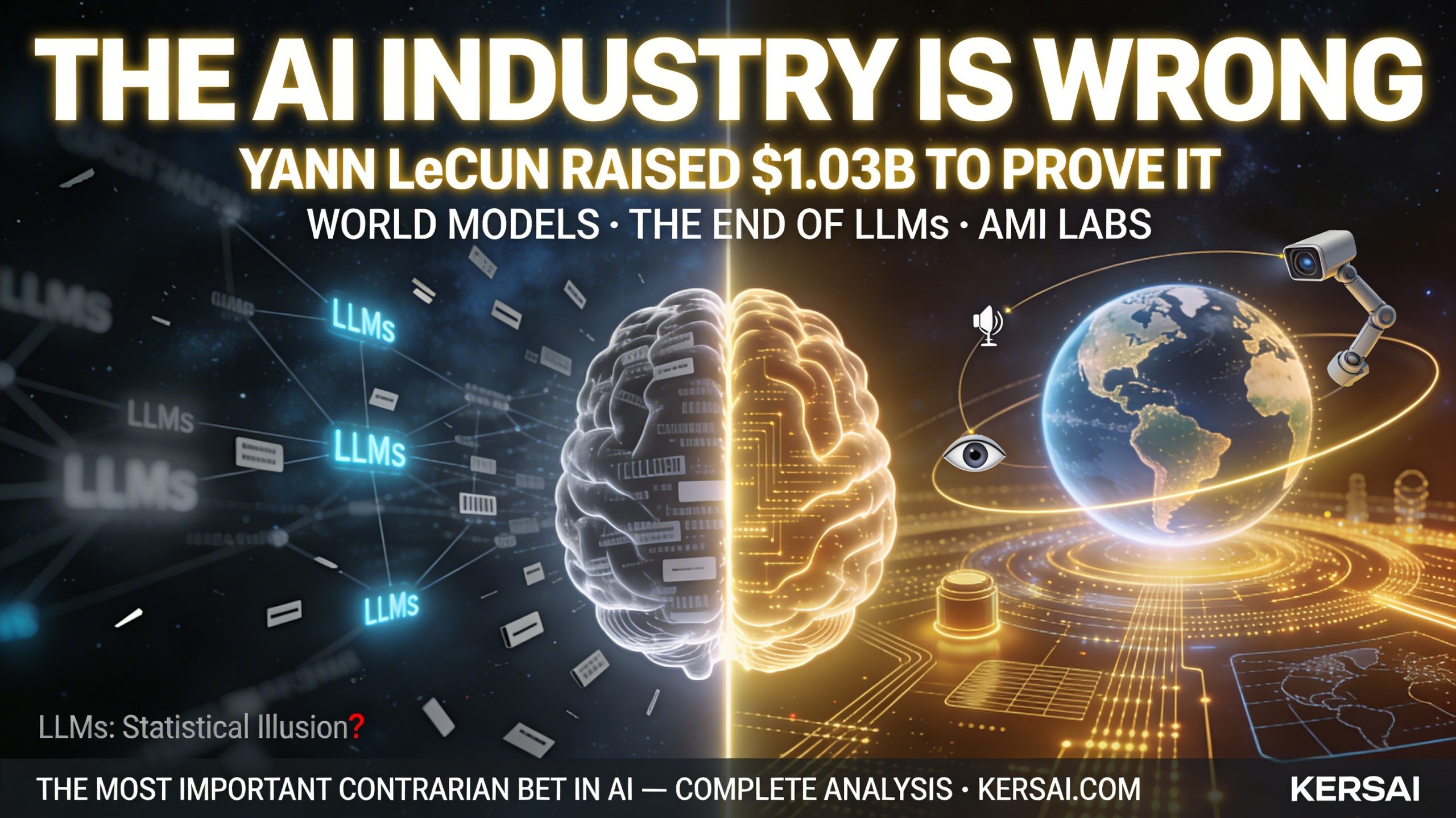
The Godfather of AI Who Says the Whole Industry Got It Wrong — And Just Raised $1.03 Billion to Prove It
Yann LeCun Spent 12 Years at Meta Building Some of the Most Powerful AI in the World. Then He Left, Secured Europe’s Largest Seed Round Ever, and Declared That ChatGPT, Claude, and Every Large Language Model Is Heading Toward a Dead End. Here Is His Complete Argument and Why It May Be the Most Important Bet in AI.
Published: April 7, 2026 | By the Kersai Research Team | Reading Time: ~22 minutes
Last Updated: April 7, 2026
Quick Summary: Yann LeCun co-winner of the 2018 Turing Award, the founding director of Meta’s AI Research lab (FAIR), and one of the three scientists credited with creating the deep learning revolution that made modern AI possible left Meta in November 2025 after 12 years. He co-founded Advanced Machine Intelligence Labs (AMI Labs), a Paris-based AI research company, with serial AI entrepreneur Alexandre LeBrun as CEO. In March 2026, AMI Labs closed a $1.03 billion seed round at a $3.5 billion pre-money valuation the largest seed round ever raised by a European company co-led by Cathay Innovation, Greycroft, Hiro Capital, HV Capital, and Bezos Expeditions (Jeff Bezos’s personal investment vehicle). LeCun’s thesis is the most consequential contrarian argument in AI today: that large language models the technology behind ChatGPT, Claude, Gemini, and every major AI product are a “dead end” for achieving genuine intelligence. They are, in his framing, sophisticated pattern matchers that have learned to produce plausible text without ever understanding the world. His alternative is “world models” AI systems built on his Joint Embedding Predictive Architecture (JEPA) that learn from physical reality through sensors and cameras rather than from predicting the next word in a text sequence. This guide covers the complete story: who LeCun is, why he left Meta, what world models actually are and how they differ from LLMs, the specific industries AMI targets, what critics say, and what it all means for businesses thinking about their AI strategy.
Table of Contents
- Who Is Yann LeCun? The Résumé Behind the Bet
- The Departure From Meta: 12 Years, One Exit, One Mission
- AMI Labs: Europe’s Largest Seed Round in History
- The Core Argument: Why LeCun Thinks LLMs Are a Dead End
- The Statistical Illusion: What LLMs Actually Do
- What Are World Models? The Alternative LeCun Is Building
- JEPA: The Architecture Underneath AMI’s Bet
- The Digital Twin Vision: What AMI Is Actually Building
- The Target Industries: Where World Models Win
- The Critics: Why Some Think LeCun Is Wrong
- The Timeline: When Will World Models Matter Commercially?
- What This Means for Businesses Using AI Today
- What This Means for Australian Businesses
- FAQ
1. Who Is Yann LeCun? The Résumé Behind the Bet
To understand why the AI world takes Yann LeCun’s contrarian argument seriously even those who disagree with it you need to understand who he is and what he has built.
LeCun is 65 years old, French-born, and has spent his career at the intersection of theoretical computer science and practical AI engineering. He holds joint academic appointments at New York University (where he remains a professor) and previously at Collège de France. His publication list is one of the most cited in the history of computer science.
Three contributions define his legacy:
1.1 Convolutional Neural Networks (CNNs) the foundation of modern computer vision
In the late 1980s and 1990s, LeCun developed and refined convolutional neural networks the mathematical architecture that enables computers to understand images. His 1998 paper introducing LeNet-5 demonstrated that CNNs could reliably read handwritten digits from bank cheques. It was an early proof that neural networks could do something genuinely useful.
At the time, most of the AI research community was focused on symbolic AI and rule-based systems. LeCun’s CNN work was largely ignored for over a decade until the ImageNet competition of 2012, when a CNN-based system called AlexNet crushed every competing approach and triggered the deep learning revolution that produced modern AI. LeCun’s 1990s work was the foundation on which AlexNet was built.
1.2 The deep learning revolution and the Turing Award
LeCun, together with Geoffrey Hinton and Yoshua Bengio, is credited as one of the three scientists who pioneered and championed deep learning through decades of unfashionable research before it became the dominant paradigm in AI. In 2018, the three were jointly awarded the Turing Award the highest honour in computer science, often called the “Nobel Prize of Computing” for their work on deep learning.
The Turing Award citation specifically recognised that deep learning had become “the dominant approach in AI for everything from medical imaging to natural language processing to game-playing.” The technology inside ChatGPT, Claude, Gemini, and every modern AI product traces directly to the theoretical foundations that LeCun, Hinton, and Bengio developed.
This is what makes LeCun’s critique of LLMs so striking: the man who helped create the mathematical foundations for today’s AI is now arguing that today’s AI has gone in the wrong direction.
1.3 12 years at Meta founding FAIR
In 2013, Mark Zuckerberg hired LeCun to found and lead Facebook AI Research (FAIR) Meta’s internal AI research organisation. Under LeCun’s leadership, FAIR became one of the most productive and respected AI research labs in the world, publishing foundational research in computer vision, natural language processing, robotics, and reasoning.
FAIR’s open-source releases including the PyTorch deep learning framework (now the most widely used framework for AI research globally) and the LLaMA family of open-source language models shaped the entire AI industry. LeCun’s stewardship of FAIR represents 12 years of institution-building at the frontier of AI research.
When someone with that track record says the industry is going in the wrong direction, the argument deserves serious attention even from those who ultimately disagree.
2. The Departure From Meta: 12 Years, One Exit, One Mission
On November 19, 2025, LeCun announced his departure from Meta on X:
“As many of you have heard through rumors or recent media articles, I am planning to leave Meta after 12 years: 5 years as founding director of FAIR and 7 years as Chief AI Scientist.”
The announcement was characteristic LeCun direct, without drama, already looking forward. He described his new venture immediately:
“I am establishing a startup to advance the Advanced Machine Intelligence (AMI) research initiative that I have pursued in collaboration with colleagues at FAIR, NYU, and elsewhere over the past few years. The mission of this startup is to catalyze the next major breakthrough in AI: systems that comprehend the physical environment, possess enduring memory, can reason, and can devise intricate action plans.”
Why he left the long version
LeCun’s departure had been telegraphed for years through a series of increasingly pointed public arguments about the direction of AI research. He had been arguing since at least 2022 loudly and consistently that the AI industry’s obsession with scaling LLMs was misguided, that auto-regressive next-token prediction was architecturally incapable of producing genuine intelligence, and that the field needed to pivot toward architectures that learn from physical reality.
These arguments put him in direct public disagreement with colleagues at OpenAI, with Geoffrey Hinton (his Turing Award co-recipient, who became a prominent AI safety advocate), and implicitly with Meta’s own significant investment in LLM-based products like LLaMA and Meta AI.
At 65, with a Turing Award on his shelf and 12 years of institution-building complete, LeCun had both the credibility and the motivation to act on his convictions rather than continue arguing for a direction change from inside an organisation committed to a different path.
What Meta gets to keep
LeCun noted that Meta would retain “ongoing interest and backing” in the AMI research suggesting a relationship more collaborative than competitive. Meta’s investment in open-source AI (LLaMA) and its research culture, which LeCun shaped, gives it more flexibility than OpenAI or Anthropic to explore alternative architectures. The departure was a graduation, not a divorce.
3. AMI Labs: Europe’s Largest Seed Round in History
3.1 The company
Advanced Machine Intelligence Labs (AMI Labs) is headquartered in Paris a deliberate choice that positions it at the centre of Europe’s rapidly growing AI ecosystem, which has produced Mistral AI and is attracting significant capital from European sovereign funds and institutions.
AMI Labs was co-founded by LeCun alongside Alexandre LeBrun, who serves as CEO. LeBrun is a serial AI entrepreneur who previously built Wit.ai a natural language processing platform and sold it to Facebook in 2015, where it became the foundation for Meta’s voice assistant technology. He later co-founded VocalIQ (acquired by Apple) and Nabla (an AI healthcare platform). LeBrun is not a researcher he is an operator, and his appointment as CEO reflects AMI’s intention to combine LeCun’s research depth with experienced commercial execution.
3.2 The funding round
In March 2026, AMI Labs announced the close of a $1.03 billion seed round at a $3.5 billion pre-money valuation the largest seed round ever raised by a European company.
The investor roster:
| Investor | Type | Significance |
|---|---|---|
| Bezos Expeditions | Jeff Bezos’s personal investment vehicle | Personal conviction bet from the world’s second-richest person |
| Cathay Innovation | Cross-border VC (US/Europe/Asia) | Deep European AI thesis |
| Greycroft | US venture capital | Strong consumer and enterprise AI portfolio |
| Hiro Capital | European deep tech VC | Focus on simulation, robotics, digital-physical convergence |
| HV Capital | European growth VC | Long-term deep tech conviction |
The Bezos Expeditions investment deserves particular attention. Jeff Bezos’s personal investment vehicle writes cheques from his own conviction rather than a fund mandate. Bezos has separately invested in Anthropic ($4 billion), and through Amazon the company committed $50 billion to OpenAI. Backing AMI Labs personally signals that Bezos is not making a single-architecture bet on the future of AI he is positioning for multiple possible paradigm shifts simultaneously.
3.3 Europe’s largest seed round the significance
The $1.03 billion figure is not just a large number it is the largest seed round in European startup history. European AI companies have historically struggled to compete with US and Chinese counterparts for capital. AMI’s round signals a maturation of the European AI investment ecosystem and reflects the global credibility of LeCun’s research agenda.
AMI Labs CEO Alexandre LeBrun offered both ambition and candour about the timeline: “AMI Labs is a very ambitious project, because it starts with fundamental research. It’s not your typical applied AI startup that can release a product in three months, have revenue in six months, and make $10 million in ARR in 12 months. It could take years for world models to go from theory to commercial applications.”
This level of transparency about timeline is rare in AI fundraising and it reflects the long-term conviction of investors who understand they are backing foundational research rather than near-term product commercialisation.
4. The Core Argument: Why LeCun Thinks LLMs Are a Dead End
LeCun’s argument against LLMs is not a vague intuition it is a specific, technical, multi-part thesis that he has developed and refined over years of public writing, lectures, and debates. Understanding it precisely is essential to evaluating its credibility.
4.1 The core claim
LeCun’s central claim: Large language models cannot achieve human-level intelligence because of a fundamental architectural limitation they learn from text, but intelligence requires understanding the physical world.
This is not a claim that LLMs are useless. LeCun explicitly acknowledges that LLMs have achieved impressive results and have commercial value. His claim is narrower and more specific: LLMs cannot be the path to genuine intelligence systems that can reason flexibly about novel situations, plan complex multi-step actions, understand physical causality, and operate reliably in the real world.
4.2 The four specific limitations
LeCun identifies four specific limitations that, in his view, are architectural not fixable by making models larger or training on more data:
Limitation 1: No grounded understanding of physical reality
LLMs learn from text. Text is a description of reality an abstraction. A child learns what “hot” means by touching a hot surface, by seeing steam rise from a pot, by feeling the warmth of sunlight. An LLM learns what “hot” means by observing that “hot” appears near “burn,” “fire,” “temperature,” and “steam” in billions of text documents.
The LLM has statistical knowledge of how “hot” relates to other words. It does not have grounded understanding of heat as a physical phenomenon. This difference is, in LeCun’s view, why LLMs hallucinate confidently about physical reality they are making statistically plausible predictions about word sequences, not reasoning about the actual physics of the world.
Limitation 2: No persistent memory across interactions
LLMs process a fixed context window a limited amount of text at a time. When a conversation ends, the LLM retains nothing. There is no persistent memory of past interactions, no accumulation of experience, no learning from new situations after training.
Human intelligence is defined by the accumulation of experience over time. We learn from our mistakes, refine our models of the world based on new observations, and apply lessons from one context to another. LLMs do none of this each conversation begins from zero, and the model’s “knowledge” is frozen at training time.
Limitation 3: No genuine causal reasoning
LLMs are trained to predict the next token in a sequence given everything that came before. This produces outputs that are statistically consistent with training data they look like reasoning, they pattern-match to reasoning, but they are not reasoning.
LeCun’s test: ask an LLM to solve a novel physical problem that requires understanding cause and effect in a system it has never seen described in text. The failure rate is high precisely because the model is matching patterns rather than simulating the physical system and reasoning about what would happen.
Limitation 4: No capacity for complex multi-step planning
Planning requires the ability to simulate future states to model “if I do X, then Y will happen, and then I can do Z.” This requires a world model: an internal simulation of how actions affect the environment. LLMs do not have this. They can describe plans in text because plans in text appear in training data but they cannot genuinely simulate the consequences of actions in a physical or even a complex logical environment.
4.3 The dead end claim
These four limitations, in LeCun’s view, are not engineering problems to be solved by more compute or better prompting. They are architectural. The auto-regressive next-token prediction paradigm that all LLMs share is fundamentally misaligned with how intelligence actually works.
This is why LeCun calls LLMs a “dead end” for achieving genuine AI. Not a dead end for commercial applications he acknowledges LLMs will continue to be useful tools. But a dead end for the path toward what he calls “Level 4 and Level 5 AI” systems with human-level or superhuman reasoning ability, reliable real-world action, and genuine understanding.
5. The Statistical Illusion: What LLMs Actually Do
LeCun has used the phrase “statistical illusion” to describe what LLMs produce and it is worth unpacking precisely what he means, because it is more nuanced than it sounds.
5.1 The parrot analogy
LeCun is fond of an analogy: a very sophisticated parrot that has listened to millions of hours of human conversation can produce sequences of words that sound intelligent without understanding a single word it says. The parrot is a pattern matcher operating on auditory sequences. An LLM is a pattern matcher operating on text sequences. The output looks like understanding. It is not understanding.
This is a deliberately provocative framing and critics have pushed back on it, arguing that at sufficient scale, pattern matching across all of human language and thought may produce something that is functionally indistinguishable from understanding. LeCun’s response: “functionally indistinguishable in a text interface” is a very different bar from “genuinely intelligent in the physical world.”
5.2 The evidence LeCun cites
LeCun points to consistent failure modes in LLMs as empirical evidence for the statistical illusion argument:
Physical intuition failures: Ask GPT-4 or Claude to predict the outcome of a simple physical scenario they have not been shown a ball rolling off a table of a specific height, a container of water tilting at a specific angle and performance degrades significantly compared to human intuition. The models can describe the physics in text but fail to simulate it reliably.
Novel problem failures: Present an LLM with a logical problem that is structurally similar to problems in training data but with different surface features, and performance drops dramatically. This suggests the model is pattern-matching to surface features rather than reasoning about the underlying structure.
Hallucination as a structural feature: LLMs hallucinate produce confidently stated false information not as a bug but as an architectural feature. A system that predicts statistically plausible text will sometimes produce plausible-sounding falsehoods. There is no internal truth-checker because there is no internal model of reality to check against.
The common sense gap: Despite training on all of human language, LLMs demonstrate persistent failures in common sense physical reasoning the kind of reasoning a three-year-old handles effortlessly but that requires physical world experience to develop.
5.3 The counterargument LeCun anticipates
The most obvious counterargument: as LLMs get larger and train on more data, don’t these failures diminish? LeCun’s response is that the failures are diminishing at the tails obvious failures are being papered over by scale but the fundamental architecture cannot produce genuine physical understanding because it has no access to physical reality. You cannot learn what gravity feels like by reading about it.
6. What Are World Models? The Alternative LeCun Is Building
A world model is an AI system’s internal representation of how the world works a simulation it can use to predict the consequences of actions, plan multi-step sequences, and reason about physical causality.
The concept is not new. Reinforcement learning researchers have used the term for years, and several AI systems (including Google DeepMind’s AlphaZero and MuZero) incorporate world models in specific, narrow domains. What LeCun is building at AMI is different in ambition: a general-purpose world model that learns from the physical world across domains, not a narrow simulator for a specific game or environment.
6.1 How a world model learns differently from an LLM
| Dimension | LLM | World Model |
|---|---|---|
| Primary input | Text (words, tokens) | Sensor data (video, audio, haptic, spatial) |
| Learning objective | Predict the next token | Predict the abstract representation of future states |
| Grounding | Statistical patterns in language | Physical reality as observed through sensors |
| Reasoning mechanism | Pattern completion | Internal simulation of cause and effect |
| Memory | Fixed context window | Persistent, updatable internal state |
| Planning | Text description of plans | Simulated action sequences with consequence evaluation |
| Physical intuition | Learned from descriptions | Learned from observations |
The fundamental difference: a world model learns from observing the world not from reading about it. It builds an internal physics engine, so to speak, that allows it to simulate “what would happen if” rather than “what text usually follows this text.”
6.2 The child learning analogy
LeCun often uses child development to illustrate what world models are trying to replicate. A human infant develops a world model before it develops language. By around 6 months, babies already have intuitive physics they are surprised when objects appear to pass through walls or float unsupported. This understanding comes from months of visual and haptic observation of the physical world, not from language.
LeCun’s argument: the path to genuine intelligence starts with the kind of embodied, sensory understanding of physical reality that infants develop. Language is a later, secondary system built on top of that physical grounding. Training an AI primarily on language, without the physical grounding that precedes it, inverts the developmental sequence that produces human intelligence.
A world model AI learns like a child: by watching, touching, experiencing building an internal simulation of physical reality before anything else.
7. JEPA: The Architecture Underneath AMI’s Bet
AMI Labs is not just an idea it is built on a specific, published AI architecture that LeCun has been developing for years: JEPA (Joint Embedding Predictive Architecture).
7.1 What JEPA is
JEPA is an alternative to the next-token prediction training objective that underlies all LLMs. Instead of training a model to predict what comes next in a sequence (what GPT-4, Claude, and every other LLM does), JEPA trains a model to predict abstract representations of future states in a learned embedding space.
The technical distinction is crucial:
- LLMs predict at the level of raw outputs words, tokens, pixels
- JEPA predicts at the level of abstract representations learned features that capture the meaningful structure of the world at a higher level of abstraction
Why does this matter? When a model predicts at the level of raw outputs, it must predict every detail every pixel, every word including the irrelevant details. This is computationally expensive and encourages the model to memorise surface patterns rather than learn abstract structure.
When a model predicts at the level of abstract representations, it learns to capture what is meaningful the structure, the relationships, the causal factors while ignoring irrelevant details. This is closer to how human perception works: we do not reconstruct every pixel of our visual experience, we extract meaningful structure.
7.2 How JEPA processes sensor data
AMI’s world model ingests data from cameras, microphones, and other sensors rather than text. The JEPA architecture processes this sensor data through a hierarchy of increasingly abstract representations:
- Perceptual encoder: Converts raw sensor input (video frames, audio signals) into abstract feature representations
- World state encoder: Integrates sensory features into a coherent representation of the current world state
- Predictive model: Given the current world state representation and a proposed action, predicts the abstract representation of the future world state
- Goal-directed planner: Works backward from a desired future state to find the sequence of actions most likely to achieve it
This architecture enables the system to plan to simulate alternative futures and choose the action sequence most likely to achieve a goal in a way that purely next-token-predicting systems cannot.
7.3 Existing JEPA research from Meta FAIR
LeCun and his colleagues at FAIR published multiple JEPA-based models before his departure:
- V-JEPA (Video JEPA): Learns visual representations by predicting abstract features of video trained on video rather than text, with no language supervision. Published in 2024, it demonstrated state-of-the-art performance on visual understanding tasks.
- I-JEPA (Image JEPA): The image-domain predecessor to V-JEPA, demonstrating that JEPA-style training could learn rich visual representations without the generative objective used in diffusion models.
AMI Labs is building on this published research foundation scaling JEPA architectures, applying them to multimodal sensor data, and working toward the industrial and physical world applications where world models’ advantages over LLMs are most pronounced.
8. The Digital Twin Vision: What AMI Is Actually Building
LeCun described AMI’s commercial vision with striking clarity: “an abstract digital twin of reality that an AI can use to understand the world, predict the consequences of its actions, and plan accordingly.”
A digital twin is a virtual model of a physical object, system, or process precise enough that experiments and predictions made on the digital twin correspond accurately to what would happen in the physical world. Digital twins are already used extensively in manufacturing, aerospace, and infrastructure engineering but they are currently built by human engineers, using physics simulations coded by hand.
AMI’s vision: AI-generated digital twins that learn from sensor data rather than being manually engineered and that are general enough to understand novel physical systems without being reprogrammed for each one.
8.1 The aircraft engine example
In its Wired interview, AMI cited the example of an aircraft engine manufacturer. Today, if an aerospace company wants to simulate how changes to a turbine blade design will affect engine performance under various conditions, it requires months of engineering work to build or update the physics simulation. A world model trained on sensor data from real engines could generate an accurate digital twin of the engine from observation and then simulate the effects of design changes, operating conditions, or failure modes without requiring the physical engine to be modified or tested.
The applications: predictive maintenance (simulating when components will fail), design optimisation (simulating how design changes affect performance), operational efficiency (simulating the effect of operating parameter changes on fuel consumption), and safety testing (simulating failure scenarios without physical risk).
8.2 The robotics application
AMI also targets robotics specifically the generalisation problem that has prevented robots from being useful outside of highly structured factory environments.
Current robots are programmed for specific tasks in specific environments. A robot that assembles one specific widget in one specific factory cannot be redeployed to assemble a different widget in a different factory without significant reprogramming. The reason: current robot control systems do not have a general world model they have narrow, task-specific programs.
A world model trained on diverse physical manipulation data could give a robot generalised physical intuition the ability to pick up novel objects, navigate unfamiliar environments, and perform tasks it has never seen specifically programmed, by reasoning from its internal model of physical reality.
8.3 The healthcare application
AMI’s third target is healthcare specifically medical imaging and physiological modelling. A world model trained on medical imaging data (MRI, CT, ultrasound) could build an internal model of human anatomy and physiology that enables genuinely diagnostic reasoning: not just pattern-matching scan images to known pathologies, but understanding how the patient’s physical condition explains the observed imaging, and predicting how disease will progress or how treatments will interact with physiology.
9. The Target Industries: Where World Models Win
LeCun’s thesis implies a specific set of industries where world models will outperform LLMs because those industries involve physical reality, physical causality, and physical planning rather than language.
| Industry | Current AI Limitation | World Model Advantage |
|---|---|---|
| Manufacturing | Current AI cannot reliably predict physical system behaviour from sensor data | World model learns equipment digital twins from sensors enables predictive maintenance, quality control, process optimisation |
| Robotics | Robots cannot generalise across tasks and environments without reprogramming | World model gives robots physical intuition general manipulation, navigation, task execution |
| Autonomous vehicles | LLMs cannot reliably reason about 3D space, physics, and real-time action planning | World model enables genuine physical scene understanding and real-time planning |
| Healthcare | Medical imaging AI pattern-matches rather than models physiological systems | World model understands anatomy and physiology enables diagnostic reasoning and treatment simulation |
| Agriculture | Precision farming requires understanding plant growth, soil dynamics, weather interaction | World model trained on agricultural sensor data enables predictive growing, yield optimisation |
| Construction and infrastructure | Structural health monitoring requires physical system understanding | World model learns building/infrastructure digital twins enables predictive maintenance and failure detection |
| Climate and energy | Climate and energy system prediction requires physical model understanding | World model provides data-grounded physical system simulation without hand-coded physics |
The common thread across all of these: they are domains where the gap between statistical pattern matching (what LLMs do) and genuine physical understanding (what world models aim for) is most consequential. A hallucinating LLM in a text generation context is an inconvenience. A hallucinating AI in an aircraft engine simulation, an autonomous surgical robot, or a nuclear plant control system is a catastrophe.
10. The Critics: Why Some Think LeCun Is Wrong
LeCun’s thesis is not universally accepted and the criticisms are substantive enough to take seriously.
10.1 “LLMs are already doing physical reasoning and getting better”
The most straightforward counterargument: LLMs have been consistently surprising researchers by demonstrating capabilities that were predicted to require world models. GPT-4 and Claude pass professional exams in medicine, law, and engineering. They solve novel mathematical problems. They write code that compiles and runs correctly in novel contexts.
If LLMs are architectural dead ends, critics ask, why do they keep exceeding the limitations they were supposed to have?
LeCun’s response: benchmark performance is not the same as genuine intelligence. A model that passes a medical licensing exam by pattern-matching to the exam corpus is not the same as a doctor who understands human physiology. The impressive benchmark performance is consistent with sophisticated pattern matching it does not require the kind of physical grounding and causal reasoning that genuine intelligence requires.
10.2 “LLMs plus world models not instead”
A more nuanced critique: Adam Holter and others have argued that the future of AI is LLMs integrated with world models, not LLMs replaced by world models. The LLM handles high-level reasoning, language, and communication. The world model handles physical simulation and grounded prediction. They work together as complementary systems.
This is actually close to what Google DeepMind is building its Gemini models incorporate multimodal inputs including video and audio, and its AlphaFold and AlphaGeometry systems use world-model-like approaches for specific scientific domains.
LeCun’s response: the hybrid approach is an engineering patch on a fundamentally flawed architecture. You cannot add genuine physical understanding to a system that was never designed to represent physical reality the grounding needs to be foundational, not additive.
10.3 “LeCun has been wrong about LLMs before”
Critics note, fairly, that LeCun’s track record on LLM predictions is imperfect. In the early days of the large language model era, he expressed skepticism about their potential that turned out to be too conservative. He underestimated how much capability would emerge from scaling transformer architectures on text.
If he was wrong about the ceiling of LLMs once, why should we trust his prediction that they have now reached their ceiling?
LeCun’s response: acknowledging the surprising capabilities of LLMs does not mean they can achieve genuine intelligence it means the bar for “impressive text performance” was higher than expected. The fundamental architectural limitation (no physical grounding) remains.
10.4 The timeline and commercial viability concern
The most practically significant criticism is one that LeBrun himself acknowledged: world models could take years to go from fundamental research to commercial applications. OpenAI went from GPT-3 to ChatGPT in approximately two years. LLMs were already architecturally mature when scaling started delivering results.
JEPA and world model architectures are in earlier stages. The scaling laws for world models are not yet well understood. The training data (sensor data, video of physical processes) is harder and more expensive to acquire than text. The benchmarks for evaluating world model performance are less developed.
AMI Labs is making a long-term research bet with a 37 year commercial horizon in a market where OpenAI is shipping new products monthly. The question of whether world models will be commercially relevant before LLMs have solved the problems LeCun says they cannot solve is genuinely open.
11. The Timeline: When Will World Models Matter Commercially?
LeBrun’s candid framing “it could take years” sets the right expectations. AMI Labs is not about to release a world model product. It is building foundational research infrastructure, training on diverse sensor data, and working toward a series of milestones that lead to commercial applications.
A reasonable projection of the world model commercialisation timeline:
| Phase | Approximate Window | What It Looks Like |
|---|---|---|
| Foundation building | 20262027 | AMI publishes research, builds training data infrastructure, demonstrates JEPA performance on benchmark physical tasks |
| Industrial pilots | 20272028 | AMI works with manufacturing, aerospace, and healthcare partners on specific digital twin and robotic applications closed pilots, not public products |
| First commercial products | 20282029 | Narrow but high-value world model applications available commercially likely industrial digital twins and robotic control systems first |
| Broad commercial availability | 20292031 | World model APIs and platforms available to developers “world models” as a mainstream AI capability category |
This is a 35 year horizon for commercially significant world model products which is why AMI’s investors are making a long-term conviction bet, not expecting near-term returns.
For context, LLMs went from academic curiosity to $100+ billion enterprise market in approximately 5 years (2017 Transformer paper to 20222026 enterprise deployment wave). If world models follow a similar trajectory from AMI’s 2026 launch, mainstream commercial relevance arrives around 20302031.
12. What This Means for Businesses Using AI Today
The most important practical question for businesses reading this: should I change what I’m doing with AI today because of LeCun’s argument?
The honest answer: no, not immediately but yes, in terms of how you think about AI strategy over a 35 year horizon.
12.1 LLMs are your tool for the next 35 years
LeCun’s argument, even if entirely correct, does not change the near-term business case for LLMs. ChatGPT, Claude, Gemini, and their successors will continue to improve and deliver genuine business value in productivity, content creation, code generation, customer service, data analysis, and dozens of other domains for at least the next 35 years while world model research matures.
The businesses that are building AI capability now workflows, integrations, governance frameworks, human skills are building the competitive advantages that will compound regardless of which architecture ultimately wins the long-term AI race. Do not wait for world models to start using AI.
12.2 The physical world industries should pay close attention
If your business operates in manufacturing, healthcare, logistics, construction, agriculture, energy, or any other industry where physical world understanding matters, AMI Labs’ research pipeline deserves active monitoring. These are the industries where world models will deliver the most transformative results and the businesses that understand and prepare for world model capabilities earliest will have the steepest adoption advantage.
Specific preparation steps:
- Start collecting and structuring sensor data now. World model training requires high-quality physical world data video, sensor readings, operational logs from physical systems. Businesses that have been instrumenting their physical operations are building the training data asset that world models will need
- Follow AMI Labs’ research publications. Their papers will telegraph commercial capability timelines months to years before products ship
- Identify your highest-value world model use case. For a manufacturer, it might be predictive maintenance digital twins. For a hospital, it might be physiological modelling for surgical planning. Identifying this now allows you to design your data collection and infrastructure for the capability before it arrives
12.3 The architectural diversity principle
LeCun’s argument whether right or wrong in the long run illustrates a principle that any sophisticated AI strategy should incorporate: no single AI architecture is likely to be the final answer, and architecture paradigms can shift rapidly.
The deep learning revolution that LeCun co-created replaced the symbolic AI paradigm almost entirely. The transformer architecture replaced convolutional networks as the dominant AI framework in less than 5 years. World models may or may not replace transformers but the history of AI suggests that paradigm shifts happen faster and more completely than incumbent practitioners expect.
Building your AI strategy with architectural flexibility using abstraction layers, multi-provider integrations, and model-agnostic frameworks wherever possible positions you to adopt new architectures as they mature without rebuilding from scratch.
13. What This Means for Australian Businesses
The industries most exposed to world model disruption in Australia
Australia’s economic base includes several industries that are precisely in AMI’s target domain:
Mining and resources: Predictive maintenance for heavy mining equipment, digital twins of processing plants, autonomous vehicle operation in open-cut mines. Australian mining companies are already among the world’s most advanced in physical AI deployment world models represent a step-change in capability for an industry that is already a sophisticated early adopter.
Agriculture: Precision agriculture for crop monitoring, yield prediction, and resource optimisation. Australia’s scale of agricultural operations and the increasing unpredictability of climate conditions make physically-grounded agricultural AI highly valuable. World models could enable the kind of real-time physical environment understanding that current precision agriculture tools based on satellite imagery and statistical models cannot achieve.
Infrastructure and construction: Australia faces significant infrastructure investment over the next decade. World models applied to structural health monitoring, construction planning, and infrastructure digital twins could significantly improve the efficiency and safety of that investment.
Healthcare: Australia’s healthcare system like all developed-world healthcare systems faces pressure to improve diagnostic efficiency and reduce costs. World models applied to medical imaging and physiological modelling represent a potential step-change in diagnostic AI capability beyond the pattern-matching approaches current medical AI tools use.
The research partnership opportunity
AMI Labs is Paris-based and is building research partnerships with industrial companies to access real-world sensor data for training. Australian companies in the sectors above should actively consider whether establishing a research partnership with AMI Labs providing operational sensor data in exchange for early access to world model capabilities represents a strategic asset worth pursuing. Research partnerships of this kind typically precede commercial availability by 23 years, giving partner organisations a significant head start.
The long-term talent consideration
World model AI will require a different skill set from current LLM-centric AI roles. The expertise of most AI practitioners today is centred on prompt engineering, LLM fine-tuning, RAG architectures, and LLM application development. World model AI will require deeper expertise in computer vision, sensor data processing, robotics, and physical system simulation.
Australian businesses building AI teams now should consider whether their talent acquisition is balanced between LLM-era skills (high near-term value) and physical AI skills (high long-term value). Both will be needed in a portfolio that remains competitive through the potential world model transition.
14. FAQ
Who is Yann LeCun and why does his opinion matter?
Yann LeCun is a French-American computer scientist and AI researcher who co-won the 2018 Turing Award the highest honour in computer science for pioneering deep learning. He invented convolutional neural networks (the technology behind modern computer vision), founded and led Meta’s AI research lab (FAIR) for 12 years, and is one of three scientists credited with creating the deep learning revolution that produced modern AI including ChatGPT, Claude, and Gemini. His opinion on AI’s future direction carries extraordinary weight because he helped build the foundations of current AI and is now arguing that the industry has taken a wrong turn.
What is AMI Labs?
Advanced Machine Intelligence Labs (AMI Labs) is an AI research company co-founded by Yann LeCun and Alexandre LeBrun in late 2025, headquartered in Paris. AMI Labs is building “world models” AI systems that learn from physical reality through sensor data rather than from text prediction. In March 2026, AMI raised $1.03 billion at a $3.5 billion pre-money valuation Europe’s largest seed round on record from investors including Bezos Expeditions, Cathay Innovation, Greycroft, Hiro Capital, and HV Capital.
What are world models in AI?
A world model is an AI system’s internal simulation of how the physical world works a mental model it can use to predict the consequences of actions, plan multi-step sequences, and reason about physical causality. World model AI learns from sensor data (video, cameras, haptic sensors) rather than text, building a grounded understanding of physical reality. LeCun argues this approach produces genuine intelligence the ability to reason about novel physical situations that text-based LLMs cannot achieve because they learn only statistical patterns in language, not physical reality.
Why does Yann LeCun say LLMs are a dead end?
LeCun’s argument is that LLMs have four fundamental architectural limitations that cannot be fixed by scaling: no grounded understanding of physical reality (they learn from text descriptions of the world, not from physical observation), no persistent memory (each conversation starts from scratch), no genuine causal reasoning (they pattern-match rather than simulate cause and effect), and no capacity for multi-step physical planning (they cannot simulate the consequences of actions in physical environments). He calls LLM outputs a “statistical illusion” plausible language that looks like understanding but lacks the physical grounding that genuine intelligence requires.
What is JEPA (Joint Embedding Predictive Architecture)?
JEPA is the AI architecture developed by LeCun and his colleagues that underlies AMI Labs’ world model approach. Instead of predicting the next word or pixel in a sequence (what LLMs and generative models do), JEPA trains AI systems to predict abstract representations of future states in a learned embedding space. This approach encourages the system to learn meaningful abstract structure the physics, the relationships, the causal factors rather than surface-level patterns. JEPA-based models (V-JEPA and I-JEPA) were published by Meta FAIR before LeCun’s departure and showed strong performance on visual understanding tasks.
When will world model AI be commercially available?
AMI Labs CEO Alexandre LeBrun was transparent that commercial products are years away “it could take years for world models to go from theory to commercial applications.” A realistic timeline: industrial pilot applications in specific manufacturing, healthcare, and robotics contexts by 20272028; first narrow commercial products by 20282029; broader developer APIs and platform availability by 20292031. This is a long-term foundational research bet, not a near-term product launch.
Should I change my AI strategy because of LeCun’s argument?
Not immediately in terms of tool adoption LLMs will remain the most practically useful AI tools for most business applications for the next 35 years. But yes in terms of strategic preparation: identify whether your business operates in physical world domains (manufacturing, healthcare, agriculture, logistics, construction) where world models will be most transformative; begin collecting and structuring physical sensor data that world model training will require; follow AMI Labs’ research publications to anticipate commercial timelines; and build AI infrastructure with architectural flexibility so you can adopt new paradigms as they mature without rebuilding from scratch.
The Bottom Line
Yann LeCun is betting his career and Europe’s largest seed round on a simple but profound argument: that intelligence begins with understanding physical reality, not language and that the industry has been building in the wrong direction.
He may be right. He may be wrong. The critics who argue that LLMs will continue improving and that the hybrid future combines LLMs with world models rather than replacing them deserve serious consideration. LeCun’s own track record of underestimating LLMs adds a note of appropriate humility to his current certainty.
But the bet itself $1.03 billion, Jeff Bezos’s personal conviction, Europe’s most ambitious AI research programme is not a fringe position. It is one of the most credentialed, most well-funded contrarian bets in the history of technology.
If LeCun is right, the entire current AI paradigm the $122 billion OpenAI, the $40 billion Anthropic, the Google and Microsoft AI stacks represents a sophisticated dead end, and the most valuable AI companies of 2030 have not yet been founded.
If he is wrong, AMI Labs will have spent $1 billion proving that LLMs were always going to get there anyway.
Either way, the argument is worth understanding because the businesses that understand what intelligence actually requires will make better AI strategy decisions than those who assume the current paradigm is final.
Kersai works with Australian businesses to develop AI strategy that is resilient to paradigm shifts from current LLM deployments through to the emerging physical AI capabilities that world models will enable. To discuss how to position your organisation for both the near-term LLM opportunity and the longer-term physical AI transition, visit kersai.com.
This article was researched and written by the Kersai Research Team. Kersai is a global AI consultancy firm dedicated to helping enterprises confidently navigate the rapidly evolving artificial intelligence landscape. To learn more, visit kersai.com.