

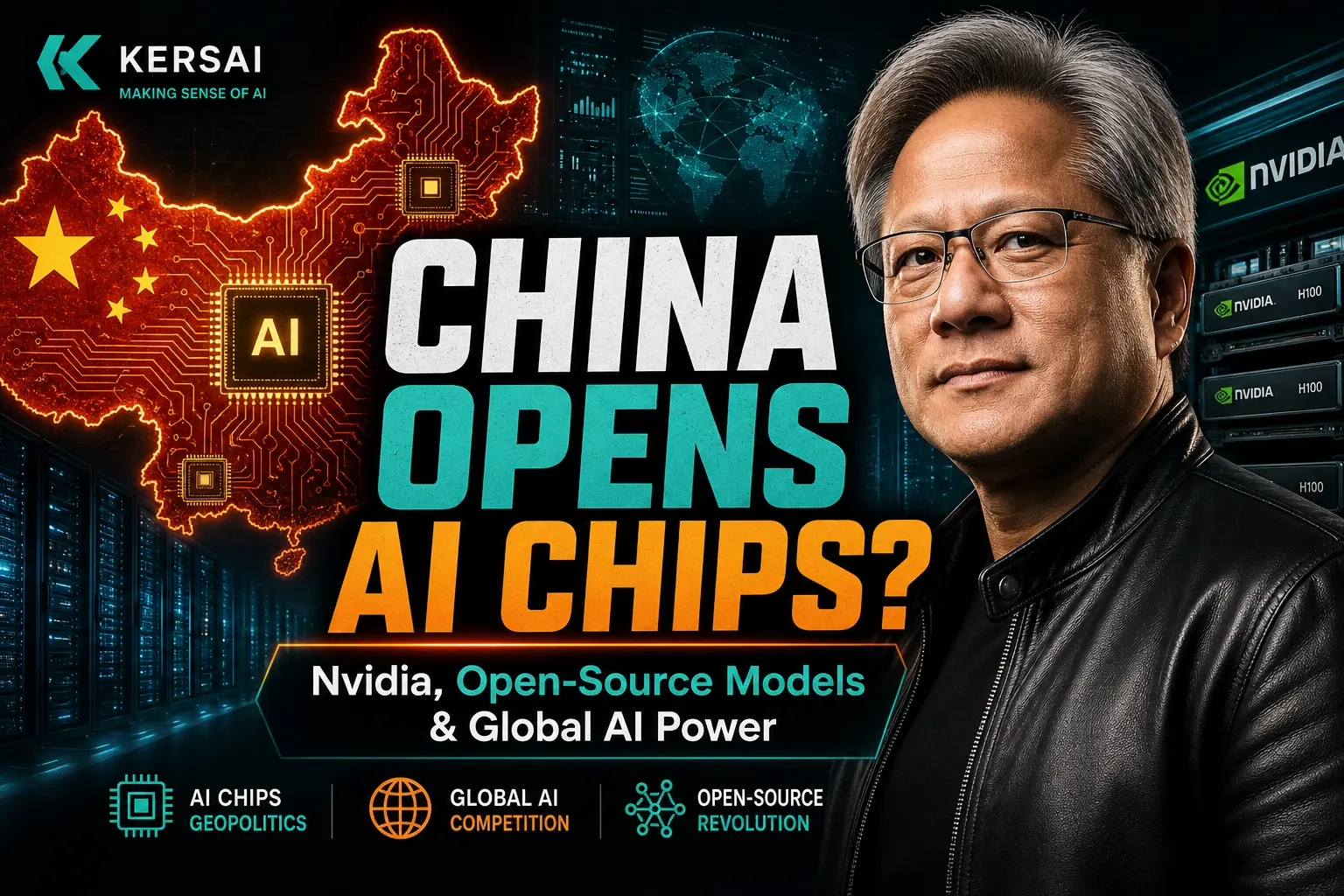
China’s AI Chip Window Just Opened: What Nvidia’s Return Means for Businesses, AI Users, and Open-Source Models in 2026
Published: May 19, 2026 By: Kersai Research Team
Category: AI Strategy / Enterprise AI / Open-Source AI / Semiconductors
Why This Matters More Than Just Nvidia
When Nvidia CEO Jensen Huang says China will eventually open its market to AI chips from the United States, it is easy to read that as a narrow semiconductor headline. It is not. It is a signal that one of the most important bottlenecks in global AI may be loosening, even if only partially.
That matters because AI chips are no longer just a hardware story. They sit underneath almost every important conversation in artificial intelligence today: who gets access to the best models, who can afford to train them, who can deploy them at scale, which countries shape the next generation of AI products, and whether powerful AI remains concentrated in a few US companies or becomes more widely distributed across the world.
For businesses, developers, founders, and everyday AI users, this is where the story gets interesting. If China gains broader access to US AI chips again, the impact is unlikely to stop at Nvidia’s revenue. It could influence global AI pricing, accelerate model releases, increase competition with US labs, strengthen China’s open-source ecosystem, and help make advanced AI more accessible to companies and users outside the current top-tier winners.
That is why this topic has much more traffic potential than a simple “Nvidia returns to China” headline. People searching for answers are not only looking for stock-market commentary. They want to know what happens next. Will AI tools get cheaper? Will open-source models improve? Will Chinese AI companies move faster? Will businesses get more choice? Will the global AI race become more competitive?
Those are the questions that matter. And they are exactly the questions this article answers.
What Actually Happened
The latest trigger for this conversation came from Bloomberg reporting that Jensen Huang believes China will open its market to AI chips from US suppliers over time. That statement followed a period of shifting policy, business lobbying, and renewed negotiations over technology access between the United States and China.
This does not mean every export barrier has disappeared, and it does not mean China suddenly has unrestricted access to Nvidia’s absolute best chips. The more realistic interpretation is that the market may be moving toward a controlled reopening, where certain classes of US AI chips become available under licenses or political agreements while the very top frontier systems remain more tightly restricted.
That distinction is important. A partial reopening is still a major shift. China does not need unrestricted access to the most extreme frontier chips to make a meaningful leap in AI capability. Even slightly older or lower-tier AI accelerators are powerful enough to support a huge amount of training, fine-tuning, inference, enterprise deployment, and model experimentation.
In other words, if the door opens even a little, the effects could be large.
Why This Matters for AI Businesses
Businesses should care because AI infrastructure shapes the economics of almost everything built on top of it.
When chip access expands, several things usually happen at once. Supply pressure eases. Training and inference capacity grows. More companies can compete. Cloud providers can plan more aggressively. AI labs can train or serve models faster. Startups get more room to experiment. And software businesses that rely on AI APIs or open models may eventually benefit from lower costs and broader model choice.
This is especially relevant in 2026 because the AI market has been dealing with multiple overlapping constraints: chip shortages, data centre power limitations, geopolitical friction, and a concentration of AI capability inside a relatively small number of US companies. Any development that reduces one of those constraints can ripple throughout the whole ecosystem.
A partially reopened China market could do that in several ways.
1. More competition in AI infrastructure
If Nvidia can sell more AI chips into China again, Chinese cloud companies, AI labs, manufacturers, and enterprise buyers get more options. That increases competitive pressure not just inside China, but globally.
Why? Because China is not a small side market. It is one of the world’s biggest technology ecosystems, with large domestic clouds, major e-commerce groups, fast-moving model labs, and a huge developer base. When that ecosystem has access to stronger infrastructure, it can produce more products, more model variants, more fine-tuned systems, and more competitors for US-led AI services.
More competition at the infrastructure layer can eventually create more competition at the model and application layer. That matters for every business choosing AI vendors in 2026.
2. Faster progress in open-source and open-weight AI
This may be the most important angle for traffic and reader interest.
A lot of people using AI today do not actually care which company makes the chips. They care whether better models become available to them. They care whether open-source or open-weight AI keeps getting stronger. They care whether they can run powerful models at lower cost, fine-tune them, self-host them, or use them without being locked into a single US provider.
If Chinese AI companies and research groups gain broader access to Nvidia-class compute, there is a real chance we see a faster cadence of open-weight model releases, stronger multilingual systems, more competition in small and medium-sized reasoning models, and more commercially useful alternatives to the current US-dominated model stack.
China has already shown it can move quickly in this direction. Even under constraint, Chinese labs have produced increasingly capable models across coding, reasoning, multimodal tasks, and enterprise use cases. With better chip access, that process could accelerate.
For businesses and developers, that means more open-weight choices, faster improvement cycles, and potentially a healthier market than one dominated by only a handful of frontier labs.
3. AI becomes more accessible outside the current winners
One of the biggest frustrations in AI today is concentration.
The most powerful systems are often controlled by a small number of well-funded US players. The best infrastructure is expensive. The best models are often API-gated. The compute needed to compete at the frontier remains inaccessible to most startups, regional labs, universities, and mid-market businesses.
A China reopening does not magically solve that problem. But it could help weaken the current concentration pattern.
Why? Because when more large-scale ecosystems can legally access stronger chips, more AI gets built outside the handful of incumbents already dominating the market. That increases the number of serious model providers, hosting options, cloud partnerships, developer tools, enterprise solutions, and eventually consumer products.
This is one of the most important strategic reasons the news matters. It is not only about China. It is about whether advanced AI remains mostly a US hyperscaler product or becomes a broader global capability.
4. Pricing pressure could shift over time
No one should promise immediate price drops. The AI market is too complex for that, and infrastructure demand remains extremely high.
But over time, more chip availability and more serious model competition can influence pricing in several ways:
- More providers training and serving models creates alternatives.
- More alternatives reduce dependence on a few premium APIs.
- More open-weight releases put pressure on fully closed offerings.
- More cloud and infrastructure competition can improve availability and bargaining power.
Even if the first impact is not cheaper AI for everyone tomorrow, the medium-term direction could still be positive for buyers. Businesses do not need an overnight collapse in costs to benefit. They only need more choice, more negotiating leverage, and more viable substitutes.
Why This Could Supercharge China’s AI Ecosystem
For years, export controls shaped the debate around whether China could keep pace in advanced AI. The common assumption was that chip restrictions would slow the ecosystem enough to preserve a US lead.
That may still be true at the absolute frontier. But that is not the same as stopping meaningful AI progress.
China already has the ingredients for fast AI expansion: massive internal demand, cloud infrastructure, digital platforms, manufacturing depth, large datasets, strong engineering talent, and major domestic technology firms willing to invest aggressively. If that ecosystem gets even partial access to stronger US chips again, it gains a powerful multiplier.
This could influence several areas:
- Foundation models: More compute means faster training cycles and more experimentation.
- Open-weight models: More labs can release capable alternatives for global developers.
- Multimodal AI: Better infrastructure supports stronger video, audio, and vision systems.
- Enterprise AI: Chinese software and cloud vendors can build more competitive business tools.
- Edge AI and robotics: More efficient model development supports products beyond chatbots.
For readers searching high-intent questions like “how China AI chips affect open source models,” “will AI get cheaper,” or “what Nvidia China means for business,” this is where the value is. The story is about capability multiplication.
Could This Lead to Better Open-Source Models?
Yes, that is one of the strongest possibilities, although it should be phrased carefully.
Not every new chip shipment turns into an open-source breakthrough. Some of the gains will stay inside companies. Some will support private enterprise deployment. Some will go toward domestic competitive advantage rather than global release.
But in broad terms, greater compute access tends to improve the conditions for better open-weight model development.
That happens because:
- More training and fine-tuning becomes possible.
- Smaller labs and specialist teams can do more serious work.
- Model iteration speeds up.
- Distillation and optimisation get better.
- Local champions have more room to challenge frontier incumbents.
For businesses using AI, this matters a lot. Better open-weight models are one of the clearest ways to reduce dependence on expensive closed APIs. They support private deployments, industry-specific fine-tuning, regional compliance strategies, and lower-cost experimentation.
For everyday users, the impact may show up more gradually. Better open models can eventually power cheaper tools, smarter assistants, more local AI features, better multilingual systems, and more AI products outside the current mainstream ecosystems.
So yes, the connection you suggested makes sense. China getting broader chip access could help improve the global open-weight model landscape. That is not guaranteed, but it is one of the most plausible and important downstream effects.
What This Means for Businesses Using AI Right Now
If you run a business and use AI already, this story matters even if you never buy a single chip.
More vendor choice
A more competitive global AI ecosystem gives businesses more options beyond the current default US providers. That matters for pricing, performance, regional fit, and negotiation leverage.
Better open-weight alternatives
Companies that want to avoid full dependence on premium API pricing may benefit from stronger open-weight models over the next 12 to 24 months.
Stronger multilingual and regional AI
China-based labs often build for huge multilingual and non-Western user bases. If their models keep improving, businesses may gain better tools for Asian markets, localisation, support automation, and international knowledge work.
More pressure on US leaders
More serious competition can be healthy for buyers. It can push the biggest AI firms to improve quality, pricing, access, and product speed.
New strategy questions for enterprise teams
At the same time, this is not just upside. Businesses should also think about:
- geopolitics and compliance,
- data sovereignty,
- supply chain exposure,
- vendor concentration,
- and how to design an AI stack that stays flexible if regulations shift again.
That last point is crucial. This is a positive opening, but it is still occurring inside a volatile geopolitical environment. Smart businesses should respond with more optionality, not more complacency.
What It Means for Everyday AI Users
For consumers, freelancers, creators, solo founders, and developers, the implications are easier to understand.
If more compute flows into a major AI ecosystem like China’s, you usually get more products, more competition, and more experimentation. Over time that can mean:
- more AI tools,
- cheaper AI features,
- stronger local and multilingual experiences,
- more open models available to download or build with,
- and less dependence on a small set of closed platforms.
This is why the story has broad interest beyond finance readers. It touches the future accessibility of AI itself.
A lot of people are tired of hearing that the future of AI belongs only to trillion-dollar companies and a few elite labs. News like this hints at a different possibility: a world where more ecosystems can build, train, release, and compete.
That possibility is exactly what makes the topic so compelling.
The Risks: Why This Is Not a Simple Victory Story
A good traffic article should still be honest. This is not a clean, one-direction story.
Several risks remain.
Policy can reverse again
US-China tech policy can change quickly. A partial reopening today does not guarantee stable access tomorrow.
The best chips may still stay restricted
China may gain access to highly capable chips without getting the absolute top frontier hardware. That still matters, but readers should understand the difference.
More competition can intensify geopolitical tension
If China’s AI capabilities accelerate quickly, that could trigger new policy responses, tighter rules, or new efforts to ringfence key technologies.
Open-weight does not always mean open access for everyone
Even if stronger models emerge, licensing, hosting, and commercial use rules may still limit how freely businesses can adopt them.
So while the upside is real, smart readers should treat this as a shift in the global AI balance, not the end of the hardware war.
The Kersai View: Why This Matters for AI Strategy
From a Kersai perspective, the most important lesson is not “Nvidia wins.” It is that AI strategy is becoming more global, more competitive, and less predictable.
Businesses that still think AI platform choices are only about whichever US model is best this month are missing the bigger shift. The next phase of AI will be shaped by infrastructure access, open-weight competition, regional ecosystems, regulation, and the growing gap between companies that build flexible AI stacks and companies that lock themselves into one narrow path.
This news reinforces three ideas Kersai believes matter in 2026:
- AI competition is broadening. More regions and ecosystems will shape the future of models and tools.
- Open-weight AI matters more than ever. Businesses need alternatives to a fully closed, high-cost AI stack.
- Optionality is strategy. The smartest AI roadmaps are vendor-aware, geopolitically informed, and flexible by design.
That is where Kersai can help.
Kersai works with businesses to understand where AI markets are moving, which model ecosystems matter, how to balance closed and open-weight AI, and how to design an AI roadmap that is future-ready rather than hype-driven.
For companies building AI-enabled products, choosing enterprise AI platforms, or rethinking international AI strategy, this is no longer background news. It is a planning signal.
Final Thought
China reopening its market to US AI chips would not just be a win for Nvidia. It could reshape the economics and accessibility of AI more broadly.
It could strengthen competition, accelerate model development, improve the odds of better open-weight systems, and give businesses and users more options beyond the current concentration of power inside a few dominant players.
That is why this story matters. Not because it is another semiconductor headline, but because it may influence who gets to build the next generation of AI, who gets access to it, and whether the future of AI becomes more open, more competitive, and more useful for everyone.
In 2026, that is exactly the kind of shift businesses and AI users should be watching.
FAQ: China, Nvidia, AI Chips and Open-Source Models in 2026
Will China really get full access to US AI chips again?
Probably not in the short term. The more realistic scenario is controlled access to certain classes of powerful, but not absolute frontier, AI chips. That is still a big deal. Even one generation behind the very latest hardware is more than enough for serious AI training, fine-tuning and enterprise deployment.
Does this mean AI will get cheaper for everyone?
Not immediately. Chip access is only one part of the cost equation, and global demand for AI compute is still exploding. Over time, though, more supply and more competition usually push markets toward better pricing, more flexible options and more negotiating power for buyers.
How could this help open-source and open-weight AI models?
Stronger access to compute makes it easier for more labs to train and iterate on models. That includes foundation models, distilled systems and specialised open-weight models. If Chinese labs and ecosystems can train more and better models, there is a good chance that some of that progress shows up in stronger open-weight releases the rest of the world can build on.
Will this reduce the dominance of US AI companies?
It will not remove US leadership, but it could rebalance things. If China’s AI ecosystem gets more capable hardware, local companies can move faster and compete harder. That means more global model providers, more tools and more AI products built outside the current US hyperscaler circle. For businesses and users, that is usually positive.
Should businesses start moving their AI stack to Chinese providers?
Not blindly. This is where strategy and governance matter. Businesses need to weigh opportunities against regulatory requirements, data sovereignty, security, compliance and geopolitics. For some companies and regions, Chinese AI platforms may become attractive options. For others, they will remain secondary or off-limits. The key is to design a stack that can adapt, not to jump from one form of lock-in to another.
What does this mean for companies that already use US AI platforms?
It is a signal to revisit assumptions, not a reason to panic. Existing investments in US platforms remain valuable. The main change is that the medium-term landscape may become more competitive and more multi-polar. That can influence pricing, roadmap expectations, risk planning and how you think about diversification.
How should startups and smaller businesses think about this?
For smaller teams, the most important impact is likely indirect: more models, more tools and more open-weight options over the next few years. Rather than tracking every policy move, startups should watch for new model releases, new hosting options and new open-weight stacks that might lower costs or reduce dependency on a single vendor.
Is this good or bad for AI safety?
It is both an opportunity and a challenge. More competition and more distributed capability can reduce concentration of power, which many people see as positive. At the same time, more powerful AI across more jurisdictions can complicate coordination, oversight and safety standards. That is why companies need clear internal governance, regardless of which models they use.
What is the smartest move for a CIO right now?
Do not rebuild your stack based on one headline. Instead, treat this as a strong signal that the AI hardware and model market is becoming more global and more complex. The smart move is to:
- avoid single-vendor lock-in,
- keep room in your roadmap for open-weight models,
- and design your AI platform so it can incorporate new ecosystems as they mature.
Where does Kersai fit into this picture?
Kersai helps businesses navigate exactly these kinds of shifts. We work with CIOs, CTOs and founders to:
- understand how changes in AI chips and geopolitics affect their AI options,
- design hybrid stacks that balance closed and open-weight models,
- and build AI roadmaps that can survive policy changes, cost swings and new competition.
If your AI plans span multiple regions, vendors or regulatory environments, this is not just news it is a set of design constraints. That is where a deliberate, model-agnostic strategy matters most.
This article was researched and written by the Kersai Research Team. Kersai helps organisations design practical AI infrastructure strategies, from model selection and compute planning to multi‑cloud deployments and governance visit kersai.com.