

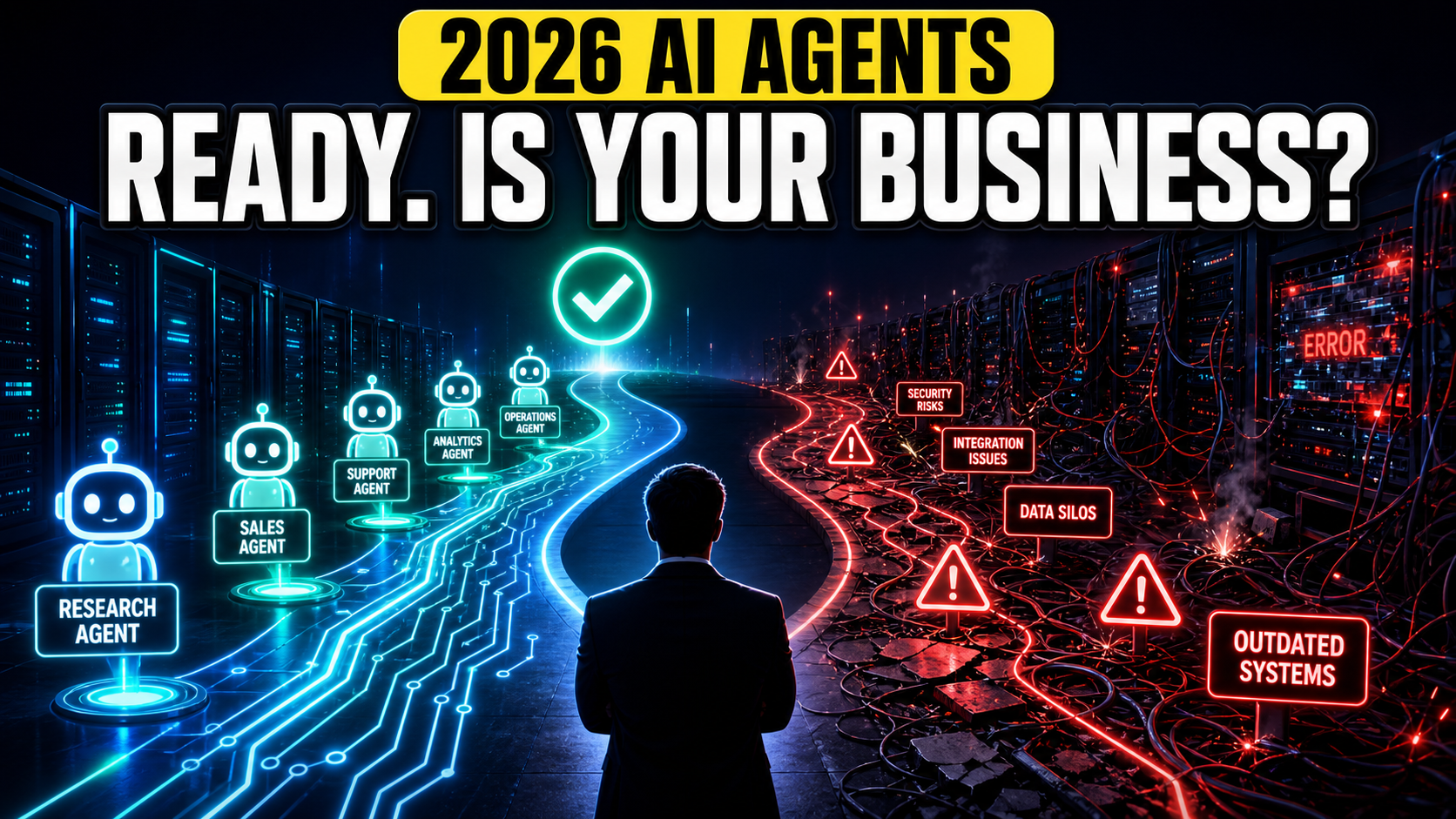
AI Agents Are Ready in 2026. Your Infrastructure and Business Model Probably Aren’t.
Published: 11 May 2026 By: Kersai Research Team
Category: AI Strategy / Agentic AI / Business Growth
Quick Summary
AI agents are moving out of the demo phase and into real business environments in 2026. They are getting easier to build, more capable at handling multi-step work and more visible in sales, support, operations and internal productivity workflows.
But there is a growing gap between what AI agents can do in a prototype and what businesses are actually ready to deploy safely, economically and at scale. That gap is no longer mainly about model quality. It is about infrastructure, orchestration, governance, data quality and business design.
This matters because more businesses are now trying to move from “we tested an agent” to “we rely on agents inside the business.” And that is a very different level of maturity.
If 2024 was the year of AI curiosity and 2025 was the year of AI pilots, 2026 is becoming the year of AI operational reality. The winners will not just be the businesses with the smartest agents. They will be the ones with the cleanest data, the strongest workflows, the clearest governance and the most realistic commercial models.
AI Agents Are Ready in 2026
For the last two years, AI agents have lived in a strange place in the market.
They were exciting enough to dominate headlines, technical demos and investor decks, but still immature enough that many business leaders could treat them as something experimental. Interesting, promising, worth exploring but not yet central to how the business actually ran.
That comfort zone is disappearing in 2026.
AI agents are no longer just clever prototypes. They are increasingly being positioned as the next software layer for business. They can answer questions, call tools, navigate systems, trigger workflows, summarise decisions, pass work between functions and execute multi-step tasks with increasingly limited human input.
That is the good news.
The harder truth is that most businesses are not ready for what that actually means.
The challenge in 2026 is no longer, “Can an AI agent do something useful in a sandbox?” In many cases, the answer is clearly yes. The real question is, “Can the business support AI agents as a reliable, secure, governed and commercially viable operating layer?”
For most organisations, the answer is still no.
That is why this matters so much right now. The new divide in AI is not simply between companies that use AI and companies that do not. It is between companies that can operationalise AI agents and companies that are still confusing demonstrations with deployment.
The Big Shift: From AI Feature to AI Operating Layer
One of the most important shifts happening in 2026 is that AI is moving from being treated as a feature to being treated as an operating layer.
A feature is something you add. An operating layer is something the business starts to depend on.
That distinction matters.
When an organisation adds a chatbot to a website, the risk is relatively contained. When it deploys agents that interact with customer records, update internal systems, trigger workflows, escalate cases, support sales follow-up or coordinate tasks between platforms, AI is no longer sitting at the edge of the business. It is moving into the middle of it.
That is why infrastructure suddenly matters so much more than the average business leader expects.
In a demo, the agent looks like the product. In reality, the agent is just the visible layer sitting on top of a much deeper stack: APIs, identity systems, access controls, data pipelines, workflow logic, orchestration tools, monitoring, logging, cost controls and governance frameworks.
If that stack is weak, the agent will be weak too.
And if that stack is missing entirely, the agent may still look impressive in a proof of concept while being completely unsuitable for production.
Why Search Intent Around AI Agents Is Rising So Fast
This topic is not just interesting from a technology perspective. It has strong search and business intent because the market has clearly moved from abstract curiosity to practical concern.
Business leaders are no longer only asking, “What is an AI agent?” They are asking more urgent, commercially loaded questions:
- How many AI agents should a business actually deploy?
- What infrastructure is needed before agents can be trusted?
- Why do agents work in demos but fail in production?
- How much do AI agents really cost when orchestration, data and integration are included?
- What is the difference between a chatbot, a copilot and a real agent?
- How can a smaller business use agents without creating chaos?
Those are high-intent questions. They sit close to budget, implementation and operational change. That makes them especially valuable for search, GEO and AEO because users asking them are much closer to decision-making than people reading general AI trend pieces.
The Agent Hype Is Real But So Is the Infrastructure Gap
There is no question that agent adoption is accelerating.
Industry reports and enterprise commentary suggest that many organisations are already running multiple AI agents in production or near-production environments. Some reports indicate the average enterprise is now running around 12 agents, with that number expected to rise quickly over the next 12 to 18 months.
That sounds impressive. But the more important statistic is not how many agents companies are running. It is how well coordinated, governed and integrated those agents actually are.
A business can have a dozen agents and still have no real agent strategy.
That is because many early deployments happen in silos. Sales experiments with one system. Customer service trials another. Operations adds a third. Marketing uses a fourth. None of them share context properly. None are governed in a consistent way. Costs are fragmented. Logging is incomplete. Human handoff is unclear. And no one really knows where the system boundaries are.
In other words, the problem is not a shortage of agents. It is a shortage of architecture.
Table: Chatbot vs Copilot vs Agent vs Agentic Operating Layer
| Category | What it does | Business value | Main risk |
|---|---|---|---|
| Chatbot | Answers prompts and FAQs | Simple self-service and information access | Hallucinations, shallow usefulness |
| Copilot | Assists a human inside a tool or workflow | Productivity improvement and faster task completion | Poor adoption, limited measurable ROI |
| Agent | Executes multi-step tasks using tools and data | Workflow acceleration and partial automation | Governance, orchestration and reliability issues |
| Agentic operating layer | Multiple agents interact across systems, workflows and decisions | Operating leverage across the business | Infrastructure fragility, cost sprawl, control risk |
Why Infrastructure Is Now the Constraint, Not Intelligence
For a while, the central question in AI was intelligence. Could the model reason? Could it write? Could it summarise? Could it code?
That question still matters, but it is no longer the bottleneck for many businesses.
In 2026, the more urgent problem is whether the environment around the model is strong enough to support production use.
That includes:
- Clean, accessible and permissioned data
- Stable APIs and systems integration
- Identity and access management
- Logging and observability
- Human handoff paths
- Cost monitoring and usage controls
- Policy enforcement and governance
- Runtime orchestration and failure handling
This is why the infrastructure conversation is becoming so central. Businesses are discovering that they can spin up an agent much faster than they can build the conditions required to trust it.
And if the business cannot trust it, it cannot scale it.
This creates a painful mismatch. Leaders see the agent work in a demo and assume deployment is near. The technical and operational teams know that the real work is just beginning.
What Business Owners Think They Are Buying vs What They Are Actually Building
This is where many businesses get caught.
From the outside, buying into agentic AI can look simple. A founder or executive sees a product demo and assumes they are buying a smarter piece of software.
In reality, they are often starting to build a miniature operating system for a new kind of digital labour.
That means they are not just buying:
- A model
- A chatbot interface
- A workflow assistant
They are actually building:
- A system that needs reliable access to business data
- A layer that makes decisions or recommendations
- A workflow actor that touches real operations
- A source of new cost patterns and risk patterns
- A process that may alter team roles and accountability
That is a much bigger commitment than most leaders realise when they first hear the phrase “AI agent.”
Table: What Businesses Think They’re Buying vs What They’re Really Building
| What it looks like | What it actually is |
|---|---|
| A productivity tool | A workflow redesign project |
| A smart assistant | A governed decision-support layer |
| A chatbot upgrade | A multi-system orchestration challenge |
| A low-cost experiment | A new cost model with scale implications |
| A quick win | A capability that changes team roles and controls |
The Five Readiness Gaps That Decide Whether Agents Work
Most businesses that struggle with agents do not fail because the agent is “not smart enough.” They fail because one or more readiness gaps were ignored.
1. Infrastructure readiness
Can the agent access the right systems reliably? Are APIs stable? Is latency manageable? Can identity and permissions be handled properly? Is there enough visibility into what the agent is doing when something goes wrong?
Without infrastructure readiness, every agent remains fragile no matter how impressive its output seems.
2. Data readiness
Does the business have clean, current and accessible data? Or is the agent being asked to operate on fragmented, inconsistent or context-poor information?
Bad data does not just create bad answers. It creates operational mistrust, which kills adoption quickly.
3. Workflow readiness
Is the workflow itself well understood? Has the business mapped where the agent adds value, where humans stay in the loop and how exceptions are handled?
Dropping an agent into a broken workflow usually just produces a faster broken workflow.
4. Governance readiness
Who approved the use case? Who owns the risk? What is logged? What happens if the agent fails, acts outside its scope or exposes sensitive information?
In 2026, agentic AI without governance is not innovation. It is unmanaged exposure.
5. Commercial readiness
Does the business actually know how value will be created and measured? Is the agent reducing cost, increasing throughput, improving conversion, lifting retention or reducing service burden?
If there is no clear commercial logic, the agent is just another experiment searching for a budget justification.
A Practical Readiness Checklist for Founders and Executives
Before deploying or scaling an AI agent, business owners should be able to answer these questions clearly:
- What exact business outcome is this agent meant to improve?
- What systems and data does it need access to?
- What decisions can it make on its own and what requires human approval?
- How will failures, exceptions or unsafe actions be caught?
- What does success look like in 30, 60 and 90 days?
- What is the full cost of operation, not just the software subscription?
- Who owns the agent once it is live?
If those questions cannot be answered confidently, the business is not ready to scale agents yet.
That does not mean it should stop exploring. It means it should stop pretending exploration and deployment are the same thing.
Where Small Teams and Growing Businesses Can Win With Agents
This does not mean AI agents are only for large enterprises. In fact, small and mid-sized businesses may benefit disproportionately if they deploy agents with discipline.
The best early wins tend to come from areas where workflows are repetitive, data is structured enough to be useful and the business can clearly measure improvement.
Examples include:
- Customer support triage and response drafting
- Lead qualification and follow-up workflows
- Internal reporting and dashboard generation
- Proposal assembly and administrative coordination
- Knowledge retrieval for sales, operations or client service teams
In these cases, agents can help smaller teams behave like larger teams without immediately increasing headcount.
But the same rule still applies: the businesses that win are not the ones with the flashiest agent demo. They are the ones that understand the workflow, control the data, measure outcomes and keep a human in the right part of the loop.
Why Business Model Readiness Matters as Much as Technical Readiness
One of the least discussed aspects of agentic AI is business model readiness.
A company may be technically capable of deploying agents and still not be strategically ready for them.
Why? Because agents do not just change tasks. They change unit economics, service models and organisational design.
For example:
- If agents reduce response times, will that increase demand in a way the rest of the business cannot handle?
- If agents lower operating cost, will the company reinvest that margin or simply absorb it?
- If agents make a premium service cheaper to deliver, does pricing need to change?
- If internal teams rely on agents for coordination, who becomes accountable when something is missed?
These are business model questions, not merely IT questions.
That is why the best executive conversations around agents in 2026 are not just about tooling. They are about operating design.
The Real Risk: Confusing Speed of Build With Readiness to Scale
One reason so many businesses are at risk in 2026 is that the speed of building an agent has collapsed.
What used to take months can now be assembled in days or weeks. That creates the illusion that the hard part is over once the agent “works.”
But in most real businesses, the opposite is true.
The faster the prototype can be built, the more discipline is needed around whether it should be scaled.
That is the trap. Low-friction creation encourages high-friction consequences later if governance, cost controls, workflow design and ownership are not in place from the beginning.
This is why so many agent initiatives may fail, not because the technology is bad, but because the business mistakes ease of creation for operational maturity.
What Smart Businesses Will Do Next
The organisations that use AI agents well in 2026 are unlikely to be the ones chasing the most hype. They will be the ones that do five things well:
- Start with one high-value workflow, not ten disconnected agent experiments.
- Build strong data and systems access before promising automation outcomes.
- Treat governance and observability as part of the product, not a post-launch fix.
- Keep humans in the loop where trust, exceptions and accountability matter.
- Measure value in business terms such as time saved, cost reduced, revenue influenced or service quality improved.
This is not a conservative approach. It is the fastest path to real value.
How Kersai Helps Businesses Become Agent-Ready
This is exactly where most businesses need help.
Not because AI agents are impossible to use, but because the difference between a useful deployment and a costly mess often depends on the design decisions made before the first agent goes live.
Kersai helps businesses become agent-ready in a way that is practical, commercially grounded and secure.
That includes helping teams:
- Identify where agents genuinely create leverage and where they are just hype
- Map the workflows, data sources and integration points required for success
- Design governance, approval and exception paths
- Build a realistic view of cost, infrastructure and scaling needs
- Create implementation plans that support both fast wins and long-term control
For founders, business owners and executives, the goal is not to “do AI agents” because the market says to. The goal is to deploy AI in a way that strengthens the business instead of creating hidden fragility.
Book a Free Call
If your business is exploring AI agents and you want a clearer view of what readiness actually looks like, Kersai can help.
A free strategy call can help you assess:
- Whether your current workflows are suitable for agent deployment
- What infrastructure and data gaps need to be addressed first
- Where agents can create measurable ROI fastest
- How to avoid governance, cost and integration mistakes early
Key Takeaways
- AI agents in 2026 are ready for serious business use, but most businesses are not yet ready to scale them safely or economically.
- The main constraint is no longer raw model intelligence. It is infrastructure, data, orchestration, governance and business design.
- A business can run many agents and still have no coherent agent strategy.
- The biggest risk for founders and executives is confusing fast prototyping with genuine production readiness.
- Small and mid-sized businesses can win with agents if they focus on well-defined workflows and measurable outcomes.
- The organisations that benefit most from agentic AI will be the ones that treat readiness as a business capability, not just a technical feature.
Frequently Asked Questions
Are AI agents worth it for small businesses in 2026?
Yes, if they are deployed against clear, high-value workflows such as support, lead qualification, internal reporting or operations coordination. They are far less effective when adopted as vague productivity experiments.
What is the difference between an AI chatbot and an AI agent?
A chatbot mainly answers prompts or questions. An AI agent can use tools, access systems, execute multi-step tasks and operate inside workflows with more autonomy.
Why do AI agents fail in production?
They usually fail because the surrounding business environment is not ready. Weak infrastructure, poor data quality, unclear workflows, limited governance and unclear ownership are more common causes than model weakness.
What does an AI agent need to work properly?
It needs access to the right systems and data, clear workflow boundaries, monitoring, governance, exception handling and a measurable commercial objective.
What should executives ask before deploying AI agents?
They should ask what specific business problem the agent solves, what systems it touches, how outcomes will be measured, what governance controls exist and who owns the result once it is live.
This article was researched and written by the Kersai Research Team. Kersai helps organisations design practical AI infrastructure strategies, from model selection and compute planning to multi‑cloud deployments and governance visit kersai.com.