

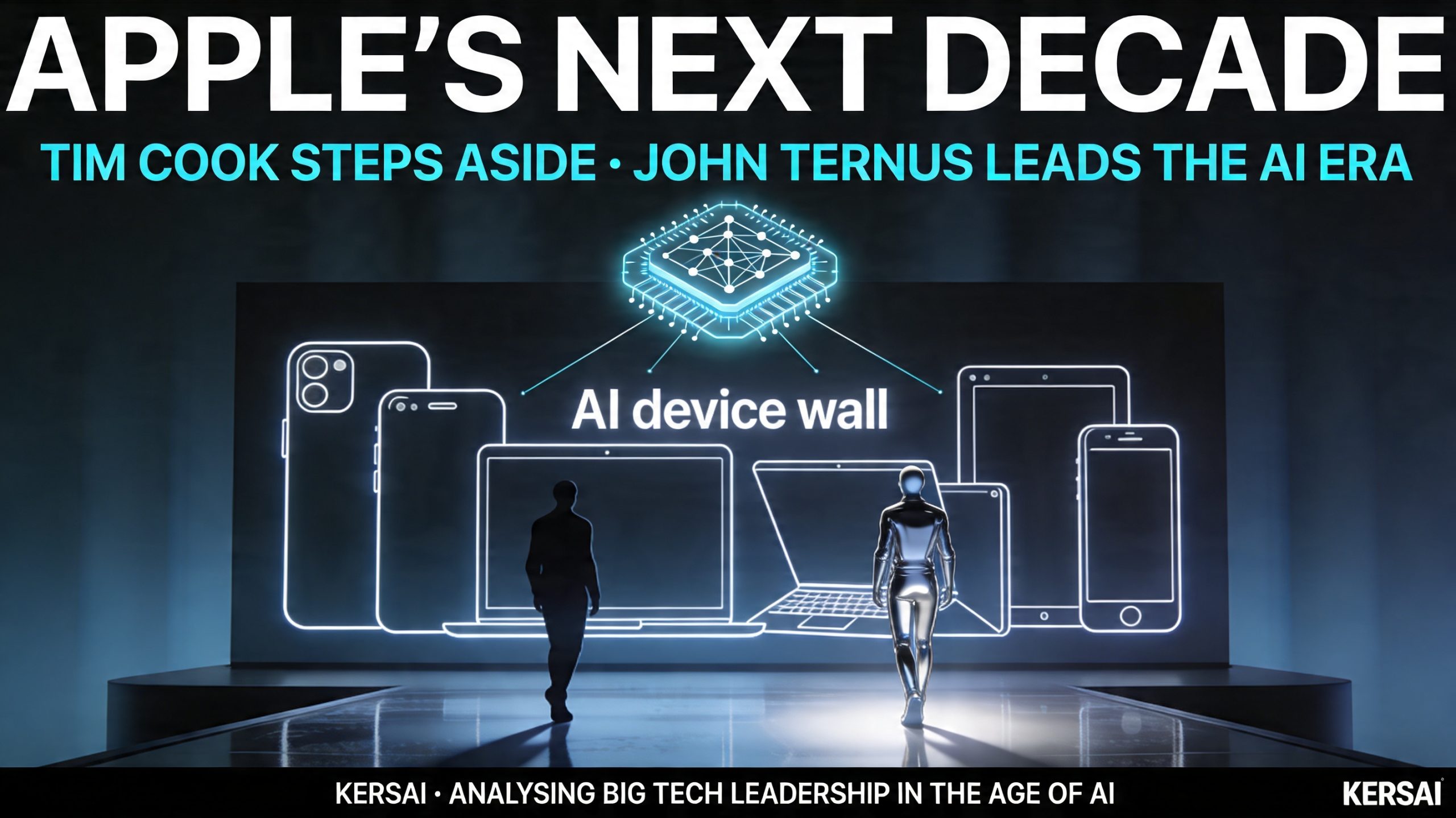
Tim Cook’s Exit and Apple’s AI Decade: Who John Ternus Is and What Happens Next
Tim Cook Is Stepping Aside as Apple CEO and Hardware Chief John Ternus Is Taking Over. At the Same Time, Apple Is Quietly Rewiring Its Entire AI Strategy. Here’s What It Means for Products, the Market and the Next 10 Years.
Published: April 21, 2026 | By the Kersai Research Team | Reading Time: ~20 minutes
Last Updated: April 21, 2026
In one sentence: Apple has confirmed that Tim Cook will step aside as CEO with hardware engineering chief John Ternus taking the role from September 2026, just as Apple’s AI push Gemini‑powered Siri, new AI leadership, M‑series AI chips and a foldable iPhone reaches a breaking point. This is not only a change of person at the top; it’s the start of a hardware‑driven AI decade for Apple.
1. The News: Tim Cook Is Stepping Aside, John Ternus Is Taking Over
Apple has officially announced that Tim Cook will step aside as CEO, with John Ternus taking over the role later this year.
Key facts:
- Cook will hand the CEO role to Ternus on a set date (early September 2026 has been reported), after Apple’s summer product cycle and its next major iPhone launch.
- Cook is expected to remain at Apple as Executive Chairman, providing continuity and board‑level leadership rather than day‑to‑day operational control.
- The change is framed as the culmination of a long‑term succession plan, not a sudden departure, with Cook signalling for months that Apple had a strong internal bench ready for the next chapter.
For markets, this ends years of speculation about who would follow Cook and it does so at a moment when Apple’s valuation and strategic pressures are both at historic highs.
2. Tim Cook’s Legacy: Operations, Services and Shareholder Value
Before looking ahead, it’s worth understanding the context of Cook’s era.
Since taking over from Steve Jobs in 2011, Tim Cook has:
- Turned Apple into a multi‑trillion‑dollar company, with one of the most consistent records of revenue and profit growth in corporate history.
- Re‑architected Apple around a combination of hardware, software and services, turning services into a major revenue pillar alongside iPhone, Mac, iPad and wearables.
- Built supply chains and operations that became case studies in efficiency, resilience and scale including navigating the pandemic and major geopolitical shocks.
- Overseen major product introductions and transitions, such as Apple Watch, AirPods, Apple Silicon and Vision Pro.
Critics argue that Apple has sometimes felt incremental under Cook iterating rather than radically reinventing and that the company was slow to show a clear AI narrative compared with OpenAI, Google and Microsoft. Supporters counter that Apple has been methodically laying the groundwork for an AI decade built on privacy, custom silicon and tightly integrated devices.
Either way, Cook is handing over a company that:
- Has enormous financial firepower.
- Sits on top of one of the largest active device bases in the world.
- Is under intense pressure to show what “Apple in the AI era” really looks like.
3. Who Is John Ternus?
3.1 Background and role inside Apple
John Ternus is not a Wall Street name, but inside Apple and the hardware world he is well known.
Highlights of his background:
- Joined Apple in 2001, working on the original iMac and early hardware products.
- Rose through the hardware organisation to become Senior Vice President of Hardware Engineering, reporting directly to Tim Cook.
- Has led hardware engineering for every iPad generation, many recent iPhones, AirPods, Apple Watch and the Mac lineup.
- Was one of the key executives behind the transition from Intel to Apple Silicon, including the M1, M2, M3 and M4 chip generations.
Public profiles describe him as a calm, collaborative engineering leader with deep credibility among Apple’s product teams. He has presented at several Apple keynotes, particularly for iPad and Mac introductions, but until now remained largely behind the scenes.
3.2 Why Apple chose a hardware engineer as CEO
Apple could have chosen:
- A services executive to double down on recurring revenue.
- A finance or operations leader to protect margins in a choppy macro environment.
- An external candidate with a visible AI or cloud background.
Instead, it chose a hardware engineer who has spent two decades shipping devices.
That choice sends a signal:
- Apple believes its next decade will be defined by AI‑centric hardware devices where on‑device models, custom silicon and tight vertical integration matter as much as, or more than, cloud AI.
- It wants a CEO who can make trade‑offs between power, performance, thermals, privacy and cost at the device level not only negotiate cloud contracts or ad deals.
- It expects to compete not just with other phones and PCs, but with AI hardware from companies like Microsoft, Google, Meta and specialised device makers.
If Tim Cook was the CEO of supply chains and services, John Ternus is poised to be the CEO of AI‑first devices.
4. Apple’s AI Reset: People, Partnerships and Chips
The leadership change is happening against the backdrop of a quiet but significant AI overhaul at Apple.
4.1 A new AI chief with Google and Microsoft experience
Apple has appointed Amar Subramanya a veteran of Google’s Gemini programme and Microsoft’s AI efforts as its new head of AI. He is responsible for:
- Apple’s internal foundation models.
- On‑device and cloud‑assisted AI experiences across iOS, macOS, iPadOS and watchOS.
- AI safety, evaluation and alignment policies inside Apple.
Subramanya’s background is important: he has deep experience building and deploying AI systems at companies that already ship large‑scale AI products. That experience now sits at the centre of Apple’s AI roadmap.
4.2 The Gemini deal and Siri’s transformation
Apple has signed a multi‑year deal with Google under which Gemini plays a central role in powering:
- A new, more conversational Siri.
- Parts of Apple’s “Apple Intelligence” stack across search, summaries, writing assistance and developer tools.
- Cloud‑assisted experiences that complement Apple’s on‑device models while respecting its privacy commitments.
The broad picture:
- Smaller and mid‑size models run on device on iPhone, iPad and Mac.
- For heavier queries, devices talk to Gemini‑class models via Apple’s Private Cloud Compute, which Apple frames as a privacy‑preserving intermediate layer.
- Over time, Apple may swap in more of its own models, but the Gemini partnership gives it a fast path to competitive AI experiences today.
4.3 M5 and the rise of AI Macs and AI iPads
Apple has also launched the M5 chip family as a major AI step:
- Higher‑throughput Neural Engines.
- AI‑optimised GPU blocks.
- Memory bandwidth and capacity designed to handle much larger on‑device models.
This powers:
- New MacBook Pro and MacBook Air models positioned as “AI laptops”, capable of running advanced models locally.
- A MacBook Neo line lower‑priced AI laptops aimed at the mass market that compete directly with AI PCs from Microsoft, Intel and Qualcomm.
- iPad Pro and future iPad models that act as AI‑capable tablets for creative and professional work.
Taken together new AI leadership, Gemini partnership, M‑series AI chips Apple’s AI story is finally visible: a hybrid of high‑performance on‑device AI and carefully controlled cloud AI, tightly coupled to hardware.
5. The Ternus Product Era: Foldable iPhone, AI Macs and New Devices
Leadership changes at Apple often line up with product shifts. Under John Ternus, several key products define the near term.
5.1 Foldable iPhone
Multiple reports point to Apple’s first foldable iPhone launching alongside the iPhone 18 family, around September 2026 right as Ternus steps into the CEO role.
Important details:
- The device is expected to be priced above the Pro line, positioning it as a halo product rather than a mass‑market iPhone on day one.
- It will likely showcase Apple’s hardware engineering strengths hinge design, durability, battery life and act as a showcase for AI‑assisted multitasking, camera features and new interface patterns.
- If successful, it could define a new form factor category for Apple in the same way as the original Plus and Pro lines.
The foldable iPhone gives Ternus a very visible product to put his mark on early.
5.2 AI‑centric Macs and MacBook Neo
Under Ternus, Apple is expanding its Mac portfolio into AI‑first territory:
- MacBook Pro and iMac models with M5 chips for professional AI workloads, creative production and development.
- A MacBook Neo line positioned as the entry point into AI PCs for students, small businesses and the mainstream.
- Deeper integration between macOS and AI features: on‑device assistants for coding, writing, mail triage, creative workflows and system automation.
The bigger strategic move: Apple is positioning itself as a top‑tier AI PC vendor without giving up its differentiation on battery life, thermals and industrial design.
5.3 New Siri experiences and potential devices
A more capable Siri, backed by Apple’s own models and Gemini, opens the door to:
- A much more useful assistant on existing devices.
- New voice‑first hardware for example, Siri‑centric home devices, or deeper Siri integration in AirPods and Apple Watch.
- Stronger AI integration in CarPlay and in‑car systems.
If Apple chooses to launch new Siri‑first hardware, it will likely happen under Ternus’s watch.
6. What This Means for the Market
6.1 For investors
Investors will focus on three questions:
- Can Ternus keep Apple’s margins and financial discipline?
Cook was a master of operations and margin management. Ternus will need to balance aggressive AI hardware bets with Apple’s long‑standing profitability expectations. - Will AI‑driven devices unlock a genuine upgrade cycle?
Foldables, AI Macs and AI‑powered iPads give Apple reasons to ask customers to upgrade especially if AI features are meaningfully better on new hardware. - Can Apple defend and grow services revenue in an AI world?
As AI assistants become primary entry points for content and transactions, Apple will need to ensure its services and App Store economics adapt rather than erode.
Short‑term volatility in the stock around the leadership change is likely. Longer‑term, the answer will depend on how quickly Apple turns its AI story into clear, differentiated products.
6.2 For developers
Developers will care about:
- On‑device model access what tools and frameworks Apple exposes for running custom models on M5 and future chips.
- Siri and app integration whether the new Siri APIs allow deeper, more reliable integration than previous approaches.
- Cross‑platform fragmentation how Apple’s AI capabilities compare to what developers can do with OpenAI, Anthropic, Google and open models.
If Apple provides strong APIs, dev tools and documentation, AI‑powered apps on Apple platforms could become significantly more powerful and privacy‑preserving than their web‑only equivalents.
6.3 For enterprises and IT
Enterprises thinking about device fleets will weigh:
- The value of on‑device AI (privacy, latency, offline capability) vs cloud AI.
- The total cost of ownership of M‑series AI Macs vs Windows AI PCs.
- Compliance implications of running AI workloads on Apple’s Private Cloud Compute and Gemini‑assisted features.
Ternus’s hardware background suggests that Apple will try to make AI‑first devices a clear, premium option for enterprise fleets especially in knowledge‑work and creative industries.
7. Risks and Unknowns
Several uncertainties remain:
- Regulatory pressure Apple faces scrutiny around app store rules, default search deals and now AI partnerships. How regulators treat the Gemini deal and Apple’s control over AI experiences will matter.
- Execution risk Combining hardware, proprietary models, Gemini and third‑party apps into coherent experiences is complex. Integration missteps could blunt the impact of new devices.
- Competitive intensity Microsoft is pushing hard with Windows AI PCs and Copilot; Google and Samsung are integrating Gemini directly into Android devices; other players are exploring new form factors and AI hardware.
Ternus and Subramanya inherit not just an opportunity, but a crowded field.
8. What Businesses Should Take Away From Apple’s Transition
For businesses outside Apple, the leadership change is still relevant. It signals that:
- The largest consumer tech company in the world is treating AI as a device‑level feature, not just a cloud service.
- There will be a growing class of AI‑capable devices (phones, laptops, tablets) where powerful models run locally.
- Integrations with Apple’s AI stack (Siri, Apple Intelligence, on‑device models) may become as important over the next five years as App Store presence was in the last decade.
If you build products, services or internal tools that touch Apple platforms, this is the time to:
- Understand where your customer journeys intersect with Apple’s AI features.
- Plan how your own AI capabilities complement or leverage Apple’s direction.
- Make sure your data, content and experiences are ready for AI‑centric discovery and usage on Apple devices.
9. FAQ
Why is Tim Cook stepping aside as Apple CEO now?
Tim Cook has been CEO since 2011 and has repeatedly indicated he would not stay in the role forever. After overseeing the transition to services, Apple Silicon and Vision Pro and with a clearly defined AI roadmap lining up Apple is implementing a long‑planned succession, with Cook moving into an Executive Chairman role and John Ternus taking over as CEO.
Who is John Ternus?
John Ternus is Apple’s Senior Vice President of Hardware Engineering and a long‑time Apple engineer. He joined Apple in 2001, has led hardware for iPad, iPhone, Mac, AirPods and other key products, and played a central role in the transition to Apple Silicon. He will become Apple’s next CEO, bringing a hardware and product engineering background to the top job.
What does this leadership change mean for Apple’s AI strategy?
The change happens just as Apple is putting a new AI chief in place, rolling out M‑series chips designed for AI, integrating Google’s Gemini into Siri and Apple Intelligence, and preparing AI‑first devices like AI Macs and a foldable iPhone. It suggests Apple plans to compete in AI through tightly integrated hardware and on‑device intelligence, not just cloud AI services.
What is Apple doing with Google Gemini?
Apple has signed a multi‑year partnership with Google under which Gemini powers parts of Siri and Apple’s broader intelligence features, especially for complex queries that go beyond what on‑device models can handle alone. Devices use a hybrid approach: smaller models on the device, and Gemini‑class models in Apple‑controlled cloud infrastructure for heavier tasks.
How will this affect Apple products I use today?
Over the next 1224 months, you can expect to see iPhones, Macs and iPads with more powerful on‑device AI features, deeper Siri integration, and new devices like AI‑focused Macs and potentially a foldable iPhone. Many of these features will work best on newer Apple Silicon hardware, which may influence upgrade decisions.
What should businesses and developers do now?
Businesses and developers should map where their products and internal tools touch Apple devices, evaluate how Apple’s on‑device AI and Siri evolution could change those touchpoints, and plan integrations accordingly. It’s also a good time to assess whether AI features in your own apps can run on‑device on Apple hardware, taking advantage of M‑series chips and future APIs.
10. How Kersai Can Help You Navigate Apple’s AI Decade
Apple’s leadership transition and AI reset are a useful signal for every company: the AI era will not just be about cloud APIs it will be about devices, chips, assistants and experiences that sit directly in front of your customers and employees.
Kersai helps organisations make sense of this shift and turn it into a practical advantage:
- Strategic mapping: Understanding how Apple’s AI direction Gemini‑assisted Siri, M‑series AI laptops, new devices intersects with your products, customer journeys and internal workflows.
- AI experience design: Designing features and flows that feel natural on Apple platforms, whether they run on device, in your own infrastructure or via external models.
- Implementation support: Working with your teams to integrate AI into apps, websites, content and internal tools, using the right mix of Apple’s capabilities, third‑party models and open‑source components.
- Change management and training: Helping product, marketing, engineering and leadership teams adopt AI safely and effectively, without losing sight of brand, compliance and long‑term maintainability.
If you want to turn Apple’s AI decade from a headline into a concrete advantage for your organisation, Kersai can help. Visit kersai.com to start a conversation.