

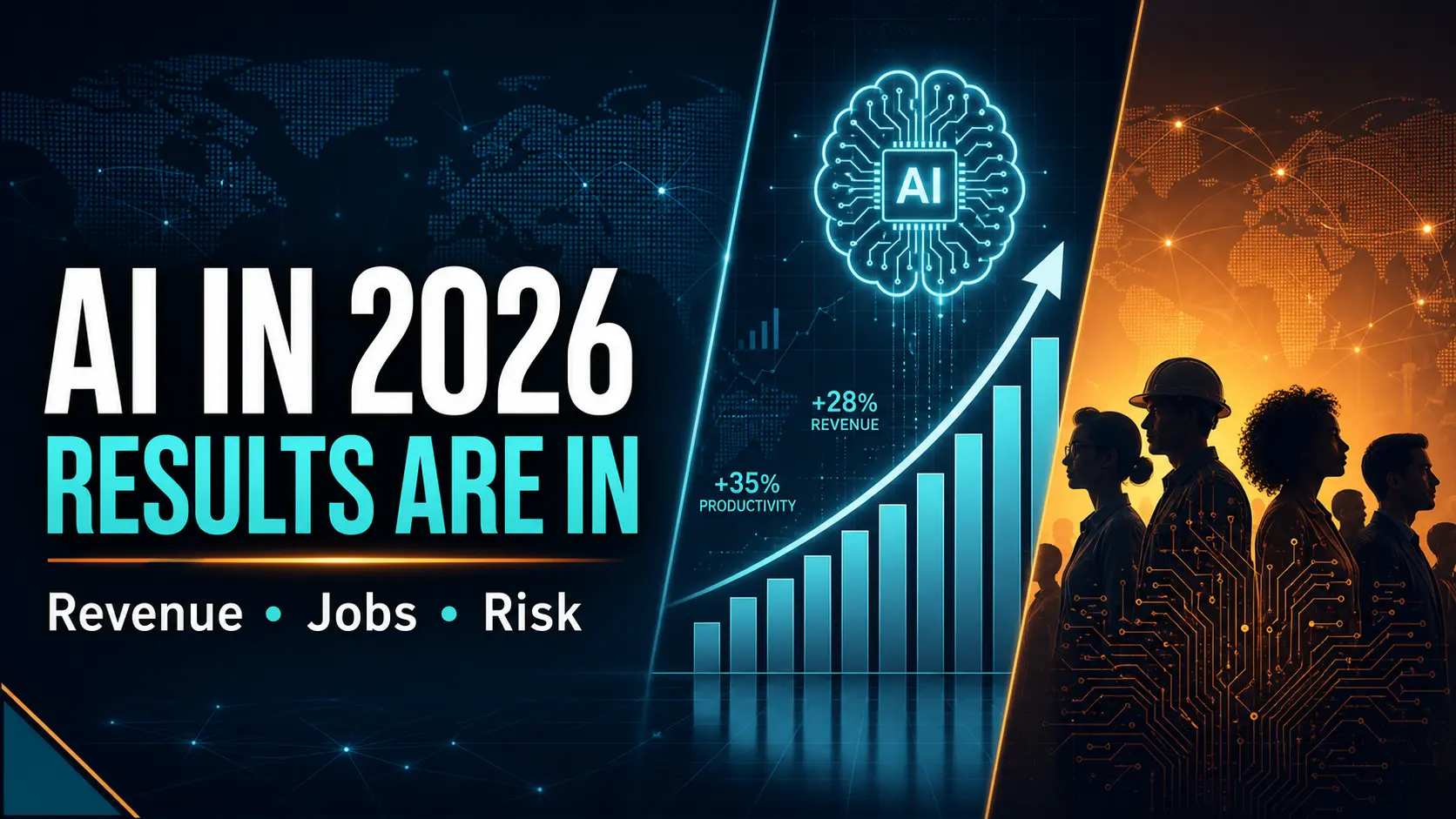
AI in 2026: Hype Is Over, Results Are In – How AI Is Really Impacting Revenue, Jobs and Risk (and What Businesses Should Do Next)
Published: June 1, 2026 By: Kersai Research Team
Category: AI Strategy / Enterprise AI / SME & Mid‑Market / Emerging Technology
Executive Summary: 2026 Is the Year AI Has to Prove Itself
For two years, AI has lived off hype. In 2026, it has to live off results.
The latest global surveys show that AI is no longer a toy or an experiment. A large majority of companies using AI say it has increased revenue, reduced costs and boosted productivity, and most plan to increase their AI budgets again this year. At the same time, leadership teams are facing a new reality: AI is reshaping jobs, pulling regulators into the conversation, stressing infrastructure and exposing gaps in governance and skills.
This guide is written for businesses that are already using AI or about to and want straight answers to three questions:
- Where is AI actually delivering value in 2026?
- What are the real risks around jobs, regulation and infra beyond clickbait?
- What should we do next so AI becomes a durable advantage, not just an expensive experiment?
1. The New Reality: AI Is Now a Business, Not a Demo
The question in 2023 was “Should we try AI?”
The question in 2026 is “Are we getting real value from it and at what cost?”
Several big signals all point in the same direction:
- Global enterprise surveys report that AI is now mainstream, with a majority of organisations actively using AI in operations, not just pilots.
- Around 88% of companies using AI say it has increased annual revenue in at least some parts of the business.
- Roughly the same proportion say AI has helped reduce costs and improve productivity.
- In markets like Australia, the UK, US and Canada, small and mid‑size businesses are adopting AI at similar rates and many report higher revenue and even higher employment as a result.
This is the first time we have data at scale showing that AI is not just “promising” but actually paying for itself in real businesses.
At the same time, that success is creating new demands:
- Boards and CFOs are asking: “Show me the ROI, not just the tool list.”
- Regulators are asking: “Where are you using AI, and how are you controlling it?”
- Employees are asking: “Is AI here to help me or replace me?”
2026 is the first real accountability year for AI.
2. Where AI Is Actually Delivering Value in 2026
The organisations getting the most out of AI in 2026 are not doing magic. They are doing the basics extremely well.
Across global reports and founder stories, a clear pattern appears: AI works best on repeatable, well‑scoped workflows with lots of text, data or routine decisions.
High‑Impact Use Cases by Function
| Function / Area | Common 2026 AI Use Cases | Typical Impact When Done Well | Complexity to Implement |
|---|---|---|---|
| Customer Support | Chatbots, email replies, triage, FAQ assistants | Faster response, 24/7 coverage, lower handle time | Medium |
| Sales & Marketing | Copy drafts, ad ideas, email personalisation | More campaigns, better testing, higher conversion | LowMedium |
| Operations & Admin | Document drafting, data entry, reporting | Time saved, fewer errors, faster turnaround | Low |
| Finance & Accounting | Invoice extraction, categorisation, reconciliations | Less manual work, faster close, fewer mistakes | Medium |
| HR & People | JD drafts, screening support, policy FAQs | Faster hiring cycles, less admin overhead | LowMedium |
| Product & Engineering | Code assist, test generation, bug explanation | Higher dev productivity, fewer repetitive tasks | MediumHigh |
| Knowledge Management | Internal search, summarisation, Q&A over docs | Less “who knows X?”, better onboarding | Medium |
Across these domains, the best results tend to come from narrow, boring problems that you can describe clearly:
- “Reduce first‑response time in support from 4 hours to 30 minutes.”
- “Cut time spent on weekly reporting by 50%.”
- “Help developers write tests and boilerplate code faster.”
The more concrete the problem, the easier it is to pick the right model, measure impact and avoid disappointment.
3. What the Data Actually Says About Revenue and Costs
Let’s pull together the most useful numbers in plain language.
3.1 Revenue
Recent global surveys of thousands of organisations across industries show:
- Around 88% of companies using AI say it has increased their annual revenue in at least some parts of the business.
- Roughly 30% report revenue gains above 10%.
- Many small and mid‑size businesses now say AI is a driver of expansion, not just a cost‑saving tool.
That is a big psychological shift. We are moving from “AI might be useful” to “AI is one of our growth levers”.
3.2 Costs and productivity
The same surveys indicate:
- Around 87% of companies using AI report reduced annual costs, often through automation of manual tasks and improved efficiency.
- Around 7980% of smaller businesses using AI report noticeable productivity gains.
Instead of replacing entire teams, AI is more often:
- compressing the time required for common tasks
- reducing error rates
- and freeing people up to do higher‑value work (when leaders manage it well)
3.3 Budgets
Crucially, most organisations plan to increase their AI spend again in 2026. That suggests they are seeing enough value to double down, not cut back.
The message is clear: for many companies, the cost of not using AI is now higher than the cost of using it if it is deployed correctly.
4. Jobs and the Workforce: Impact, Not Instant Extinction
The loudest conversation about AI and jobs is still: “Will AI replace everyone?”
The quieter and more accurate conversation in 2026 is:
- AI is changing work in almost every knowledge role
- it is eliminating some tasks, not entire professions
- and in many businesses it is leading to more hiring, not less
4.1 What is actually happening to jobs
Global and regional reports show trends like:
- A substantial share of workers in advanced economies will see their work changed by AI over the next few years.
- In markets like Australia, more businesses using AI report increased headcount than reduced headcount.
- The most common pattern is role shift, not role deletion:
- support agents become “exception handlers” and escalation specialists
- analysts spend less time on manual spreadsheet work and more on interpretation
- marketers spend less time on first drafts and more on strategy
4.2 Where the real risk lies
The risk is not that AI annihilates every job overnight. The risk is that:
- organisations use AI as a blunt cost‑cutting tool without redesigning processes
- employees are left without training or clarity, fuelling fear and resistance
- leadership underestimates how quickly skills expectations change
The companies managing this well are treating AI as:
- a force multiplier for their best people
- a reason to invest in training, not cut it
- and a prompt to re‑think job design, not just headcount
5. Risk and Regulation: AI Has Grown Up
As AI moves from experiments to core workflows, regulators and risk teams are catching up.
5.1 Governance and auditability
Professional‑services‑focused reports are clear: 2026 is the year organisations need to move from “playing” with AI to governing it.
That means:
- knowing where AI is used in your business
- knowing which models are used for which tasks
- having a clear view of training data, prompts, outputs and review processes
- being able to explain AI‑assisted decisions to auditors, regulators and clients
The old pattern “a few teams quietly using ChatGPT on the side” is no longer acceptable in regulated or risk‑sensitive environments.
5.2 Content labelling and AI safety
Regulators, industry bodies and platforms are increasingly pushing for:
- clear labelling of AI‑generated content in some contexts
- internal policies about when AI‑generated content is allowed, and when it is not
- guardrails in high‑risk domains (legal advice, medical content, financial advice, etc.)
For many businesses, this is new territory. They need policies that are:
- specific enough to be enforceable
- flexible enough not to kill experimentation
- and clear enough that staff know what is allowed
5.3 Fraud, security and misuse
AI is also boosting the sophistication of fraud, impersonation and cyberattacks:
- more convincing phishing and social‑engineering
- deepfake audio and video used against executives and customers
- automated attempts to probe systems and policies
AI risk is now a security and brand protection topic, not just a “tech thing”.
6. The Biggest Gap: Hype vs Reality Inside Businesses
If AI is delivering value, why are so many leaders still frustrated?
Because there is a gap between the promise and the operational reality.
Common patterns we see:
- Dozens of tools adopted by individuals, but no coherent AI strategy
- Pilots that look great in slides but never make it into production
- Internal resistance from teams who feel “AI is being done to them”
- Leadership unclear on what AI is actually doing day‑to‑day
The companies bridging this gap tend to:
- start with specific, measurable use cases
- involve the people who do the work in designing the solution
- put some minimal governance and measurement in place
- and treat AI as one part of a broader operating‑model shift, not a silver bullet
7. A Simple Framework: Five Questions to Make AI Real in Your Business
You do not need a 200‑page strategy to move forward. You do need clear thinking.
Here are five questions every leadership team should answer in 2026.
1. Where, exactly, do we expect AI to move a needle?
- Revenue (e.g. conversions, upsell, new product lines)?
- Cost (e.g. fewer hours on repetitive tasks, lower error rates)?
- Capacity (e.g. more handled tickets, more content, more experiments)?
If you cannot name the metric, you are not ready to deploy AI there.
2. Which specific workflows are we targeting first?
Pick low‑risk, high‑friction workflows where AI is most likely to succeed:
- repetitive, text‑heavy tasks
- structured decisions based on clear rules
- internal processes where mistakes are not catastrophic
This is where the “88% say AI increased revenue” story starts: small, focused wins.
3. Who owns AI outcomes in each function?
Someone has to be responsible for:
- defining success
- choosing the right tools and models
- monitoring impact
- keeping an eye on risk and compliance
That “someone” should be a business owner partnered with IT/data not just a central AI team operating in a vacuum.
4. How will we measure value beyond cost savings?
A mature AI ROI view looks at:
- financial ROI (revenue, margin, cost)
- risk ROI (better controls, fewer errors)
- talent ROI (time freed up, skills uplift, reduced burnout)
- innovation ROI (new products and services created)
- societal/brand ROI (trust, transparency, impact)
If you only track “time saved”, you will miss the bigger picture.
5. How will we keep control as AI spreads?
This is where architecture and governance come in:
- a short approved tool and model list
- a simple AI usage policy staff can understand
- basic logging and monitoring of key AI workflows
- and a way to retire or improve what is not working
The goal is not to slow AI down. It is to make it safe enough to scale.
8. Kersai’s Playbook: From Experimentation to Evidence
At Kersai, we see a clear divide emerging in 2026:
- Organisations that stay in “tool‑collecting” mode and burn political capital as AI fatigue sets in
- Organisations that quietly turn AI into a measurable, governed capability that compounds over time
When we work with clients, we usually do four things:
- Map the AI reality
- Where AI is already being used (formally and informally)
- Which vendors and models are involved
- Where the biggest opportunities and risks actually sit
- Prioritise 35 high‑impact use cases
- Tie each one to a business metric (revenue, cost, capacity)
- Design the workflow end‑to‑end, not just “add a model”
- Build a minimal AI platform and governance layer
- Routing across at least one frontier model and one open‑weight option
- Logging, monitoring, simple access controls
- A short, human‑readable AI policy
- Measure and communicate value
- Before/after metrics
- Stories from staff and customers
- Clear guidance to the board: what’s working, what is next, and what we are not doing
The result is a program that can survive beyond the hype cycle and keep paying off even when AI becomes “just how we work”.
9. FAQ: AI and Business in 2026
Is AI really increasing revenue, or is that just vendor marketing?
For many companies, it genuinely is. Surveys across thousands of organisations show that a large majority of AI adopters report revenue growth and cost reductions. The key difference is how they use AI: focused, workflow‑based deployments tend to work; vague, tool‑driven experiments do not.
Will AI replace my team?
AI is far more likely to change roles than to erase them all at once. It will automate parts of jobs, especially repetitive or text‑heavy work. The companies seeing the best outcomes are using AI to augment their teams and re‑design roles, not simply to cut headcount.
What’s the safest place to start with AI in my business?
Start with internal, low‑risk workflows that are easy to measure:
- support triage
- invoice or document processing
- sales email drafts
- internal knowledge search
Avoid starting with high‑stakes decisions or customer‑facing automation where errors could damage trust before you have built up experience.
How do we know if our AI experiments are working?
Define a small set of metrics for each use case before you start, such as:
- tickets handled per agent
- time to complete a specific task
- number of leads touched per week
- time to produce a report
Track them for a few months. If you cannot see movement, either the use case is wrong or the implementation needs to change.
Do we need an AI policy?
Yes. Even a short one. People need to know:
- where AI is allowed and where it is not
- how to handle sensitive data
- when outputs must be reviewed by humans
- how AI‑generated content should be labelled, if at all
Without a policy, you will get shadow AI use and uncontrolled risk.
Is it too late to start with AI in 2026?
No but it is too late to ignore it. Many companies are still early or inconsistent in their deployments. The real gap is not between “AI users” and “non‑users”, but between those with disciplined, measured programs and those still doing random experiments.
If your organisation is at the point where AI is everywhere in conversation but patchy in practice, this is exactly the moment to move from experimentation to evidence. That is what Kersai helps global businesses do: design AI programs that leaders can defend, staff can trust and customers can feel in the quality of what you deliver.
This article was researched and written by the Kersai Research Team. Kersai helps organisations design practical AI infrastructure strategies, from model selection and compute planning to multi‑cloud deployments and governance visit kersai.com.