
Claude in June 2026: The Complete Business Guide to Claude Platform, Fable 5, Opus 4.8, Claude Code, Scheduling, Cowork, Tasks and 24/7 AI Agents
Published: June 10, 2026 By: Kersai Research Team
Category: AI Strategy / Enterprise AI / AI Implementation / Emerging Technology
Executive Summary
Claude in June 2026 is no longer just a model that writes well. It has become an ecosystem for knowledge work, coding, internal automation, agentic workflows and persistent AI teammates now powered by Claude Fable 5 and Claude Opus 4.8.
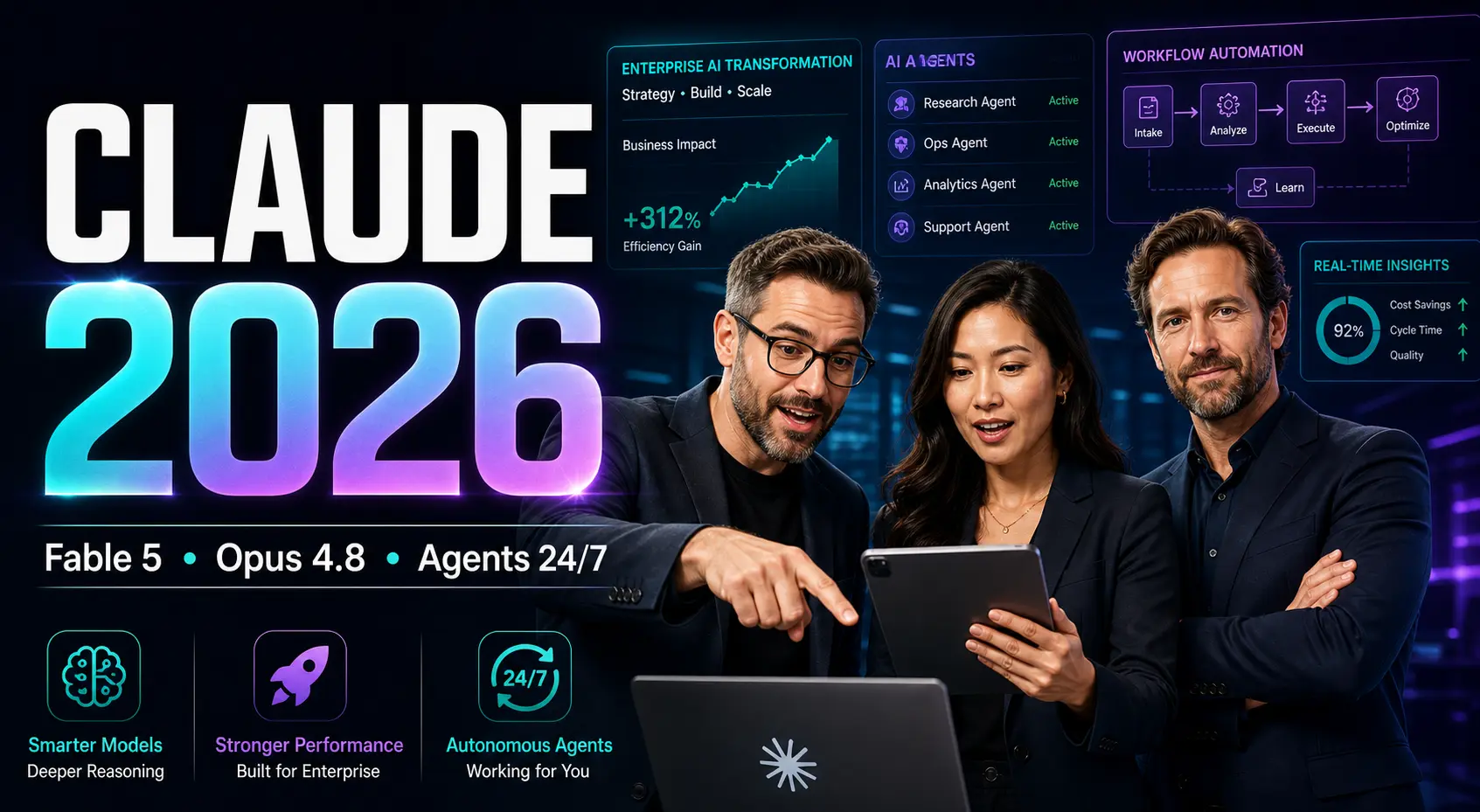
Anthropic now offers two frontier tiers: Claude Fable 5, a Mythos‑class model released on June 9, 2026 as its most capable generally available system for long, complex enterprise work, and Claude Opus 4.8, launched May 28, 2026 as the high‑throughput flagship for everyday reasoning and agentic coding at the same price as Opus 4.7. Around those models, Claude has grown into a full platform: Claude Code, managed agents, routines, scheduled tasks, Cowork‑style collaboration, memory, Projects, Artifacts, MCP‑based integrations and private‑network sandboxes for serious enterprise use.
For businesses, the question is no longer “Should we use Claude?” but “How do we design Claude as part of the way we work?” The opportunity is to treat Claude as an operating layer for research, coding, internal processes and 24/7 agents with the right governance, routing and integrations. That is where Kersai helps: we design and implement Claude architectures that route the right work to Fable 5 and Opus 4.8, connect to your systems safely, and turn Claude from an impressive demo into a measurable business asset.
1. Why Claude Matters More in June 2026
The Claude story has changed again in the last few months.
Anthropic is no longer simply the company behind a high‑quality chatbot. It is now building a broader enterprise AI environment with a strong emphasis on reasoning, coding, controllability and long‑running agents. Its product announcements, platform documentation and ecosystem updates all point in the same direction: Claude is becoming an AI work platform rather than just a language model endpoint.
There are several reasons this matters for businesses.
First, Claude is increasingly strong in the kinds of work businesses actually pay for: summarisation, policy‑aware writing, internal knowledge retrieval, code generation, document analysis, structured automation and multi‑step task completion.
Second, Anthropic is focusing on the full system around the model. That includes agent infrastructure, memory, orchestration, permissions, context management and tool use. In other words, it is not only trying to make the model smarter. It is trying to make the work environment more usable.
Third, recent releases show Anthropic continuing to update its frontier tier: Claude Opus 4.8 now anchors the Opus line, and Claude Fable 5 extends that capability into Mythos‑class territory for organisations that need the deepest, longest‑horizon reasoning and coding.
2. What the Claude Ecosystem Actually Includes
Many teams say “we use Claude” when what they really mean is “someone in the company opens the Claude chat product.” That is far too narrow.
In 2026, the Claude ecosystem spans several layers.
The Claude stack in plain English
| Layer | What it includes | Why it matters |
|---|---|---|
| Model layer | Claude Fable 5, Claude Opus 4.8, Sonnet & Haiku families | Fable 5 for the hardest long‑horizon work; Opus 4.8 as the default for most business workflows |
| Chat/workspace layer | Projects, Artifacts, Memory, Cowork‑style collaboration, Skills | Persistent workspaces and shared context for teams |
| Coding layer | Claude Code, multi‑session desktop, routines, background tasks, checkpoints | Turns Claude into a technical teammate and scheduled automation engine |
| Agent layer | Managed Agents, dynamic workflows, Outcomes, Dreaming, multi‑agent orchestration | Lets Claude coordinate multiple steps and sub‑agents for complex workflows |
| Integration layer | MCP connectors, add‑ins, private‑network tunnels, enterprise integrations | Connects Claude to the systems and data that actually drive your business |
| Governance layer | Permissions, sandboxes, review flows, logging, policies | Makes Claude safe to scale in production, not just a pilot tool |
Claude is no longer one tool. It is a system of tools and capabilities that can be assembled in different ways depending on what the business needs.
3. The Claude Model Layer: Fable 5 and Opus 4.8
The model layer is the foundation.
On May 28, 2026, Anthropic released Claude Opus 4.8, an upgrade to Opus 4.7 with stronger coding and knowledge‑work performance and new dynamic workflows for multi‑step agentic tasks. On June 9, 2026, Anthropic announced Claude Fable 5, a Mythos‑class model described as its most capable generally available system, designed for long‑horizon, complex reasoning and coding.
These two tiers now define the top of the Claude stack.
| Model | What it is | Best for |
|---|---|---|
| Claude Fable 5 | Mythos‑class, Anthropic’s most capable GA model | Long, complex projects; deep coding; multi‑day reasoning and analysis |
| Claude Opus 4.8 | High‑throughput flagship Opus model | Most production workloads: coding, knowledge work, agents, legal/ops assistants |
Opus 4.8 keeps the same price tier as 4.7 $5/M input tokens and $25/M output but adds a fast mode that can be roughly 2.5× faster and 3× cheaper than previous high‑effort runs. Fable 5, by contrast, is priced and positioned as a premium tier: you reach for it when the task is too long, too complex or too important for a standard model.
For your architecture, the practical pattern is:
- Opus 4.8 as the default engine for most day‑to‑day workflows.
- Fable 5 reserved for the hardest, highest‑value, longest‑horizon tasks, with extra review and safeguards.
4. Claude Platform: The Business Foundation
The Claude Platform is the base layer for companies that want more than chat. It gives organisations access to the Claude API, model choice, release notes, enterprise documentation, structured tool use and the broader Anthropic developer ecosystem.
This is where businesses decide:
- which models they want for which workloads,
- how much reasoning depth they need,
- where latency matters more than maximum capability,
- and how Claude should connect to internal systems.
For many organisations, the Claude Platform becomes the backbone for:
- internal assistants,
- customer support automation,
- document analysis pipelines,
- coding copilots,
- workflow bots,
- and agent‑based automations.
A practical example: a mid‑sized consulting firm might use Claude through chat for research and drafting, through the platform API for proposal generation and document analysis, and through Claude Code for internal software tooling.
Why businesses get stuck here
Most organisations underestimate the setup work. The problem is not the API key. The problem is deciding how Claude should be used safely and consistently across teams. That includes:
- model selection,
- prompt and workflow design,
- permissions,
- review steps,
- and integration logic.
This is one of the places Kersai adds value. We help businesses design the Claude operating model, not just activate the tools.
5. Claude Code: Where Claude Becomes a Technical Teammate
Claude Code is one of the most important products in Anthropic’s ecosystem because it moves Claude from “assistant” to “builder.”
Anthropic’s recent product and ecosystem materials show Claude Code evolving quickly. The desktop redesign introduced multi‑session support, a sidebar for managing parallel work, integrated terminal and file editing workflows, better previews and faster navigation.[web:1703] Anthropic also added Routines, which are saved autonomous Claude Code tasks that run on Anthropic’s cloud infrastructure even when your laptop is closed.
With Opus 4.8, Claude Code gains dynamic workflows: the model can break large problems into smaller steps, coordinate sub‑agents and sustain longer agentic sessions with fewer errors. Anthropic also added an effort control so teams can dial in how much thinking time Claude should invest in each task balancing speed, depth and cost.
What Claude Code can do for a business
- Refactor codebases more safely than a simple chat‑prompt workflow.
- Run multiple code sessions in parallel.
- Keep test, linting and review steps tied into the development flow.
- Maintain context over longer tasks with compaction and effort controls.
- Support ongoing engineering automation rather than isolated generation.
Why this matters beyond software companies
Claude Code is not only for startups building apps. Internal product teams, IT departments, operations teams with scripts and integrations, data teams and digital agencies can all use Claude Code to automate technical work. It effectively gives companies an AI teammate that can work in code, terminal, file systems and structured project environments.
For organisations that have developers but not enough developer time, this can be transformative.
6. Scheduling, Tasks and Running Claude 24/7
One of the biggest reasons businesses are paying more attention to Claude in 2026 is that it can now run tasks when humans are not awake.
Anthropic’s ecosystem updates, tutorials and related coverage point to several related capabilities:
- Scheduled tasks inside Claude Code desktop, where users can define recurring tasks that run hourly, daily or weekly.
- Routines, which run on Anthropic’s own infrastructure and can be triggered by schedules, APIs or GitHub events.
- Background tasks and long‑running processes that do not block the rest of Claude Code’s work.[web:1706]
- Managed Agents that can execute more autonomous workflows with sandboxes and connector access.
This is where the “24/7 agent” language starts to make sense.
Claude is not just responding when asked. It can be configured to do work repeatedly and persistently.
Real business examples
- A finance team schedules Claude to produce a morning revenue summary every weekday.
- A security team runs overnight checks on logs, tickets or policy drift.
- A product team uses Claude Code routines to test, document and monitor code changes on a schedule.
- An agency creates recurring research and reporting tasks for multiple clients.
- An internal ops team runs weekly compliance or document classification routines.
The important distinction
There are now multiple ways Claude can “run later” or “run continuously,” and businesses need to understand the difference.
| Capability | Runs where | Best for |
|---|---|---|
| Scheduled desktop tasks | User machine / desktop environment | Light recurring tasks for individual or local workflows |
| Routines | Anthropic cloud infrastructure | Reliable recurring work that must run when locals are off |
| Background tasks | Within Claude Code workflow | Long‑running technical jobs that shouldn’t block other work |
| Managed agents | Managed execution environment | More advanced, integrated, tool‑using autonomous workflows |
This is exactly the kind of nuance that makes implementation important. A business can easily overestimate what a task system can safely do without governance, or underestimate the value of cloud‑based routines for recurring work.
7. Cowork, Projects, Memory and Persistent Team AI
The next major shift is that Claude is becoming persistent.
A big weakness in early AI products was that every conversation started over. Businesses need more than that. They need an AI that remembers context, understands the project, stays attached to documents and can work with teams over time.
The Claude ecosystem in 2026 includes features such as Projects, Artifacts, Memory, Skills, and what many users refer to as Cowork‑style collaboration a mode where Claude acts less like a one‑off prompt engine and more like an ongoing teammate embedded in shared workspaces.
Anthropic’s agent‑focused developer event also highlighted concepts like Dreaming, where agents review sessions and memory stores between runs to improve future performance, and Outcomes, where grading agents evaluate task success against a rubric.
Why businesses should care
Persistent context changes the value of AI.
Instead of repeatedly teaching Claude the same context, you can design environments where it already understands:
- the project goals,
- the internal language,
- the key documents,
- the business rules,
- and the expected standard of output.
That can dramatically reduce friction for teams doing recurring knowledge work.
Good business uses for persistent Claude workspaces
- Research and strategy teams
- Client account teams
- Internal knowledge bases
- Product and engineering documentation
- HR policy assistants
- Proposal and tender environments
- Legal review support workflows
This is where Claude starts to feel less like software and more like a digital colleague.
8. Managed Agents, Multi‑Agent Orchestration and Business Automation
One of the most important developments in the Claude ecosystem is the move toward managed agents.
Recent product coverage highlights features such as:
- Managed Agents with better execution control,
- self‑hosted sandboxes,
- MCP tunnels for private‑network access,
- multi‑agent orchestration, where a lead agent delegates work to specialist sub‑agents,
- and Outcomes, where separate evaluation agents score task quality.
This is a major shift in what Claude can do for businesses.
A single model can be useful. A managed system of agents can become operational.
Example workflow
Imagine a due‑diligence workflow for an investment or acquisition team:
- A lead Claude agent receives the brief.
- One sub‑agent analyses financial documents.
- Another checks legal clauses and risk flags.
- Another gathers market context from approved sources.
- An evaluation agent checks the result against a scoring rubric.
- A final synthesis is delivered to the human reviewer.
That is a much more powerful business system than “summarise this PDF.”
Why this matters for Kersai clients
Most companies do not need a demo. They need repeatable, governed AI workflows that fit a real business process. Managed agents are how many of those use cases become possible.
Kersai helps design these systems with:
- role design for agents,
- task boundaries,
- escalation rules,
- review checkpoints,
- data‑access decisions,
- and measurement of output quality.
9. MCP, Integrations and Private Network Access
No business platform matters unless it connects to the real tools people use.
Anthropic’s ecosystem increasingly revolves around MCP (Model Context Protocol), connectors, add‑ins and enterprise integrations. Coverage and docs point to:
- broader connector support,
- add‑ins that allow Claude to work inside productivity software,
- MCP tunnels for private network access,
- and integration pathways for enterprise platforms and cloud environments.
This is important because businesses do not want AI in a vacuum. They want Claude to be able to work with:
- their docs and files,
- internal tools,
- developer environments,
- cloud systems,
- and secure data sources.
The practical business question
The question is no longer “Can Claude answer well?”
The question is “Can Claude act in the right systems, with the right permissions, and leave the right audit trail?”
That is the real implementation problem.
Kersai helps organisations decide:
- what Claude should connect to,
- what it should never touch,
- which workflows need human approval,
- and how to keep the integration architecture maintainable.
10. What Claude Can Do Today for Different Types of Businesses
To make this practical, here is how Claude’s ecosystem maps to real business scenarios.
SMEs
For small and medium businesses, Claude can be used for:
- content drafting and editing,
- proposals and reports,
- customer response support,
- recurring admin and documentation tasks,
- website and light coding work through Claude Code,
- internal research and knowledge search,
- and scheduled reporting or weekly operational summaries.[web:1726][web:1724]
Mid‑sized companies
For mid‑sized businesses, Claude can support:
- cross‑team research environments,
- sales enablement and proposal workflows,
- internal agent‑based reporting,
- product and engineering velocity through Claude Code,
- policy and compliance document processing,
- and AI assistants embedded in team workflows.[web:1724][web:1700]
Larger enterprises
For larger organisations, Claude becomes more strategic:
- managed agent systems,
- internal copilots with persistent memory,
- role‑based automation,
- software engineering acceleration,
- secure integrations and private‑network workflows,
- and cross‑functional AI governance.[web:1718][web:1723]
Employees
For employees, Claude increasingly behaves like:
- a researcher,
- a writer,
- a coding assistant,
- an internal analyst,
- and in some contexts, a recurring background task operator.
This does not mean employees disappear. It means the shape of work changes toward review, instruction, orchestration and domain judgment.
11. Fable 5 vs Opus 4.8: Which Should You Use?
To keep things concrete, here is a simple decision frame.
| Scenario | Recommended model | Why |
|---|---|---|
| Daily coding, small features, scripts, bugfixes | Opus 4.8 | Great coding performance at standard pricing; dynamic workflows handle complexity. |
| Long, complex refactors or multi‑repo changes | Fable 5 | Better long‑horizon reasoning and cross‑file coherence. |
| Research, drafting, policy‑aware internal writing | Opus 4.8 | Strong reasoning and writing with good throughput. |
| Deep investigations, multi‑day analysis, high‑stakes projects | Fable 5 | Mythos‑class capabilities intended for the hardest problems. |
Kersai’s job is to design routing so your teams rarely have to think about model choice on every prompt the system selects the right model based on the workflow, risk and value.
12. What Claude Still Does Not Do Well
A strong implementation guide should not sound like a brochure. Claude has limits, and businesses need to understand them.
According to ecosystem summaries, Claude remains primarily a text‑output platform with text and image input. It is not natively a full multimedia generation system in the way some other AI platforms focus on images, video or audio generation.
There are also broader practical constraints:
- long‑running automation still needs oversight,
- agent reliability varies by task type,
- recurring tasks can drift without review,
- integration design can become messy quickly,
- and not every business workflow should be automated.
The main risk is not that Claude is weak. The main risk is that businesses assume a powerful model automatically means a robust business system.
That is why design, governance and implementation matter so much.
13. How Kersai Helps Organisations Implement Fable 5, Opus 4.8 and the Claude Stack
Most organisations are not short of AI tools. They are short of design.
Kersai helps you turn the Claude ecosystem including Fable 5, Opus 4.8, Claude Code, Cowork, Routines and Managed Agents into a structured, governed capability.
1. Architecture and routing
- We design when to use Fable 5 vs Opus 4.8, and when to stick with smaller models.
- We build routing so routine work uses Opus 4.8, while high‑stakes, long‑horizon work can escalate to Fable 5 with extra checks.
2. Workflow and agent design
- We turn your processes into clear Claude workflows and managed agents: roles, steps, escalation rules and evaluation (Outcomes).
3. Integration and MCP strategy
- We decide which systems Claude should talk to via MCP and connectors, and which data must stay off‑limits.
4. Governance and safety for Mythos‑class capability
- Fable 5 and other Mythos‑class models need guardrails; Anthropic itself has warned about cybersecurity risks if misused.
- We implement permissions, logging, review flows and policy so you can use that power without creating unacceptable risk.
5. Training and change management
- We train teams to work with Claude as a teammate: how to brief it, how to review it, how to combine it with domain expertise, and how to avoid “automation without understanding.”
You are not selling “Claude access.” You are building a Claude operating model that uses the very latest Anthropic models and features in a way that business leaders can defend.
FAQ: Claude Platform and Business Implementation in June 2026
What is the latest Claude model in June 2026?
As of June 10, 2026, Anthropic’s latest and most capable generally available model is Claude Fable 5, a Mythos‑class system built for long, complex enterprise work. Claude Opus 4.8, released May 28, 2026, remains the high‑throughput flagship for most day‑to‑day workloads.
Is Claude just a chatbot?
No. Claude now includes a broader platform covering chat workspaces, Claude Code, managed agents, memory, routines, MCP integrations and persistent team workflows.
Can Claude run tasks on a schedule?
Yes. Claude Code supports scheduled tasks, and Anthropic’s Routines can run on Anthropic’s cloud infrastructure based on schedules, API calls or events.
Can Claude run 24/7 agents?
Claude can support recurring and persistent agent‑like workflows through routines, managed agents, background tasks and orchestration features, but safe business use still requires review design and governance.
What is Claude Code best for?
Claude Code is best for software development, technical automation, code refactoring, agentic coding, documentation and long‑running engineering workflows.
What is MCP and why does it matter?
MCP helps Claude connect to tools, systems and data sources in a structured way. That matters because business value comes from Claude working inside real workflows, not in isolation.
Why would a business need Kersai for Claude implementation?
Because using Claude casually is easy, but implementing Claude as a governed, integrated, high‑value business system is much harder. Kersai helps design the architecture, workflows, governance and rollout so Claude actually delivers results.
Final Thought
Claude in June 2026 is not just a model. It is one of the clearest examples of how AI is becoming an operating layer for real work.
Claude Fable 5, Opus 4.8, Claude Code, scheduled tasks, routines, managed agents, memory, integrations and persistent workspaces all point in the same direction: businesses are moving from “asking AI questions” to “designing AI coworkers.”
That shift creates a real opportunity. Organisations that implement Claude properly can unlock meaningful gains in productivity, automation, coding speed, internal knowledge work and operational consistency.
But those gains do not come from switching the tool on. They come from designing the system around it.
That is the work Kersai helps organisations do.
This article was researched and written by the Kersai Research Team. Kersai helps organisations design practical AI infrastructure strategies, from model selection and compute planning to multi‑cloud deployments and governance visit kersai.com.