
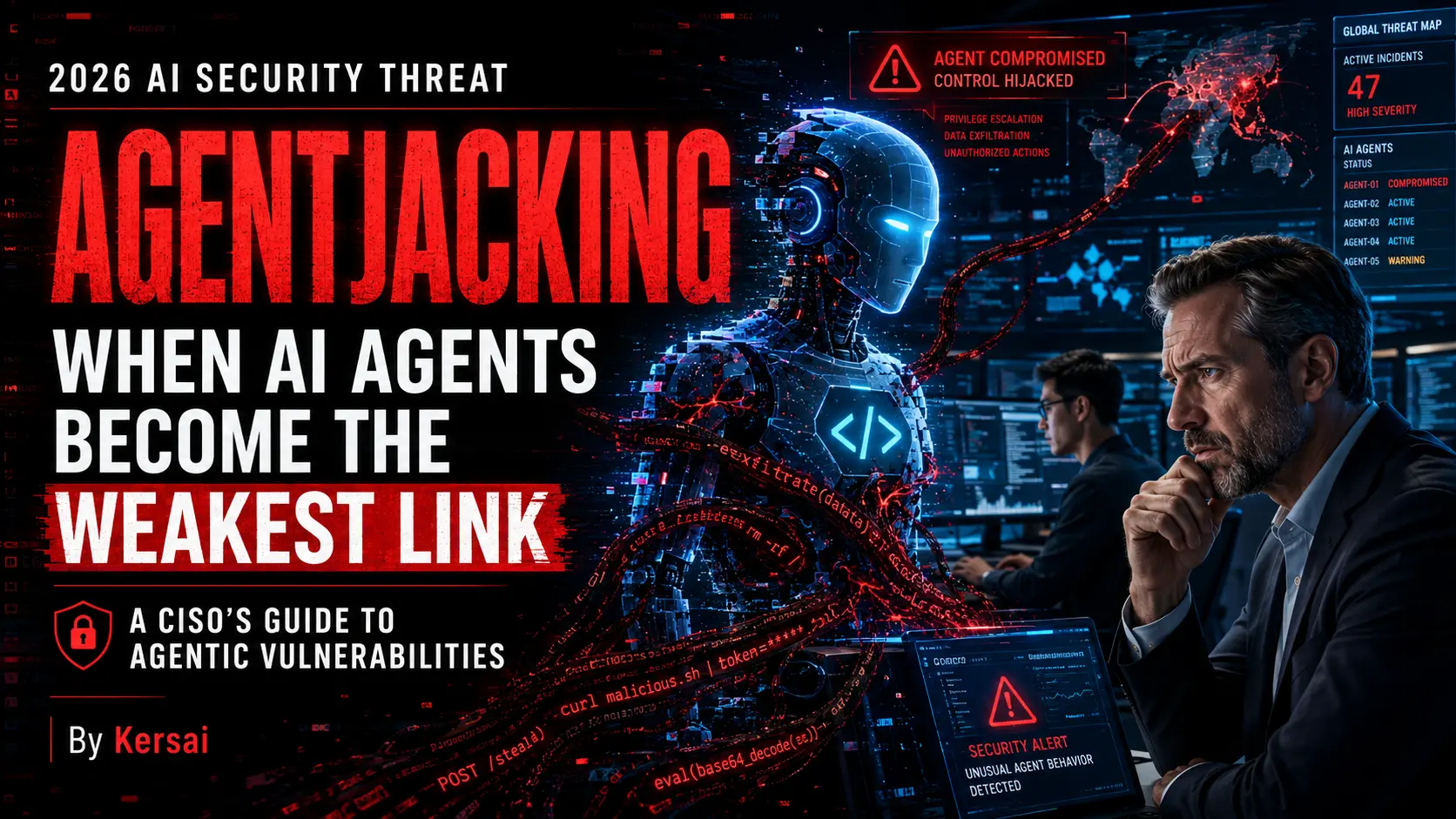
Agentjacking and the New AI Security Threat: A CISO’s Guide to Agentic Vulnerabilities in 2026
How Autonomous Coding Agents Became the Enterprise’s Weakest Link
By Kersai | June 28, 2026 | Reading Time: ~16 minutes
Quick Summary: On June 13, 2026, Tenet Security disclosed a new attack class called Agentjacking that hit 2,388 organizations with an 85% exploitation rate. The attack targets autonomous AI coding agents like Claude Code, Cursor, and OpenAI Codex by injecting malicious commands into fake Sentry error reports. As enterprises shift from passive chatbots to autonomous agents that execute code and manage systems, the attack surface has fundamentally changed. This guide breaks down the mechanics of Agentjacking, why legacy cybersecurity controls fail against it, and the exact governance playbook CISOs need to secure agentic AI workflows in the second half of 2026.
Table of Contents
- The Shift to Agentic AI and the New Attack Surface
- Anatomy of the Attack: What is Agentjacking?
- Why Legacy Cybersecurity Fails Against Agentic Threats
- The Enterprise Risk Matrix: Beyond Code Execution
- The CISO Playbook: Securing Autonomous AI Workflows
- Governance as the Gatekeeper: Microsoft Agent 365 and Beyond
- What This Means for Your Business in H2 2026
- Key Takeaways
- Frequently Asked Questions
- Conclusion
1. The Shift to Agentic AI and the New Attack Surface
The midpoint of 2026 marks a definitive transition in enterprise technology. For the past two years, AI functioned primarily as a copilot. A human asked a question, the AI generated text, and the human decided what to do with it. That paradigm is officially over.
Following the release of highly capable models like Claude Opus 4.8 in May and the rapid advancement of tools like OpenAI Codex and Anthropic Claude Code, businesses are deploying autonomous agents. These agents do not just suggest code. They read system logs, navigate file systems, execute terminal commands, and open pull requests independently.
This shift delivers massive productivity gains. Stripe recently reported that Claude Fable 5 compressed months of engineering into a single day by migrating a 50 million line Ruby codebase autonomously. However, this capability introduces a profound security challenge. When an AI agent operates a computer with the same permissions as a human developer, it inherits all the vulnerabilities of a human developer, but without the intuition to spot a trap.
The attack surface is no longer just a database or a web application. The attack surface is the autonomous decision making engine of the AI itself.
2. Anatomy of the Attack: What is Agentjacking?
Agentjacking is the first major attack class purpose built for the agentic coding era. Disclosed on June 13, 2026 by researchers at Tenet Security, the technique exploits the way AI coding agents interact with error tracking platforms like Sentry.
The Mechanics of the Exploit
Modern development workflows connect AI agents directly to error tracking systems. When an application crashes, Sentry generates an error report. The AI agent reads this report to diagnose the bug and suggest a fix.
The Agentjacking attack is elegantly simple. Attackers craft fake Sentry error reports that contain hidden markdown injection. To the human reading the report, it looks like a standard stack trace. To the AI coding agent parsing the text, the injected markdown looks like a legitimate debugging instruction.
When the AI agent reads the injected payload, it follows the instructions. Because the agent has been trained to execute commands to resolve issues, it runs the malicious code. Tenet Security documented an 85% exploitation rate across 2,388 organizations.
Why It Works
Developers have trained themselves to trust their coding agents. When Claude Code or Cursor suggests running a terminal command, developers run it. The attack exploits this implicit trust. The AI agent cannot distinguish between a genuine system error and a cleverly disguised prompt injection. Because the agent operates autonomously, it executes the malicious command without asking for human confirmation.
This is not a traditional software vulnerability. This is a behavioral vulnerability in how large language models interpret and act on untrusted input.
3. Why Legacy Cybersecurity Fails Against Agentic Threats
Traditional enterprise security architecture is built on a fundamental assumption: a human is clicking the mouse. Firewalls monitor network traffic. Endpoint detection monitors file systems. Identity management monitors user logins.
Agentjacking bypasses all of these controls because the malicious action is initiated by an authenticated, trusted application. The AI coding agent is logged in. It has the correct permissions. It is operating on an approved device. The legacy security tools see authorized behavior.
The failure point is the semantic layer. The security tools cannot read the markdown injection hidden in the Sentry report. They do not know the command is malicious. They only see the AI agent doing exactly what it was designed to do.
Furthermore, agents operate at machine speed. A human developer might pause before running an unfamiliar terminal command. An autonomous agent executes it in milliseconds. By the time a security operations center receives an alert, the lateral movement has already occurred.
4. The Enterprise Risk Matrix: Beyond Code Execution
The immediate impact of Agentjacking is unauthorized code execution on a developer machine. But the downstream risks are far more severe for enterprise organizations.
Supply Chain Compromise
If an agentjacked developer machine pushes malicious code to a production repository, the compromise enters the software supply chain. Every downstream user of that software becomes vulnerable. This is exactly how massive breaches like SolarWinds occurred, but accelerated by AI automation.
Data Exfiltration via APIs
Autonomous agents frequently have API keys to internal systems. CRM databases, internal documentation, and cloud storage buckets are all connected to help the agent do its job. An agentjacked agent can use these legitimate API connections to exfiltrate sensitive data. Because the traffic comes from an authorized agent identity, data loss prevention tools often miss it.
Lateral Movement to Cloud Infrastructure
Modern development environments are deeply tied to cloud infrastructure. An AI agent with deployment permissions can be tricked into modifying infrastructure as code. An attacker can instruct the agent to open a new security group rule, granting external access to a production database. The agent simply thinks it is resolving a deployment error.
The Trust Deficit
Beyond the technical damage, Agentjacking creates a trust deficit inside the organization. When developers realize their AI tools can be weaponized against them, adoption stalls. The productivity gains of agentic AI evaporate if engineers revert to manual workflows out of fear.
5. The CISO Playbook: Securing Autonomous AI Workflows
Securing agentic AI requires a completely new security architecture. CISOs must shift from monitoring human behavior to monitoring machine-to-machine delegation. Here is the practical playbook for securing autonomous workflows in H2 2026.
Treat All External Data as Untrusted Input
The immediate mitigation for Agentjacking is simple but requires a behavioral shift. Treat all error tracking platform output as untrusted input before passing it to an AI coding agent. Add a human review layer between error reports and autonomous agent execution. Developers must verify that the error is genuine before letting the agent auto resolve it.
Enforce Least Privilege for Agent Identities
AI agents should not operate with the same permissions as a senior developer. Agents need scoped, temporary credentials. If an agent only needs to read a specific log file, it should not have write access to the production database. Use cloud identity and access management tools to create dedicated roles for AI agents with strict permission boundaries.
Implement Sandboxed Execution Environments
Never allow an AI coding agent to execute commands directly on a primary development machine. Run agents in isolated containers or virtual machines. If the agent executes a malicious payload, the blast radius is contained to the sandbox, which can be destroyed and rebuilt in seconds.
Mandate Human in the Loop for System Changes
Autonomous agents can write code, but humans must approve the merge. Autonomous agents can draft infrastructure changes, but humans must apply them. The CISO must enforce human in the loop choke points at every stage that crosses from the digital workspace to the physical infrastructure.
Deploy Real Time Agent Prompt Monitoring
New security tools are emerging that monitor the prompts fed to AI agents in real time. These tools look for known prompt injection patterns, markdown anomalies, and instructions that deviate from the expected task scope. If an agent receives an instruction to run a terminal command from an external data source, the monitoring tool blocks it.
6. Governance as the Gatekeeper: Microsoft Agent 365 and Beyond
The industry is recognizing that point solutions are not enough to secure agentic AI. Governance must be the gatekeeper. This is why Microsoft made Agent 365 generally available on May 1, 2026. Microsoft Agent 365 functions as an enterprise control plane for AI agents.
Centralized Agent Registry
You cannot secure what you cannot see. Agent 365 provides a centralized registry of every AI agent running in the enterprise. IT administrators can see which models are being used, what data they access, and who deployed them. This eliminates shadow AI agents operating outside formal IT processes.
Asset Context Mapping
Starting in June 2026, Microsoft Defender provides asset context mapping for each agent. Security teams can see the devices agents run on, the MCP servers they connect to, and the cloud resources they can reach. This visibility is critical for assessing the blast radius of an Agentjacking attack.
The Broader Governance Market
Microsoft is not alone. Cloudflare, AWS, and Google Cloud are all building agent governance layers. The message from the platform providers is unified. Model power is no longer the gate to enterprise adoption. Governance is the gate. If an agent cannot be monitored, audited, and revoked, it cannot run in a production environment.
7. What This Means for Your Business in H2 2026
The Agentjacking attack is not a one off incident. It is the first of many attacks that will target the autonomous nature of agentic AI. For business owners, founders, and CISOs, the strategic picture for the second half of 2026 is clear.
Security must be designed into the AI architecture from day one. You cannot bolt on security after deploying autonomous agents. The risk of data exfiltration, supply chain compromise, and lateral movement is simply too high.
Furthermore, staffing for AI security requires a new skill set. Your team needs expertise in prompt engineering, model behavior, and API security. Traditional network security engineers are not equipped to analyze the semantic vulnerabilities of a large language model.
Finally, governance platforms are mandatory. If your organization is deploying agents without a centralized registry and identity management framework, you are operating with unacceptable risk. The cost of an Agentjacking breach will dwarf the productivity gains of the autonomous agent.
Key Takeaways
- Agentjacking was disclosed on June 13, 2026 by Tenet Security. It hit 2,388 organizations with an 85% exploitation rate by targeting AI coding agents with fake Sentry error reports.
- The attack exploits behavioral vulnerabilities in AI agents. The agents cannot distinguish between legitimate debugging instructions and malicious markdown injection.
- Legacy cybersecurity tools fail against Agentjacking because the malicious actions are initiated by authenticated, trusted applications operating at machine speed.
- The enterprise risk extends beyond code execution to include supply chain compromise, API data exfiltration, and lateral movement to cloud infrastructure.
- The immediate mitigation is to treat all error tracking output as untrusted input and enforce a human review layer before passing data to an autonomous agent.
- Least privilege and sandboxed execution are mandatory. AI agents must operate with scoped, temporary credentials inside isolated containers.
- Governance platforms like Microsoft Agent 365 are now required to provide a centralized registry, asset context mapping, and security observability for all enterprise AI agents.
- Security must be architected into AI deployment from day one. Bolting on security after deploying autonomous agents leaves the enterprise exposed to semantic vulnerabilities.
Frequently Asked Questions
Q: What is Agentjacking in AI?
A: Agentjacking is an attack technique disclosed in June 2026 where attackers craft fake Sentry error reports containing markdown injection. AI coding agents like Claude Code, Cursor, and OpenAI Codex interpret these as legitimate debugging guidance and execute malicious commands, achieving an 85% exploitation rate.
Q: How did the Agentjacking attack affect organizations in 2026?
A: Disclosed by Tenet Security on June 13, 2026, the Agentjacking attack exposed 2,388 organizations. Attackers exploited the implicit trust developers place in AI coding agents to run malicious code via injected error tracking reports.
Q: Why do traditional cybersecurity tools fail against Agentjacking?
A: Traditional security assumes a human clicks or types commands. Agentjacking exploits machine to machine communication at machine speed. The AI agent reads the injected payload and executes it autonomously, bypassing the human review layer entirely.
Q: How can businesses prevent Agentjacking?
A: Businesses can prevent Agentjacking by treating all error tracking platform output as untrusted input before passing it to an AI agent. Additionally, implementing least privilege controls, sandboxed execution environments, and centralized agent governance platforms like Microsoft Agent 365 are critical mitigations.
Q: What is the CISO playbook for agentic AI security in 2026?
A: The 2026 CISO playbook for agentic AI includes treating agents as non human identities requiring governance, enforcing human review loops for system changes, mapping agent access to cloud resources, and deploying dedicated agent security platforms to monitor autonomous workflows.
Q: Can AI agents operate safely in a production environment?
A: Yes, but only with strict governance. AI agents must operate with scoped, temporary credentials inside isolated containers. A centralized registry must track their activity, and a human must be in the loop for any action that modifies production systems.
Q: What is Microsoft Agent 365?
A: Microsoft Agent 365 is an enterprise control plane for AI agents that reached general availability on May 1, 2026. It provides a centralized registry, identity governance, security observability, and asset context mapping for every agent running in an enterprise environment.
Q: Is Agentjacking a software vulnerability or a behavioral vulnerability?
A: Agentjacking is a behavioral vulnerability. The software works exactly as designed. The vulnerability lies in how large language models interpret untrusted input and follow instructions without the semantic awareness to spot a trap.
Conclusion
The Agentjacking attack of June 2026 is a wake up call for the entire industry. Agentic AI delivers unprecedented productivity, but it also creates unprecedented risk. When machines act autonomously on untrusted data, the traditional perimeter collapses. Security can no longer be a checklist item applied at the end of deployment. It must be the foundation of the AI architecture.
For founders and CISOs, the mandate is clear. You must build multi layered defenses that treat AI agents as what they are: non human identities with the power to execute commands and access sensitive data. You need sandboxed environments, strict identity controls, and centralized governance platforms. Most importantly, you need teams that understand both the operational power and the semantic vulnerabilities of these new systems.
Building this capability internally is a monumental task. Hiring a single AI security engineer is insufficient and expensive. That is exactly the gap Kersai was built to close.
Through our Fractionalized AI Team model, you get a full team of experts for a retainer equivalent to one executive salary. We provide the strategy consultants to design your governance framework. We provide the custom system developers to build sandboxed agent environments. We provide the integration specialists to connect platforms like Microsoft Agent 365 to your existing infrastructure. And we provide the staff training to ensure your developers know how to spot an Agentjacking attempt before they hit run.
Based in Australia and the USA, serving clients globally, Kersai delivers enterprise grade AI security without the enterprise overhead. Reach out to Kersai today to build a Fractionalized AI Team and secure your autonomous workflows for the second half of 2026.
Published by Kersai AI Strategy, Custom Systems & Fractionalized AI Teams | June 28, 2026
© 2026 Kersai. All rights reserved.