
June 2026 AI News Roundup: Anthropic, SpaceX, Google, Regulation and What the Next Few Months Mean for Businesses and Employees
Published: June 1, 2026 By: Kersai Research Team
Category: AI Strategy / Enterprise AI / AI Markets / Emerging Technology
Executive Summary
If May 2026 felt like the biggest month in AI history, early June is confirming that the story was not hype. The market is changing faster than most businesses can update their slide decks.
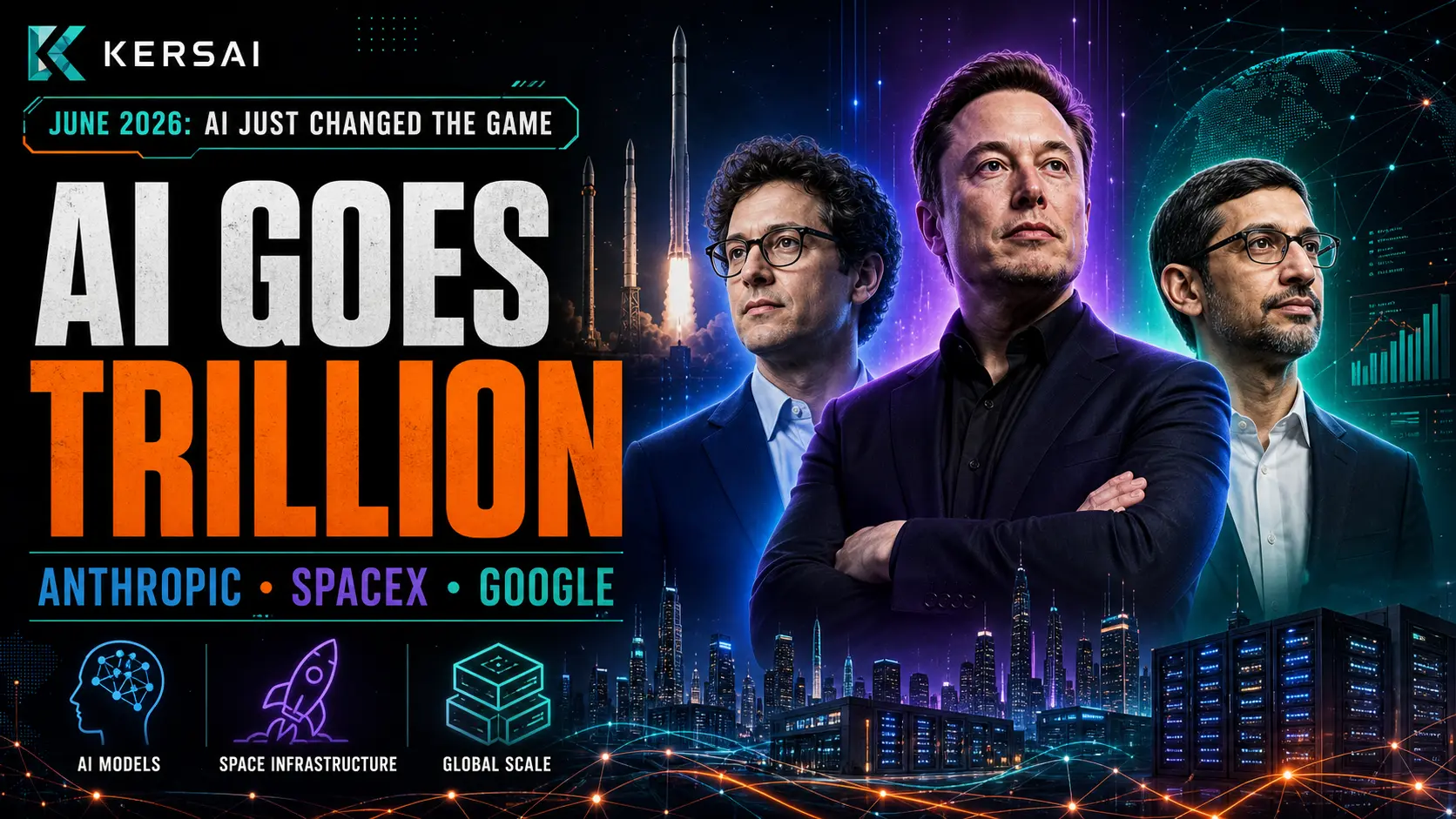
Anthropic has now raised $65 billion at a $965 billion post-money valuation, making it the most valuable private AI company in the world and pushing it ahead of OpenAI in private-market value. At the same time, Anthropic is expanding compute through a major SpaceX deal, shipping Claude Opus 4.8, and preparing to release Mythos-class models to customers in the coming weeks. SpaceX is no longer just adjacent to AI either. It is becoming an infrastructure and platform force through Colossus, a potential $60 billion Cursor acquisition, and broader capital raising tied to AI compute. Google is accelerating hard into the “agentic era” with Gemini Enterprise Agent Platform, Gemini 3.5 Flash in Search AI Mode, new chips, and Gemma 4. Meanwhile, the EU AI Act is moving toward real enforcement in August, which means AI governance is about to become a board-level issue for any business touching European markets.
The practical message is simple: AI is becoming more powerful, more integrated, more regulated and more infrastructure-constrained at the same time. That is good news for SMEs and large enterprises in one sense, because they are getting access to stronger tools, lower-cost competition and more embedded AI inside the software they already use. But it also means more complexity. Vendor choice, compliance, workforce design and infrastructure exposure are now all part of the same conversation.
1. Anthropic Just Rewrote the AI Pecking Order
Until recently, many people still talked about Anthropic as the thoughtful challenger to OpenAI: respected, high quality, but clearly second in the market hierarchy. That framing no longer holds.
On May 28, 2026, Anthropic announced a $65 billion Series H that valued the company at $965 billion post-money. That puts it ahead of OpenAI in private-market valuation and on the doorstep of becoming the first trillion-dollar AI company. This is a dramatic jump from Anthropic’s roughly $380 billion valuation only a few months earlier, and it signals that investors no longer see Claude as a niche enterprise tool. They see Anthropic as one of the defining AI infrastructure and platform companies of the decade.
That matters because valuation at this scale is not just a vanity number. It changes what Anthropic can do. The company now has the capital to buy time, talent, compute and market share. It can fund more aggressive model training, subsidise enterprise expansion, secure bigger infrastructure contracts and stay in the race even if the market becomes more capital intensive. When a company raises at a near-trillion-dollar valuation, customers should stop asking whether it will survive. The more useful question becomes what kind of power it will accumulate.
For businesses, Anthropic’s rise is strategically important because it creates a more credible alternative to OpenAI and Google. A market with several giant frontier players is healthier than one dominated by a single vendor. It gives buyers more leverage and increases the chance that pricing, product direction and governance standards remain contested rather than dictated.
2. Claude Opus 4.8 and Mythos: Why the Model Story Matters Again
Anthropic’s valuation news would be significant enough on its own, but it arrived alongside product news that makes the story even more important.
Anthropic has released Claude Opus 4.8, an upgraded flagship model aimed at better coding, stronger knowledge work and more capable multi-step task performance. At the same time, the company says Mythos-class models are expected to reach customers in the coming weeks once its updated safety controls are ready. In other words, Anthropic is not only winning the capital race. It is still advancing the frontier.
For business leaders, this matters because the next phase of AI is not just about “better answers.” It is about models that can handle longer projects, operate with more autonomy and become more useful in real workflows. That affects developers, analysts, operations teams, support staff and knowledge workers generally.
What Anthropic’s latest releases mean in practice
| Development | What it is | Why it matters to business |
|---|---|---|
| Claude Opus 4.8 | Anthropic’s updated flagship model | Better coding, stronger reasoning, more capable knowledge-work support |
| Dynamic workflows | More agent-like orchestration and effort control | Better fit for multi-step tasks, internal copilots and workflow automation |
| Mythos rollout | Anthropic’s most powerful system moving toward broader availability | Signals that higher-end frontier capabilities may soon become commercial tools, not just lab experiments |
For SMEs, this is particularly important because higher-end capability usually starts expensive and exclusive, then moves downmarket. If Anthropic’s stronger models become broadly available and competition intensifies, smaller firms get access to more advanced AI without needing hyperscaler-sized budgets.
For employees, the shift is even more direct. AI is moving from “give me a draft” to “help me complete the whole task.” That raises productivity potential, but it also means workers will need to get better at steering, checking and integrating AI into their daily decisions.
3. SpaceX Is Becoming an AI Company by Infrastructure, Not by Chatbot
One of the biggest underappreciated stories in AI right now is that the race is no longer only about models. It is also about who controls the compute.
SpaceX has signed a deal to give Anthropic access to Colossus 1, its massive AI supercomputer, and reporting indicates Anthropic will pay roughly $1.25 billion per month through 2029 for that capacity. Reuters and CNBC describe the arrangement as giving Anthropic access to more than 300 megawatts of new compute capacity, which is enormous by current market standards. This immediately turns SpaceX into something more than an Elon-adjacent side story. It becomes a serious infrastructure player in the AI economy.
This matters because compute is now one of the main bottlenecks in AI growth. The biggest labs do not just need better models; they need sustained access to power, chips, cooling, data-centre space and financing. Whoever controls those layers can shape the direction of the industry, even if they do not own the most famous chatbot interface.
SpaceX is also exploring the idea of orbital compute capacity, which sounds futuristic but makes strategic sense in a market where terrestrial energy and cooling constraints are biting harder every quarter. Even if orbital compute remains experimental for now, the fact that serious companies are discussing it shows how extreme AI infrastructure demand has become.
For businesses, the key takeaway is not “buy SpaceX stock someday.” It is that infrastructure competition could eventually improve AI availability, pricing and resilience. More compute providers means fewer points of failure and more pressure on the traditional cloud giants.
4. The Cursor Deal Shows Where the Next AI Value Will Sit
SpaceX’s arrangement with Cursor is another sign that the market is widening beyond model labs.
The deal gives SpaceX the option to acquire Cursor for $60 billion later this year, or alternatively to pay $10 billion for the joint work between the two companies. Cursor is not a general consumer chatbot. It is an AI coding environment, which makes the logic here especially interesting.
What this tells us is that coding tools and developer environments are now seen as strategic control points. If you combine huge compute resources with a deeply embedded developer product, you do not just own infrastructure and models. You start to shape how software gets built.
That has huge implications for SMEs and enterprise teams alike. Smaller software firms may soon have access to much more capable AI coding environments backed by hyperscale infrastructure. Larger enterprises may find that internal engineering workflows become one of the first places where AI produces consistent, measurable gains.
The boring but very important fact here is this: the winners in AI may not be the companies with the most famous chatbot brand. They may be the companies that own the workflow layer, the compute layer, or both.
5. Google’s “Agentic Era” Means AI Is About to Feel Normal
If Anthropic is rewriting the private-market leaderboard and SpaceX is shifting the infrastructure map, Google is doing something equally important: making AI disappear into everyday software.
Google’s recent updates point clearly toward what it calls the agentic era. That includes the Gemini Enterprise Agent Platform, Gemini 3.5 Flash becoming the default model in Search AI Mode, Gemma 4 as an open model family, and continued expansion of AI features across Search, Workspace, developer tools and Cloud.
This matters because the easiest AI adoption path for most organisations is not “buy a completely new AI stack.” It is “make the software we already use more intelligent.” Google understands that better than almost anyone. If your company already uses Gmail, Docs, Sheets, Meet, Search and Google Cloud, then Gemini is no longer a separate product choice. It is becoming part of your operating environment.
Why Google’s wave matters for businesses of all sizes
- SMEs get more AI inside tools they already pay for, reducing the friction of adoption.
- Mid-sized companies can build lightweight agents over documents, internal knowledge and workflows without assembling everything from scratch.
- Larger enterprises can start to treat agentic AI as part of search, productivity and cloud strategy, rather than as an isolated experiment.
Google’s expansion also matters for content, marketing and SEO teams. When Search AI Mode becomes more capable and AI-generated content credentials spread through systems like SynthID and C2PA, discoverability, attribution and trust all change together. That affects how businesses publish, verify and compete for attention.
The boring fact: a lot of businesses will “adopt AI” in 2026 without a major procurement event, simply because Google and Microsoft are wiring it into the tools they already use.
6. The EU AI Act Is About to Make AI Governance Real
The most exciting AI stories tend to be about funding rounds and model launches. The most durable ones are often about regulation and compliance.
On 2 August 2026, most of the EU AI Act rules come into force and enforcement begins. That includes transparency obligations for AI-generated content and compliance obligations for certain high-risk systems. The European Commission is also finalising a code of practice on marking and labelling AI-generated content, with the final version expected around June 2026.
This matters far beyond Europe. Any business that serves European users, works with European customers or uses AI in functions that may be classified as high-risk will need to think about documentation, risk categorisation, disclosures, testing and governance.
For SMEs, this can feel like an annoying legal overhead. But it is also a forcing function that pushes companies to become more deliberate about how they use AI. For larger organisations, it makes AI governance a cross-functional issue involving product, legal, security, HR and operations.
The boring facts that matter here are not glamorous:
- Where are you using AI?
- Which models are involved?
- Which outputs need human review?
- What content needs labelling?
- What logs and documentation do you keep?
These questions are becoming part of normal business operations.
7. What This Means for SMEs, Large Companies and Employees
The good news is that all of this activity will make AI more accessible, more powerful and, in many cases, more affordable.
SMEs
For small and medium businesses, the current wave is positive overall. Competition between Anthropic, OpenAI, Google and others increases the odds that frontier capabilities move downmarket more quickly. Better coding tools, more embedded AI in productivity suites, stronger APIs and more competition in infrastructure should all help SMEs use AI without enterprise-only budgets.
The catch is that SMEs will also need to become more disciplined. Choosing tools, handling customer data, checking outputs and understanding compliance can no longer be treated casually. The upside is real, but so is the need for a basic AI operating model.
Mid-size and large enterprises
Bigger businesses gain the most from scale, but also carry more risk. They can use AI to transform support, engineering, analytics, knowledge management and internal operations. At the same time, they must handle vendor risk, workforce redesign, regulation and security. The next few months will be important for enterprises because the foundational choices they make now about platforms, compliance and internal AI architecture will shape costs and flexibility for years.
Employees
For employees, the picture is mixed but not bleak. AI will continue to automate slices of work rather than entire professions in one hit. The employees who benefit most will be those who learn to supervise, direct and combine AI with domain expertise. Junior tasks may shrink. Mid-level leverage may rise. The premium shifts toward judgment, workflow design, critical review and the ability to work effectively with intelligent tools.
This is not a distant future story. In 2026, that shift is already under way.
8. Interesting Facts vs Boring Facts
One useful way to think about the next phase of AI is to separate the “interesting” facts from the “boring” ones.
Interesting facts
- Anthropic is now valued at $965 billion, ahead of OpenAI, after raising $65 billion in a single round.
- SpaceX is supplying more than 300 megawatts of compute capacity to Anthropic and may receive roughly $1.25 billion per month for it through 2029.
- SpaceX has a deal that could lead to a $60 billion acquisition of Cursor, one of the most important AI coding platforms.
- Google has shifted AI from “feature” to “environment” through Search AI Mode, Gemini agents, Gemma 4 and enterprise platform tooling.
Boring facts
- Most of the EU AI Act rules begin applying on 2 August 2026.
- AI-generated content labelling is becoming a practical compliance issue, not an abstract policy debate.
- Power, cooling, chips and data-centre access are still the hidden constraints behind every glamorous AI announcement.
- Employees will need retraining and workflow redesign even when no one is announcing layoffs.
The reason the boring facts matter is that they determine whether the interesting facts turn into durable business value or just another noisy news cycle.
9. Kersai’s View: The Next Few Months Are About Convergence
The most important thing happening right now is not one individual launch or one individual funding round. It is convergence.
Capital, models, infrastructure, workflow software and regulation are all tightening around the same set of companies and use cases. Anthropic is getting bigger and more powerful. SpaceX is becoming more relevant to AI than most people expected. Google is making AI part of normal work. Regulators are making governance unavoidable. And businesses of all sizes are being pulled into the same conversation: how do we use this well without losing control of cost, risk and quality?
From Kersai’s perspective, the winning response is not to chase every headline. It is to treat this moment as a signal that AI is becoming a permanent operating layer.
That means:
- choosing platforms more deliberately,
- protecting optionality where possible,
- focusing on workflows rather than demos,
- and making sure governance grows alongside capability.
The next 36 months will not just determine which company wins the AI narrative. They will determine how thousands of businesses decide to build with AI in practice.
FAQ: June 2026 AI News and Business Impact
Is Anthropic now bigger than OpenAI?
In private-market valuation terms, yes. Anthropic raised $65 billion at a $965 billion post-money valuation on May 28, 2026, overtaking OpenAI’s most recently reported valuation range.
Why does the SpaceX deal matter so much?
Because AI is constrained by compute, not just model quality. SpaceX giving Anthropic access to Colossus 1 means infrastructure providers can become as strategically important as model builders.
What does Cursor have to do with the bigger AI market?
Cursor shows that developer workflow tools are becoming strategic assets. The company that shapes how software gets written can capture enormous value, especially when combined with large-scale AI infrastructure.
Why should SMEs care about Anthropic, Google and SpaceX?
Because these moves will influence the AI tools SMEs use every day. Better models, more competition and more embedded AI should improve access and pricing, but they also increase the need for basic governance and smarter vendor choices.
Is the EU AI Act only a European issue?
No. Any company that serves European users, sells into Europe or works with European partners may be affected by the Act’s transparency and compliance requirements.
What should businesses do right now?
Audit where AI is already being used, identify the highest-value workflows, choose vendors more deliberately, and put in place a simple governance model before regulation or scale forces a rushed response.
This article was researched and written by the Kersai Research Team. Kersai helps organisations design practical AI infrastructure strategies, from model selection and compute planning to multi‑cloud deployments and governance visit kersai.com.