
Frontier AI for Governments, Small Models for Agents: How 2026’s New AI Reality Changes Business Strategy
Published: 29 June 2026 By: Kersai Research Team
Category: AI Strategy / Agentic AI / Business Risk
Quick Summary
In mid 2026, AI has clearly split into two realities.
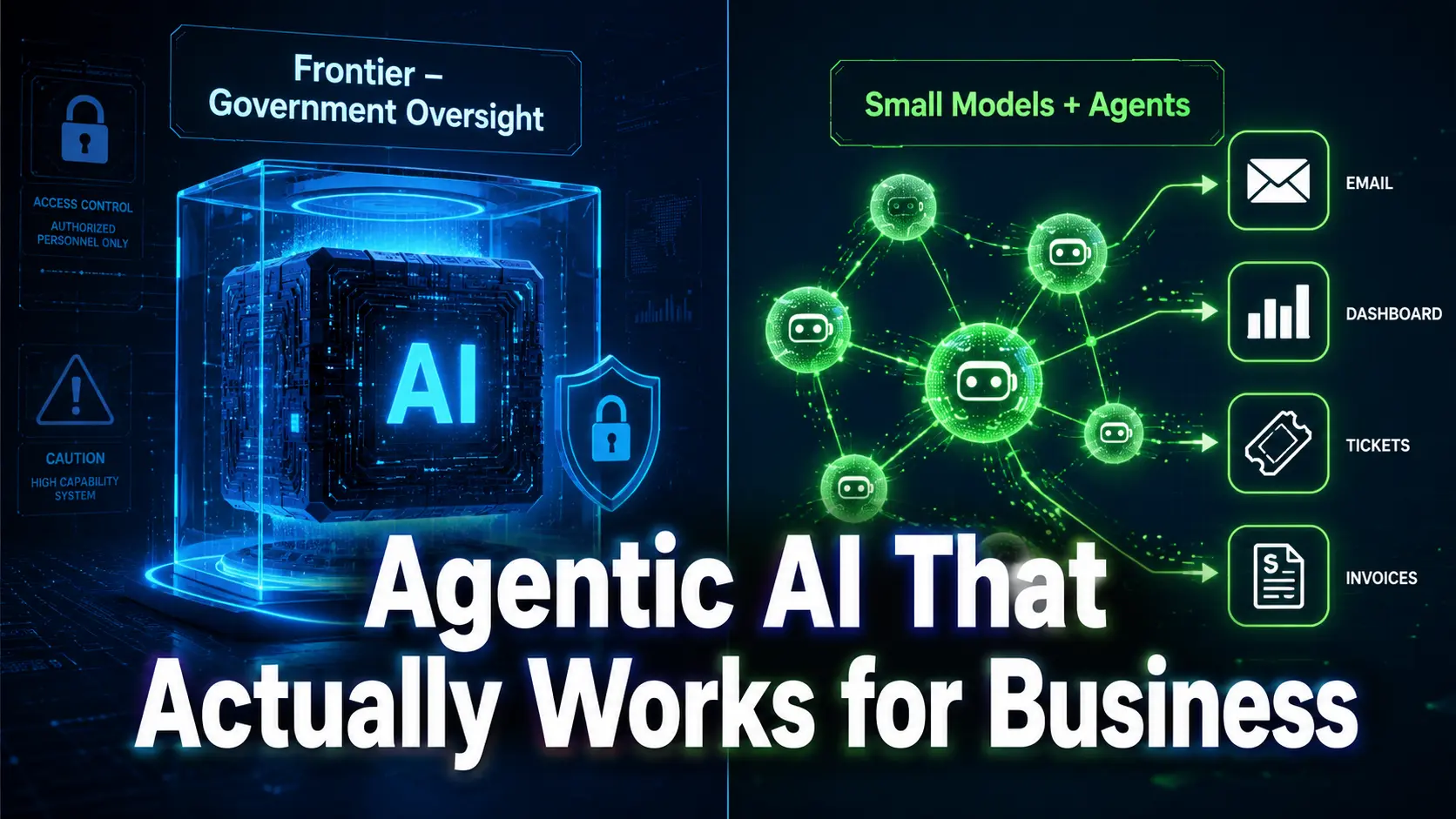
On one side, frontier AI models are being placed under new oversight, with governments testing powerful systems like Anthropic’s Mythos and inviting voluntary cybersecurity review before release. On the other side, businesses are quietly discovering that agentic workflows run better and cheaper on small language models that can be tuned for specific tasks.
For business owners and CIOs, this split changes how to think about AI strategy. Frontier models will matter for national security, critical infrastructure and a small number of high stakes use cases. Everyday automation, however, will increasingly depend on smaller, specialised models powering agents inside support, sales, finance and operations.
This article explains what has changed in June 2026, why it matters, and how Kersai believes businesses should design their AI stack so that it takes advantage of both worlds without getting crushed by cost, lock in or regulatory risk.
How 2026’s New AI Reality Changes Business Strategy
The story of AI in 2026 is no longer simply about bigger models. It is about who gets access to frontier power, who carries the risk, and which systems actually deliver value on the ground.
In recent weeks two clear signals have emerged. Governments are creating structured ways to test and contain frontier models that have advanced cyber capabilities. At the same time AI research and industry practice are converging on the idea that small language models are the most sensible engine for agentic AI in business.
Understanding this split is now a practical requirement for any serious AI strategy.
Frontier AI Moves Under Government Oversight
The first reality is the frontier.
In April and May, Anthropic and the Australian Government signed a memorandum of understanding to collaborate on the national AI plan and critical infrastructure readiness. Shortly after, Anthropic granted selected organisations access to Claude Mythos Preview, an advanced model explicitly held back from public release because of its cybersecurity capabilities and associated risk.
The access program covered government agencies and a limited number of private organisations across multiple countries. It treated Mythos as a restricted system suitable for controlled usage, not for general consumer deployment. Subsequent concerns and incidents then led to further scrutiny and tightening of access.
In parallel, the United States has now formalised its direction of travel for frontier oversight. On 2 June 2026, the White House signed an order on Promoting Advanced Artificial Intelligence Innovation and Security. That order instructs national security, cyber and standards agencies to benchmark advanced AI models and define when a system becomes a covered frontier model.
It also creates a voluntary framework. Developers of these models are invited to give the government access for up to 30 days before release to other trusted partners. The idea is to allow classified testing of cyber capabilities, hazard thresholds and suitable early partners without creating mandatory licensing or pre clearance.
Together these developments say something simple. Frontier AI is starting to be treated like critical infrastructure technology. Governments want visibility into the most advanced systems before they spread, even if they are not yet willing to impose full licensing regimes.
For most businesses this is not about direct participation in frontier review. It is about recognising that the most capable models will increasingly be governed through alliances between governments and a small number of labs.
Agentic AI Becomes the Enterprise Workhorse
The second reality is the world of agents.
Across 2026 trend reports, conferences and product launches, enterprise AI is described as moving from copilots toward agentic systems that can act inside workflows. Agentic commerce platforms, agentic customer experience, automated marketing agents and fraud detection agents have all become recurring examples.
The key difference is what these systems do. Copilots primarily assist humans inside tools. Agents receive goals, call tools and systems and execute multi step tasks with limited human intervention.
For businesses, practical agentic AI is showing up first in:
- Service and support operations
- Sales and revenue operations
- Finance and back office workflows
- Internal knowledge work and reporting
In these domains agents triage tickets, route work, prepare responses, update records and provide drafts that humans review. When designed well, agents compress cycle times, reduce manual error and free staff to focus on judgement and high value interaction.
Importantly, the strongest examples are not moonshots. They are narrow, repetitive workflows where performance can be measured and improvement is easy to see. Enterprises that succeed with agents are those that connect them to obvious business metrics, not those that chase vague digital employee fantasies.
Small Language Models Become the Engine for Agents
The third reality is the rise of small language models, often called SLMs.
Papers and practice from NVIDIA and others now make a clear case. For many agentic applications small models are sufficiently powerful, inherently more suitable and economically superior.
The reasoning is straightforward.
Small models can run with much lower latency and energy. They can be deployed on standard infrastructure, at the edge, or even on devices. They are easier to fine tune for specific tasks. They cost less to run per request. For tasks that repeat in narrow patterns, these advantages matter more than raw general capability.
Research teams have showed a pragmatic pattern that works in production.
First, prototype agent workflows with a strong generalist model to discover the tasks and failure modes. Second, identify high volume subtasks such as intent classification, extraction or structured generation. Third, replace these hot spots with specialised small models fine tuned on domain data. Fourth, keep a heterogeneous stack. Use small models as default workers and reserve large models for rare, complex or unusual queries.
Enterprise experience supports this. Usage logs often show that most agent calls fall into a limited set of repetitive patterns. Those patterns can be served just as well by small models that have been tuned for the job.
The practical implication is clear. Frontier models are still essential for some roles, such as complex reasoning or broad synthesis. However, small language models are now the natural choice for the bulk of agent work inside businesses.
Frontier Models vs Small Models vs Hybrid
| Approach | Best suited for | Main strengths | Main trade offs |
|---|---|---|---|
| Frontier LLMs | Complex reasoning, broad synthesis, creative generation, high stakes edge cases | Highest general capability and flexibility | Higher cost, higher latency, more dependence on external platforms, more scrutiny |
| Small language models | Repetitive internal tasks, private workflows, fast classification and generation, edge or local deployment | Lower cost, faster responses, more control over deployment and privacy | Narrower capability, more effort needed to tune for domain |
| Hybrid stack | Agentic systems that mix planning and execution, layered workflows | Balance of capability and efficiency, ability to reserve frontier power for hard problems | More design complexity, requires orchestration and observability |
What This Split Means for Business Owners
For business owners the most pressing questions are not about national security benchmarks. They are about leverage.
The frontier reality matters indirectly. It increases pressure on governments and big labs to treat AI risks as real. It may influence which platforms are considered safe or acceptable for certain industries. It may affect how regulations evolve.
However the daily opportunity lies in agentic workflows powered by models that can be trusted, controlled and afforded.
Owners should focus on questions like:
- Which workflows are consuming disproportionate time or money
- Where faster response directly translates into revenue, retention or satisfaction
- Where staff are stuck doing repetitive admin instead of the work they are hired to do
- Which processes have clear definitions and outcomes, making them suitable for automation
In many cases the right pattern is to introduce task specific agents that perform a bounded job under clear guardrails. For example, triaging low risk support tickets, preparing outreach drafts for review, routing simple invoices, or summarising documents for decision makers.
In these workflows small language models can often provide the backbone. They are cheaper to run, easier to govern and flexible enough when tuned.
The frontier conversation may shape the background of the industry. The agentic small model conversation will shape the economics of individual businesses.
What This Split Means for CIOs
For CIOs the split between frontier oversight and small agent engines creates a design problem.
The frontier oversight direction points toward models that will be:
- evaluated under classified benchmarks
- partially controlled through early access programs
- subject to more visible national security and cyber risk attention
CIOs will want to understand this for risk management, vendor relationships and policy alignment. In some sectors, particularly critical infrastructure or government, frontier programs will be directly relevant.
At the same time CIOs need an architecture that can support agentic systems at scale.
That means answering questions like:
- Which systems can agents read from and write to
- Under what identities and permissions do agents operate
- Which actions are allowed autonomously and which require human approval
- How agent behaviour is logged, monitored and reviewed
- How to handle model changes, vendor changes and policy changes without breaking workflows
In practice this leads to a hybrid design.
Frontier models sit as high capacity generalists reserved for specific tasks where their breadth genuinely matters. Small language models and domain models serve as the main engine for agent workflows in service, sales, finance, HR, and internal operations.
Identity, access control, audit logging and observability become first class components of the architecture. Without them agents are too risky to trust in production.
The Kersai Perspective
Kersai views the new AI split as an opportunity to build smarter, more resilient stacks.
It is tempting to treat frontier oversight headlines as the main story. They are dramatic and politically charged. Yet for most businesses the main story is different. The main story is that there is now a more efficient, controllable way to get agentic AI value using small models and good design.
From Kersai’s perspective the right approach in 2026 is:
- Recognise that frontier models are strategic infrastructure, not the default tool for every task
- Use frontier power where it truly changes capability, especially in complex judgement work
- Design agents around small and domain models to handle the bulk of repetitive load
- Invest in governance, identity, logging and monitoring as product features, not compliance extras
- Keep the architecture flexible so models and vendors can be swapped without rewriting the business
Kersai helps businesses map this landscape and build practical plans. That means working with owners and CIOs to identify high impact workflows, choose suitable models, design agent contracts and embed controls from day one.
The goal is not simply to adopt AI. It is to adopt AI in a way that survives regulation, market shifts and internal change.
A 90 Day Playbook for Late June 2026
Business owners and CIOs do not need a perfect blueprint to start. They need a concrete plan.
Step 1: Pick one painful workflow
Choose a workflow that clearly wastes time, such as ticket triage, invoice routing, inbox handling, meeting scheduling or report preparation. Document the current steps and metrics.
Step 2: Decide the agent role
Define whether the agent will assist a human, perform a bounded task end to end or just prepare drafts. Write down what the agent is allowed to do and what it must never do.
Step 3: Choose the model mix
Use a frontier model only if the workflow genuinely requires broad reasoning or complex judgement. Otherwise prefer a small model or domain specific model for most steps, keeping the option to call a large model for corner cases.
Step 4: Design identity and controls
Assign a clear identity to the agent. Specify which systems it can access, which actions require approval, how every significant action will be logged and how failures will be handled.
Step 5: Implement with production in mind
Connect the agent to real systems, not just test data. Monitor performance, catch errors early and involve security or compliance teams if the workflow has external impact.
Step 6: Measure outcomes
Compare resolution time, throughput, error rates, customer satisfaction or cost metrics against the baseline. Expand the scope only if the metrics improve in a way that matters.
This sequence keeps ambition grounded in reality and avoids the trap of building impressive prototypes that never produce measurable value.
Panic Reaction vs Strategic Reaction
| Panic reaction | Strategic reaction |
|---|---|
| Focus only on frontier oversight headlines | Understand frontier oversight but design everyday workflows around small and domain models |
| Try to run every agent on the biggest model available | Use frontier models selectively and rely on small models for repetitive tasks |
| Delay AI adoption until regulation is fully clear | Adopt AI now with strong controls and flexible architecture |
| Ignore identity and logging for agents | Treat identity, access and audit trails as essential design elements |
| Choose projects based on hype | Choose projects based on clear operational pain and measurable metrics |
Key Takeaways
- AI has split into two realities. Frontier models are moving under government oversight while small language models are becoming the engine of agentic workflows.
- Frontier oversight is about cybersecurity and national security. It matters, but most businesses will feel its effects indirectly through vendor choices and policy.
- Small language models offer practical advantages for business agents, including lower cost, faster responses and better deployment control.
- The smartest path for most organisations in mid 2026 is a hybrid stack with frontier models reserved for hard problems and small models doing most of the daily work.
- Governance is not optional. Identity, access, logging and observability must be part of the design if agents are to be trusted in production.
- Kersai helps businesses navigate this split, choose the right workflows and build AI systems that remain useful and resilient even as the frontier landscape changes.
Frequently Asked Questions
Do I need frontier AI models for my business?
You may not. Frontier models are most important in complex, high stakes tasks that require broad reasoning. Many common business workflows can be handled by smaller, tuned models with better economics and control.
Should I be worried about government AI oversight?
You should be aware of it but not paralysed by it. Government oversight shapes how frontier models are tested and released. Your responsibility is to choose vendors wisely and build systems with good governance.
Are small language models really good enough for agentic AI?
For many tasks yes. When a workflow repeats in consistent patterns and does not require broad creativity, a well tuned small model can perform as well as a large one at lower cost and latency.
How do I decide which model to use where?
Start by mapping tasks. Use large models for planning, complex decisions and rare edge cases. Use small or domain models for repetitive, structured steps. Aim to reserve expensive capacity for problems that genuinely require it.
How does Kersai help in practice?
Kersai works with business owners and CIOs to identify valuable use cases, select the right model mix, design agent contracts and embed identity and governance. The aim is to get real ROI from AI while keeping systems safe and adaptable.
Published by Kersai AI Strategy, Custom Systems & Fractionalized AI Teams | June 28, 2026
© 2026 Kersai. All rights reserved.