
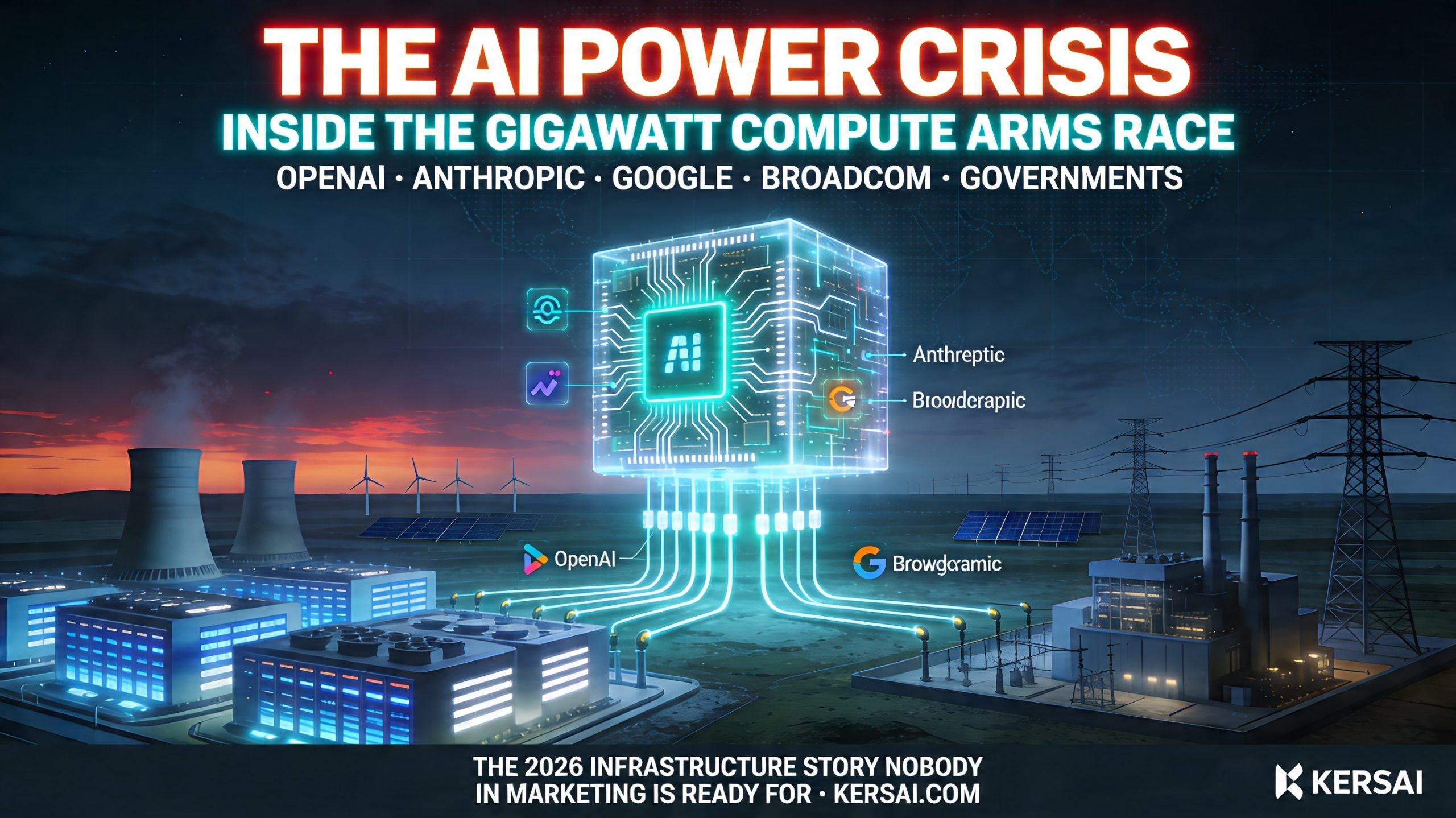
The AI Power Crisis: Inside the Gigawatt Compute Arms Race
Morgan Stanley Warns of a 918 GW Power Shortfall as Labs Lock In Gigawatt-Scale Compute. A Kimberley MegaData Centre, Anthropic’s Multi‑Gigawatt TPU Deal, and What SEO/GEO/AEO Mean in a World Where Electricity, Not Clicks, Is the Bottleneck.
Published: April 20, 2026 | By the Kersai Research Team | Reading Time: ~22 minutes
Last Updated: April 20, 2026
Quick Summary: In March 2026, Morgan Stanley published an “Intelligence Factory” report warning that a massive AI breakthrough is coming in the first half of 2026 driven by an unprecedented build‑up of compute at America’s top AI labs. The same report projects a net U.S. power shortfall of 9 to 18 gigawatts through 2028, a 1225% deficit versus the electricity needed to run planned AI infrastructure. On the other side of the world, plans have emerged for what would be Australia’s biggest AI data centre in Western Australia’s Kimberley region, explicitly framed around gigawatt‑scale AI workloads. Anthropic has just signed a new deal with Google and Broadcom for “multiple gigawatts of next‑generation TPU capacity” coming online from 2027 to power its Claude models. In other words: the limiting factor for AI is quietly shifting from algorithms to energy. This has direct consequences for businesses: cloud costs, regional latency, data‑centre access and, less obviously, how you should think about SEO, GEO (Generative Engine Optimisation), and AEO (Answer Engine Optimisation) in an environment where AI engines themselves are running on constrained infrastructure. This guide explains the power crisis, the gigawatt arms race, and what it means for how your content gets found in 2026 and beyond.
Table of Contents
- The Intelligence Factory: How We Got an AI Power Crisis
- What 918 Gigawatts Actually Means in Plain English
- The Kimberley MegaData Centre: Australia Enters the Gigawatt Game
- Anthropic, Google and Broadcom: Multiple Gigawatts of TPU
- The 15-15-15 Economics of AI Data Centres
- Who Wins When Power Is the Bottleneck?
- How the Power Crunch Affects Cloud Prices and Availability
- What This Means for SEO in 2026
- What This Means for GEO: Optimising for AI Engines Under Constraints
- What This Means for AEO: Capturing AI Overviews When Every Token Costs More
- Why Local Models Like Gemma 4 Suddenly Matter Strategically
- A Practical Playbook: 9 Actions to Take in the Next 90 Days
- FAQ
1. The Intelligence Factory: How We Got an AI Power Crisis
Morgan Stanley’s March 2026 report is blunt: a transformative leap in AI capability is imminent, powered less by new algorithms and more by a massive ramp‑up in compute and energy.
The bank calls this the “Intelligence Factory” model of AI: you feed models compute and electricity, and they output economically valuable intelligence. In this framing, data centres are no longer just infrastructure they are factories whose output is cognition.
Several key points from the report:
- Executives at major AI labs are telling investors to expect progress that will “shock” them over the next 1218 months.
- Elon Musk has argued that applying 10x more compute to training roughly doubles an LLM’s apparent “intelligence,” and Morgan Stanley’s analysts say the scaling laws supporting this claim are still holding.
- OpenAI’s GPT‑5.4 “Thinking” model has already scored at or above human expert levels on key benchmarks for economically valuable tasks.
- The limiting factor is not cleverness; it is power. The report projects a significant electricity shortfall relative to the demand created by this compute build‑out.
This is not speculation from AI researchers on Twitter. It is a global investment bank telling pension funds, sovereign wealth funds, and Fortune 500 boards that the real bottleneck in AI is becoming energy infrastructure.
2. What 918 Gigawatts Actually Means in Plain English
Numbers like “918 gigawatts” are so large that they become abstract. To make sense of them, we need to translate them into something more concrete.
Morgan Stanley’s model forecasts a net U.S. power shortfall of 918 gigawatts between now and 2028 which they estimate as 1225% of the power needed to run planned AI data centres.
Here is what that means in real‑world terms:
- 1 gigawatt is roughly the output of a large nuclear power plant, or the average electricity consumption of about 700,000 homes.
- 918 gigawatts is equivalent to the output of 9 to 18 nuclear plants, or the consumption of 612 million homes.
- In data‑centre terms, the shortfall is similar to being unable to power dozens of hyperscale facilities dedicated entirely to AI workloads.
Developers are not waiting for the grid to catch up. The report describes them:
- Converting Bitcoin mining sites into AI compute centres.
- Restarting or building new natural gas turbines purely to feed data centres.
- Installing on‑site fuel cells and microgrids to reduce dependence on public infrastructure.
The economics are summarised with a new rule of thumb: “15‑15‑15”.
- 15‑year data‑centre leases.
- 15% yields on capital.
- Approximately $15 per watt of net economic value created by AI workloads.
When data centres generate that level of return, they can outbid almost any other energy consumer for electricity including manufacturing, logistics, and, in some regions, residential customers. Power stops being a commodity input and becomes a competitive moat.
3. The Kimberley MegaData Centre: Australia Enters the Gigawatt Game
This is not just an American story. In April 2026, the ABC reported on plans for what would be Australia’s largest AI data centre, proposed for the Kimberley region in Western Australia.
Key points of that plan:
- It is explicitly framed as a gigawatt‑scale AI data centre, built to host the kind of large‑scale training runs used for models like ChatGPT and Claude.
- The proposal includes massive new transmission infrastructure to carry power from remote generation sites to the data centre.
- Local communities and environmental groups have raised concerns about the impact on Country, water usage, and the broader Kimberley ecosystem.
- Proponents argue that, if built, the site would position Australia as a serious global player in AI infrastructure rather than just a consumer.
The Kimberley site is part of a broader pattern: countries and regions with access to relatively cheap, stable power and politically stable governance are racing to become AI power exporters selling not just cloud capacity, but the energy‑backed intelligence that runs on top of it.
For Australian businesses, this is a strategic fork in the road: do you treat AI as a service you import from U.S. data centres, or as an industry you help host and shape domestically?
4. Anthropic, Google and Broadcom: Multiple Gigawatts of TPU
On April 6, 2026, Anthropic announced that it has signed a new agreement with Google and Broadcom for multiple gigawatts of next‑generation TPU (Tensor Processing Unit) capacity, expected to come online starting in 2027.
The announcement matters for several reasons:
- “Multiple gigawatts” is not marketing language; it is an infrastructure commitment on the scale of national grids. It implies several massive data centres dedicated largely to Claude models.
- Anthropic’s revenue has exploded: run‑rate revenue has crossed $30 billion, up from about $9 billion at the end of 2025, with more than 1,000 enterprise customers each spending over $1 million per year on Claude double the number from just a couple of months earlier.
- Most of this new compute will be sited in the United States, expanding on a prior commitment to invest tens of billions of dollars in American AI infrastructure.
- Anthropic continues to train and run Claude across a mix of AWS Trainium, Google TPUs and NVIDIA GPUs, matching workloads to the most suitable hardware and spreading risk across multiple clouds.
On the hardware side, Broadcom has simultaneously told investors that expanded deals with Google and Anthropic will drive tens of billions of dollars in AI chip revenue over the next decade. Google is effectively committing to building and operating data centres that draw gigawatts of power so that Anthropic and other AI customers can rent slices of that compute.
Taken together, the Morgan Stanley forecast, the Kimberley proposal, and the AnthropicGoogleBroadcom deal all point to the same reality: over the next 35 years, AI will be limited by power long before it is limited by algorithms.
5. The 15-15-15 Economics of AI Data Centres
The Morgan Stanley report uses the “15‑15‑15” shorthand to describe a new economics of AI data centres:
- 15‑year leases long‑term contracts tying specific sites, power sources and customers together.
- 15% yields returns that are exceptionally attractive in a world starved for yield, drawing in infrastructure funds and sovereign capital.
- $15 per watt of net value the estimated value generated per watt of data‑centre capacity by AI workloads.
This is very different from traditional cloud computing, where utilisation rates and pricing pressure pushed margins downward over time. In the AI era:
- Utilisation is extremely high training and inference workloads can run 24/7 with little idle time.
- Customers often sign take‑or‑pay contracts that guarantee minimum usage levels.
- The scarcity of power and specialised chips allows providers to maintain pricing power.
For businesses, this translates into two effects:
- Cloud AI prices are unlikely to collapse. Even as models become more efficient, demand for tokens and more capable models grows faster.
- Regional availability and latency will diverge. Regions with more power and more AI‑specific data centres will enjoy lower prices and better performance than those without.
SEO professionals have spent two decades optimising for algorithms that behaved as if compute and power were effectively infinite. That assumption is breaking.
6. Who Wins When Power Is the Bottleneck?
When electricity becomes the main constraint, the players who win are not necessarily the ones with the best algorithms but the ones with the best access to power and chips.
There are three tiers emerging:
- Frontier labs with gigawatt commitments
OpenAI, Anthropic, Google DeepMind, and a handful of others are locking in multi‑gigawatt deals. They will control the highest‑capability models and command premium prices for access. Their products (ChatGPT, Claude, Gemini) will be the primary targets for GEO/AEO strategies. - Hyperscalers and chipmakers
Companies like Google Cloud, AWS, Microsoft Azure, NVIDIA, and Broadcom sit in the middle building the hardware, leasing the data centres, and selling slices of compute to both AI labs and enterprises. Their pricing and capacity decisions will influence how expensive AI is for everyone else. - Everyone else
Enterprises, governments, and smaller AI companies that do not control their own power and chip supply will be price‑takers. They will need to choose between:
- Paying for access to frontier APIs.
- Building on open models like Gemma 4, Llama, and Mistral.
- Running some workloads locally or in regional data centres to reduce dependency on global power bottlenecks.
For your SEO/GEO/AEO strategy, this matters because it determines how often and how deeply AI engines can afford to crawl, read and re‑process the web and how selective they will be in what they index and cite.
7. How the Power Crunch Affects Cloud Prices and Availability
In a world where AI workloads can generate $15 per watt in economic value, data‑centre operators have strong incentives to prioritise AI over less profitable uses of compute.
The practical implications for businesses:
- AI API pricing will remain structurally higher than many people expected. The dream that “AI will get cheap like storage” was based on the wrong analogy. Storage is capacity‑constrained; AI is power‑constrained.
- Regional capacity constraints will show up as waitlists and throttling. You will see more “rate limit exceeded” messages, regional restrictions on certain AI features, and priority tiers for enterprise customers.
- Cloud providers will quietly push customers toward more efficient models (e.g., smaller variants, low‑latency options) that generate more revenue per watt, even if they are slightly less capable on paper.
- Energy‑intensive features (like always‑on browsing, long context windows and heavy multimodal usage) will be priced or throttled separately. They will not disappear, but they will be treated as premium features.
This isn’t theoretical. We already see:
- Separate pricing tiers for “thinking” or “deep reasoning” modes.
- Premium charges or caps for 200K1M token context windows.
- Additional fees for multimodal use (e.g., video analysis).
All of this feeds directly into how SEO/GEO/AEO should be done in 2026.
8. What This Means for SEO in 2026
Traditional SEO assumes that search engines can crawl the web essentially for free and that ranking is a pure function of relevance and authority. In a world where power is the bottleneck, crawling and indexing become economically constrained activities.
Three practical shifts for SEO:
8.1 Crawl budget becomes power budget
If each additional crawl, re‑index, or rendering of a JavaScript‑heavy site consumes meaningful power and GPU time, search engines will:
- Prioritise sites that are lightweight and well‑structured.
- Re‑index content that has historically proven to be useful and engaged with.
- Down‑prioritise sites that are slow, bloated, or rarely provide unique value.
Action: Treat performance and cleanliness as ranking factors. Lightweight HTML, fast load times, and minimal client‑side rendering are no longer just “nice for users” they make your site cheaper to crawl.
8.2 Freshness gets more selective
Re‑crawling the entire web every few days is expensive. Search engines will favour fresh content in high‑value domains (finance, health, news, AI) and let low‑value, static content age.
Action: If you want frequent re‑crawls, publish in topic clusters where you can build recognised expertise and engagement. Thin, scattered content across many unrelated topics will not earn frequent crawl cycles.
8.3 Structural clarity matters more
If AI models and search engines are power‑constrained, they will favour content that is cheap to parse:
- Clear headings that map to specific questions.
- Concise summaries at the top of sections.
- Structured data (schema.org) that can be processed without running a full LLM pass.
Action: Write every section as if you are trying to minimise the compute required to extract its meaning. That mindset naturally improves both SEO and GEO/AEO.
9. What This Means for GEO: Optimising for AI Engines Under Constraints
GEO (Generative Engine Optimisation) is about making your content easy for AI engines like ChatGPT, Perplexity, Gemini and Claude to discover, understand and cite. In a power‑constrained world, those engines face similar trade‑offs to search engines, but with an extra layer: they must decide how much compute to spend on each user query.
This leads to three GEO implications:
9.1 Engines will prefer “cheap to answer” topics
When users ask questions, AI engines can:
- Generate answers from their internal parameters (no browsing).
- Browse and fetch just one or two high‑quality sources.
- Perform heavy browsing and synthesis across many sites.
Heavy browsing is expensive: it consumes bandwidth, GPU time and power. Over time, engines will try to minimise costly browsing except where the value (and possibly paid tier) justifies it.
Action: Position your content as a canonical, one‑stop source on a topic so the engine can satisfy its “fetch one or two sources and stop” strategy. Deep, comprehensive guides (like your Mythos and Gemma 4 articles) are ideal for this.
9.2 GEO is about being the default citation, not one of many
If engines want to conserve power, they will cite fewer sources per answer. Instead of 10 references, you may see 34.
Action: GEO strategy should aim to be the default citation for specific question clusters, not just “one of many” sources. That means:
- Owning narrow, high‑intent topics (e.g., “Gemma 4 hardware requirements”, “Anthropic compute deal explained”).
- Structuring content so that the answer appears in one self‑contained section the engine can easily lift.
9.3 Engines will favour structured, tool‑friendly outputs
Models like Gemma 4 are built for agentic workflows they can output structured JSON, call tools and follow system instructions. For GEO, this means engines will favour content that is easy to turn into structured data.
Action: Include:
- Bullet lists of key numbers.
- Tables of benchmarks or comparisons.
- Consistent phrasing for critical facts (e.g., “Anthropic’s run‑rate revenue is now $30 billion, up from $9 billion at the end of 2025.”)
The more predictable your phrasing, the easier it is for AI to extract and reuse without additional compute.
10. What This Means for AEO: Capturing AI Overviews When Every Token Costs More
AEO (Answer Engine Optimisation) is about structuring content so that AI engines can answer specific questions directly using your words. In a power‑constrained environment, AEO becomes even more important because:
- Engines want to minimise the number of tokens they generate per answer.
- Well‑structured answers that fit within a tight budget are more attractive.
- Poorly structured content forces engines to think more, which costs more.
Three AEO tactics for a power‑constrained world:
10.1 Lead every section with a 4060 word direct answer
For every heading that maps to a likely user question (“Is there really an AI power crisis?” “What is Anthropic’s compute deal?”), start with a 4060 word direct answer in plain language before any elaboration.
This lets AI engines:
- Copy or paraphrase your first paragraph.
- Minimise additional reasoning tokens.
- Attribute you as the source with minimal cost.
10.2 Build FAQ sections that mirror real AI prompts
At the end of the article (like the FAQ in this guide), include questions written exactly as users type them into ChatGPT, Perplexity or Gemini. Then answer each in 24 sentences.
This gives AEO‑optimised content that maps one‑to‑one with AI queries.
10.3 Use schema to label answers explicitly
When you can, add FAQPage, HowTo and Article schema, with:
- Questions and acceptedAnswers fields for FAQs.
- Step lists for how‑to sections.
- Key facts encoded where appropriate.
This helps not only Google but any AI engine that uses schema as a low‑compute way to assemble answers.
11. Why Local Models Like Gemma 4 Suddenly Matter Strategically
So far we’ve focused on frontier labs and cloud compute. But there is a parallel story: models like Google’s Gemma 4 free, open, and designed to run on laptops, phones and small servers.
This matters for three reasons:
- They bypass the global power bottleneck.
Running Gemma 4 E2B or E4B on devices spreads power consumption across billions of phones and laptops, instead of concentrating it in a few data centres. At the organisational level, running a 26B or 31B Gemma model on your own GPU cluster lets you control where and how power is used. - They create a second tier of AI search and reasoning.
Not every query needs to hit a frontier API. In the same way browser caches reduce web traffic, locally deployed models reduce calls to power‑constrained cloud AI. That means many internal search and Q&A workloads can run entirely on Gemma‑class models. - They change the GEO/AEO surface area.
If organisations embed their own Gemma‑based retrieval over their own content, your public content is no longer the only surface where AI engines retrieve answers. For B2B, that means you need both:
- Public‑facing content optimised for global AI engines.
- Private content (e.g., in customer portals, docs and PDFs) optimised for clients’ internal AI systems.
For Kersai’s positioning, this is gold: you can help clients design two‑layer AI content strategies one for external GEO/AEO, one for internal retrieval over local models.
12. A Practical Playbook: 9 Actions to Take in the Next 90 Days
Bringing it all together, here is a concrete playbook for the next 90 days.
12.1 Map your AI dependencies
List where you depend on external AI APIs today (ChatGPT, Claude, Gemini, etc.) and estimate:
- Monthly tokens consumed.
- Workloads that are latency or privacy sensitive.
- Workloads that could move to local models without losing quality.
This gives you a baseline for how exposed you are to future price and capacity shocks.
12.2 Identify “must own” topics for GEO/AEO
For your industry, list:
- 1020 questions that must return your brand in ChatGPT, Perplexity and Gemini answers.
- For each question, plan one flagship article or guide that gives a complete, structured, AEO‑friendly answer.
You have already done this for AI bots/GEO and for specific models like Mythos and Gemma 4. Extend the approach to the AI power topic and your clients’ verticals.
12.3 Re‑engineer your top 10 pages for “cheap parsing”
Take your top 10 traffic pages and:
- Add a 4060 word direct answer at the top of every major section.
- Add clear H2/H3 headings phrased as questions.
- Reduce unnecessary fluff and heavy scripts.
You want your most important content to be the least expensive for AI engines to crawl and extract.
12.4 Add FAQ and HowTo schema wherever relevant
Anywhere you already have Q&A or step‑by‑step content:
- Mark it up with FAQPage schema.
- Use HowTo schema for process‑driven sections.
- Ensure the questions match real AI prompts, not just SEO keywords.
12.5 Pilot an internal Gemma 4 deployment
For your own stack (and for clients):
- Deploy Gemma 4 E4B or 26B behind the firewall.
- Connect it to a small corpus (e.g., internal docs, support tickets).
- Compare quality and latency vs a cloud‑only solution.
This is as much about learning how local AI feels operationally as it is about immediate cost savings.
12.6 Add power and compute to your risk register
At the leadership level, add AI power and compute availability as a formal risk:
- What if your primary AI provider throttles access during peak times?
- What if prices increase 50100%?
- What if regulatory or political changes affect data‑centre sites in a key region?
Then outline mitigation strategies: multi‑provider integration, local models, regional redundancy.
12.7 Build a “power‑aware” AI roadmap for clients
For Kersai specifically: every AI roadmap you deliver should:
- Acknowledge power and compute constraints explicitly.
- Distinguish between workloads that truly need frontier APIs and those that can run on local or smaller models.
- Position open models (like Gemma 4) as part of a strategic resilience plan, not just a cost‑saving tool.
12.8 Monitor AI infrastructure announcements like product launches
Treat data‑centre and compute announcements the same way you treat model releases:
- Track where major labs are building capacity.
- Note regions gaining or losing AI infrastructure investment.
- Watch for national strategies (like the Kimberley proposal) that may change regional cloud dynamics.
This helps you anticipate where GEO/AEO opportunities may concentrate geographically.
12.9 Educate your audience about the AI power story
Most executives are still thinking about AI purely in terms of features and cost. Bringing the power story into your content:
- Differentiates you as someone who understands the full stack (models + infrastructure + regulation).
- Naturally leads into discussions about SEO/GEO/AEO under constraints.
- Creates a content niche you can own globally.
This article is one such piece; build supporting content (short posts, explainers, graphics) around it.
13. FAQ
Is there really an AI power crisis in 2026?
Yes. Morgan Stanley’s “Intelligence Factory” report projects a 918 gigawatt U.S. power shortfall through 2028, equivalent to 1225% of the electricity needed to power planned AI data centres. Developers are already scrambling for alternative power sources and repurposing existing infrastructure to keep up.
What is the Kimberley AI data centre plan?
In April 2026, plans emerged for what would be Australia’s largest AI data centre in Western Australia’s Kimberley region. The proposal envisions gigawatt‑scale power consumption focused on AI workloads like large language model training, prompting debates over environmental impact, Indigenous land rights and the role of Australia as an AI infrastructure host.
What is Anthropic’s multi‑gigawatt TPU deal?
Anthropic announced a new agreement with Google and Broadcom to secure multiple gigawatts of next‑generation TPU capacity, with most of that compute coming online starting in 2027. This deal is designed to support Anthropic’s explosive revenue growth and the training and deployment of future Claude models, and it significantly expands U.S. AI infrastructure.
How does the AI power crisis affect cloud prices?
When data centres can generate high, predictable returns from AI workloads, operators have little incentive to cut prices aggressively. In practice, that means AI API prices are likely to remain structurally higher than many expect, with premium features (long context, browsing, multimodal processing) priced or throttled separately. Regional power constraints may also result in capacity limits or waitlists.
How does this change SEO?
Search engines will be more selective about what they crawl and how often they re‑index content. Lightweight, well‑structured, high‑value sites will be prioritised. Crawl budget effectively becomes a power budget: if your site is slow, bloated or low‑value, it is less likely to earn frequent re‑crawls, reducing your visibility.
How does this change GEO?
GEO becomes a race to be the default citation in AI answers. AI engines facing power constraints will try to minimise browsing and rely on a small number of high‑quality sources per query. That rewards deep, canonical guides with clear structure and penalises thin content. GEO is no longer just about being relevant; it is about being the cheapest reliable source to query.
How does this change AEO?
AEO favours content that lets AI answer specific questions with minimal extra reasoning. Sections that open with 4060 word direct answers, clear FAQ blocks that mirror real prompts, and structured schema make it cheaper for AI engines to use your content. In a power‑constrained environment, that cheapness becomes a ranking factor inside AI systems themselves.
Should my company use local models like Gemma 4?
In many cases, yes. Local models like Gemma 4 can handle a large share of everyday tasks document processing, internal search, coding assistance, multilingual support at low cost and with full data control. They reduce dependence on power‑constrained cloud AI and create resilience if API prices rise or capacity is limited. They also allow you to deploy AI where data residency or privacy rules make cloud use difficult.
This article was researched and written by the Kersai Research Team. Kersai is a global AI consultancy firm helping businesses navigate the intersection of AI models, infrastructure and regulation and redesign SEO, GEO and AEO strategies for the AI‑first era. To discuss how the AI power crisis affects your digital strategy, visit kersai.com.