
Microsoft Just Launched 3 World-Class AI Models It Built Entirely In-House — And Nobody Is Talking About What It Really Means
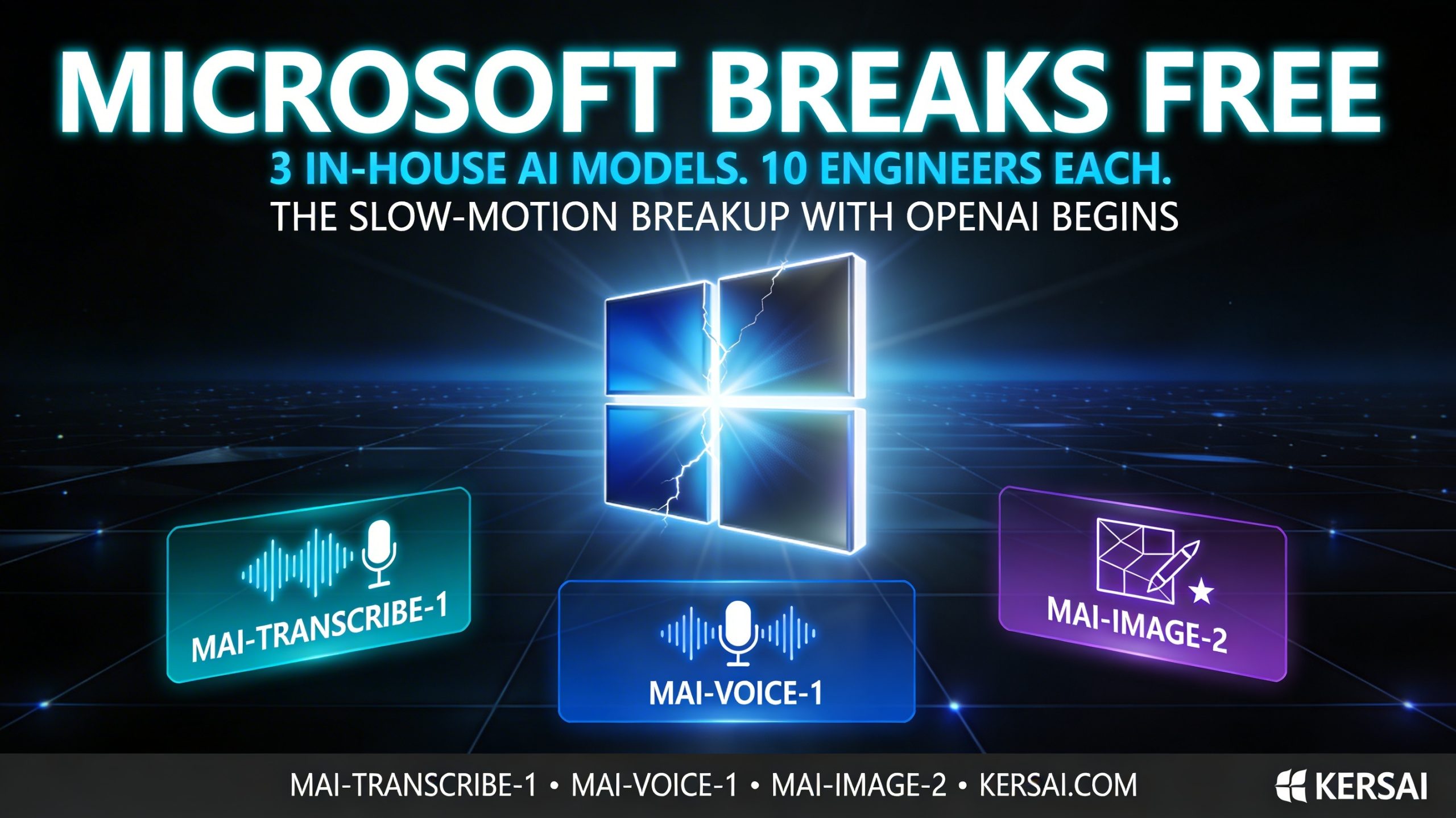
MAI-Transcribe-1, MAI-Voice-1, and MAI-Image-2. Built by Teams of Fewer Than 10 Engineers. Priced Below Every Hyperscaler. Running on Half the GPUs. This Is Microsoft’s Slow-Motion Breakup With OpenAI And the Most Strategically Important AI Story of the Week.
Published: April 7, 2026 | By the Kersai Research Team | Reading Time: ~20 minutes
Last Updated: April 7, 2026
Quick Summary: On April 2, 2026, Microsoft’s AI Superintelligence team led by Mustafa Suleyman and formed just six months ago launched three new in-house AI models available immediately via Microsoft Foundry and the new MAI Playground: MAI-Transcribe-1 (speech-to-text), MAI-Voice-1 (voice generation), and MAI-Image-2 (image generation). Each model claims best-in-class or near-best performance in its category beating OpenAI’s Whisper on all 25 benchmarked languages, generating 60 seconds of voice audio in one second, and landing top-three on the Arena.ai image leaderboard. The kicker: each was built by a team of fewer than 10 engineers, runs on half the GPU footprint of competitors, and is priced below every major cloud hyperscaler including Amazon and Google. This announcement is not just about three new models. It marks the opening move of Microsoft’s explicit strategy of AI self-sufficiency building a complete in-house AI stack that reduces its dependency on OpenAI, with a frontier large language model confirmed as the next objective. Until October 2025, Microsoft was contractually prohibited from independently pursuing superintelligence. That constraint is gone. And Mustafa Suleyman is moving fast.
Table of Contents
- The Context Nobody Is Explaining: Why Microsoft Building Its Own Models Is a Big Deal
- The Contract Renegotiation That Changed Everything
- Meet the MAI Superintelligence Team and Mustafa Suleyman
- MAI-Transcribe-1: The World’s Most Accurate Speech-to-Text Model
- MAI-Voice-1: 60 Seconds of Voice in One Second
- MAI-Image-2: From Copilot to PowerPoint to the World’s Biggest Ad Agency
- The Lean Team Story: How 10 Engineers Beat Hundreds
- The Pricing Strategy: Deliberately Cheaper Than Amazon and Google
- “Humanist AI”: What Suleyman’s Philosophy Means for Enterprise Buyers
- The Frontier LLM Is Coming And Microsoft Plans to Be “Completely Independent”
- What This Means for the OpenAI Partnership
- How the MAI Models Fit Into Microsoft’s Broader AI Stack
- What This Means for Australian Businesses
- FAQ
1. The Context Nobody Is Explaining: Why Microsoft Building Its Own Models Is a Big Deal
To understand why this announcement matters, you need to understand Microsoft’s position in the AI landscape and the uncomfortable dependency it has been quietly working to escape.
Since 2019, Microsoft has been the primary backer and infrastructure partner of OpenAI. The relationship has been the defining technology partnership of the AI era: Microsoft invested over $13 billion, provided the Azure cloud compute that trains and runs OpenAI’s models, and in return received the right to distribute and embed OpenAI’s technology across its entire product portfolio Copilot, Teams, Bing, Office 365, GitHub, Azure.
On paper, it looked like a perfect arrangement. In practice, it created a strategic vulnerability that Microsoft’s board and investors have been increasingly uncomfortable with: Microsoft’s AI capability was entirely dependent on a single third-party supplier that it did not control.
OpenAI could raise its API prices. OpenAI could change its terms. OpenAI could prioritise other distribution channels. OpenAI could and has struck deals with Microsoft’s direct competitors. If OpenAI’s technology strategy diverged from Microsoft’s needs, Microsoft had no alternative. It was, in Suleyman’s own words, building the world’s most important AI products on a foundation it did not own.
The three MAI models launched on April 2 are Microsoft’s first concrete answer to that vulnerability. They are the opening moves in a multi-year strategy to make Microsoft’s AI capability independent of any single external supplier what Suleyman calls “AI self-sufficiency.”
That is not a marginal strategic adjustment. It is a fundamental restructuring of one of the most consequential technology partnerships in history.
2. The Contract Renegotiation That Changed Everything
The most significant detail in the entire MAI launch story is one that has been largely buried in the coverage: until October 2025, Microsoft was contractually prohibited from independently pursuing artificial general intelligence.
The original 2019 Microsoft-OpenAI deal gave Microsoft an exclusive cloud partnership and broad licence rights to OpenAI’s models in exchange for building and funding the compute infrastructure OpenAI needed to train its models. Embedded in those terms was a restriction: Microsoft could not independently pursue AGI or superintelligence. The deal was, implicitly, a non-compete OpenAI’s insurance against its primary investor and infrastructure partner becoming its primary competitor.
That changed in September 2025. When OpenAI sought to expand its compute footprint beyond Microsoft striking infrastructure deals with SoftBank, Oracle, and others as part of the Stargate project Microsoft used the moment to renegotiate the entire agreement. The revised terms, which came into effect in October 2025, removed the AGI restriction. Microsoft retained its licence to everything OpenAI builds through 2032, but was now free to build competing models independently.
Suleyman described the significance bluntly in an interview: “Back in September of last year, we renegotiated the contract with OpenAI, and that enabled us to independently pursue our own superintelligence. Since then, we’ve been convening the compute and the team and buying up the data that we need.”
The MAI Superintelligence team was formally stood up in October 2025 the same month the revised contract took effect. The three models launched April 2 are the first output of a team that has existed for just six months. The pace of delivery is remarkable.
The timeline that matters
| Date | Event |
|---|---|
| 2019 | Original Microsoft-OpenAI deal signed Microsoft prohibited from independent AGI pursuit |
| 20232025 | Microsoft invests $13B+ total; embeds OpenAI across all products |
| September 2025 | Contract renegotiated AGI restriction removed |
| October 2025 | MAI Superintelligence team formally established under Suleyman |
| March 2026 | Suleyman relieved of day-to-day Copilot responsibilities to focus on MAI |
| April 2, 2026 | Three MAI models launched Microsoft’s first in-house frontier AI releases |
| 20272028 | Frontier LLM confirmed as next target |
3. Meet the MAI Superintelligence Team and Mustafa Suleyman
Mustafa Suleyman is one of the most consequential figures in AI’s history though he is less widely known than Sam Altman or Demis Hassabis. He co-founded DeepMind in 2010 alongside Demis Hassabis and Shane Legg the company that went on to develop AlphaGo, AlphaFold, and Gemini before being acquired by Google. At DeepMind, Suleyman led applied AI the translation of research into real-world products.
He left DeepMind in 2022 under complex circumstances, co-founded the AI safety company Inflection AI (which developed the Pi personal AI assistant), and was then recruited by Satya Nadella to join Microsoft in 2024 where he became CEO of Microsoft AI, overseeing Copilot and all AI products.
In October 2025, with the OpenAI contract renegotiated, Nadella gave Suleyman a new mandate: build Microsoft’s own superintelligence capability from scratch. In March 2026, Suleyman was formally separated from day-to-day Copilot product responsibilities with former Snap executive Jacob Andreou taking over as EVP of Copilot to focus exclusively on the MAI mission.
The MAI Superintelligence team Suleyman leads operates unlike anything else in Microsoft. In his own description:
“There are groups of people around round tables, circular tables, not traditional desks, on laptops instead of big screens. They’re basically vibe coding, side by side all day, morning till night, in rooms of 50 or 60 people.”
It sounds less like a $3 trillion corporation’s research division and more like a well-funded startup. That is entirely intentional and it explains how teams of fewer than 10 engineers built models that are competing with the outputs of organisations hundreds of times larger.
4. MAI-Transcribe-1: The World’s Most Accurate Speech-to-Text Model
4.1 What it does
MAI-Transcribe-1 is a speech-to-text transcription model it converts spoken audio into written text. That sounds simple, but accurate transcription at scale across multiple languages, accents, and acoustic environments is one of the hardest problems in applied AI. The quality gap between a good and a bad transcription model is immediately obvious to anyone who has used voice transcription in a real business context.
MAI-Transcribe-1 is Microsoft’s answer to this problem and by the industry-standard benchmark, it is currently the best transcription model in the world.
4.2 The benchmark numbers
The FLEURS benchmark measures Word Error Rate (WER) across multiple languages lower is better, as a lower WER means fewer transcription errors. Across the top 25 languages by Microsoft product usage:
| Model | Average WER | Languages Won |
|---|---|---|
| MAI-Transcribe-1 | 3.9% | Benchmark leader |
| OpenAI GPT-Transcribe | 4.2% | |
| ElevenLabs Scribe v2 | 4.3% | |
| Google Gemini 3.1 Flash | 4.9% | |
| OpenAI Whisper-large-v3 | 7.6% |
MAI-Transcribe-1 beats OpenAI’s Whisper-large-v3 the reigning open-source transcription standard on all 25 benchmarked languages. It beats Google’s Gemini 3.1 Flash on 22 of 25. It beats both ElevenLabs Scribe v2 and OpenAI’s GPT-Transcribe on 15 of 25 each.
These are not marginal improvements. Cutting average WER from 7.6% (Whisper) to 3.9% (MAI-Transcribe-1) roughly halves the error rate meaning transcripts that previously required significant human correction now need far less editing.
4.3 The speed advantage
Beyond accuracy, MAI-Transcribe-1 delivers batch transcription at 2.5x the speed of Microsoft’s existing Azure Fast transcription offering. Suleyman noted that the audio model uses half the GPU resources of state-of-the-art competitors to achieve this performance a combination of superior accuracy, faster throughput, and lower compute cost that is difficult to achieve simultaneously.
4.4 Technical specifications
- Architecture: Transformer-based text decoder with a bi-directional audio encoder
- Supported formats: MP3, WAV, FLAC files up to 200MB
- Supported languages: Top 25 languages by Microsoft product usage
- Coming soon: Diarization (speaker identification), contextual biasing, streaming transcription
- Pricing: Starts at $0.36 per hour of audio transcribed
- Available: Microsoft Foundry and MAI Playground
4.5 Where it’s already deployed
Microsoft is already testing MAI-Transcribe-1 inside two of its largest consumer and enterprise products: Copilot Voice mode and Microsoft Teams meeting transcription. This embedded deployment path building the model into products that hundreds of millions of people use daily is Microsoft’s primary competitive advantage over pure-play transcription vendors like AssemblyAI, Deepgram, or Rev.
Any developer or business currently paying for third-party transcription APIs should benchmark MAI-Transcribe-1 immediately. The accuracy, speed, and price combination is aggressive and Microsoft’s Foundry distribution means integrating it requires no new vendor relationships if you are already in the Azure ecosystem.
5. MAI-Voice-1: 60 Seconds of Voice in One Second
5.1 What it does
MAI-Voice-1 is a text-to-speech voice generation model the reverse of transcription. It takes written text as input and outputs natural, human-sounding spoken audio. The applications range from voice assistants and conversational AI to audiobook generation, accessibility tools, and customer service automation.
5.2 The headline specifications
- Speed: Generates 60 seconds of audio in a single second 60x real-time generation speed
- Voice cloning: Creates a custom synthetic voice from just a few seconds of source audio
- Identity preservation: Maintains speaker identity consistently across long-form content the voice stays recognisably the same whether generating a 10-second response or a 30-minute audio document
- Emotional range: Described as “rich with nuance, emotional range and expression” the model handles the prosodic variation (pitch, emphasis, rhythm) that distinguishes natural speech from robotic text-to-speech
- Pricing: $22 per 1 million characters
- Available: Microsoft Foundry; voice experiences in Copilot via Copilot Audio Expressions and Copilot Podcasts
5.3 The custom voice capability and its implications
The most commercially significant capability in MAI-Voice-1 is custom voice creation from just a few seconds of audio. This means:
- A business can create a branded AI voice for its customer service system using only a brief sample of a human voice actor no lengthy recording sessions required
- Developers building voice agents can personalise the AI voice to match a specific persona or brand identity with minimal setup
- Content creators can generate audio in their own voice from written text without recording
Voice cloning from minimal audio has existed in the market ElevenLabs pioneered commercial voice cloning but MAI-Voice-1’s integration into Microsoft Foundry means this capability is now available within the same enterprise platform and governance framework that Microsoft’s enterprise customers already use. For businesses with compliance requirements around AI-generated voice content, having voice cloning within Azure’s governance infrastructure is a material advantage over external voice AI vendors.
5.4 Competitive positioning
MAI-Voice-1 directly competes with:
- ElevenLabs: The current market leader in voice cloning and generation but a standalone platform with its own pricing and API
- OpenAI TTS: OpenAI’s text-to-speech model, without custom voice cloning capability at this level
- Google Cloud Text-to-Speech: Strong but without the voice cloning feature at comparable depth
- Amazon Polly: AWS’s TTS service competitive on price but behind on naturalness and cloning
Microsoft’s distribution moat is decisive here: any developer already building on Azure and Foundry can add MAI-Voice-1 without a new vendor relationship, a new pricing agreement, or a new governance review.
6. MAI-Image-2: From Copilot to PowerPoint to the World’s Biggest Ad Agency
6.1 What it does and how it performs
MAI-Image-2 is Microsoft’s upgraded AI image generation model. It debuted as a top-three model family on the Arena.ai leaderboard a community-driven benchmark where real users rate AI image outputs making it competitive with the best image generation models available, including Midjourney, DALL-E 3, and Stable Diffusion XL.
The key performance improvements over its predecessor:
- 2x faster generation on Foundry and Copilot compared to the previous MAI-Image model, based on real-world production traffic data
- Better skin tones and natural lighting: Specifically optimised for photorealistic human subjects skin tone accuracy and natural lighting have historically been weak points in AI image generation
- Accurate in-image text: Renders legible, accurate text within generated images critical for diagrams, layouts, infographics, and marketing materials where text clarity matters
- Pricing: $5 per 1M tokens for text input, $33 per 1M tokens for image output
6.2 Where it’s being deployed
MAI-Image-2 is rolling out across:
- Microsoft Copilot: Already the primary image generation experience for Copilot users
- Bing Image Creator: The image generation tool within Bing Search
- PowerPoint: AI image generation within presentations enabling users to generate custom visuals directly inside their slides
- Microsoft Foundry: Available via API for developers to integrate into their own applications
The PowerPoint integration deserves particular attention for Australian business users. The ability to generate high-quality, brand-appropriate images directly within a presentation tool without leaving the application, without a separate subscription, and without copyright concerns removes one of the most common friction points in business content creation.
6.3 WPP partnership enterprise creative at scale
WPP one of the world’s largest advertising and marketing holding companies, with clients including virtually every major global brand is among the first enterprise partners building with MAI-Image-2 at scale.
WPP’s Global Chief Creative Officer Rob Reilly said: “MAI-Image-2 is a genuine game-changer. It’s a platform that not only responds to the intricate nuance of creative direction, but deeply respects the sheer craft involved in generating real-world, campaign-ready images. WPP has some of the best creative talent in the world and MAI-Image-2 is making them even better.”
The WPP endorsement matters because WPP represents the enterprise creative use case at maximum scale billions of marketing assets produced annually for global clients with strict brand standards, legal requirements, and creative quality bars. If MAI-Image-2 meets WPP’s standard for campaign-ready creative, it can meet virtually any enterprise creative standard.
For Australian businesses, this means AI-generated images that are genuinely usable in professional marketing and communications not the obviously-AI aesthetic that has plagued earlier generation models.
7. The Lean Team Story: How 10 Engineers Beat Hundreds
The most striking detail Suleyman shared is the size of the teams that built these models. When asked directly, he confirmed:
“The audio model was built by 10 people, and the vast majority of the speed, efficiency and accuracy gains come from the model architecture and the data that we have used. My philosophy has always been that we need fewer people who are more empowered. So we operate an extremely flat structure. Our image team, equally, is less than 10 people.”
Ten engineers building the world’s most accurate speech transcription model. Ten engineers building a top-three image generation model. This is not an incremental efficiency improvement it is a fundamentally different model of AI development.
7.1 Why small teams are producing frontier results
The prevailing narrative in AI has been that frontier model development requires enormous teams, enormous compute, and enormous budgets. Meta has been offering individual AI researchers compensation packages of $100M to $200M. OpenAI employs approximately 4,500 people. Google DeepMind has thousands of researchers.
Suleyman’s lean-team approach challenges this directly and the results suggest it is not just philosophy, but an operationally validated model. The explanation lies in two factors:
Model architecture and data quality over raw scale: Suleyman explicitly attributes the performance gains to model architecture innovation and data quality rather than raw compute. The MAI audio model delivers best-in-class accuracy while using half the GPUs of competitors suggesting that architectural choices (like the bi-directional audio encoder in MAI-Transcribe-1) can achieve more with less than brute-force scale.
AI-assisted development: Suleyman’s description of his team “basically vibe coding, side by side all day” is a direct reference to AI-assisted development workflows. The MAI team is itself a demonstration of what AI-augmented engineering looks like at the frontier: small teams using AI coding tools to achieve outputs that would previously have required teams many times larger.
7.2 The implication for every organisation building with AI
If 10 engineers can build a world-class speech transcription system using modern AI-assisted development tools and good data, the cost and team size assumptions embedded in most organisations’ AI development plans need to be revisited.
The staffing models, budget projections, and timeline estimates that your organisation is using to plan AI development initiatives were likely built on pre-2026 assumptions about what AI development requires. Those assumptions may be significantly wrong.
8. The Pricing Strategy: Deliberately Cheaper Than Amazon and Google
Microsoft’s pricing for the MAI models is explicitly positioned to undercut every major hyperscaler:
| Model | Price | Competitive Context |
|---|---|---|
| MAI-Transcribe-1 | $0.36/hour | Below AWS Transcribe, Google Speech-to-Text |
| MAI-Voice-1 | $22/1M characters | Comparable to ElevenLabs; below Azure Cognitive Services TTS |
| MAI-Image-2 | $5/1M input tokens; $33/1M image output tokens | Competitive with DALL-E 3 and Stable Diffusion API pricing |
Suleyman was direct about the intent: “We’re pricing them to be the very best of any hyperscaler. So there will be the cheapest of any of the hyperscalers out there, Amazon. And obviously Google. And that’s a very conscious decision.”
The economics that make this possible: Microsoft can amortise the model development cost across its enormous installed base of enterprise customers. When MAI-Transcribe-1 replaces a more expensive third-party transcription service inside Teams (which has hundreds of millions of users), the cost efficiency is captured internally before a single external developer pays a dollar. External API pricing can therefore be set aggressively because the model pays for itself through internal deployment before external revenue begins.
This is a structural pricing advantage that standalone AI companies like ElevenLabs or AssemblyAI cannot replicate. They have to charge enough to cover development and infrastructure costs through API revenue alone. Microsoft does not.
For any Australian business evaluating AI API providers, the combination of best-in-class performance and below-market pricing on Microsoft Foundry demands serious attention even if you are not currently an Azure customer.
9. “Humanist AI”: What Suleyman’s Philosophy Means for Enterprise Buyers
Suleyman has been building a philosophical framework for Microsoft’s AI approach that he calls “Humanist AI” a term that appeared in the official blog post and that he elaborated on in his VentureBeat interview:
“I think that the motivation of a humanist superintelligence is to create something that is truly in service of humanity. Humans will remain in control at the top of the food chain, and they will be always aligned to human interests.”
This framing serves multiple simultaneous purposes that are worth understanding:
Differentiation from OpenAI’s acceleration rhetoric: Sam Altman and OpenAI have leaned into the “accelerationist” framing AI as a force that will rapidly transform everything, including human roles and economic structures. “Humanist AI” positions Microsoft as the responsible, governance-forward alternative AI that empowers humans rather than replacing them.
Enterprise compliance positioning: The most significant AI adoption barriers for regulated industries banking, healthcare, legal, government are governance, compliance, and safety. “Humanist AI,” combined with Suleyman’s explicit “humans remain in control” framing and Microsoft’s enterprise-grade compliance infrastructure (SOC 2, ISO 27001, FedRAMP, HIPAA), is a direct pitch to regulated enterprise buyers who cannot deploy AI without governance assurances.
Clean training data as a competitive moat: Suleyman described conversations with Satya Nadella about “a clean lineage of models where the data is extremely clean” drawing an implicit contrast with open-source models potentially trained on improperly licensed data. For enterprises worried about copyright liability from AI-generated content, Microsoft’s claim of clean training data provenance is commercially significant.
Alignment safety signal: In an environment where AI safety is increasingly a board-level concern, Suleyman’s red-lines framing describing human control and containment as non-negotiables positions Microsoft as the AI partner that won’t create existential risk for its customers’ brands and operations.
For Australian enterprise buyers, “Humanist AI” is not just philosophy it is a purchasing argument. If your board requires assurance that AI tools maintain human oversight, that training data is clean and legally sound, and that the vendor is committed to governance-first AI deployment, Microsoft’s positioning directly addresses those requirements.
10. The Frontier LLM Is Coming And Microsoft Plans to Be “Completely Independent”
The three models launched on April 2 are impressive but they are specialised models in specific modalities (speech, voice, images). They do not yet challenge the core of OpenAI’s value proposition: the large language model that powers ChatGPT, Copilot’s reasoning capability, and virtually every enterprise AI workflow.
Suleyman confirmed that the LLM is next and left no ambiguity about Microsoft’s ultimate ambition:
“We absolutely are going to be delivering state-of-the-art models across all modalities. Our mission is to make sure that if Microsoft ever needs it, we will be able to provide state-of-the-art at the best efficiency, the cheapest price, and be completely independent.”
“Completely independent.” Those two words are the most significant in the entire announcement.
The frontier LLM timeline
Suleyman described a multi-year roadmap to “set up the GPU clusters at the appropriate scale” acknowledging that building a frontier LLM is a categorically different challenge from the specialised models already launched. The MAI Superintelligence team was six months old when these models shipped. A competitive frontier LLM likely requires 1836 months of development from a standing start, suggesting a realistic target window of late 2027 to 2028.
That timeline means Microsoft retains its OpenAI partnership and its licence to GPT models through the interim period the 2032 licence retention in the renegotiated contract ensures continuity. But it also means that from approximately 2028 onward, Microsoft could replace every OpenAI model in every Microsoft product with an in-house MAI equivalent.
What stands between Microsoft and frontier LLM capability
Suleyman is candid about the challenge:
“Building a competitive frontier LLM is a different order of magnitude in complexity, data requirements, and compute cost from what we demonstrated Thursday.”
The gap is real. OpenAI, Google DeepMind, and Anthropic have years of frontier model development experience, purpose-built training infrastructure, and massive datasets assembled over years. Microsoft is starting that specific race later. The lean-team philosophy that produced world-class specialised models may not translate directly to the frontier LLM challenge where scale, data, and training duration matter as much as architectural innovation.
What Microsoft has that its competitors lack: Nadella’s public backing, a $3 trillion balance sheet, access to the world’s largest enterprise customer base to generate proprietary training data, and Suleyman’s track record at DeepMind of turning research capability into world-changing products. The outcome is genuinely uncertain but dismissing Microsoft’s frontier LLM ambition would be a mistake.
11. What This Means for the OpenAI Partnership
The obvious question: does the MAI launch mean the Microsoft-OpenAI relationship is ending?
Suleyman’s public answer is unambiguous: “Nothing’s changing with the OpenAI partnership. We will be in partnership with them at least until 2032 and hopefully a lot longer. They have been a phenomenal partner to us.”
The diplomatic framing is genuine the partnership remains commercially intact, and Microsoft continues to distribute and build on OpenAI’s models. But the strategic reality is more nuanced.
What “partnership continues” actually means
Microsoft retains its licence to OpenAI’s models through 2032 meaning Copilot, Azure OpenAI Service, and GitHub Copilot continue running on GPT models for the foreseeable future. OpenAI continues to need Microsoft’s Azure infrastructure for a significant portion of its training compute (even as it diversifies through Stargate). The revenue flows in both directions remain substantial.
But the nature of the relationship has fundamentally shifted. Until October 2025, Microsoft’s AI capability ceiling was defined by whatever OpenAI chose to build and share. From October 2025 forward, Microsoft is building its own ceiling. The partnership is transitioning from a dependency relationship to a competitive coexistence two entities that have significant shared interests but are also, increasingly, rivals.
The parallel with Google and Android
The dynamic is not without precedent. Google built Android as the mobile operating system for other manufacturers, but simultaneously invested in its own Pixel hardware establishing a reference platform and ultimately a competitor to its own ecosystem partners. Microsoft is doing something analogous: building on OpenAI’s foundation while building the capability to stand independently.
The difference is timeline and intent. Google’s Pixel was not designed to replace all Android manufacturers. Microsoft’s MAI roadmap, as Suleyman described it, explicitly targets complete independence. By 2028, Microsoft’s goal is to not need OpenAI even if it chooses to maintain the relationship.
12. How the MAI Models Fit Into Microsoft’s Broader AI Stack
The three MAI models do not exist in isolation. They slot into an AI platform architecture that Microsoft has been assembling across multiple dimensions:
| Layer | Microsoft Asset | Status |
|---|---|---|
| Consumer AI assistant | Copilot (powered by GPT-4/OpenAI) | Live transitioning to MAI models progressively |
| Enterprise AI assistant | Copilot for Microsoft 365 | Live GPT-4 today, MAI LLM target |
| Developer AI coding tool | GitHub Copilot | Live powered by OpenAI Codex |
| Speech transcription | MAI-Transcribe-1 | Live April 2, 2026 |
| Voice generation | MAI-Voice-1 | Live April 2, 2026 |
| Image generation | MAI-Image-2 | Live April 2, 2026 |
| AI model platform | Microsoft Foundry | Live distributes OpenAI, Anthropic, and MAI models |
| Health AI | Copilot Health | Recently launched |
| Frontier LLM | MAI LLM (unnamed) | In development 20272028 target |
Microsoft is building a vertically integrated AI stack own the model, own the platform, own the distribution, own the end-user experience. The MAI models are the model layer coming into Microsoft’s own hands, one modality at a time.
For developers and businesses building on Microsoft’s platform, this means the underlying AI capabilities powering your Microsoft tools will increasingly be Microsoft-built rather than OpenAI-built with Microsoft’s governance, pricing, and product roadmap decisions determining what you get, rather than OpenAI’s.
13. What This Means for Australian Businesses
Immediate action: evaluate MAI-Transcribe-1 for your transcription workflows
If your business uses voice transcription in any capacity Teams meeting notes, call centre analytics, voice-to-text for accessibility, audio content transcription, customer service recordings benchmark MAI-Transcribe-1 today. At $0.36 per hour and best-in-class accuracy across 25 languages, it is likely the most cost-effective and accurate option available on the Australian market. If you are already on Azure, the integration path requires no new vendor relationship.
Specific Australian use cases where MAI-Transcribe-1 is immediately valuable:
- Legal firms: Court proceeding transcription, client meeting notes
- Healthcare providers: Clinical consultation documentation subject to your HIPAA/Australian Privacy Act compliance review
- Financial services: Compliance call recording transcription, advisor meeting notes
- Customer service operations: Call centre transcript analytics and QA scoring
- Media and content: Interview transcription, podcast-to-text, video captioning
The MAI-Voice-1 opportunity for Australian businesses
Custom voice cloning from a few seconds of audio opens a category of business application that was previously too expensive or complex for most Australian organisations:
- Customer service: Deploy a branded AI voice agent that sounds consistent with your brand identity not a generic robot voice
- Internal communications: Generate audio versions of written communications (policy updates, training materials) in a consistent branded voice
- Accessibility: Automatically generate audio versions of written content for customers or employees with reading difficulties
- Marketing content: Produce audio advertising or branded podcast content at scale without recording studio costs
At $22 per million characters, the economics of voice-generated content are dramatically more accessible than traditional voice production.
Microsoft’s AI self-sufficiency strategy reduces your supplier risk
From a procurement and risk management perspective, Microsoft’s MAI development trajectory is good news for Australian businesses heavily invested in the Microsoft ecosystem. The single largest risk in your Microsoft AI investment has been the dependency on OpenAI a company with its own strategic agenda, its own pricing power, and its own relationship risks. As Microsoft develops in-house AI capability, that dependency diminishes.
If you have been hesitant to deepen your Microsoft AI commitment because of concerns about OpenAI’s stability, roadmap, or pricing the MAI launch materially reduces that concern.
Watch the frontier LLM timeline carefully
The most important Microsoft AI development for Australian businesses over the next two years is not the three models already launched it is the frontier LLM that Suleyman confirmed is coming. When Microsoft deploys a competitive frontier LLM across Copilot and Azure OpenAI Service, Australian businesses will have a genuine choice between Microsoft-native intelligence and OpenAI intelligence within the same platform. That choice with potential pricing, performance, and governance differences between the options will matter significantly for enterprise AI procurement decisions.
Begin tracking MAI’s LLM development now so you are ready to evaluate it on launch rather than scrambling to understand it after the fact.
14. FAQ
What are Microsoft’s MAI models?
Microsoft’s MAI models are a family of in-house AI models built by Microsoft’s AI Superintelligence team, led by Mustafa Suleyman. The first three models launched April 2, 2026 are MAI-Transcribe-1 (speech-to-text), MAI-Voice-1 (voice generation), and MAI-Image-2 (image generation). They are available via Microsoft Foundry and the MAI Playground. A frontier large language model is confirmed as the next development target.
What is MAI-Transcribe-1 and how accurate is it?
MAI-Transcribe-1 is Microsoft’s speech-to-text transcription model. On the FLEURS benchmark the industry standard for multilingual transcription accuracy it achieves an average 3.9% Word Error Rate across 25 languages, ranking first among all tested models. It beats OpenAI’s Whisper-large-v3 on all 25 languages and Google’s Gemini 3.1 Flash on 22 of 25. It transcribes audio at 2.5x the speed of Microsoft’s previous Azure Fast offering and runs on half the GPU resources of competitor models. Pricing starts at $0.36 per hour.
What is MAI-Voice-1 and what makes it special?
MAI-Voice-1 is Microsoft’s text-to-speech voice generation model. It generates 60 seconds of natural-sounding audio in one second (60x real-time), preserves speaker identity across long-form content, and can create a custom synthetic voice from just a few seconds of source audio. It is available via Microsoft Foundry and priced at $22 per 1 million characters. It is also powering Copilot Audio Expressions and Copilot Podcasts.
What is MAI-Image-2?
MAI-Image-2 is Microsoft’s upgraded AI image generation model, ranked top-three on the Arena.ai leaderboard. It delivers at least 2x faster generation than its predecessor, with improved natural lighting, accurate skin tones, and legible in-image text. It is rolling out across Microsoft Copilot, Bing Image Creator, and PowerPoint. WPP one of the world’s largest advertising groups is an early enterprise partner. Pricing is $5 per 1M input tokens and $33 per 1M image output tokens.
Is Microsoft breaking up with OpenAI?
Not immediately the partnership continues through at least 2032 under the renegotiated contract. However, Microsoft’s MAI Superintelligence team, formed in October 2025 after the contract renegotiation removed restrictions on independent AGI pursuit, is explicitly building toward what Suleyman calls “complete independence.” The three models launched in April 2026 are the first step; a frontier LLM to compete directly with GPT is the ultimate target. The partnership is transitioning from dependency to competitive coexistence over a 23 year horizon.
Who is Mustafa Suleyman and why does he matter?
Mustafa Suleyman co-founded DeepMind in 2010 the AI research lab that developed AlphaGo, AlphaFold, and Gemini. He led applied AI at DeepMind before leaving in 2022, co-founding Inflection AI, and joining Microsoft in 2024 as CEO of Microsoft AI. Since October 2025, he has led the MAI Superintelligence team with the explicit mandate to make Microsoft AI self-sufficient. He is one of the most experienced AI leaders in the world and represents Microsoft’s most serious commitment to independent AI development in the company’s history.
When will Microsoft release a frontier LLM?
Suleyman confirmed a Microsoft frontier LLM is in development, targeting best-in-class performance across all modalities. Given the MAI team was formed in October 2025 and the specialised models launched in April 2026, a realistic timeline for a competitive frontier LLM is 20272028. Microsoft retains its OpenAI licence through 2032, ensuring continuity of GPT-powered products during the development period.
How do I access Microsoft’s MAI models?
MAI-Transcribe-1, MAI-Voice-1, and MAI-Image-2 are available now via Microsoft Foundry for developers and enterprise customers. The MAI Playground (currently US only) allows immediate testing without a Foundry account. If you do not have Foundry access, Microsoft has published a form to request access. Australian businesses on Azure can integrate the models through the standard Foundry API without new vendor relationships.
The Bottom Line
Three models. Ten engineers each. Half the GPUs of competitors. Best-in-class accuracy. Cheaper than Amazon and Google. Shipped six months after the team was formed.
Microsoft’s MAI launch is not a product announcement. It is a proof of concept demonstrating that a small, empowered team using AI-assisted development can compete with and beat the outputs of organisations many times larger. The same lean-team philosophy that Suleyman applied to audio and image models is now being pointed at the hardest problem in AI: the frontier large language model that will determine whether Microsoft can truly stand independent of OpenAI.
The models available today MAI-Transcribe-1, MAI-Voice-1, MAI-Image-2 are immediately useful for Australian businesses and priced to make evaluation risk-free. The frontier LLM in development is the strategic story that will define Microsoft’s AI position for the decade.
Suleyman said his mission is to make Microsoft “completely independent.” He has six months of results. He has Nadella’s backing. He has a $3 trillion balance sheet. And he now has a track record.
Watch this space.
Kersai helps Australian businesses evaluate, select, and implement AI tools including Microsoft’s rapidly evolving Foundry and Copilot ecosystem. To discuss how MAI-Transcribe-1, MAI-Voice-1, or MAI-Image-2 could fit into your workflows, or to develop a broader Microsoft AI strategy, visit kersai.com.
This article was researched and written by the Kersai Research Team. Kersai is a global AI consultancy firm dedicated to helping enterprises confidently navigate the rapidly evolving artificial intelligence landscape. To learn more, visit kersai.com.