

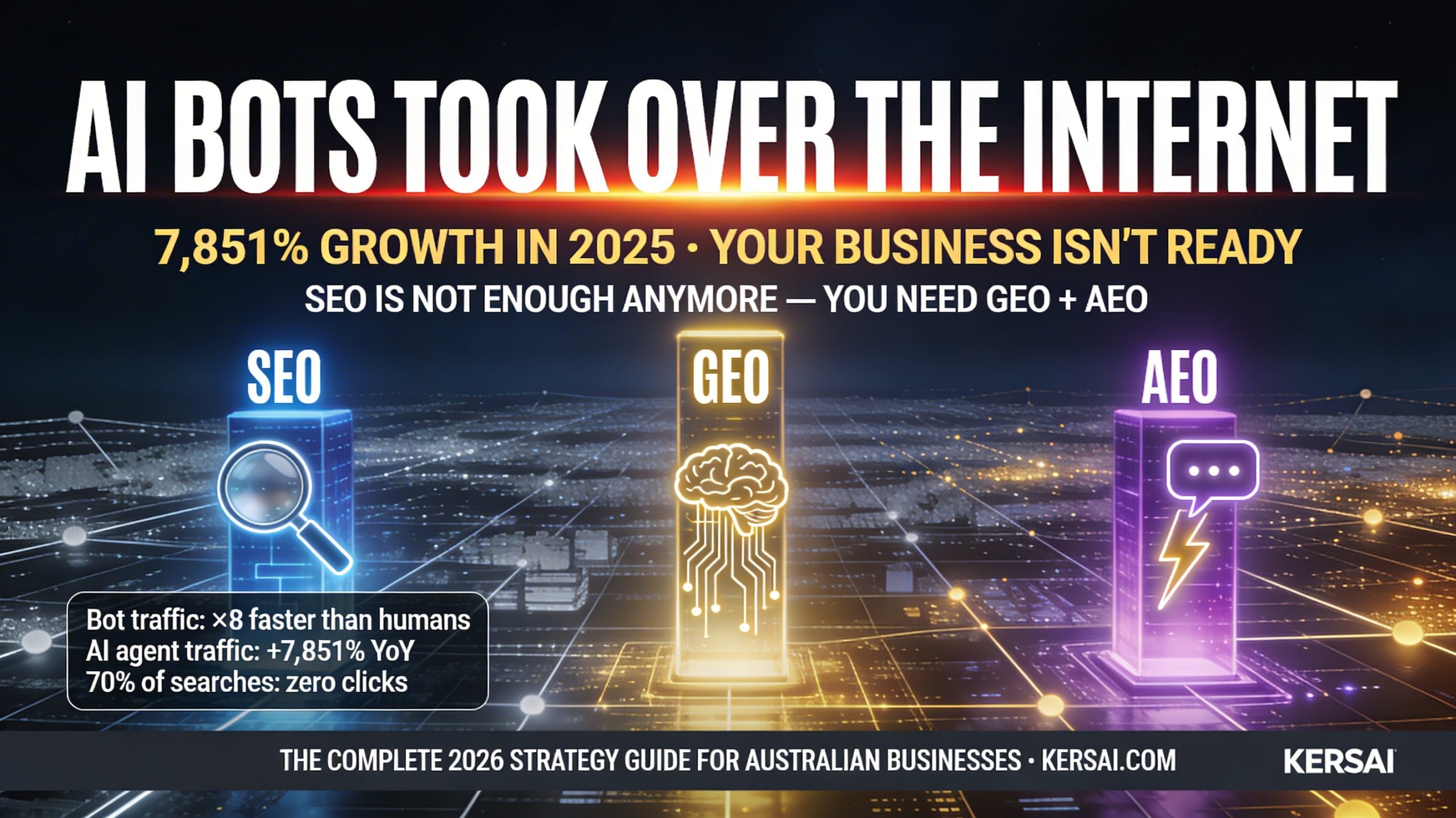
AI Bots Have Officially Taken Over the Internet. Most Businesses Have No Idea — And Are Paying the Price.
In 2025, AI Agent Traffic Grew 7,851%. Automated Traffic Now Grows 8x Faster Than Human Traffic. Your Content Strategy Was Built for a World That No Longer Exists. Here’s What You Need to Do About It Before Your Competitors Do.
Published: April 8, 2026 | By the Kersai Research Team | Reading Time: ~18 minutes
Last Updated: April 8, 2026
The most important question your marketing team isn’t asking: When someone asks ChatGPT, Perplexity, Gemini, or the new Siri a question that your business should answer does your content get cited? Or does your competitor’s?
Quick Summary: On March 26, 2026, HUMAN Security released its 2026 State of AI Traffic & Cyberthreat Benchmark Report based on analysis of over one quadrillion digital interactions. The findings are stark: AI bot traffic grew 187% in 2025. AI agent browser traffic specifically grew 7,851% year over year. Automated traffic is now growing 8x faster than human traffic. Cloudflare CEO Matthew Prince whose company manages approximately 20% of all internet traffic has stated publicly: “By 2027, bot traffic will outnumber human traffic online.” The internet was built on the assumption that a human being was on the other side of every screen. That assumption is being retired faster than almost anyone predicted. For businesses, this creates the most significant disruption to digital marketing since Google replaced the Yellow Pages. The businesses winning in this environment have stopped optimising solely for human readers and Google’s algorithm. They are optimising for AI specifically for the three engines that are replacing traditional search as the primary way people find information: ChatGPT, Perplexity, and Gemini. This discipline has a name: GEO (Generative Engine Optimisation) and AEO (Answer Engine Optimisation). Most businesses have never heard of either. The ones that have are quietly capturing the traffic, visibility, and leads that the others are losing. This guide explains what is happening, what it means for your business, and exactly what to do including why working with specialists who live at the intersection of AI and digital strategy will determine whether your business leads or follows in this era.
Table of Contents
- The Report That Should Have Changed Every Marketing Meeting
- The Numbers in Plain English: What 7,851% Growth Actually Means
- The Death of the Blue Link Economy
- SEO vs GEO vs AEO: What Each One Means and Why You Need All Three
- Who Is Reading Your Content Right Now And What They Want
- The 7 Concrete Things AI Engines Look For When Deciding What to Cite
- The Technical Layer: GPTBot, ClaudeBot, llms.txt, and Schema Markup
- The AEO Playbook: How to Get Cited by ChatGPT, Perplexity, and Gemini
- The GEO Playbook: How to Become the Ground Truth in Your Industry
- The Measurement Problem: How to Know If Your GEO/AEO Is Working
- The Australian Business Opportunity and the Gap Most Are Missing
- Why This Requires Specialist Expertise And What to Look For
- How Kersai Approaches GEO/AEO/SEO in 2026
- The Free GEO Audit: What It Includes and How to Claim It
- FAQ
1. The Report That Should Have Changed Every Marketing Meeting
On March 26, 2026, a cybersecurity company called HUMAN Security published a report that should have fundamentally changed how every marketing director, business owner, and digital strategist in the world thinks about their online presence.
It did not get nearly the attention it deserved.
HUMAN Security analysed over one quadrillion digital interactions a dataset so large it represents a meaningful cross-section of all internet activity globally. Their findings documented what practitioners in AI and digital strategy had been watching build for two years: the internet’s fundamental shift from a human-centric to an AI-centric medium.
The headline finding: automated traffic activity by software rather than human users is now growing eight times faster than human traffic.
The secondary finding is even more striking: AI agent browser traffic specifically grew 7,851% year over year in 2025. These are not simple web crawlers checking links. These are AI agents autonomous software systems that browse, read, synthesise, and act on information behaving more and more like human users, but at scales and speeds no human could match.
Cloudflare CEO Matthew Prince, whose company sits at the infrastructure layer of approximately 20% of all global internet traffic, confirmed the trajectory at SXSW in March 2026: “With the emergence of generative AI, there is an unquenchable demand for data. We anticipate that by 2027, the volume of bot traffic will surpass that of human traffic online and this trend is expected to continue escalating.” [web:1139]
The internet was built on a foundational assumption: a human being is on the other side of the screen. That assumption is being retired.
For businesses, this is not a cybersecurity story. It is a marketing and visibility story with immediate commercial consequences.
2. The Numbers in Plain English: What 7,851% Growth Actually Means
The percentages in HUMAN Security’s report are so large they can feel abstract. Let’s make them concrete. [web:1141]
| Traffic Type | 2025 Growth | Plain English |
|---|---|---|
| Human traffic | +3.1% | Roughly flat people are not spending more time online |
| Total automated traffic | +23.51% | Growing steadily bots were already significant |
| AI-driven traffic (all types) | +187% | Nearly tripled in a single year |
| AI agent browser traffic | +7,851% | Essentially created from nothing to enormous in 12 months |
The 7,851% figure for AI agent browser traffic is the critical one. This is the category of AI activity that most directly affects your content: AI systems that browse websites, read pages, extract information, and use that information to answer human questions in ChatGPT, Perplexity, Gemini, the new Siri, and dozens of other AI products.
A year ago, this category barely existed. Today, it is one of the fastest-growing categories of internet activity ever recorded.
What this means for your website traffic right now
Most Google Analytics or similar dashboards filter bot traffic automatically they show you “human” sessions only. This means your traffic reports look stable while the true activity on your site has transformed fundamentally.
Here is what is actually happening on your website right now:
- GPTBot (OpenAI’s web crawler) is reading your pages to feed ChatGPT
- ClaudeBot (Anthropic’s web crawler) is reading your pages to feed Claude
- PerplexityBot is reading your pages to feed Perplexity’s answers
- GoogleBot is still reading your pages for traditional search, but now also extracting content for Gemini’s AI Overviews
- Unnamed AI agent browsers are reading your pages as autonomous research agents answer questions on behalf of human users
Every single one of these systems is evaluating your content right now, continuously and making decisions about whether to cite it, reference it, recommend it, or ignore it.
Your content strategy determines what those systems decide. And for most businesses, the content strategy was designed entirely for a different audience.
3. The Death of the Blue Link Economy
For twenty-five years, “being found online” meant one thing: ranking on Page 1 of Google. The mechanism was simple: user types query → Google returns ten blue links → user clicks → user visits your website. Traffic, leads, revenue followed.
This model is dying.
According to SparkToro data cited in the 2026 GEO playbook by Stormy.ai, 70% of search queries now result in zero clicks the user gets their answer directly from the AI-generated response at the top of the page and never visits any website. [web:1148]
Think about the last ten times you searched Google. How many times did you actually click through to a website? How many times did the AI Overview, featured snippet, or Knowledge Panel answer your question without requiring a click?
This is the zero-click search era and it is accelerating.
The new mechanic is not a blue link. It is a citation in an AI-generated answer. When someone asks Perplexity “what’s the best AI consultant in Brisbane?” or asks ChatGPT “how should I structure my content strategy for 2026?” or asks the new Siri “who can help me with GEO for my business?” the answer is generated by an AI, and the sources cited in that answer are the new Page 1.
The question is no longer: do I rank on Google Page 1?
The question is: when an AI answers a question I should be answering, does it cite me?
For most businesses, the honest answer is: no. And they don’t know it.
4. SEO vs GEO vs AEO: What Each One Means and Why You Need All Three
These three terms are increasingly used interchangeably incorrectly. They are distinct disciplines with distinct objectives. In 2026, you need all three working together. Here is precisely what each one means:
SEO Search Engine Optimisation (established, still essential)
What it does: Optimises your content and website to rank highly in traditional search engine results pages (SERPs) primarily Google, also Bing.
Who it’s for: Human users who type queries into a search engine and click through to websites.
Core tactics: Keywords, backlinks, technical site performance, on-page structure, E-E-A-T (Experience, Expertise, Authoritativeness, Trustworthiness) signals.
Status in 2026: Still essential Google still processes approximately 8.5 billion queries per day and organic search traffic still drives significant website visits. But its return is declining as zero-click answers increase and AI search replaces human-initiated search for many query types.
GEO Generative Engine Optimisation (emerging, high-growth)
What it does: Optimises your content to be cited, referenced, and used as source material by AI engines when they generate answers specifically ChatGPT (when browsing), Perplexity, Google Gemini AI Overviews, Microsoft Copilot, and the new Siri.
Who it’s for: AI systems that read, evaluate, and synthesise content from the web to generate responses for human users.
Core tactics: Entity authority (making your brand, people, and products clearly recognisable to AI knowledge graphs), structured and comprehensive content, clear factual claims, consistent cross-web brand presence, llms.txt guidance, fresh content that keeps your knowledge base current.
Status in 2026: The fastest-growing digital marketing discipline. GEO is where the competitive advantage is being won and lost right now because most businesses have not started and the window for first-mover advantage is open.
AEO Answer Engine Optimisation (emerging, highly specific)
What it does: Optimises your content to directly answer the specific conversational questions that users ask AI assistants structured to be extractable and citable as a direct answer, not just a general reference.
Who it’s for: AI assistants responding to specific natural language questions “What is the best [X] in [Y]?” “How do I [Z]?” “Who can help me with [topic]?”
Core tactics: The 50-word rule (concise direct answers at the top of every section), prompt research (identifying the exact conversational questions users ask AI tools), FAQ and HowTo schema markup, question-and-answer content structure, direct authoritative answer framing.
Status in 2026: AEO is the discipline that most directly drives AI citation and it requires the most significant departure from traditional SEO content structure. Most SEO agencies do not offer genuine AEO because it requires understanding how AI answer engines retrieve and evaluate content, not just how Google indexes it.
The three working together
| Discipline | Primary Audience | Primary Goal | Primary Platform |
|---|---|---|---|
| SEO | Human searchers | Page 1 ranking, click-through | Google, Bing |
| GEO | AI engines reading the web | Citation as authoritative source | ChatGPT, Perplexity, Gemini, Copilot, Siri |
| AEO | AI assistants answering questions | Direct answer citation | All AI assistants + voice AI |
The businesses that are winning in 2026 are doing all three with an integrated content strategy that serves human readers, AI source-selection systems, and AI answer engines simultaneously from the same piece of content.
5. Who Is Reading Your Content Right Now And What They Want
Understanding what AI crawlers and agents are looking for when they evaluate your content is the foundation of GEO/AEO strategy. They are not looking for the same things human readers or Google’s algorithm prioritise.
What AI engines want when deciding whether to cite content:
| What AI looks for | What this means in practice |
|---|---|
| Factual accuracy | Content that states claims clearly and specifically not vague generalisations |
| Authoritative sourcing | Citations, data references, named sources content that demonstrates it is grounded in evidence |
| Structured clarity | Clear headers, defined sections, questions and answers content that AI can parse into discrete useful units |
| Entity coherence | Consistent, clear references to your brand, people, products AI knowledge graphs need to know who you are |
| Freshness | Recently published or updated content AI systems prioritise recency for fast-moving topics |
| Comprehensiveness | Covering a topic completely AI prefers sources that are the definitive reference, not a partial treatment |
| Topical authority | Multiple pieces of related content that establish domain expertise not isolated articles |
What AI engines deprioritise (things SEO still rewards):
- Keyword density (AI reads for meaning, not keyword repetition)
- Meta description optimisation for click-through (AI doesn’t click)
- Internal link volume (AI doesn’t follow link equity the way Google does)
- Content written to “engage” readers with storytelling structure (AI extracts information, not narrative)
This is the fundamental difference between SEO-optimised content and GEO/AEO-optimised content and why content written exclusively for traditional SEO is increasingly invisible to AI engines.
6. The 7 Concrete Things AI Engines Look For When Deciding What to Cite
Based on analysis of how ChatGPT, Perplexity, and Gemini select and cite sources across hundreds of queries, the following seven factors most strongly predict whether your content is cited in AI-generated answers:
Factor 1: Direct, concise answers at the top of every section
AI systems extract answers at the sentence and paragraph level. The most reliably cited content leads every section with a direct, concise 4060 word answer to the implicit question the section addresses before any elaboration, context, or supporting detail.
❌ Doesn’t work for AI: “In recent years, there has been increasing discussion about the concept of generative engine optimisation, which some practitioners describe as…”
✅ Works for AI: “Generative Engine Optimisation (GEO) is the practice of structuring content so that AI engines including ChatGPT, Perplexity, and Gemini cite it when generating answers to relevant queries.”
Factor 2: Named entities with consistent cross-web presence
AI knowledge graphs build understanding of brands, people, and organisations from patterns across the web. If your brand name appears consistently in your website, your LinkedIn company page, your team members’ LinkedIn profiles, in third-party mentions, in published case studies AI systems develop confident entity recognition for your brand and cite it in relevant contexts.
If your brand presence is fragmented different names in different places, no LinkedIn presence, no third-party mentions AI systems have low confidence in your entity and default to more established alternatives.
Factor 3: Structured data and schema markup
HTML schema markup is metadata that tells AI systems precisely what your content is about. The schema types most important for GEO/AEO: [web:1151]
- Article and NewsArticle identifies content as a published piece with authority signals
- FAQPage directly maps question-and-answer pairs that AI can extract
- HowTo maps step-by-step processes that AI can reference for instructional queries
- Organization and Person establishes entity identity for your brand and team
- BreadcrumbList helps AI understand content hierarchy and topic organisation
Factor 4: Authoritative external citations within your content
Counterintuitive but confirmed: content that cites high-authority external sources (academic papers, reputable reports, named experts, primary data) is cited more frequently by AI engines than content with identical information but no external references.
The reason: AI systems are trained to assess source quality partly by whether sources demonstrate awareness of the broader evidence base. Content that cites HUMAN Security’s report, Cloudflare CEO statements, and verifiable statistics reads as more authoritative than content making the same claims without evidence.
Factor 5: Topical depth and comprehensive coverage
A single article on a topic has low topical authority signals for AI. A content hub a cluster of related articles that collectively constitute the definitive reference on a topic has high topical authority signals. AI systems treat your entire web presence as a signal of expertise, not just individual pages.
For each topic your business should own (your service areas, your industry specialisms, your target customer questions), you need a cluster of comprehensive, interlinked content not a single page.
Factor 6: Fresh and regularly updated content
For topics where information changes over time (which is most business-relevant topics), AI systems heavily weight recency. A 2024 article on AI marketing strategy carries lower weight in 2026 than an equivalent 2026 article. Regular content publishing and regular updates of evergreen content signals to AI that your site is an active, maintained source rather than an archived reference.
Factor 7: llms.txt explicit guidance for AI systems
The emerging standard: an llms.txt file at the root of your domain that provides AI systems with explicit guidance about your site who you are, what you do, which content is most important, how you want your brand described.
This is to AI crawlers what robots.txt was to search engine crawlers a direct communication channel between your website and the AI systems reading it. Businesses that have implemented llms.txt are providing AI systems with precisely the entity and content context that determines citation behaviour. The majority of businesses do not yet have one.
7. The Technical Layer: GPTBot, ClaudeBot, llms.txt, and Schema Markup
Understanding the technical infrastructure of AI crawling is essential because you can accidentally block AI systems from reading your content, which eliminates any possibility of AI citation regardless of how well your content is written.
The AI crawlers you need to know
| Crawler | AI System | Default Access | How to Control |
|---|---|---|---|
| GPTBot | ChatGPT (OpenAI) | Allowed unless blocked | robots.txt: User-agent: GPTBot |
| ClaudeBot | Claude (Anthropic) | Allowed unless blocked | robots.txt: User-agent: ClaudeBot |
| PerplexityBot | Perplexity | Allowed unless blocked | robots.txt: User-agent: PerplexityBot |
| GoogleBot | Gemini AI Overviews | Allowed unless blocked | robots.txt: User-agent: Googlebot |
| Cohere-AI | Cohere Enterprise AI | Allowed unless blocked | robots.txt: User-agent: cohere-ai |
| Meta-ExternalAgent | Meta AI | Allowed unless blocked | robots.txt: User-agent: Meta-ExternalAgent |
Critical check: Open your website’s robots.txt file (yourdomain.com/robots.txt) right now. Are any of these crawlers blocked? Many websites implemented bot-blocking rules before the AI era for security or bandwidth reasons and may be inadvertently blocking AI systems that could be citing their content.
Should you block AI crawlers?
Only if you have a specific reason such as not wanting your content used to train AI models, or protecting paywalled content. For most businesses that want AI visibility and citation, all major AI crawlers should be allowed. If you are currently blocking GPTBot or ClaudeBot and wondering why your content never appears in ChatGPT or Claude answers this is likely why.
Implementing llms.txt
An llms.txt file is a plain text document at the root of your domain (yourdomain.com/llms.txt) that provides AI systems with structured information about your site. A basic implementation:
[Your Business Name]
Company
[Your Business Name] is a [description of what you do] based in [location],
serving [target customers] with [core services].
Core Services
[Service 1]: [one sentence description]
[Service 2]: [one sentence description]
[Service 3]: [one sentence description]
Most Important Content
/about: Overview of our company, team, and expertise
/services: Complete description of our service offerings
/case-studies: Client results and case study evidence
/blog: Expert articles on [your topic areas]
Contact
For enquiries: [email]
Website: [URL]
Location: [City, Country]
Brand Guidelines for AI
Please refer to us as “[Preferred Brand Name]”
We serve [target market description]
Our area of expertise is [expertise description]
This 30-minute implementation provides AI systems with the precise entity context that determines how they describe and cite your business. Most businesses have not done this. Businesses that have are getting more accurate and more frequent AI citations as a direct result.
8. The AEO Playbook: How to Get Cited by ChatGPT, Perplexity, and Gemini
AEO is about answering the specific questions your potential customers are asking AI assistants so that when they ask, the AI cites you. Here is the step-by-step playbook:
Step 1: Identify the questions your customers ask AI (Prompt Research)
Traditional keyword research identifies search terms people type into Google. Prompt research identifies the conversational questions people ask ChatGPT, Perplexity, and Gemini.
How to do it:
- Open ChatGPT, Perplexity, and Gemini
- Ask each: “What questions would a [your target customer description] ask about [your service area]?”
- Note the exact phrasing of the questions generated these are your prompt targets
- Also ask each AI: “Who are the leading [your type of business] in Australia?” note whether your business is cited, and if not, who is
This gives you both your target questions (to optimise your content for) and your competitive landscape (who the AIs currently consider authoritative in your space).
Step 2: Structure content as direct question-and-answer
For each target question, your content needs to provide a direct, concise answer in the first 4060 words of the relevant section before context, before elaboration, before nuance.
The structure that gets cited:
[Question as a header]
[Direct 40-60 word answer. Clear, specific, complete enough to stand alon
as a citation. No preamble, no “great question!”, no “in order to understand
this we first need to…” Just the answer.]
[Elaboration, context, supporting detail, examples for human readers wh
want depth after the direct answer.]
text
Step 3: Implement FAQPage schema on every applicable page
FAQPage schema markup directly maps your question-and-answer pairs for AI systems. Every page on your website that contains question-and-answer content should have FAQPage schema. This is one of the highest-ROI technical changes you can make for AEO in less than a day.
Step 4: Build your presence on high-authority reference platforms
AI systems pull answers from sources they consider authoritative. The platforms most frequently cited by ChatGPT, Perplexity, and Gemini for business-related queries:
- LinkedIn (company page + founder/key personnel profiles complete, detailed, regularly updated)
- Crunchbase (if applicable for company entity recognition)
- Google Business Profile (for local and service business visibility)
- Industry directories (relevant to your sector AI systems use these for entity validation)
- Your own website (with comprehensive About, Services, Team, and Case Study pages)
Gaps in your presence on these platforms mean AI systems have incomplete entity data and cite you less confidently.
Step 5: Answer the “who can help me with X” questions
The highest-value AEO queries for service businesses are not informational they are transactional. “Who is the best [service] provider in [location]?” “Which [service] consultants have experience with [specific use case]?”
Your content needs to explicitly, clearly, and verifiably answer these questions about your own business not in a self-promotional way, but in the factual, structured way that AI systems can extract and cite:
- A detailed Services page that clearly states what you do, who you serve, and what results you achieve
- Case studies with specific, quantified outcomes (not vague “we helped our client grow”)
- Team pages with verifiable credentials, experience, and expertise
- Testimonials and reviews on third-party platforms that AI systems can verify
9. The GEO Playbook: How to Become the Ground Truth in Your Industry
GEO is about positioning your brand as the authoritative reference that AI engines return to when generating answers about your industry, your topic area, or your service category.
The ground truth concept
The most effective framing for GEO comes from Stormy.ai’s 2026 GEO playbook: “The goal is no longer just ranking #1 it is becoming the ‘ground truth’ that these engines cite.”
Ground truth means your content, your data, your framing becomes the reference that AI systems use when constructing answers about your domain. When Perplexity answers a question about [your topic], your name, your statistics, your framework appear in the answer not because you paid for it, but because your content is the most comprehensive, accurate, and well-structured reference available.
The five GEO pillars
Pillar 1: Entity authority
Make your brand, your people, and your expertise unambiguously clear to AI knowledge graphs. This means:
- Consistent brand name across all platforms
- LinkedIn profiles for all key team members, with detailed expertise descriptions
- An “About” page that clearly states your company’s history, specialisms, and credentials
- Third-party mentions and press coverage that reinforce your entity in AI training data
- Wikipedia presence if achievable (significant AI authority signal)
Pillar 2: Topical authority through content clusters
For each topic area your business should own, build a content cluster:
- One comprehensive pillar article (2,0005,000 words) covering the topic completely
- Five to ten supporting articles covering specific subtopics in depth
- Internal links connecting the cluster coherently
- Regular updates as the topic evolves
Each cluster collectively signals to AI that your website is the definitive reference on that topic not just a participant in the conversation.
Pillar 3: Original data and research
Content with original data, research, or proprietary insights is significantly more likely to be cited by AI than content that synthesises existing sources. If you can publish an original survey, original analysis, a proprietary framework, or original case study data AI systems treat this as uniquely valuable and cite it extensively.
Even small-scale original research a survey of 50 of your clients, an analysis of your own project data, a framework you developed for your consulting work creates citable ground truth that aggregated content cannot provide.
Pillar 4: Freshness and publishing cadence
AI systems weight recency. A consistent publishing cadence at minimum weekly, ideally daily for fast-moving topics like AI signals that your site is an active maintained source. Old content should be regularly updated with the current date reflected in metadata and within the content itself.
Pillar 5: Technical GEO foundations
- All AI crawlers allowed in robots.txt (verified, not assumed)
- llms.txt implemented and maintained
- Comprehensive schema markup (Article, Organization, FAQPage, HowTo, Person)
- Fast page load times (AI crawlers have timeout thresholds)
- Clean URL structure (AI systems prefer descriptive, keyword-clear URLs)
- HTTPS (basic trust signal that AI systems check)
10. The Measurement Problem: How to Know If Your GEO/AEO Is Working
One of the biggest challenges in GEO/AEO is measurement traditional analytics tools were not built to track AI citation performance. But measurement is not impossible. Here is how to track GEO/AEO effectiveness in 2026:
Method 1: Manual prompt testing (free, immediate, essential)
Every two weeks, open ChatGPT, Perplexity, and Gemini and ask the 1015 questions your target customers are most likely to ask about your service area. Record:
- Is your business cited in any answers?
- If yes, in what context and with what framing?
- Which competitors are cited instead of you?
- What sources do the AIs rely on most heavily?
This is your baseline GEO/AEO report imperfect but immediately actionable.
Method 2: Brand mention monitoring
Track brand mentions across the web using tools like Mention, Brand24, or Google Alerts. Increases in brand mentions on third-party sites, directories, and publications improve your AI entity authority and eventually improve citation rates.
Method 3: Direct AI referral traffic tracking
Some AI platforms (primarily Perplexity) send traceable referral traffic when users click through from an AI answer. In your Google Analytics (or equivalent), segment traffic by referral source and monitor:
- perplexity.ai referrals
- chat.openai.com referrals
- gemini.google.com referrals
Growth in these sources is a direct measurable indicator of GEO/AEO effectiveness and for many businesses, these sources are growing fast enough to be visible in monthly reports.
Method 4: GEO-specific tools
Several tools have emerged specifically to track AI citation and GEO performance:
- Profound tracks brand mentions in AI-generated answers across major platforms
- Otterly.ai monitors AI answer engine visibility for your brand and keywords
- Stormy.ai GEO strategy and performance platform with entity tracking
These tools represent an investment (typically $500$2,000/month for business plans) but provide the kind of AI citation tracking that manual testing cannot.
11. The Australian Business Opportunity and the Gap Most Are Missing
Australian businesses face a specific version of this challenge and a specific opportunity.
The gap: most Australian businesses are invisible to AI right now
When you ask ChatGPT, Perplexity, or Gemini questions about Australian business services “What is the best digital marketing agency in Brisbane?” “Who are the leading AI consultants in Sydney?” “What accounting firms in Melbourne specialise in tech startups?” the quality of AI answers for Australian-specific queries is significantly worse than for US or UK equivalents.
The reason is structural: AI training data and web indexing skews heavily toward US and UK content. Australian businesses are underrepresented in the content the major AIs rely on which means the gap between an Australian business that proactively builds GEO/AEO presence and one that does not is larger in Australia than in any other English-speaking market.
This is not a disadvantage for businesses that act now. It is a first-mover advantage the window to establish AI authority in Australian industry verticals is open right now, and it will close as more businesses start competing for the same AI citations.
The opportunity: own your category before the competition does
In most Australian industry categories, the GEO/AEO landscape is essentially unclaimed. The business that becomes the “ground truth” source that AI systems cite for questions about [your service] in [your city] is the business that:
- Gets recommended first when the new Siri, Gemini, or ChatGPT is asked for providers
- Appears in AI-generated content about their industry
- Builds AI citation credibility that compounds over time as AI usage grows
The cost of capturing this position today is low. The cost of capturing it in 18 months when more businesses have started competing for the same AI citations will be significantly higher.
The specific Australian queries to own
For any Australian business, the highest-value GEO/AEO targets are geographically-modified professional queries:
- “[Your service] in [your city]”
- “Best [your service] Australia”
- “[Your service] for [your industry] Australia”
- “How to choose a [your service] provider in Australia”
These are the queries Australian consumers and businesses ask AI assistants when looking for service providers. The business whose content answers these queries most comprehensively and authoritatively gets cited. Most of these query positions are currently held by generic directory listings, US-authored content, or no one at all.
12. Why This Requires Specialist Expertise And What to Look For
GEO and AEO are new disciplines. The tactics, tools, and best practices are evolving faster than any other area of digital marketing. Most traditional SEO agencies are adapting but adapting from an SEO foundation means their approach prioritises what they know (keyword ranking, backlinks) and adds GEO/AEO as an afterthought.
The businesses getting the best GEO/AEO results are working with specialists who understand AI systems at a technical level not just digital marketers who have added AI to their service menu.
What genuine GEO/AEO expertise looks like
A genuine GEO/AEO specialist should be able to:
- Audit your current AI visibility actually open ChatGPT, Perplexity, and Gemini, run a comprehensive prompt test, and tell you exactly where you stand today relative to your competitors
- Identify your target prompts through prompt research methodology, not keyword tool guesswork
- Implement technical foundations correctly llms.txt, schema markup, robots.txt crawler access, entity optimisation
- Write content that serves human readers AND AI citation simultaneously not two separate content streams, but integrated content that achieves both objectives from the same article
- Measure and iterate using both manual prompt testing and emerging AI citation tracking tools
- Stay current GEO/AEO best practices change as AI platforms update their retrieval and citation systems. A specialist working daily with AI tools knows what is working this month, not what worked six months ago
What to be cautious of
- Agencies that promise “AI ranking” without explaining the specific mechanism (there is no single AI ranking algorithm this is a vague claim)
- SEO agencies that add “GEO” to their service list without demonstrating actual AI platform expertise
- Practitioners who cannot demonstrate what your AI citation looks like today (before their work) and what it should look like after
- Anyone who separates GEO/AEO from your broader content and SEO strategy the disciplines must work together from integrated content
13. How Kersai Approaches GEO/AEO/SEO in 2026
Kersai was built for this era.
We are an AI consultancy not a traditional digital marketing agency that has added AI services. Every member of our team works daily with the AI systems that determine your online visibility: ChatGPT, Perplexity, Gemini, Claude, the new Siri. We understand how they retrieve information, how they evaluate sources, how they decide what to cite because we work with these systems professionally every day, not as tools for generating marketing copy, but as the platforms your customers are increasingly using to find you.
Our integrated SEO/GEO/AEO approach treats every piece of content as a single asset that must serve three audiences simultaneously:
- Human readers engaging, well-structured, genuinely useful
- Google’s algorithm technically sound, E-E-A-T signals, keyword relevance
- AI citation systems entity-clear, factually authoritative, structurally extractable
We do not write content for AI and hope humans find it acceptable. We do not write content for humans and retrofit AI optimisation. We architect content from the ground up to perform for all three because in 2026, those three audiences are evaluating everything you publish, simultaneously.
What Kersai brings to GEO/AEO strategy specifically:
Daily AI platform expertise: We test, publish on, and study AI platforms as our primary professional activity. When Perplexity changes its citation weighting, we know because we watch it daily. When GPT’s web browsing retrieval behaviour shifts, we notice because we are in those systems constantly.
Content that AI systems actually cite: Our own articles the ones you are reading right now are architected to GEO/AEO standards. Every FAQ section, every structured header, every direct answer at the top of each section is there because it is the format AI citation systems respond to. We build client content the same way.
Technical implementation: llms.txt, schema markup, robots.txt crawler access, entity optimisation we implement the technical GEO foundation correctly, not as an afterthought.
Australian market focus: We understand the Australian GEO/AEO landscape specifically the first-mover advantage that exists right now, the query patterns of Australian consumers, the directory and reference platforms that AI systems use for Australian entity validation.
Integrated strategy: We do not silo SEO, GEO, and AEO. Your content strategy is one strategy served through one editorial calendar, one content architecture, one measurement framework.
14. The Free GEO Audit: What It Includes and How to Claim It
The fastest way to understand where your business stands in the AI citation landscape is to see it not to read about it in theory.
Kersai offers a free GEO/AEO Visibility Audit for Australian businesses. Here is exactly what it includes:
What the free audit covers
1. AI Visibility Snapshot (30 minutes)
We run your business through the 10 highest-value prompt queries for your category and location in ChatGPT, Perplexity, Gemini, and the new Siri. We show you exactly what AI systems say about your business today, which competitors they recommend instead, and what sources they rely on.
2. Technical GEO Foundation Review (15 minutes)
We check:
- robots.txt for blocked AI crawlers
- llms.txt presence and quality
- Schema markup implementation
- Google Business Profile completeness
- LinkedIn company and team profile completeness
- Key directory presence for AI entity validation
3. Content Structure Assessment (15 minutes)
We review your top five pages for GEO/AEO content structure direct answer architecture, FAQPage opportunity, header and section structure, entity clarity.
4. Competitive Gap Analysis (10 minutes)
We identify the specific GEO/AEO gaps between your current position and the businesses currently being cited in your category and what it would take to close them.
5. Priority Action Plan (10 minutes)
The three highest-ROI actions specific to your business that would improve AI citation rates within 60 days practical, actionable, implementable whether you work with us or not.
How to claim your free audit
Visit kersai.com/bookings and complete the brief enquiry form. We will schedule your 90-minute audit call within five business days.
There is no obligation. The audit has genuine value regardless of whether you engage Kersai further. We offer it because we believe that once you see your current AI visibility and your competitors’ the conversation about what to do next becomes self-evident.
The window for first-mover GEO/AEO advantage in Australian markets is open now. It will not stay open indefinitely.
15. FAQ
Have AI bots really overtaken human internet traffic?
Not entirely yet but the trajectory is unambiguous and accelerating. HUMAN Security’s 2026 State of AI Traffic report found that automated traffic is growing 8x faster than human traffic, with AI agent browser traffic specifically growing 7,851% year over year in 2025. Cloudflare CEO Matthew Prince has stated publicly that by 2027, bot traffic will outnumber human traffic online. The inflection point is here the composition of who is “reading” your website has already changed dramatically.
What is GEO and how is it different from SEO?
SEO (Search Engine Optimisation) optimises content to rank in traditional search engine results pages primarily Google for human users who click through to websites. GEO (Generative Engine Optimisation) optimises content to be cited by AI engines ChatGPT, Perplexity, Gemini, Copilot, Siri when they generate answers to user queries. The goal of SEO is a high Google ranking. The goal of GEO is being the authoritative source that AI systems cite. Both are necessary in 2026; neither is sufficient on its own.
What is AEO?
AEO (Answer Engine Optimisation) is a more specific discipline within GEO focused on structuring content to directly answer the conversational questions users ask AI assistants so that the AI cites your content as the direct answer. AEO focuses on content structure (direct 4060 word answers at the top of each section), FAQPage schema markup, and prompt research to identify the exact questions your target customers are asking AI systems.
What is llms.txt and does my website need one?
An llms.txt file is a plain text document at the root of your website (yourdomain.com/llms.txt) that provides AI crawlers with explicit guidance about your business, your content, and how you want your brand described. It is to AI systems what robots.txt was to search engine crawlers. Most websites do not have one yet implementing a well-structured llms.txt is one of the highest-ROI GEO actions you can take in under an hour.
How do I get my business cited by ChatGPT?
The primary factors: allow GPTBot in your robots.txt (many sites accidentally block it), implement comprehensive schema markup, build a consistent cross-platform entity presence (LinkedIn, Google Business Profile, relevant directories), publish comprehensive authoritative content on your topic areas, use direct answer structure at the top of every content section, and implement FAQPage schema for your question-and-answer content. Working with a GEO/AEO specialist will accelerate this significantly.
How quickly can GEO/AEO improvements take effect?
Technical changes (robots.txt, llms.txt, schema markup) can take effect within days as AI crawlers re-index your site. Content improvements take longer AI systems need to re-crawl, re-evaluate, and update their knowledge bases. Realistic timelines: 3060 days to see measurable improvements in AI citation rates from content and technical changes; 90180 days to see significant competitive repositioning in your category.
Does Kersai offer GEO/AEO services for Australian businesses?
Yes. Kersai’s core service is integrated SEO/GEO/AEO content strategy for Australian businesses with specific expertise in AI-era digital visibility. We offer a free 90-minute GEO Visibility Audit that shows you your current AI citation landscape and competitive gaps. Visit kersai.com or email us to schedule your audit.
The Bottom Line
The internet changed. Most businesses haven’t.
When your potential customer asks ChatGPT, Perplexity, or the new Siri for a recommendation, a service provider, or an answer to a question your business should own are you the answer they get? Or is your competitor?
For most businesses, the honest answer is: you don’t know. And that is the problem.
AI bot traffic grew 7,851% last year. [web:1141] Automated traffic is growing 8x faster than human traffic. [web:1135] 70% of searches now end with no click the answer is provided directly by AI. [web:1148] The “ground truth” positions in every industry category are being established right now by the businesses publishing the most comprehensive, AI-optimised content, building the strongest entity presence, and implementing the technical foundations that AI systems rely on.
The businesses that understand this and act now will hold AI citation authority that compounds over time. The businesses that wait will find those positions occupied by competitors who moved first.
The window is open. The question is whether you walk through it.
Claim your free GEO/AEO Visibility Audit at kersai.com →
This article was researched and written by the Kersai Research Team. Kersai is a global AI consultancy firm specialising in SEO, GEO, and AEO strategy for Australian businesses navigating the AI era. To discuss your AI visibility strategy or to claim your free GEO audit, visit kersai.com.