
The AI SaaS Scare: How Anthropic’s 10 New Enterprise Plug-Ins Just Sent Shockwaves Through the Software Market
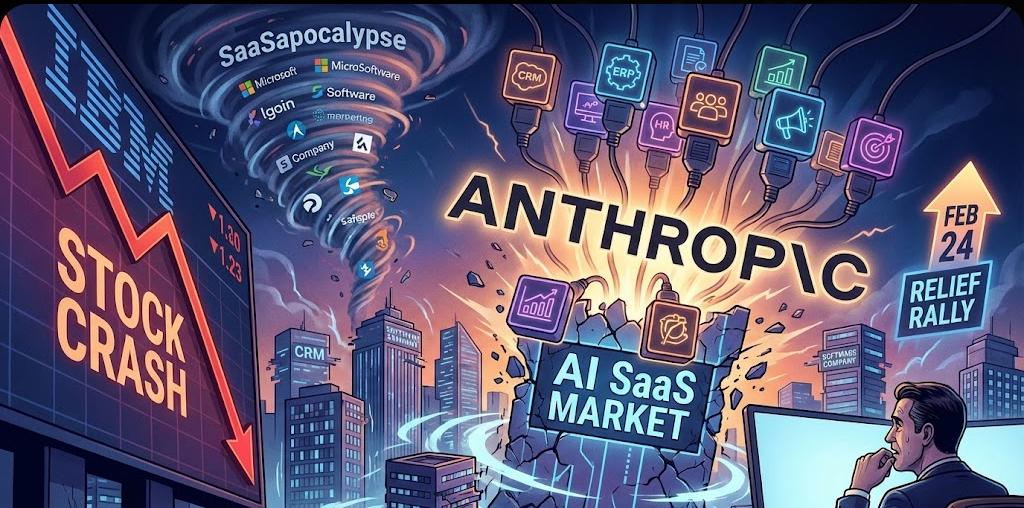
What the IBM Stock Crash, the “SaaSapocalypse” Fear, and the February 24 Relief Rally Mean for Every Business Running Software Today
Published: February 25, 2026 | By the Kersai Research Team | Reading Time: ~15 minutes

1. The Day AI Actually Broke the Stock Market
For years, enterprise software vendors have quietly dismissed the AI threat. Chatbots were impressive party tricks. GPT wrappers were novelties. The real, mission-critical workinvestment banking workflows, HR onboarding, wealth management, legacy code maintenancewas safe from disruption.
February 24, 2026 changed that.
In a single 48-hour window:
- Anthropic announced 10 new enterprise plug-ins embedding Claude directly into financial, HR, engineering, and legal workflows.
- IBM suffered its worst single-day stock drop since the year 2000 after Anthropic indicated Claude Code could modernise COBOL systems running on IBM mainframes.
- Software stocks that had been haemorrhaging value for weeks staged a dramatic relief rallybut only for companies that had already partnered with Anthropic.
- The message to the rest of the software industry was blunt:
Partner with AI infrastructure providers nowor watch your market cap erode while your competitors do.
This is not a trend piece. This is a live case study in how the “agentic AI” era is reshaping enterprise software markets in real time.
2. The IBM Shock: When AI Went After the Mainframe
To understand the February 24 relief rally, you first need to understand what happened to IBM.
2.1 The COBOL problem
COBOLshort for Common Business Oriented Languagewas developed in 1959. It runs on IBM mainframes. And despite being older than most people in the workforce, it still processes an estimated:
- 95% of ATM transactions worldwide.
- 80% of in-person credit card payments.
- The core banking systems of most of the world’s major financial institutions.
Rewriting COBOL is expensive, slow, and terrifying. For decades, IBM has profited enormously from the fact that nobody dared try.
2.2 What Anthropic said
During a series of briefings with enterprise clients and press in mid-to-late February 2026, Anthropic executives made a pointed claim: Claude Code can successfully modernise legacy COBOL systems running on IBM mainframes.
Not “assist with” or “provide suggestions for.” Actually modernisetranslating COBOL into modern languages and restructuring the underlying logic of systems that have not been touched in decades.
2.3 The market reaction
IBM’s stock collapsed.
The drop was described by multiple financial analysts as IBM’s steepest one-day decline since 2000. The market’s reasoning was straightforward:
- IBM’s mainframe and COBOL ecosystem is one of its most reliable, high-margin revenue streams.
- If Claude Code can genuinely modernise these systems, enterprise clients no longer need IBM’s proprietary services and locked-in hardware contracts.
- The moat that has protected IBM’s legacy revenue for 60+ years now has a crack in it.
For AI analysts, this was the real story inside the story. Anthropic had not just released a productit had pointed at one of the oldest and most powerful revenue fortresses in enterprise technology and said:
We have a key.
3. The 10 New Enterprise Plug-Ins: From Chatbot to Infrastructure
The IBM moment set the scene. Then Anthropic launched its broader announcement.
On February 24, 2026, Anthropic released 10 new enterprise plug-ins designed to move Claude from a standalone AI assistant into embedded business infrastructure. The goal, in Anthropic’s own words, is not to own every enterprise workflowbut to provide the underlying intelligence and infrastructure so partners can apply specialised business knowledge on top.
Here is a breakdown of the key verticals targeted.
3.1 Investment Banking
Claude’s new investment banking plug-in automates deal reviews and due diligence workflows. Rather than a junior analyst spending 16 hours reviewing an information memorandum, Claude can:
- Identify key risk factors.
- Cross-reference deal terms against comparable transactions.
- Generate a structured summary for senior review in minutes.
This does not replace the banker. It replaces the tedious extraction work that banks have been paying expensive analysts to do for decades.
3.2 Wealth Management
The wealth management plug-in offers deep portfolio analysis embedded directly into existing platforms. Use cases include:
- Automated stress testing of client portfolios against macroeconomic scenarios.
- Natural language summaries of portfolio performance for client-facing advisors.
- Flagging compliance and concentration risks before quarterly reviews.
3.3 Human Resources
The HR plug-in focuses on onboarding and internal documentation, with one critical feature that separates it from generic AI tools: it learns and matches the specific tone and language of the company’s existing materials.
An onboarding guide for a global consulting firm sounds very different from one for a tech startup. Claude’s HR plug-in is designed to understand and replicate that distinction automatically.
3.4 Legal and Compliance
The legal plug-in targets contract review, clause extraction, and regulatory mappingsome of the highest-volume, most time-intensive work in corporate legal departments. For compliance teams dealing with evolving AI regulation, this plug-in can also help map new regulatory requirements against existing internal policies.
3.5 Engineering and DevOps
Building on the Claude Code announcement, the engineering plug-in extends into DevOps workflows:
- Automated code review.
- Documentation generation.
- Bug triage and root-cause analysis from error logs.
- Legacy code translation (including the now-famous COBOL modernisation capability).
3.6 The Broader Pattern
Across all 10 plug-ins, the structural logic is identical:
- Identify the most high-volume, cognitively repetitive tasks in a professional workflow.
- Embed Claude so it performs those tasks inside the tools professionals already use.
- Free the human for the judgment-intensive, relationship-driven, or genuinely creative work.
This is not AI replacing workers. It is AI absorbing the boring half of every white-collar joband doing it faster, more consistently, and at a fraction of the cost.
4. The Relief Rally: Partner or Perish
For months leading up to February 24, enterprise software stocks had been under severe pressure.
The fear driving that pressure had a name: the “SaaSapocalypse.”
4.1 What is the SaaSapocalypse?
The SaaSapocalypse thesis goes like this:
- Traditional SaaS companies charge per seat. You pay for access to the software, and humans use it.
- AI agents do not need seats. They can perform the same tasks the human was doingwithout a login, without a subscription, without a user licence.
- Therefore, as AI agents mature, enterprises will cancel SaaS subscriptions in bulk, replacing expensive human + software combinations with cheap, automated AI pipelines.
This fear sent software sector valuations tumbling in late 2025 and early 2026. Investors were pricing in a scenario where the entire SaaS business modelbuilt over 20 yearsbecomes obsolete within a decade.
4.2 Why February 24 triggered a relief rally
Anthropic’s plug-in announcement changed the narrative in one crucial way.
Rather than AI agents replacing enterprise software, Anthropic’s model shows AI agents living inside enterprise software. The platforms that partner with Anthropic do not lose their usersthey gain a powerful AI layer that makes their product dramatically more valuable.
The market responded immediately.
Software companies that had announced Anthropic integrationsincluding FactSet, DocuSign, Intuit, Intapp, and Salesforce’s Slacksaw their stock prices surge on February 24.
FactSet alone jumped 6% on the day.
The message was clear:
The SaaSapocalypse is not the death of all software. It is the death of software that refuses to evolve.
Companies that position themselves as the workflow layer on top of AI intelligencerather than trying to compete with itwill not just survive. They will thrive.
5. The “Partner or Perish” Framework: What This Means for Software Leaders
The February 24 events crystallise a decision every software company, enterprise technology buyer, and CIO now has to make.
5.1 Decide what layer you are
There are two viable positions in the emerging AI-powered enterprise stack:
The Intelligence Layer
- Companies like Anthropic, OpenAI, and Google DeepMind.
- They build and maintain the foundational AI models.
- They provide APIs, plug-in frameworks, and enterprise SDKs.
- They are not trying to own specific workflowsthey are the engine under the hood.
The Workflow Layer
- Companies like Salesforce, Intuit, DocuSign, FactSet, and Slack.
- They own the specific context, data, and user relationships in a given domain.
- Their competitive advantage is not raw intelligenceit is domain knowledge, trust, and workflow integration.
- By embedding AI intelligence into their workflow layer, they become dramatically more valuable to their users.
The danger zone is the middle:
- Companies that try to be their own intelligence layer (building proprietary small models instead of using best-in-class APIs) without the resources to compete with Anthropic or OpenAI.
- Companies that ignore AI entirely and rely on their existing feature set to protect market share.
Both of these positions are eroding in real time.
5.2 Stop building chatbot wrappers
One of the most commonand most costlymistakes enterprises are making right now is treating AI integration as a UI problem.
They add a chat interface to their existing product. They put a “Powered by AI” badge on their homepage. They ship a basic summarisation feature that calls the OpenAI API.
This is not AI integration. It is a cosmetic upgrade on a product that is structurally unchanged.
Anthropic’s plug-ins are the counter-example. They do not sit on top of workflowsthey are embedded inside them. Claude in the investment banking plug-in does not open a side panel where you can chat about your deal. It reviews the deal, extracts the key terms, and delivers a structured output directly into the analyst’s existing document environment.
The difference between “AI chat widget” and “AI infrastructure” is the difference between a novelty and a defensible business.
5.3 The multi-model future
For enterprise technology buyers specifically, the February 24 developments reinforce a clear strategic principle:
Do not build single-vendor AI dependencies.
Anthropic’s plug-ins are powerful today. OpenAI, Google DeepMind, and others will release competing enterprise frameworks in the months ahead. The enterprises that will navigate this transition most effectively are those that:
- Build abstraction layers between their internal systems and any specific AI provider.
- Evaluate AI tools on real-world task performance, not marketing benchmarks.
- Maintain the flexibility to swap or combine AI providers as the market evolves.
6. The Bigger Picture: What AI Is Doing to White-Collar Work
It is worth pausing to name what is actually happening here.
Anthropic’s 10 enterprise plug-ins are not an isolated product release. They are a data point in a much larger transition:
White-collar work is being restructured around AI assistance at a pace that most enterprises are not prepared for.
In investment banking, the junior analyst who spent two years building Excel models as a rite of passage now competes with a Claude plug-in that can do the same work in 10 minutes. In HR, the generalist who spent half their week writing and updating internal documents now has those documents generated automatically.
This does not necessarily mean those jobs disappear. But it does mean:
- The volume of work those professionals can handle increases dramatically.
- The skills that are valued shift from execution to judgment, oversight, and relationship management.
- The headcount required for any given output level falls.
For business leaders, the question is not whether to adopt AI in white-collar workflows. That decision has already been made by the market. The question is how fast, with which partners, and with what governance framework.
7. The Claude Code + COBOL Story: A Warning for Every Legacy Tech Incumbent
Before we close, it is worth dwelling on the IBM story one more timebecause it contains a warning that extends far beyond mainframes.
IBM’s COBOL and mainframe business survived for 60 years not because it was the best technology, but because switching costs were prohibitive. Nobody rewrote COBOL. Nobody moved off the mainframe. The cost, risk, and complexity of doing so were all too high.
What Anthropic has donepotentiallyis lower those switching costs dramatically.
And IBM is not the only company whose moat was built on switching costs rather than ongoing value creation.
Any technology vendor whose customers stay primarily because leaving is too painfulnot because the product is genuinely superiorshould pay close attention to this story.
AI is becoming very good at eliminating the friction that keeps customers locked in.
8. FAQ
What are Anthropic’s new enterprise plug-ins?
Anthropic released 10 new integrations on February 24, 2026, designed to embed Claude directly into enterprise workflows across investment banking, wealth management, HR, legal, and engineering. Unlike standalone AI tools, these plug-ins operate inside existing software environments, automating specific high-volume professional tasks rather than simply providing a chat interface.
Why did IBM’s stock drop so dramatically?
IBM’s stock suffered its worst single-day decline since 2000 after Anthropic indicated that Claude Code could modernise legacy COBOL systems running on IBM mainframes. Investors interpreted this as a direct threat to one of IBM’s most durable and high-margin revenue streamsthe enterprise mainframe and legacy services business that has been effectively protected by switching costs for decades.
What is the SaaSapocalypse?
The SaaSapocalypse is the fear that AI agents will replace traditional SaaS subscriptions by automating the tasks that human users previously performed. Rather than paying per seat for software, enterprises would instead deploy AI agents that perform the same work without needing user licences. Anthropic’s plug-in model suggests a more nuanced outcome: software platforms that embed AI will become more valuable, while those that ignore it will be displaced.
Which software companies benefited from the Anthropic announcement?
Companies including FactSet, DocuSign, Intuit, Intapp, and Salesforce’s Slack saw stock price increases on February 24 after announcing integrations with Anthropic’s new plug-in framework. FactSet alone rose approximately 6% on the day, reflecting investor confidence that embedded AI partnerships represent a path to growth rather than disruption.
What should enterprise technology leaders do right now?
The immediate priorities are: decide whether your organisation is positioned as a workflow layer or an intelligence layer; stop investing in cosmetic AI features and invest instead in deep workflow integration; build abstraction layers that allow you to work with multiple AI providers; and establish internal governance frameworks for AI agent deployment before expansion outpaces oversight.
This article was researched and written by the Kersai Research Team. Kersai is a global AI consultancy firm dedicated to helping enterprises confidently navigate the rapidly evolving artificial intelligence landscapefrom cutting-edge strategic insights to practical, large-scale AI implementation. To learn more, visit kersai.com.