

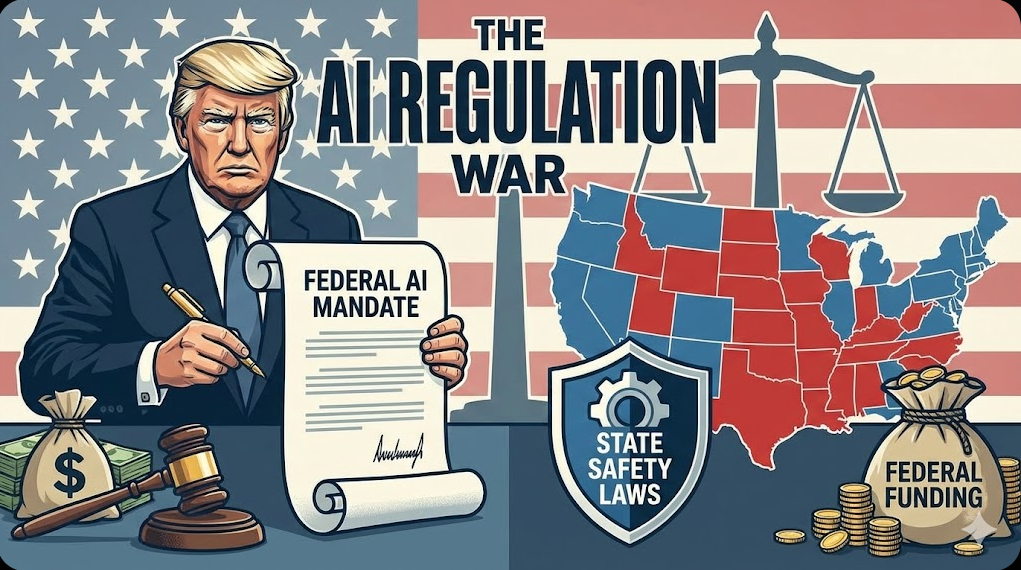
The AI Regulation War: Trump’s Executive Order Forces States to Choose Between Safety Laws and Billions in Federal Funding
How a December Executive Order Created an AI Litigation Task Force, Threatens $42 Billion in Broadband Funding, and Sparked the Biggest Federal-State Battle Since Healthcare Reform
Last Updated: February 6, 2026 | Reading Time: 14 minutes
On January 10, 2026exactly 30 days after President Trump signed an executive order titled “Ensuring a National Policy Framework for Artificial Intelligence”the Department of Justice launched the AI Litigation Task Force with a singular mission: sue states whose AI regulations the administration deems “onerous.”
Colorado’s groundbreaking algorithmic discrimination law, which took effect February 1, is the first in the crosshairs. California’s Frontier AI Safety regulations are next. Texas, Utah, and potentially a dozen other states face the same threat.
But lawsuits are just the beginning. The executive order weaponizes $42 billion in Broadband Equity, Access, and Deployment (BEAD) Program fundinginfrastructure money already allocated to statesthreatening to withhold it from any state that refuses to back down on AI regulation.
Within eight days of the order’s signing, 23 state attorneys general from both parties filed a bipartisan letter pushing back, calling the federal overreach unconstitutional and warning it threatens states’ rights to protect their citizens.
This is the story of how AI regulation became the next major constitutional showdown between federal and state powerand what it means for every business operating in America’s increasingly fragmented regulatory landscape.
What the Executive Order Actually Does
The Five-Pronged Federal Strategy
President Trump’s December 11, 2025 executive order doesn’t just express a policy preferenceit mobilizes multiple federal agencies to actively dismantle state AI laws through litigation, funding restrictions, and regulatory preemption.
1. AI Litigation Task Force (Launched January 10, 2026)
The Attorney General must establish a dedicated task force whose “sole responsibility” is challenging state AI laws on grounds including:
- Unconstitutional regulation of interstate commerce (Dormant Commerce Clause)
- Preemption by existing federal regulations
- Any other basis the Attorney General deems unlawful
The Task Force consults with the Special Advisor for AI and Crypto, White House Science Advisor, and Economic Policy Assistant to identify which state laws to challenge first.
2. Commerce Department Evaluation (Deadline: March 11, 2026)
The Secretary of Commerce must publish a comprehensive evaluation identifying:
- “Onerous” state AI laws that conflict with federal policy
- Laws requiring AI models to alter “truthful outputs”
- Laws compelling disclosure or reporting that may violate the First Amendment
- Laws that should be referred to the Litigation Task Force for challenge
This evaluation will essentially create a federal “hit list” of state regulations targeted for elimination.
3. BEAD Funding Restrictions (Deadline: March 11, 2026)
The most aggressive provision: States identified as having “onerous” AI laws become ineligible for BEAD non-deployment funds “to the maximum extent allowed by federal law.”
The BEAD Program provides $42.45 billion for expanding broadband access to underserved areas. The Trump administration’s “Benefit of the Bargain” reforms already clawed back significant portions; now remaining funds are explicitly conditioned on AI regulatory compliance.
The logic: AI applications rely on high-speed networks, therefore states with restrictive AI laws threaten the BEAD mission of delivering universal connectivity.
4. FCC Preemption Proceeding (Deadline: March 11, 2026)
The FCC Chairman must initiate a rulemaking to determine whether to adopt federal AI reporting and disclosure standards that preempt conflicting state laws.
FCC Chairman Brendan Carr welcomed the directive the day after the order was signed, signaling likely cooperation.
5. FTC Policy Statement (Deadline: March 11, 2026)
The Federal Trade Commission must issue guidance explaining how state laws requiring alterations to AI outputs are preempted by the FTC Act’s prohibition on “deceptive acts or practices.”
This targets anti-bias provisions in laws like Colorado’s that require reasonable care to prevent algorithmic discriminationframing bias mitigation as “forcing AI to lie.”
Why Colorado Is Target Number One
SB 24-205: The Algorithmic Discrimination in Artificial Intelligence Act
Colorado’s law, which took effect February 1, 2026, represents the most comprehensive state-level AI regulation in the United Statesand the White House explicitly names it in the executive order.
What Colorado’s Law Actually Requires:
For AI Developers:
- Use reasonable care to protect against algorithmic discrimination in high-risk AI systems
- Make specific disclosures about AI capabilities and limitations
- Provide documentation to deployers about intended use cases
- Notify Colorado Attorney General of any known or reasonably foreseeable risks of algorithmic discrimination
For AI Deployers:
- Conduct impact assessments before deploying high-risk AI in consequential decisions
- Implement risk management policies and programs
- Provide notice to consumers when AI makes consequential decisions about them
- Allow consumers to appeal or correct AI-driven adverse decisions
“High-risk AI systems” are defined as systems that make or substantially assist in making consequential decisions affecting:
- Education (admissions, financial aid, employment)
- Employment (hiring, promotion, termination, compensation)
- Financial services (credit, lending, insurance)
- Government benefits and services
- Healthcare (diagnosis, treatment, insurance coverage)
- Housing (rentals, sales, financing)
- Legal services
Penalties: Up to $20,000 per violation, enforced by the Colorado Attorney General as unfair trade practices.
The White House’s Criticism
The executive order claims Colorado’s law “may even force AI models to produce false results in order to avoid a ‘differential treatment or impact’ on protected groups.”
This framing is controversial. Colorado’s law requires reasonable care to prevent unjustified discriminationnot elimination of all statistical differences. Legal experts note the distinction between:
- Disparate treatment: Intentionally treating protected groups differently (illegal)
- Disparate impact: Neutral practices with disproportionate effects (may be justified by business necessity)
Colorado’s law addresses both, requiring deployers to assess whether differential impacts are justified and to implement mitigation measures when they’re not.
The Other States in the Crosshairs
Colorado isn’t alone. Multiple states enacted comprehensive AI laws in 2024-2025 that now face federal challenge:
California: Transparency for Frontier AI Systems Act (TFAIA)
Effective 2026, requires developers of frontier AI models (those exceeding specified compute thresholds) to:
- Submit safety and security protocols to California Attorney General
- Conduct regular safety testing and red-teaming
- Implement mechanisms to prevent catastrophic outcomes
- Report critical failures and shutdown capability
The law targets existential AI risks from the most powerful modelsGPT-5-class systems and beyond.
Texas: House Bill 1709
Effective September 1, 2025, requires:
- Disclosure when consumers interact with AI rather than humans
- Clear labeling of AI-generated content in certain contexts
- Privacy protections for data used to train AI models
Utah: Senate Bill 149
Effective May 1, 2024, focuses on:
- AI disclosure requirements in regulated industries
- Consumer protections when AI influences decisions
- Prohibitions on deceptive AI practices
Other States with AI Regulations
At least 45 states considered AI legislation in 2025. Laws passed in:
- Illinois (amendments to Human Rights Act covering AI in employment)
- Maryland (AI procurement standards for state agencies)
- Vermont (consumer protection provisions)
- Washington (facial recognition restrictions)
- Connecticut (automated decision-making disclosures)
All are potentially vulnerable to federal challenge or funding restrictions.
The $42 Billion Hostage: How BEAD Funding Became a Weapon
What Is the BEAD Program?
The Broadband Equity, Access, and Deployment Program was created by the bipartisan Infrastructure Investment and Jobs Act of 2021 with $42.45 billion to expand high-speed internet access to underserved and unserved areas.
Funds are allocated by formula to states and territories, which develop plans for deployment. As of December 2025, most states had approved plans but hadn’t yet received full deployment funding.
Trump Administration’s “Benefit of the Bargain” Reforms
Before the AI executive order, the administration already clawed back significant BEAD funds through new policies requiring:
- Lower deployment cost estimates
- Reduced per-location subsidies
- More stringent matching requirements
These reforms “saved” funds that the AI executive order now conditions on state compliance with federal AI policy.
The Conditional Funding Strategy
The executive order directs Commerce to issue a Policy Notice specifying that states with “onerous” AI laws (those identified in the March 11 evaluation) become ineligible for BEAD “non-deployment funds.”
What are non-deployment funds?
A portion of BEAD allocation can be used for:
- Planning and administration
- Technical assistance
- Capacity building
- Workforce development
- Digital equity initiatives
By targeting non-deployment funds specifically, the administration may be trying to avoid legal challenges based on conditioning infrastructure deployment funds on unrelated policy compliance.
The Constitutional Question
Legal experts at Paul Hastings, Goodwin, and other firms note this raises South Dakota v. Dole issuesthe Supreme Court case establishing limits on conditional federal spending.
For conditions to be constitutional:
- Spending must be for the general welfare
- Conditions must be clearly stated
- Conditions must relate to the federal interest in the project
- Conditions can’t violate other constitutional provisions
- Financial pressure can’t be “coercive”
The link between AI regulation and broadband deployment may be tenuous enough to fail the “relatedness” test. And withholding billions could constitute impermissible coercion.
The Bipartisan State Pushback
23 Attorneys General Fight Back
On December 19, 2025just eight days after the executive ordera remarkable bipartisan coalition of 23 state attorneys general filed reply comments with the FCC urging the agency not to adopt preemptive AI regulations.
The coalition includes:
- Blue states: California, Colorado, Connecticut, Delaware, Hawaii, Illinois, Maine, Maryland, Massachusetts, Minnesota, Nevada, New Jersey, New Mexico, Oregon, Rhode Island, Vermont, Washington, Wisconsin, District of Columbia
- Purple states: Arizona, North Carolina
- Red states: Tennessee, Utah
Key Arguments:
1. FCC Lacks Authority
The FCC’s jurisdiction extends to communications infrastructure, not AI systems generally. Adopting AI reporting standards would exceed statutory authority.
2. States Have Traditional Police Powers
States have long regulated consumer protection, employment, housing, and other areas where AI is deployed. Federal preemption of these traditional state functions requires clear Congressional authorization.
3. Preemption Would Create Gaps
If federal agencies preempt state AI laws without enacting comprehensive federal protections, consumers and workers lose all safeguardsa regulatory void rather than a “minimally burdensome national framework.”
4. Congressional Intent Is Unclear
Congress has considered but not passed comprehensive AI legislation. Executive branch agencies can’t preempt state law without clear statutory direction from Congress.
This Isn’t the First Fight
The bipartisan letter notes this is the administration’s third attempt to block state AI regulation in 2025:
Attempt #1: “One Big Beautiful Bill Act” included a proposed 10-year moratorium on new state AI laws. After 40 state attorneys general objected, the provision was removed before passage.
Attempt #2: NDAA Provision sought similar preemption language in the National Defense Authorization Act. After 36 state AGs objected, it was stripped out.
Attempt #3: Executive Order bypasses Congress entirely, using litigation and funding threats to achieve what legislation couldn’t.
The Legal Battle Ahead: Five Key Questions
1. Can the Executive Branch Preempt State Law Without Congressional Authorization?
Traditional federalism principles hold that only Congress can preempt state laweither expressly through legislation or implicitly when federal law occupies a field so comprehensively that state regulation is impossible.
Executive agencies can preempt state law only when Congress has delegated that authority through statute.
Here, no comprehensive federal AI statute exists. The FTC Act and FCC’s communications authority may not provide sufficient basis for broad AI preemption.
Predicted outcome: Courts likely to find executive overreach without clear Congressional authorization.
2. Does the Dormant Commerce Clause Bar State AI Regulation?
The DOJ’s litigation theory will likely invoke the Dormant Commerce Clausethe constitutional principle that states can’t unduly burden interstate commerce even without conflicting federal law.
To succeed, DOJ must prove state AI laws either:
- Discriminate against out-of-state actors
- Impose burdens on interstate commerce clearly excessive relative to local benefits
Colorado’s law applies equally to in-state and out-of-state AI companies. The question becomes whether compliance costs are “excessive” compared to consumer protection benefits.
Predicted outcome: Mixed results. Some provisions may survive, others may be narrowed.
3. Can Federal Agencies Condition Unrelated Funding on AI Compliance?
The Supreme Court’s South Dakota v. Dole framework permits conditional spending if:
- Conditions clearly relate to the federal interest in the funded program
- Pressure isn’t coercive
Linking AI regulation to broadband deployment funding is a stretch. BEAD’s purpose is expanding internet access, not regulating AI applications.
Predicted outcome: If challenged, courts may find conditioning impermissible, especially if financial pressure is deemed coercive.
4. Do State Anti-Bias Requirements Violate the First Amendment?
The executive order directs the FTC to frame state anti-bias provisions as compelling “deceptive” outputsessentially arguing AI has First Amendment rights to discriminate.
This is novel legal territory. Questions include:
- Do AI systems have First Amendment protections?
- Are anti-discrimination requirements “compelled speech”?
- Does government interest in preventing discrimination justify any burden on expression?
Predicted outcome: Highly uncertain. Could reach the Supreme Court and establish major precedent.
5. Will Congress Act to Clarify Federal AI Policy?
The executive order directs White House officials to prepare legislative recommendations for a comprehensive federal AI framework that preempts conflicting state laws.
Previous attempts failed due to:
- Bipartisan state opposition
- Disagreement between pro-innovation and pro-regulation factions
- Difficulty crafting rules that work across all AI use cases
Predicted outcome: Congressional action unlikely in the near term given divided opinions and upcoming midterm elections.
What This Means for Businesses
The Compliance Nightmare: Three Regulatory Regimes at Once
Companies operating nationally now face three incompatible compliance frameworks:
1. State Laws (Enforceable Now)
Colorado, California, Texas, Utah, and other state laws remain fully enforceable unless and until courts strike them down. Ignoring state requirements risks:
- Penalties up to $20,000 per violation (Colorado)
- Attorney General enforcement actions
- Private lawsuits (in some states)
- Reputational damage
2. Federal Executive Pressure (Active Enforcement)
The AI Litigation Task Force is operational as of January 10, 2026. The administration signals that companies complying with state AI laws may face federal scrutiny or enforcement.
3. Pending Federal Preemption (March 11 Deadlines)
By March 11, FCC, FTC, and Commerce must issue guidance that may preempt state lawbut it’s unclear:
- Which provisions will be preempted
- Whether preemption will survive legal challenge
- What federal requirements (if any) will replace state rules
Strategic Options for Companies
Option 1: Comply with All Regimes
Most conservative approach: Meet state requirements even if federal policy opposes them, betting courts will uphold state authority.
Pros: Minimizes legal risk from state enforcers
Cons: Highest compliance costs, may face federal pressure
Option 2: Follow Federal Guidance
Wait for March 11 agency guidance, then comply with federal framework and challenge state enforcement if it occurs.
Pros: Aligns with administration policy
Cons: State penalties until courts rule, uncertain federal protection
Option 3: Minimal Compliance
Meet only clearly mandatory, uncontroversial requirements while monitoring litigation.
Pros: Lower compliance costs
Cons: Risk of enforcement from both federal and state authorities
Option 4: Geographic Segmentation
Operate differently in states with strict AI laws vs. states without comprehensive regulation.
Pros: Tailored compliance
Cons: Operationally complex, may not be feasible for national platforms
Industry-Specific Implications
Financial Services
Already heavily regulated at both federal and state levels. AI in lending, insurance, and credit decisions faces scrutiny under existing anti-discrimination laws plus new AI-specific requirements.
Healthcare
HIPAA provides federal baseline, but state AI laws add disclosure and impact assessment requirements for diagnosis and treatment AI. Fragmentation threatens multi-state health systems.
Employment and HR
AI hiring tools now subject to Colorado impact assessments, Illinois human rights protections, and potential federal preemption. Compliance costs may outweigh AI benefits for smaller employers.
Technology Platforms
National platforms (social media, e-commerce, search) face the worst fragmentation. Content moderation AI, recommendation systems, and advertising algorithms all potentially covered.
The Innovation vs. Safety Debate
The Case for Federal Preemption
Supporters of the executive order argue:
1. Patchwork Regulation Kills Innovation
50 different state frameworks make compliance impossible, especially for startups. Only large companies can afford multi-state compliance teams.
2. State Laws Impose Ideological Bias
Anti-discrimination requirements force AI to produce results favoring protected groups rather than statistically accurate predictions, undermining model integrity.
3. Interstate Commerce Requires National Standards
AI systems don’t respect state borders. A chatbot serving users in California and Colorado simultaneously can’t comply with contradictory requirements.
4. U.S. Must Compete with China
China’s centralized AI strategy enables rapid deployment without regulatory friction. U.S. fragmentation hands China competitive advantage in AI race.
5. States Lack Technical Expertise
AI policy requires deep technical knowledge that most state legislatures and attorney general offices lack, leading to poorly designed, counterproductive regulations.
The Case for State Autonomy
Opponents of federal preemption argue:
1. States Protect Citizens from Federal Inaction
Congress has failed to pass comprehensive AI legislation. Without state action, consumers and workers have zero protections from AI harms.
2. States as Laboratories of Democracy
Different approaches (Colorado’s impact assessments, California’s frontier model focus, Texas’s disclosure emphasis) allow experimentation to determine what works best.
3. Traditional State Police Powers
States have always regulated employment, housing, healthcare, and consumer protection. AI used in these domains falls within traditional state authority.
4. Federal Framework Is a Trojan Horse
The administration’s “minimally burdensome” framework means effectively no regulationgiving AI companies carte blanche to deploy systems without safety testing or accountability.
5. Bias Mitigation Is Not “Deception”
Requiring reasonable care to prevent discriminatory outcomes isn’t forcing AI to lieit’s ensuring outputs don’t perpetuate historical biases in training data.
What Happens Next: Timeline and Scenarios
Key Dates in Early 2026
January 10, 2026: AI Litigation Task Force operational (completed)
February 1, 2026: Colorado algorithmic discrimination law effective (completed)
March 11, 2026: Multiple deadlines:
- Commerce Department publishes evaluation of “onerous” state laws
- BEAD funding eligibility conditions announced
- FTC issues policy statement on preemption via FTC Act
- FCC initiates preemption rulemaking proceeding
Q2 2026: Initial federal lawsuits against states expected
2026-2027: Court battles over Dormant Commerce Clause, conditional spending, First Amendment implications
Scenario 1: Federal Victory
What happens:
- Courts uphold Dormant Commerce Clause challenges to comprehensive state AI laws
- FCC and FTC successfully preempt conflicting state requirements
- States rescind AI laws to avoid losing BEAD funding
- Congress passes minimal federal framework preempting all state AI regulation
Result: National “light-touch” regulatory environment. AI companies can innovate with minimal compliance burden. Consumer protections rely on general FTC oversight.
Winners: Tech companies, AI startups, federal government
Losers: State authority, consumer advocates, workers
Scenario 2: State Victory
What happens:
- Courts reject federal preemption claims, finding no Congressional authorization
- Conditional spending challenged as coercive and unrelated to BEAD purpose
- Bipartisan Congressional coalition blocks federal preemption legislation
- States continue developing independent AI frameworks
Result: Fragmented regulatory landscape continues. Companies must comply with most restrictive applicable state law.
Winners: State authority, consumer protections, federalism
Losers: AI companies, startups, national platforms
Scenario 3: Negotiated Compromise
What happens:
- Litigation proceeds slowly through courts for 2-3 years
- Congress eventually passes comprehensive AI legislation with:
- Federal baseline protections (transparency, impact assessments)
- Explicit carveout for stronger state requirements in traditional police power areas
- Harmonization provisions reducing compliance fragmentation
Result: Hybrid federal-state framework balancing innovation and safety.
Winners: All stakeholders (partially)
Losers: Extreme positions on both sides
Most Likely Outcome
Mixed results with prolonged uncertainty:
- Some state provisions survive legal challenges, others struck down
- Federal preemption succeeds in narrow areas, fails in broader applications
- Patchwork regulatory environment persists for years pending Supreme Court resolution
- Companies develop compliance programs addressing multiple regimes simultaneously
How Organizations Should Prepare
For Legal and Compliance Teams
1. Monitor March 11 Guidance
FTC, FCC, and Commerce announcements will clarify which state provisions face preemption and what federal standards replace them.
2. Assess Litigation Risk
Evaluate AI systems against both state requirements and Dormant Commerce Clause theories. Identify high-risk applications where conflicting requirements are irreconcilable.
3. Preserve Optionality
Design compliance programs that can flex based on litigation outcomes. Avoid irrevocable decisions pending court rulings.
4. Engage in Advocacy
Comment on FCC rulemaking, participate in industry coalitions, engage state and federal legislators. Regulatory outcomes aren’t predetermined.
For Business Leaders
1. Budget for Regulatory Uncertainty
Compliance costs will be higher and more volatile over the next 2-3 years. Plan for multiple scenarios.
2. Consider Geographic Strategy
Some companies may choose to exit states with comprehensive AI regulation, focusing on more permissive jurisdictions. Others will invest in robust compliance to serve all markets.
3. Evaluate AI ROI in Light of Regulation
For some applications, compliance costs may exceed AI benefits. Reassess business cases for AI deployment.
4. Build Regulatory Affairs Capacity
AI regulation is now a strategic business consideration requiring dedicated expertise, not an afterthought.
For Technology Teams
1. Design for Transparency
Systems that can explain decisions, provide audit trails, and support impact assessments will be more adaptable to evolving regulations.
2. Implement Fairness Testing
Regardless of regulatory outcome, testing for bias and discrimination is good engineering practice and risk management.
3. Build Configurability
Systems that can operate under different regulatory regimes with configuration changes rather than architectural overhaul provide more flexibility.
4. Document Everything
Litigation and regulatory investigations will demand evidence of design decisions, testing, and risk mitigation efforts.
The Bigger Picture: What This Reveals About AI Governance
The Fundamental Tension
The federal-state AI regulation battle exposes a deeper question: Can democratic governance keep pace with exponentially advancing technology?
By the time legislatures debate, draft, pass, and implement AI regulations, the technology has evolved multiple generations. Laws written for GPT-4-class systems may be obsolete when GPT-6 arrives.
This regulatory lag creates pressure for:
- Faster processes (executive orders, agency guidance)
- Lighter touch (principles rather than prescriptive rules)
- Self-regulation (industry standards and voluntary commitments)
But speed and flexibility often come at the expense of democratic accountability, public participation, and comprehensive protections.
The Global Context
The U.S. federal-state fragmentation is playing out while:
- EU AI Act establishes comprehensive risk-based framework (effective 2025-2027)
- China pursues centralized, security-focused AI governance
- UK experiments with sector-specific, pro-innovation approach
- International standards bodies (ISO, IEEE) develop technical specifications
Companies operating globally now navigate not just 50 U.S. state regimes, but fundamentally incompatible international frameworks.
The question isn’t just federal vs. state, but whether harmonization is possible or even desirable in a multi-polar AI world.
How Kersai Can Help You Navigate AI Regulatory Chaos
At Kersai, we help organizations cut through regulatory uncertainty and build AI strategies that deliver value regardless of which jurisdiction “wins” the federal-state showdown.
AI Compliance Strategy & Risk Assessment
- Multi-jurisdiction compliance mapping – Understand obligations across state and potential federal frameworks
- Risk-based prioritization – Identify which AI systems face highest regulatory risk and require immediate attention
- Scenario planning – Develop compliance strategies that remain viable under federal victory, state victory, or prolonged uncertainty
- Litigation impact analysis – Assess how pending court cases affect your regulatory exposure
AI Governance Program Development
- Impact assessment frameworks – Build processes that satisfy Colorado, California, and emerging requirements
- Bias testing and mitigation – Implement technical controls that meet anti-discrimination standards
- Transparency and explainability – Design systems that can justify decisions to regulators and affected individuals
- Audit and documentation – Create evidence trails for regulatory investigations and litigation defense
Policy Monitoring & Advocacy Support
- Regulatory tracking – Monitor Commerce, FCC, FTC guidance plus state legislative developments
- Comment and testimony – Help craft public comments on rulemakings and legislative testimony
- Industry coalition engagement – Connect you with trade associations and coalitions shaping policy outcomes
Content & Thought Leadership
- Expert analysis of AI policy developments – Translate complex regulatory battles into strategic insights
- Authority building – Position your brand as a trusted voice on AI governance
- SEO-optimized content – Drive organic traffic with comprehensive, data-driven policy analysis
Facing AI regulatory uncertainty and need expert guidance? Contact us to discuss your compliance strategy, or subscribe to our newsletter for weekly insights on AI regulation, policy developments, and practical implementation guidance.
Key Takeaways
✅ Trump’s December 11 executive order establishes AI Litigation Task Force to sue states over “onerous” AI laws
✅ States with identified problematic AI laws lose eligibility for $42B+ in BEAD broadband funding
✅ Colorado’s algorithmic discrimination law (effective Feb 1) is explicitly targeted; California, Texas, Utah also at risk
✅ 23 bipartisan state attorneys general are fighting back, arguing federal agencies lack preemption authority
✅ March 11, 2026 deadlines for Commerce, FCC, and FTC guidance will clarify scope of federal preemption
✅ Businesses face competing compliance obligations from state laws, federal pressure, and pending court battles
✅ Legal challenges will take years to resolve, creating prolonged regulatory uncertainty
✅ Core issues include Dormant Commerce Clause, conditional spending limits, First Amendment questions, and federalism
FAQ
Are state AI laws still enforceable?
Yes. State laws remain fully enforceable unless and until courts rule otherwise. The executive order signals federal opposition but doesn’t automatically invalidate state regulations. Companies ignoring state requirements risk enforcement actions.
When will we know which state laws survive?
Initial clarity by March 11, 2026 when Commerce identifies “onerous” laws. But litigation will take 2-3+ years to reach final resolution, likely including Supreme Court review.
Can states really lose BEAD funding over AI laws?
The executive order directs Commerce to make states with identified AI laws ineligible for BEAD non-deployment funds. Whether this is legally permissible is uncertainit may violate conditional spending limits and could be challenged in court.
What should my company do right now?
Monitor March 11 agency guidance. Assess AI systems against state requirements. Build flexibility into compliance programs. Avoid irrevocable decisions pending litigation outcomes. Engage legal counsel with AI regulatory expertise.
Is federal or state regulation better for AI?
Depends on your priorities. Federal regulation provides consistency and reduces compliance costs, but may sacrifice consumer protections. State regulation allows experimentation and fills gaps in federal inaction, but creates fragmentation. Most experts favor federal baseline with state flexibility.
Will Congress pass comprehensive AI legislation?
Unlikely in the near term. Previous attempts failed due to bipartisan state opposition and disagreement over innovation vs. safety priorities. Midterm elections and divided Congress make major legislation difficult.
Which states are most likely to fight back?
California and Colorado have the most comprehensive laws and strong economic and political incentives to defend them. The 23-state bipartisan coalition suggests broad resistance. Red states like Utah and Tennessee joining the fight indicates state sovereignty concerns transcend partisan politics.
About the Author: This analysis was prepared by Kersai’s AI policy research team, combining legal analysis, regulatory tracking, and strategic implications assessment. We help organizations navigate complex AI governance landscapes with expert guidance on compliance, risk management, and strategic positioning.