
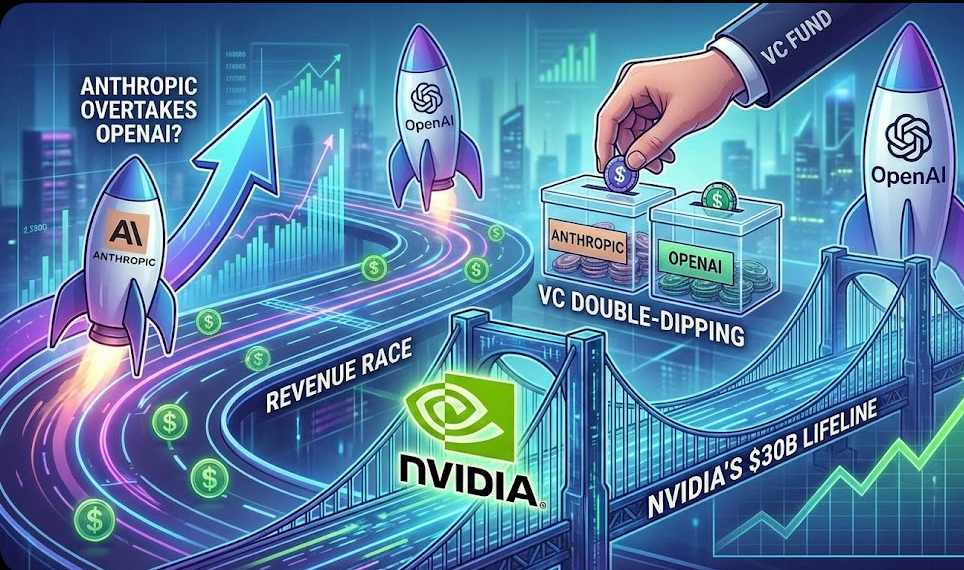
Did Anthropic Just Overtake OpenAI?
Inside the Revenue Race, VC Double-Dipping, and Nvidia’s $30B Lifeline
Published: February 24, 2026 | Reading time: ~18 minutes
1. Everyone Thought OpenAI Was Untouchable. February 2026 Says Otherwise.
For the last three years, OpenAI has felt inevitable: biggest brand, biggest user base, biggest cultural footprint. ChatGPT became the default word people used for “AI,” the way “Google” became the verb for search.
But February 2026 has quietly flipped the narrative from “OpenAI vs everyone” to “OpenAI vs Anthropic and Anthropic might actually win the money game.”
In the span of a few weeks:
- Epoch AI released data showing Anthropic’s annualised revenue growing around 10× per year after hitting a $1B run rate, compared to OpenAI’s 3.4× per year.
- Their models suggest Anthropic could overtake OpenAI in annualised revenue by mid‑2026, with a crossover around August at roughly $43B run rate if recent trends continue.
- Nvidia was reported to be nearing a $30B equity investment in OpenAI, replacing a previously announced but never-finalised $100B infra deal, potentially valuing OpenAI around $730B.
- TechCrunch revealed that at least a dozen OpenAI investors now also back Anthropic, declaring that “with AI, investor loyalty is (almost) dead.”
In other words: OpenAI still has the biggest spotlight, but the revenue momentum, enterprise sentiment, and VC hedging are all tilting toward Anthropic.
This isn’t just a gossip story about two labs. It’s a live case study in how AI is maturing from hype to power dynamics: revenue, infra, regulation, and geopolitics.
2. The Revenue Race: How Anthropic Caught Up So Fast
Let’s start with the money.
2.1 The growth curves
Epoch AI analysed revenue data for both labs from the point each crossed $1B in annualised revenue.
Their key findings:
- OpenAI:
- Annualised revenue growth of about 3.4× per year since hitting the $1B mark.
- Internal reporting suggests OpenAI is budgeting for a slower ~2.2× growth in 2026 as the business matures.
- Anthropic:
- Annualised revenue growth around 10× per year initially, based on external reporting and internal estimates.
- More recently, growth has slowed to roughly 7× per year since July 2025, as scale effects kick in.
- Internal figures reportedly project around 4× growth or less in 2026, still well above OpenAI’s expected rate.
Even with those more conservative assumptions, both internal and external projections converge on a similar conclusion:
Anthropic is likely to surpass OpenAI in annualised revenue sometime between late 2026 and early 2027, with some models placing the crossover as early as mid‑2026.
Epoch’s trend-based estimate centres the crossover around August 2026 at ~$43B run rate, with a 90% confidence interval from February 2026 to April 2027.
2.2 Why this matters more than vanity metrics
OpenAI still dominates:
- Mindshare (ChatGPT is synonymous with “AI”).
- User count (hundreds of millions of monthly active users).
- Cultural influence (from schools to CEOs).
But revenue growth is a different scoreboard:
- It tells you where enterprises are actually signing cheques.
- It reflects repeat use, integration depth, and perceived reliability, not just hype.
- It determines who can sustainably fund:
- Larger training runs,
- Better infrastructure,
- And more aggressive GTM.
On that scoreboard, February 2026 is the first time Anthropic looks like a genuine favouriteif not today, then soon.
3. Nvidia’s $30B Lifeline: OpenAI’s New Capex Engine
While Anthropic is catching up on revenue, OpenAI is moving to secure the biggest war chest in AI history.
3.1 From $100B “circular deal” to $30B equity
Multiple outlets, including Reuters, Yahoo Finance, CNBC, and The Guardian, report that Nvidia is close to investing up to $30B into OpenAI’s new mega funding round.
Key details:
- The investment could value OpenAI at around $730B pre-money, just behind SpaceX on the private-company leaderboard.
- This replaces a previously announced $100B infrastructure agreement, which was criticised as “circular” because OpenAI would effectively be committing to buy Nvidia hardware with Nvidia’s own money.
- The new structure is straight equity:
- Nvidia invests cash in exchange for stock.
- There’s no explicit obligation for OpenAI to buy specific amounts of Nvidia hardware in return, though everyone expects that’s where most of the cash is going.
Reporting suggests OpenAI will still allocate a “substantial portion” of the new funding to purchase Nvidia chips for training and deployment.
3.2 Why Nvidia is doing this
For Nvidia, this is both:
- A defensive move:
- OpenAI is one of its largest AI customers.
- Locking in that relationship with equity reduces the risk that OpenAI shifts large-scale workloads to AMD or custom accelerators.
- An offensive move:
- Equity in OpenAI gives Nvidia exposure to downstream value created by apps, agents, and platforms built on top of its hardware.
- It deepens Nvidia’s role from “GPU vendor” to strategic AI partner in the ecosystem.
For OpenAI, it’s straightforward:
You don’t try to raise $100B+ without a deep, aligned relationship with the company that makes the chips you depend on.
4. Investor Loyalty Is (Almost) Dead
The old startup myth goes like this: VCs pick sides. If they back you, they don’t back your closest rival.
In AI 2026, that rule is collapsing.
4.1 The double-booked cap table
TechCrunch’s reporting shows that at least a dozen direct investors in OpenAI also invested in Anthropic’s recent $30B round, including major names like:
- Founders Fund
- Iconiq
- Insight Partners
- Sequoia Capital
At the same time, some investors have chosen not to hedge:
- Andreessen Horowitz: OpenAI only (no Anthropic, at least for now).
- Menlo Ventures: Anthropic only.
- Others like Bessemer, General Catalyst, Greenoaks reportedly also stick to one camp.
But the headline trend is unavoidable:
The classic “we back one champion per category” norm is eroding in AI. Many funds are now explicitly hedged across both labs.
4.2 Why funds are hedging
Several structural reasons:
- AI is too big to be winner-takes-all.
This looks more like cloud computing than search. Multiple hyperscalers will coexist: some stronger on consumer, others on enterprise, infra, or specific verticals. - Risk diversification.
At the speed this space is moving, betting on a single research and policy culture is dangerous. Backing both OpenAI and Anthropic spreads technical, regulatory, and execution risk. - LP pressure.
When your limited partners see deals of this magnitude, not participating can look like malpractice. Backing both labs is easier to defend than backing none.
The result is an ecosystem where capital is loyal only to returns, not to any particular “AI vision.”
5. Product Positioning: Why Anthropic Feels “More Enterprise”
If OpenAI still owns the public imagination, Anthropic is increasingly seen as the serious enterprise AI partnerespecially for legacy code and infrastructure.
5.1 The IBM shock: Claude vs COBOL
Reuters recently reported that IBM’s stock suffered its sharpest one-day fall since 2000, after comments from Anthropic executives about Claude Code’s ability to modernise legacy COBOL systems running on IBM mainframes.
The core story:
- Anthropic has been pushing Claude Code as a solution for:
- Translating COBOL and other legacy languages.
- Refactoring large, mission-critical codebases.
- Helping enterprises migrate away from mainframe dependencies.
- For a company like IBM, whose mainframe and COBOL footprint still represents a major revenue stream, that’s more than a tech demo. It’s an existential threat narrative.
Markets noticed.
5.2 Anthropic’s enterprise pitch
Anthropic’s positioning revolves around a few consistent themes:
- Safety-first branding:
- Emphasis on “constitutional AI” and guardrails.
- Stronger messaging on alignment, reliability, and risk reduction.
- Enterprise-first go-to-market:
- Claude Opus and Claude Sonnet tuned for high-stakes knowledge work (legal, finance, government).
- Claude Code targeting modernisation of legacy systems, not just code completion.
- High-quality, low-chaos outputs:
- Many early adopters report Claude’s behaviour feels “more conservative, less hallucination-happy,” which is appealing for regulated sectors.
5.3 OpenAI’s product arc
OpenAI’s product map looks different:
- Massive consumer funnel:
- ChatGPT with hundreds of millions of users.
- App store-style GPTs, agents, and workflows.
- Enterprise and agents:
- Deepening partnerships with Microsoft and others.
- Frontier/Operator-style agent platforms for internal automation.
- New revenue streams from advertisements and integrations.
Anthropic is not trying to beat OpenAI at memetic awareness. It’s primarily trying to own the enterprise AI stack where risk, compliance, and reliability drive buying decisions.
6. Anthropic vs OpenAI in 2026: A Snapshot
Here’s a concise view of where things stand.
6.1 Side-by-side table
| Dimension | OpenAI | Anthropic |
|---|---|---|
| Valuation (reported/rumoured) | Targeting ~$730B pre-money in current round. | Recent round around ~$350380B valuation range. |
| Annualised revenue growth (post $1B) | ≈ 3.4× per year, projected ~2.2× in 2026. | Initially 10×, more recently ~7×; internal expectations ~4× or less in 2026. |
| Crossover projection | May be overtaken by Anthropic in annualised revenue between late 20262027. | Could surpass OpenAI around August 2026 at ~$43B run rate if trends hold. |
| Flagship models/products | GPT‑5.x family, ChatGPT, agents/Operator, enterprise APIs. | Claude 3/4.x (Opus, Sonnet), Claude Code, enterprise APIs. |
| Primary GTM focus | Huge consumer base + horizontal enterprise + ad-supported surfaces. | Safety-first, enterprise-first, deep in code and legacy infra modernisation. |
| Key infra relationship | Massive Nvidia commitment via $30B investment + cloud deals (Microsoft, etc.). | Multi-cloud and multi-partner, significant spend but less publicised, still heavily GPU-dependent. |
| Investor base | Mega-round toward $100B total raise; overlapping VCs with Anthropic. | Closed a ~$30B round; at least a dozen VCs also back OpenAI. |
The takeaway:
- OpenAI: Bigger valuation, broader product surface, deeper consumer moat, massive fresh capital.
- Anthropic: Faster revenue growth, sharper enterprise story, growing perception as the “serious” alternative.
7. Prediction Markets and Sentiment: Who’s Winning the “Model War”?
Beyond revenue and cap tables, there’s another soft indicator: prediction markets and performance leaderboards.
Several AI-focused briefs and markets highlight that many traders currently give Anthropic very high odds of leading the model-quality racefor example, selecting Claude Opus 4.6 as the “model of the month” through February.
These markets aren’t perfect, but they show:
- Developers and power users increasingly see Claude as at least on par with, and often superior to, GPT models for certain tasks (reasoning, code refactoring, enterprise prompts).
- Perception in the technical community is diverging from mainstream perception, where OpenAI still dominates.
This matters because many CIOs and CTOs listen more to their engineers than to brand campaigns.
8. The Legal and Regulatory Overhang
Both labs are racing under the same regulatory storm clouds.
8.1 Copyright and training data
OpenAI faces high-profile lawsuits, including The New York Times v. OpenAI/Microsoft, alleging copyright infringement in training data. Other model companies face similar suits (e.g., Getty vs Stability), and while Anthropic isn’t front-page in these cases yet, the legal precedents will apply to both.
The 2026 AI legal landscape highlights:
- Growing risk around training data provenance.
- Potential for statutory damages and licensing settlements.
- Pressure to adopt opt-out / licensing frameworks for publishers and rightsholders.
8.2 Government oversight and constitutional clashes
Policy analysts noting “three critical global decisions” for AI in February 2026 point to emerging tensions between:
- National governments pushing for strong AI controls, audits, and safety standards.
- State and regional authorities asserting their own regulatory powers.
- International coordination attempts that may clash with constitutional limits or commercial interests.
Both OpenAI and Anthropic will need:
- Strong compliance,
- Transparent safety processes,
- And tight enterprise controls to keep winning high-stakes deals under this scrutiny.
In other words: whoever feels less risky to regulators and Fortune 500 legal teams will have an edge, regardless of who has the flashiest demo.
9. What This Means for Different Players
9.1 For enterprises
If you’re a CIO/CTO, the OpenAI vs Anthropic rivalry is a gift:
- More negotiating power: You can play vendors off each other on price, SLAs, and feature roadmaps.
- Multi-model strategies: Instead of going all‑in on one lab, you can:
- Use OpenAI for agents, end-user workflows, and experimentation.
- Use Anthropic for core enterprise workloads, code modernisation, and safety-critical tasks.
Expect best practices to converge on:
- Routing layers that send different tasks to different models.
- Abstraction libraries that hide vendor specifics behind a single interface.
9.2 For developers and builders
If you’re building products:
- Don’t marry one provider.
- Invest in model-agnostic architectures:
- Feature flags for different LLM backends.
- Evaluation harnesses that can benchmark GPT vs Claude vs others on your real workloads.
As Anthropic gains revenue and OpenAI secures huge capex, competition should keep prices pressured and innovation highgood news for you.
9.3 For investors
The main lesson from February 2026:
AI is not a single-slot machine. It’s an entire casino.
Instead of asking “Who is the one winner?” the better questions are:
- Who will own the most profitable verticals (code, infra, agents, consumer, safety tooling)?
- How will capex demands and regulatory constraints affect margins?
- Which players will convert early hype into durable, high-value contracts?
Backing both OpenAI and Anthropic is no longer seen as a conflict. It’s seen as baseline risk management.
10. So… Did Anthropic “Overtake” OpenAI?
It depends on what game you’re looking at:
- Brand and cultural impact:
- OpenAI is still far ahead. ChatGPT remains the default front-door to AI for most of the world.
- Near-term revenue growth and enterprise excitement:
- Anthropic is clearly ahead on growth rate and could surpass OpenAI’s annualised revenue as early as mid‑2026 if trends hold.
- Enterprise sentiment around Claude Code and legacy modernisation is strong enough to move the stock price of companies like IBM.
- Capital and infrastructure war chest:
- OpenAI’s expected $100B+ round, including Nvidia’s $30B stake, gives it an enormous capex and R&D advantage.
The most realistic outcome is not “OpenAI dies” or “Anthropic dies,” but:
A multi-polar AI market where OpenAI, Anthropic, and a handful of other players dominate different layers and verticals of the stack.
Anthropic may well beat OpenAI in revenue growth and certain enterprise segments, while OpenAI may remain more valuable as a platform and brand.
11. FAQ
Is Anthropic bigger than OpenAI now?
No. OpenAI is still more valuable by private-market valuation and has a much higher general brand profile. However, external analyses suggest Anthropic’s annualised revenue is growing much faster (historically ~10× vs OpenAI’s ~3.4×) and could overtake OpenAI’s run rate sometime in 20262027.
Why did Nvidia decide to invest $30B in OpenAI?
Reports indicate Nvidia is close to a $30B equity investment in OpenAI as part of a massive new funding round. This replaces a prior $100B infrastructure commitment and gives Nvidia a direct stake in one of its biggest AI customers, while helping OpenAI fund huge GPU purchases for training and deployment.
Why are some OpenAI investors also backing Anthropic?
TechCrunch found that at least a dozen direct OpenAI investors are also in Anthropic’s $30B round, including Founders Fund, Iconiq, Insight, and Sequoia. In a market this large and uncertain, many VCs see hedging across multiple AI leaders as smart risk management rather than a conflict.
What does this mean for AI buyers?
For enterprises and builders, the OpenAIAnthropic rivalry means more choice, better pricing leverage, and faster innovation. The practical strategy is to stay multi-model: integrate both, test them on your real workloads, and avoid hard dependencies that lock you into a single provider.
About the Author & Kersai
About the Author: Kersai’s AI Research Team tracks the good, the bad, and the rogue. Subscribe to our newsletter to stay safe in the Agent Economy.