


AI Breakthroughs in 2026
AI Breakthroughs in 2026: The Year of Agentic AI, Physical Robots &Intelligent Machines
Executive Summary
Artificial intelligence in 2026 has transcended the era of large language models and entered a transformative phase focused on agentic AI, physical automation, and specialized intelligence systems. From humanoid robots deployed in manufacturing to compact AI models delivering enterprise-grade performance, the industry is shifting toward practical, autonomous systems that drive measurable business outcomes.
This article explores the most significant AI developments shaping 2026, the dominant players driving innovation, viral breakthroughs that are redefining what’s possible, and real-world use cases transforming industries worldwide.
Table of Contents
- Latest AI Innovations in January 2026
- The Major Players Dominating AI
- Viral AI News & Breakthroughs
- Real-World AI Use Cases
- AI Impact on Australian Businesses
- The Future: What’s Next for AI
- Frequently Asked Questions
Latest AI Innovations in January 2026
1. Agentic AI: The Shift from Tools to Autonomous Workers
The most significant trend defining 2026 is the rise of agentic AIautonomous systems capable of executing complex, multi-step tasks without human intervention. Unlike previous AI applications that served as passive assistants, agentic AI agents make decisions, adapt to challenges, and complete workflows independently[1].
Key metrics:
- Market projected to grow from $5.2 billion (2024) to $200 billion (2034)
- One real-world example: Danfoss reduced customer response times from 42 hours to nearly instant by automating 80% of transactional decisions using AI agents
As tech leaders state, “2026 will be the year AI agents fundamentally reshape business”.
This shift represents the evolution from “AI that helps you” to “AI that works for you”a fundamental reimagining of workplace productivity.
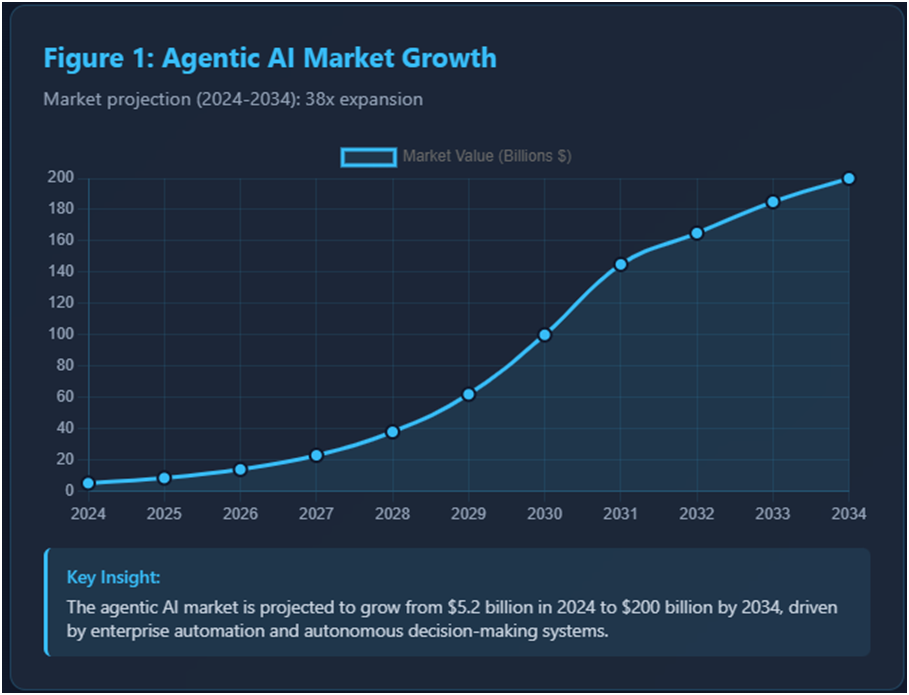
Figure 1: Agentic AI Market Growth Projection (2024-2034). The agentic AI market is projected to grow from $5.2 billion in 2024 to $200 billion by 2034, representing a 38x expansion driven by enterprise automation and autonomous decision-making systems.
2. Physical AI & Humanoid Robots in Manufacturing
Humanoid robots are no longer experimentalthey’re operational. In a breakthrough moment captured by CBS News’ “60 Minutes” on January 4, 2026, Boston Dynamics’ Atlas humanoid robot began its first field test at Hyundai’s manufacturing facility near Savannah, Georgia.
What makes this significant:
Physical AI combines robotics with advanced vision-language-action (VLA) models, enabling machines to understand complex environments and perform delicate tasks. Key developments include:
- NVIDIA Alpamayo: A 10-billion-parameter Vision-Language-Action model designed specifically for autonomous driving, incorporating chain-of-thought reasoning to handle real-world driving scenarios.
- AlpaSim: NVIDIA’s simulator that reduces validation metric variance by up to 83%, allowing autonomous systems to train in virtual environments before real-world deployment.
- LG CLOiD: LG Electronics launched a smart home AI robot powered by NVIDIA Jetson Thor, capable of simulating and learning behaviors in virtual environments before home deployment
Manufacturing impact: NVIDIA and Siemens AG partnered to integrate Physical AI into factories through digital twin technology, enabling factories to simulate and validate entire operations virtually before implementation, addressing skilled labor shortages and improving supply chain resilience.
| Physical AI System | Capability | Key Metric | Application |
| Boston Dynamics Atlas | Multi-task humanoid automation | Field operational (2026) | Manufacturing assembly |
| NVIDIA Alpamayo | Vision-Language-Action reasoning | 10B parameters | Autonomous driving |
| NVIDIA AlpaSim | Simulation and validation | 83% variance reduction | Virtual training environments |
| LG CLOiD | Smart home robot learning | NVIDIA Jetson Thor | Domestic automation |
| Tesla Optimus | Manufacturing and service robots | Continuous improvement | Factory and service roles |
Table 1: Key Physical AI Systems Deployed in 2026. These represent the frontier of autonomous robotics, combining hardware innovation with advanced AI reasoning capabilities.
3. Falcon-H1R: Compact Intelligence Outperforming Larger Models
In January 2026, the Technology Innovation Institute (TII) unveiled Falcon-H1R 7B, a paradigm-shifting compact AI model that delivers performance comparable to systems 7x larger.
Performance benchmarks:
- 88.1% on AIME-24 math benchmark (vs. 86.2% for 15B Apriel 1.5)
- 68.6% on LCB v6 coding tasks (outperforming 32B Qwen3 by ~7 percentage points)
- Processes 1,500 tokens per second per GPU at batch size 64
- Features DeepConf (Deep Think with Confidence) capability for reliable reasoning
The Transformer-Mamba hybrid architecture enables Falcon-H1R to deliver elite-level performance with exceptionally low memory and energy consumption, making it ideal for robotics, autonomous vehicles, and edge computing.
Why this matters: The industry is moving away from “bigger is better” toward specialized, efficient models optimized for specific tasksa democratization of AI that enables startups and smaller organizations to deploy enterprise-grade capabilities.
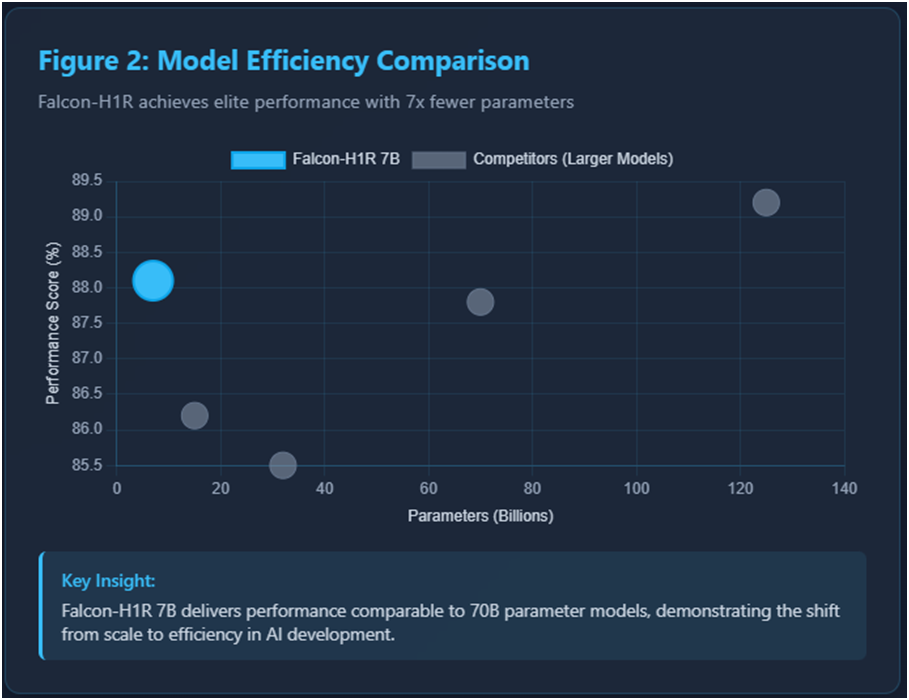
Figure 2: Model Efficiency vs. Performance Comparison. Falcon-H1R achieves elite performance with 7x smaller parameter count than competing models, demonstrating the shift from scale to efficiency in AI development.
4. NVIDIA’s Next-Generation AI Infrastructure: Vera Rubin & H300 GPUs
At CES 2026, NVIDIA unveiled Vera Rubin, its latest flagship AI platform engineered to handle trillion-parameter models. Following the Blackwell architecture, Vera Rubin introduces:
- Radical improvements in processing power and memory bandwidth
- New H300 GPUs specifically designed for massive-scale AI workloads
- A dedicated AI foundry for custom silicon development
- Full production launch expected later in 2026
Competitive implication: NVIDIA is signaling its intent to maintain dominant leadership in the global AI hardware race, with infrastructure supporting the next wave of sovereign and enterprise AI systems.
5. Apple’s Reimagined Siri with Google Gemini Integration
Apple announced a fundamental transformation of Siri, debuting in 2026 as a context-aware, on-screen-aware assistant with seamless cross-app integration. The strategy involves:
- Partnering with Google to leverage the 1.2 trillion parameter Gemini model
- Running Gemini on Apple’s Private Cloud Compute to maintain strict privacy standards
- Enabling Siri to understand visual context and application states
This move signals a broader industry trend: specialized partnerships to access best-in-class capabilities while maintaining proprietary advantages (in this case, privacy).
6. Speech Recognition Leap: NVIDIA Nemotron Speech ASR
NVIDIA released Nemotron Speech ASR, an open-source automatic speech recognition model 10x faster than traditional systems, enabling:
- Real-time live captions
- Voice assistant applications
- In-car voice command systems
- Available as NVIDIA NIM microservice for secure edge, cloud, and data center deployment[2]
Market accessibility: Development and testing access is free for NVIDIA Developer Program members, with production use requiring an NVIDIA AI Enterprise licensea consumption-based model that lowers adoption barriers.
The Major Players Dominating AI in 2026
Tech Giants Leading the Innovation Race
| Player | Key 2026 Initiative | Strategic Focus |
| NVIDIA | Vera Rubin platform, Physical AI, Nemotron models | AI infrastructure, specialized models, robotics |
| OpenAI | GPT-5.2 release, agentic workflows | Advanced reasoning, autonomous systems |
| Google DeepMind | GenCast (weather forecasting), Gemini integration | Scientific AI, enterprise partnerships |
| Meta | Nuclear energy investments for AI infrastructure | Large-scale compute, sustainable AI |
| Apple | Siri reimagined with Gemini partnership | On-device AI, privacy-first integration |
| Microsoft | Copilot expansion across enterprise tools | Workplace AI, productivity integration |
| Anthropic | Claude model advancements | Safety-focused AI, enterprise reliability |
| Boston Dynamics | Atlas deployment in manufacturing | Physical AI robotics, real-world automation |
| Tesla | Optimus humanoid robot improvements | Manufacturing robotics, autonomous systems |
Table 2: Major Players Dominating AI in 2026. These organizations are driving the most significant innovations in agentic AI, physical robotics, specialized models, and enterprise integration.
Regional Standouts
China: Continued advancement in LLM development with Qwen and other models, though facing regulatory constraints.
Europe: Focus on regulatory compliance with AI Act implementation, influencing global standards.
Australia: Growing AI adoption with government support through AI Adopt centers and emerging local AI startups achieving billion-dollar valuations.
Viral AI News & Breakthroughs Making Headlines
Healthcare Breakthroughs
AI Diagnoses Heart Disease from EKG in Seconds
University of Michigan researchers developed an AI system that diagnoses coronary microvascular dysfunction (CMVD) using only a standard 10-second EKG stripa condition previously requiring advanced imaging or invasive procedures.
AI-Designed Molecule Enhances Pancreatic Cancer Treatment
Researchers used AI to design novel molecules that significantly boost chemotherapy effectiveness in pancreatic cancer by targeting specific resistance mechanisms in tumor cells[6].
Dementia Detection with 97% Accuracy
Örebro University developed AI systems analyzing EEG (brainwave) data to distinguish between healthy individuals and those with dementia, including Alzheimer’s disease, achieving over 97% accuracy using federated learning for privacy preservation.
AI-Enhanced Cardiac Imaging
Philips announced new AI-powered cardiac magnetic resonance (CMR) innovations delivering up to 3x faster imaging and 80% sharper images, with “SmartHeart” automation setting up full cardiac scans in under 30 seconds.
Scientific & Environmental Innovation
Google DeepMind’s GenCast: AI Weather Forecasting
GenCast is a generative AI model for medium-range weather predictions, offering superior performance in predicting extreme weather events like heatwaves and storm tracks with a fraction of the computational cost of traditional ensemble model.
Quantum-AI Hybrid Computing
Microsoft and industry partners are advancing hybrid computing where quantum systems work alongside supercomputers and AI, with logical qubits enabling error detection and correctiona critical step toward practical quantum computing.
AI Identifies Gut-Brain Connections
Fujitsu and Kirin Holdings developed an AI-based Quantitative Systems Pharmacology (QSP) model identifying mechanisms linking gut health to brain function, accelerating functional food identification and reducing clinical trial timelines.
Business Productivity Records
Automated Decision-Making Reduces Response Time by 99%
Danfoss achieved near-instant customer response by automating 80% of transactional decisions with AI agents, transforming a 42-hour process.
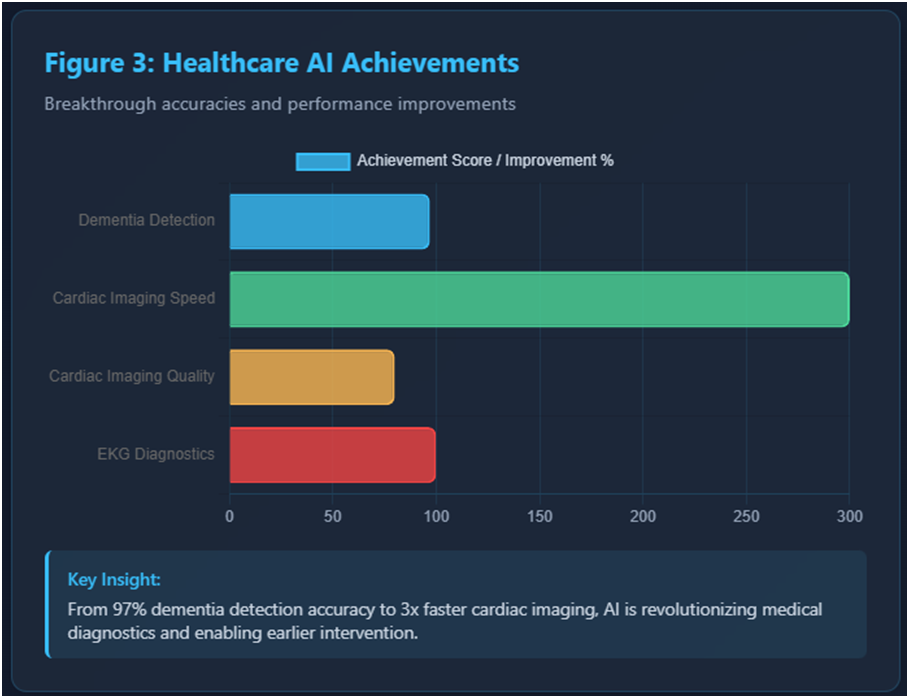
Figure 3: Healthcare AI Breakthroughs Timeline. From 97% dementia detection accuracy to 3x faster cardiac imaging, AI is revolutionizing medical diagnostics and enabling earlier intervention and better patient outcomes.
Real-World AI Use Cases Transforming Business
1. Customer Service & Engagement
Amazon & Personalized Recommendations
Amazon’s AI recommendation engine analyzes browsing history, purchase behavior, and cart contents, driving massive cross-selling and upselling opportunities.
Netflix Content Personalization
Netflix AI algorithms recommend shows and movies based on viewing history and preferences, reducing churn and increasing engagement through personalized experiences.
H&M & AI Shopping Assistant
H&M deployed AI-powered chatbots assisting customers with shopping experience, answering queries, and providing product recommendations.
Erica (Bank of America)
Bank of America’s AI virtual assistant handles customer inquiries and provides financial advice, significantly improving customer engagement and support efficiency.
2. Supply Chain & Inventory Optimization
Walmart’s Demand Forecasting
Walmart uses AI to forecast demand and optimize inventory management, ensuring products are available when and where needed, reducing waste and improving customer satisfaction.
Amazon’s Logistics Revolution
Amazon employs AI to streamline supply chain operations from warehouse management to last-mile delivery, resulting in faster delivery times and reduced operational costs.
Coca-Cola’s Automated Supply Chain
Coca-Cola uses AI to automate supply chain management, optimizing logistics and inventory processes, resulting in improved efficiency and reduced operational costs.
UPS Route Optimization
UPS integrated AI into logistics operations to optimize delivery routes and manage fleet maintenance, improving delivery efficiency and reducing fuel consumption.
3. Automated Business Processes
IBM’s Robotic Process Automation (RPA)
IBM uses RPA to streamline business processes by automating repetitive tasks such as data entry, customer support, and transaction processing, improving efficiency and allowing employees to focus on higher-value work.
Finance & Compliance Automation
Finance teams use AI to automate invoicing, payment processing, and compliance checks, reducing manual errors and accelerating cash cycles.
Insurance Claims Processing
Insurance companies automate claims processing and policy management, reducing processing time and improving customer satisfaction.
4. Healthcare Operations & Diagnostics
Administrative Task Automation
Healthcare facilities automate administrative tasks and patient record management, freeing clinicians to focus on patient care.
Personalized Treatment Plans
AI analyzes patient data to create personalized treatment recommendations based on individual medical history, genetics, and lifestyle factors.
Predictive Staffing
Healthcare AI predicts staffing needs based on patient influx patterns, optimizing workforce allocation.
5. Content Generation & Marketing
Automated News & Marketing Content
Media and marketing teams use AI for automated article generation and personalized content creation for targeted audiences.
Dynamic Product Descriptions
E-commerce platforms generate product descriptions and marketing materials automatically, enabling rapid catalog updates.
Personalized Learning Content
Educational platforms create customized learning materials and assessments for individual learners.
6. Manufacturing & Predictive Maintenance
Equipment Breakdown Prevention
Manufacturing facilities use AI to prevent equipment breakdowns by predicting maintenance needs, optimizing maintenance schedules.
Quality Control & Defect Detection
AI systems detect defects in manufacturing processes in real-time, improving product quality and reducing waste.
Labor Distribution Optimization
AI ensures optimal labor distribution based on production demands and peak-hour requirements.
7. Code Development & Software Testing
GitHub Copilot for Development Acceleration
GitHub Copilot, powered by OpenAI, suggests code snippets and completes lines of code, significantly increasing coding efficiency and reducing development time.
Automated Code Review
DeepCode uses AI to review code, identify potential bugs, and suggest improvements, enhancing code quality and reducing code review time.
Software Quality Assurance
AI monitors software systems and applications for errors and performance issues, ensuring reliability and security.
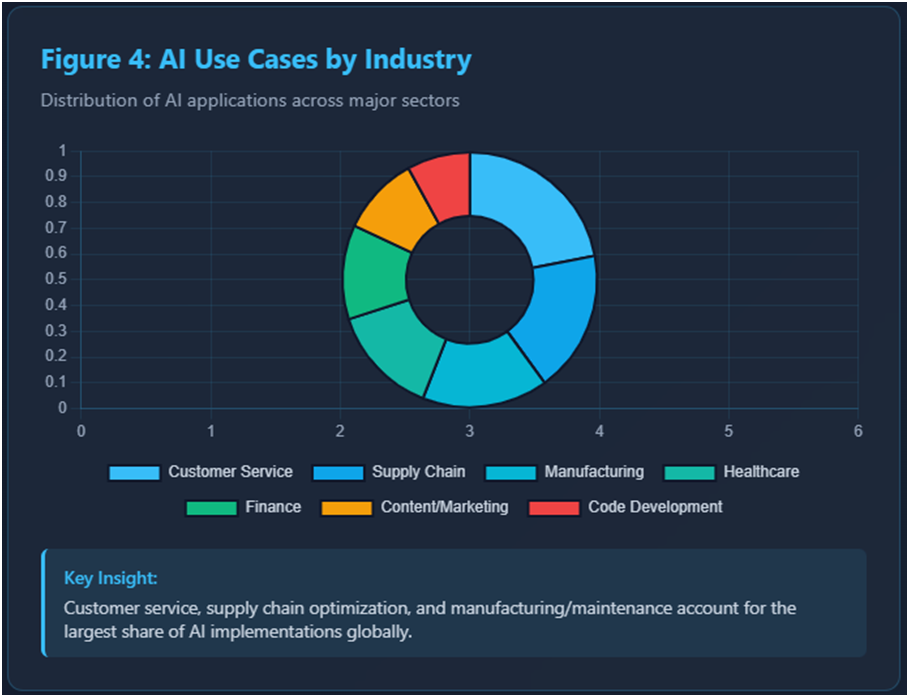
Figure 4: AI Use Cases Across Industries. From customer service chatbots to predictive maintenance systems, AI is transforming operational efficiency, cost reduction, and customer experience across all major business sectors.
AI Impact on Australian Businesses
Australia is experiencing rapid AI adoption, with significant economic implications:
- 68% of Australian businesses have integrated AI technologies into their operations
- 23% more are planning adoption within the next year
- 41% of SMEs are currently adopting AI (up 5% from previous quarter)
- $44 billion economic opportunity from AI adoption by SMEs, representing 1.3% increase in GDP
A critical trend emerging in Australia: startups (81%) are adopting AI far faster than large enterprises (61%)
- 42% of startups are building entirely new AI-driven products (vs. only 18% of enterprises)
- Only 22% of large enterprises have comprehensive AI strategies
- This divergence risks creating a two-tier economy where agile startups capture market advantages
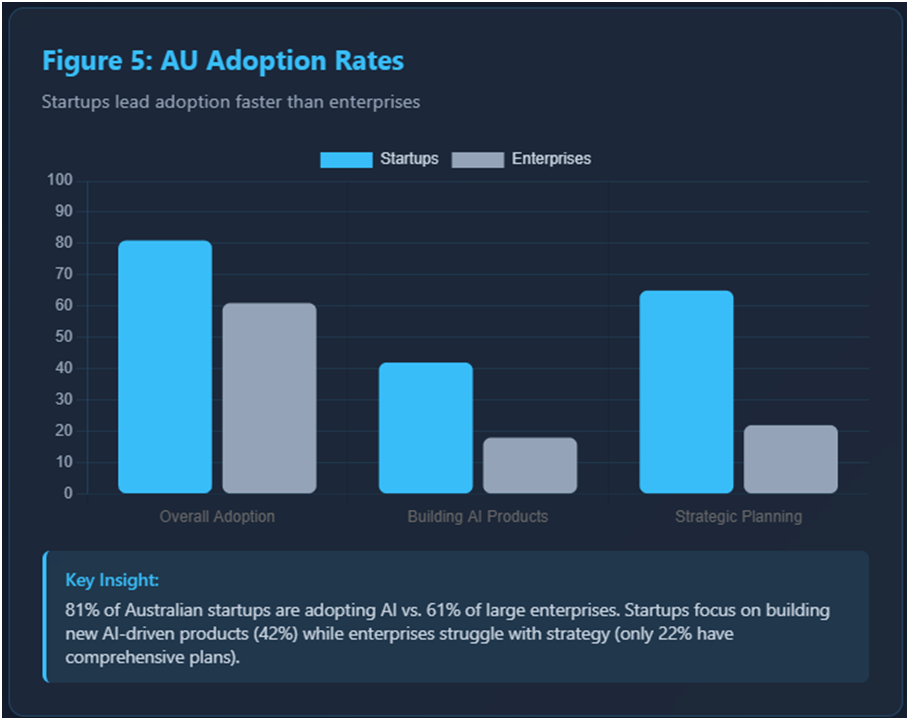
Figure 5: Australian AI Adoption: Startups vs. Enterprises. Startups (81%) are adopting AI at significantly faster rates than large enterprises (61%), with startups focusing on building new AI-driven products while enterprises struggle with strategic alignment.
Australian Industries Leading Adoption
| Industry | AI Adoption Focus | Expected Impact |
| Retail & E-commerce | Inventory management, personalized recommendations, chatbots | 42% forecast accuracy improvement, 48% increase in repeat visits |
| Healthcare | Diagnostics, personalized medicine, administrative automation | Faster diagnosis, improved patient outcomes, operational efficiency |
| Manufacturing | Predictive maintenance, robotics, supply chain optimization | Reduced downtime, improved productivity, labor efficiency |
| Finance & Banking | Fraud detection, customer service, risk assessment | Enhanced security, faster processing, improved decision-making |
| Logistics | Route optimization, warehouse automation, demand forecasting | Faster delivery, reduced costs, improved customer satisfaction |
Table 3: Australian Industries Leading AI Adoption. Retail, healthcare, manufacturing, finance, and logistics are experiencing the most significant AI transformation with measurable ROI and operational improvements.
Australian businesses adopting AI report tangible benefits:
- 95% report average revenue increase of 34%
- 86% see productivity improvements
- 94% anticipate average cost savings of 38%
- Average SME profit increase of 45% from modest AI integration (up to $500,000 additional revenue for retail from customer service bots)
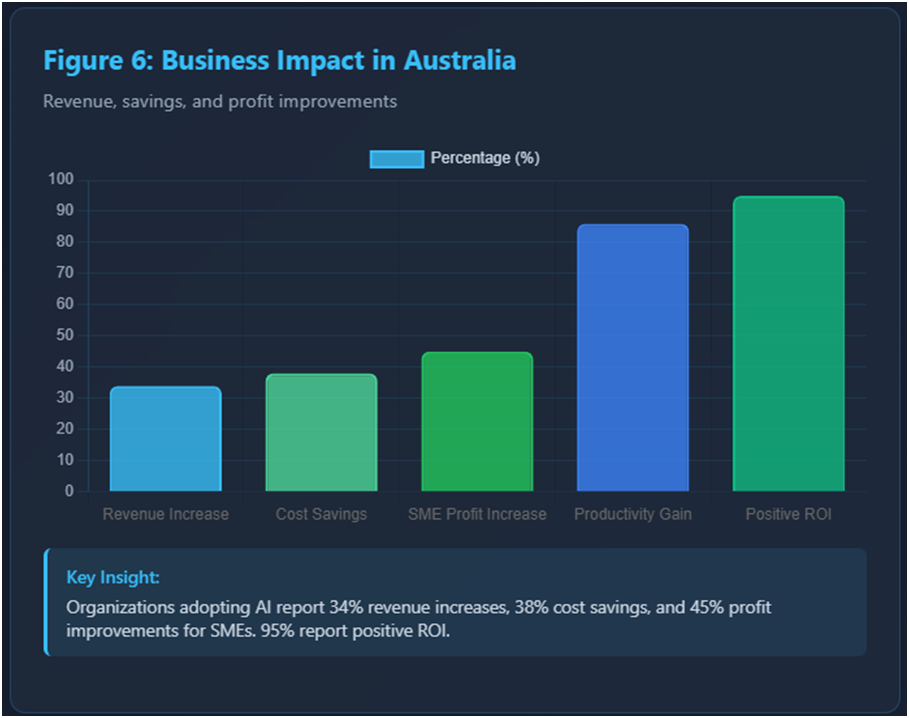
Figure 6: Australian Business AI Benefits. Organizations adopting AI report 34% average revenue increases, 38% cost savings, and 45% profit improvements for SMEs, making AI adoption a critical strategic priority.
Despite strong growth, significant challenges remain:
- 39% cite lack of digital skills as primary barrier[5]
- 27% report unclear ROI on AI investments[5]
- 21% cite financial constraints limiting investment[5]
- 51% lack workforce capability to fully implement AI systems[5]
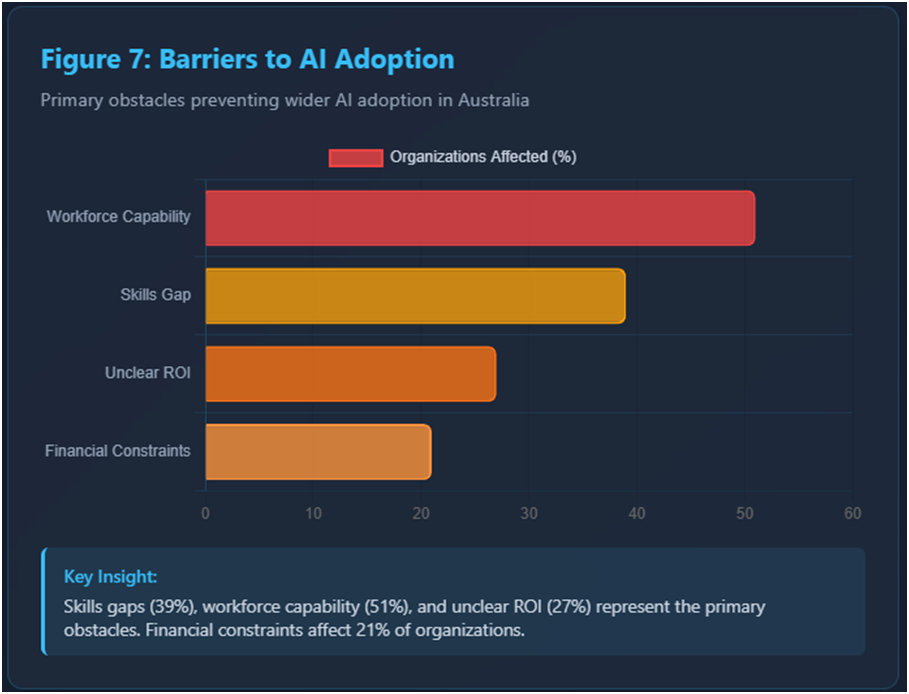
Figure 7: Australian AI Adoption Barriers. Skills gaps (39%), unclear ROI (27%), and workforce capability (51%) represent the primary obstacles preventing wider AI adoption, particularly among enterprises and smaller organizations.
Government Support Initiatives
The Australian Government is actively supporting AI adoption:
- AI Adopt Centers: $17 million investment in establishing AI adoption centers nationwide[8]
- National AI Plan: Supporting commercialization of AI solutions made in Australia with “AI Accelerator” funding rounds[10]
- Skill Development: TAFE NSW offering “Introduction to Artificial Intelligence” micro skill courses[8]
- AWS AI Spring Australia: $20 billion investment in infrastructure and skills training (2025-2029)[5]
What’s Next: The Future of AI Beyond 2026
Emerging Trends Shaping 2026-2027
1. On-Device AI & Edge Intelligence
While cloud-based models dominated recent years, 2026 marks the shift to on-device AIpowerful models running locally on smartphones, IoT devices, and industrial sensors without constant cloud connectivity. This enables:
- Real-time language translation
- Predictive maintenance
- Personalized learning
- Data privacy through local processing
2. Specialized Foundation Models
The industry is moving away from general-purpose mega-models toward specialized foundation models optimized for specific domains (video, robotics, scientific research), improving efficiency and performance.
3. World Models & Simulation
Video generation models and emerging world models demonstrate that simulating the physical world unlocks new possibilities in synthetic training data, digital twins, and real-world AI deployment.
4. AI for Scientific Discovery
Generative AI is accelerating breakthroughs in drug discovery, protein folding, climate modeling, and disease eradicationpositioning AI as essential infrastructure for solving global challenges.
5. Quantum-AI Hybrid Computing
Hybrid computing architectures combining quantum processors, supercomputers, and AI will unlock new possibilities for molecular modeling and complex system simulation.
6. Regulatory Maturation
As AI adoption accelerates, regulatory frameworks (EU AI Act, proposed frameworks in other regions) will mature, establishing standards for safety, transparency, and accountability.
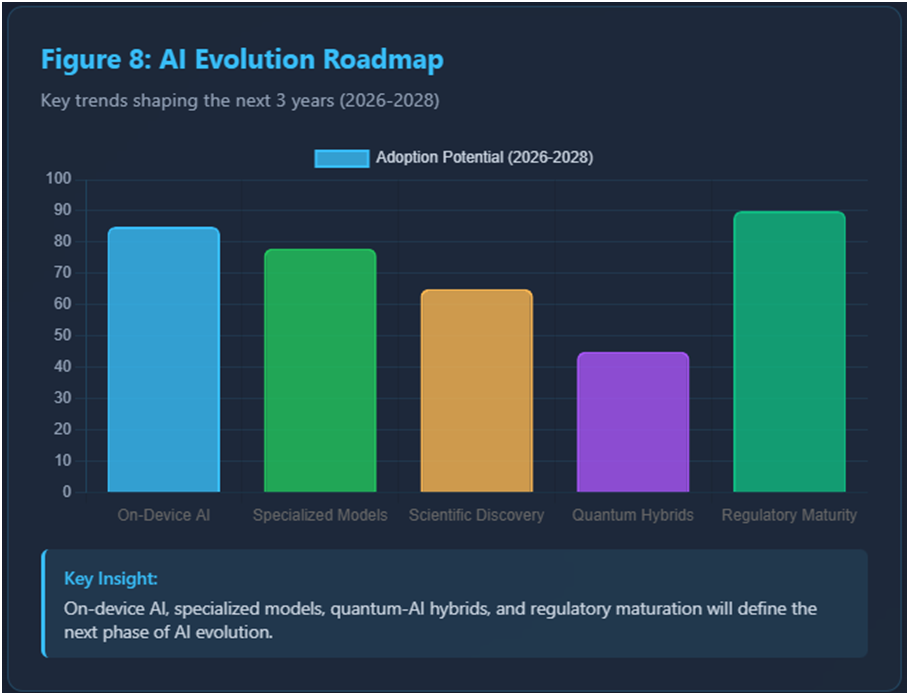
Figure 8: AI Evolution Roadmap (2026-2028). The next frontier of AI development will be characterized by on-device intelligence, specialized foundation models, quantum-AI hybrids, scientific discovery applications, and mature regulatory frameworks.
Frequently Asked Questions
1. What is Agentic AI and How is It Different from Traditional AI Assistants?
Answer: Agentic AI represents a fundamental shift from reactive AI assistants to proactive autonomous agents. Traditional AI assistants (like chatbots) respond to user queries and execute specific commands. Agentic AI agents can independently plan complex workflows, make decisions, adapt to obstacles, and complete multi-step tasks without human intervention. For example, an agentic AI system could autonomously manage customer service across multiple channels, handle exceptions, learn from outcomes, and continuously improveall while making decisions that would previously require human judgment. The market for agentic AI is projected to grow from $5.2 billion in 2024 to $200 billion by 2034.
2. When Will Humanoid Robots Like Boston Dynamics’ Atlas Be Available for Commercial Use?
Answer: Boston Dynamics’ Atlas began its first field test in January 2026 at a Hyundai manufacturing facility, marking the transition from experimental to operational deployment. However, widespread commercial availability faces several timelines: small-scale industrial deployments (manufacturing, logistics) are expected by late 2026-2027; broader commercial availability for diverse applications will likely occur 2027-2028; and consumer-grade humanoid robots remain 3-5 years away. Cost remains a significant barrierearly commercial units will command premium pricing ($150,000-$500,000+), with economies of scale expected to drive prices down over the next decade.
3. Can Small Businesses and Startups Access Enterprise-Grade AI Without Massive Capital Investment?
Answer: Yes, increasingly so. Models like Falcon-H1R 7B demonstrate that elite-level AI performance is achievable with significantly smaller models (7 billion parameters vs. 70+ billion for competing systems). This democratization means startups can deploy powerful AI on modest infrastructure. Additionally, cloud providers offer consumption-based pricing (you pay for what you use), and open-source models reduce licensing costs. The barrier has shifted from “capability access” (which is now widely available) to “implementation expertise and integration” (requiring skilled teams or consulting support). For Australian SMEs, government initiatives like AI Adopt Centers provide subsidized support for implementation.
4. What AI Skills Are Most in Demand in 2026, and How Can Organizations Build Capability?
Answer: Current demand focuses on:
(1) AI implementation and integration specialists,
(2) prompt engineering and AI workflow design,
(3) data strategy and governance,
(4) AI ethics and compliance, and
(5) domain-specific AI application (industry-specific use cases). Skills development pathways include: formal education (university programs, bootcamps), online certifications (NVIDIA, Google, AWS), hands-on project experience, and mentorship from experienced practitioners. In Australia, TAFE NSW micro-credentials and government-funded AI Adopt Centers provide accessible entry points. Organizations should invest in continuous learningthe field is evolving rapidly, and today’s cutting-edge skill becomes standard knowledge in 12-24 months.
5. What Are the Main Barriers Preventing Australian Businesses from Adopting AI?
Answer: Research identifies five primary barriers:
(1) Skills gap (39% cite lack of digital/AI expertise),
(2) Unclear ROI (27% uncertain about return on investment),
(3) Workforce capability (51% lack internal resources to implement),
(4) Financial constraints (21% cite investment costs), and
(5) Organizational alignment (lack of executive commitment and strategy). Interestingly, 81% of Australian startups are adopting AI vs. only 61% of large enterprises, suggesting that organizational culture and agility matter as much as resources. Solutions include: targeted upskilling, proof-of-concept projects to demonstrate ROI, government support programs, and hiring or consulting with AI expertise.
6. How Can Existing Employees Avoid Obsolescence as AI Becomes More Prevalent?
Answer: Rather than replacing workers, AI is transforming job rolesautomating routine tasks while creating demand for strategic, creative, and human-centered skills. Proactive strategies include:
(1) Upskilling in AI literacy (understanding how AI works, its limitations, and applications in your domain),
(2) Developing uniquely human skills (complex problem-solving, emotional intelligence, ethical judgment, creativity),
(3) Becoming an AI translator (bridging technical AI teams and business stakeholders), (4) Industry specialization (deep domain knowledge + AI application), and
(5) Continuous learning mindset (treating skill development as ongoing, not one-time). Organizations investing in employee development see better retention and performance than those focusing purely on automation.
7. What Does the Evidence Show About AI’s Actual Business Impact in 2026?
Answer: Concrete evidence is compelling: 95% of Australian businesses adopting AI report average revenue increases of 34%; 86% see measurable productivity improvements; 94% anticipate cost savings averaging 38%; and SMEs using customer service AI bots report up to $500,000 in additional annual revenue. Specific examples include Danfoss reducing customer response times from 42 hours to nearly instant (99% improvement), and manufacturing facilities reporting 15-30% reduction in equipment downtime through predictive maintenance. However, success requires proper implementationorganizations with clear strategies, executive alignment, and skill development significantly outperform those taking ad-hoc approaches.
8. Which Industries Should Prioritize AI Adoption First?
Answer: Based on current adoption rates and ROI evidence, the following industries show immediate payback:
(1) Retail & E-commerce (42% forecast accuracy improvement, 48% increase in repeat visits),
(2) Supply chain & logistics (route optimization, demand forecasting, inventory),
(3) Healthcare (diagnostics, administrative automation, personalized treatment),
(4) Finance & banking (fraud detection, risk assessment, customer service), and
(5) Manufacturing (predictive maintenance, quality control, labor optimization). However, “best” depends on your specific competitive positionearly adopters in high-value use cases gain outsized advantages[7][8].
9. Is AI Data Privacy and Security Adequately Addressed in Current Deployments?
Answer: Privacy is increasingly central to AI strategy. Examples include: Apple’s Siri uses Gemini but runs it through “Private Cloud Compute” to prevent data collection; federated learning (used in healthcare AI) trains models without centralizing sensitive patient data; on-device AI runs models locally without cloud transmission. However, data governance remains inconsistent across organizationsmany still transmit sensitive information to cloud services. Best practices include:
(1) data minimization (use only necessary data),
(2) encryption in transit and at rest,
(3) regular privacy audits,
(4) compliance with regulations (GDPR, Australia’s Privacy Act), and
(5) transparent data use policies. Expect regulatory frameworks to mature significantly in 2026-2027[1][6].
10. How Should Organizations Approach AI ImplementationBig Bang or Incremental?
Answer: Evidence strongly favors incremental, project-based approaches over comprehensive transformations:
(1) Start with high-ROI use cases (customer service, demand forecasting, quality control),
(2) Build internal capability through pilot projects before scaling, (3) Establish governance and ethics frameworks early,
(4) Measure and communicate success to build organizational buy-in, and
(5) Iterate based on results rather than following predetermined plans. Successful organizations follow a 3-stage model: (Stage 1) proof-of-concept (2-3 months), (Stage 2) pilot deployment (3-6 months), (Stage 3) scaled rollout (6-12+ months). This approach reduces risk, builds expertise internally, and creates organizational momentum[5][8][9].
11. What’s the Realistic Timeline for AI Implementation to Show ROI?
Answer: Timeline varies by use case but generally follows this pattern: Quick wins (3-6 months): customer service automation, basic demand forecasting, document processing; Medium-term (6-12 months): supply chain optimization, predictive maintenance, personalized recommendations; Long-term (12+ months): agentic AI workflows, advanced scientific applications, major organizational transformation. However, organizations should expect ROI planning at three levels: (1) Quick metrics (cost savings, efficiency gains), (2) Strategic metrics (revenue growth, market share), and (3) Long-term value (competitive positioning, new capabilities). Most organizations see positive financial return within 12-18 months if properly implemented.
12. How Do Businesses Prepare for Regulatory Changes Around AI?
Answer: Regulatory frameworks are evolving rapidly (EU AI Act is implemented; other regions developing frameworks). Preparation strategies include:
(1) Stay informed about emerging regulations in your jurisdiction and industry,
(2) Establish AI governance (ethics board, impact assessments, documentation),
(3) Ensure transparency in AI use (documenting algorithms, training data, decision processes),
(4) Build audit trails (track AI decisions and human oversight), (5) Plan for bias detection and mitigation, and
(6) Invest in explainable AI (systems that can justify their decisions). Organizations that build compliance infrastructure early will have competitive advantage as regulations maturethose rushing to comply later face costly retrofitting.
13. Can Smaller Organizations Compete with Tech Giants in AI Capability?
Answer: Yes, with important caveats. Advantages of smaller organizations:
(1) Agility (faster decision-making, implementation),
(2) Focus (can dominate specific domains/applications),
(3) Capital efficiency (lean implementations often outperform bloated enterprise systems), (4) Talent attraction (mission-focused work attracts skilled people). Advantages of tech giants:
(1) Scale (more data, more compute),
(2) Integration (products work together),
(3) Ecosystem (tools, APIs, platforms). Reality: smaller organizations can achieve superior results in specific domains and use cases by combining focused implementation, strong execution, and domain expertise. Eighty-one percent of Australian startups adopting AI (vs. 61% of enterprises) suggests organizational culture matters more than size.
14. What Should Organizations Do if They’ve Been Slow to Adopt AI?
Answer: Starting late is not fatalthe technology is still very new. Recommended approach for late starters:
(1) Don’t try to catch up on everything (focus on 2-3 high-impact use cases relevant to your business),
(2) Hire or contract experienced AI implementation partners (accelerates learning curve),
(3) Invest in employee reskilling immediately (build internal capability alongside external partnerships),
(4) Learn from early adopters (case studies, peer networks),
(5) Prioritize quick wins to build organizational momentum and buy-in,
(6) Establish strong governance from the start (avoid technical debt and poor practices). Technology is still commoditizingcompetitive advantage comes from implementation excellence and domain knowledge, not just access to cutting-edge models.
15. What’s the Most Important Factor for Successful AI Implementation?
Answer: Research consistently points to organizational and cultural factors as more important than technology choices. Most critical factors:
(1) Executive alignment and commitment (without it, initiatives stall), (2) Clear business strategy (knowing what problems you’re solving),
(3) Skilled team (execution matters more than model choice),
(4) Continuous learning mindset (willingness to iterate and adapt),
(5) Transparent communication (building trust with employees), and
(6) Measured, data-driven approach (proving value, not hype). Organizations that treat AI as a strategic capability requiring organizational change see 3-5x better outcomes than those treating it as a purely technical implementation.
Key Takeaways
- Agentic AI is the defining trend of 2026, transitioning AI from assistant to autonomous worker, with market projected to grow from $5.2B to $200B by 2034.
- Physical AI and humanoid robots are operational reality, with Boston Dynamics’ Atlas deployed in manufacturing and NVIDIA’s physical AI driving autonomous vehicle and robotics innovation.
- Specialized, compact models (like Falcon-H1R) are outperforming larger systems while consuming less energydemocratizing AI access for organizations of all sizes.
- Australian businesses are rapidly adopting AI, with 68% integration rate and $44B economic opportunity, though significant skills gaps remain.
- Real-world impact is measurable, with organizations reporting 34% revenue increases, 38% cost savings, and dramatic improvements in efficiency (from 42-hour customer response times to near-instant).
- The industry is shifting from “more parameters” to “smarter systems”with focus on context, memory, reliability, and real-world applicability rather than raw scale.
References
[1] Amiko Consulting. (2026, January 9). The January 2026 AI Revolution: 7 Key Trends Changing the Future of Manufacturing. https://amiko.consulting/
[2] AIApps. (2026, January 7). Top AI News for January 2026: Breakthroughs, Launches & Trends. https://www.aiapps.com/
[3] Google Cloud. AI Agents: Reshaping Business. Retrieved from industry discussions and presentations.
[4] CBS News. (2026, January 4). Boston Dynamics’ Atlas Robot Deployed at Hyundai Manufacturing Facility. 60 Minutes.
[5] AWS. (2025). Australian Businesses and AI: Adoption Trends & Growth Opportunities. https://cfotech.com.au/
[6] Crescendo AI. (2026, January 12). Latest AI News and AI Breakthroughs: 2026 & 2025. https://www.crescendo.ai/
[7] Product School. (2025, September 23). 15 AI Business Use Cases in 2026 + Real-World Examples. https://productschool.com/
[8] Appinventiv. (2026, January 11). AI in Australia: Top Business Opportunities and Applications. https://appinventiv.com/
[9] VA For Everyone. (2026, January 11). How AI Will Help Australian SMEs Thrive in 2026. https://vaforeveryone.com.au/
[10] Australian Government Department of Industry. (2025, December). National AI Plan: Empowering All Australians. https://www.minister.industry.gov.au/
[11] Trigyn. (2026, January 12). AI Trends in 2026: A New Era of AI Advancements and Breakthroughs. https://www.trigyn.com/
[12] Forbes. (2025, October 13). 10 Generative AI Trends In 2026 That Will Transform Work And Life. https://www.forbes.com/