

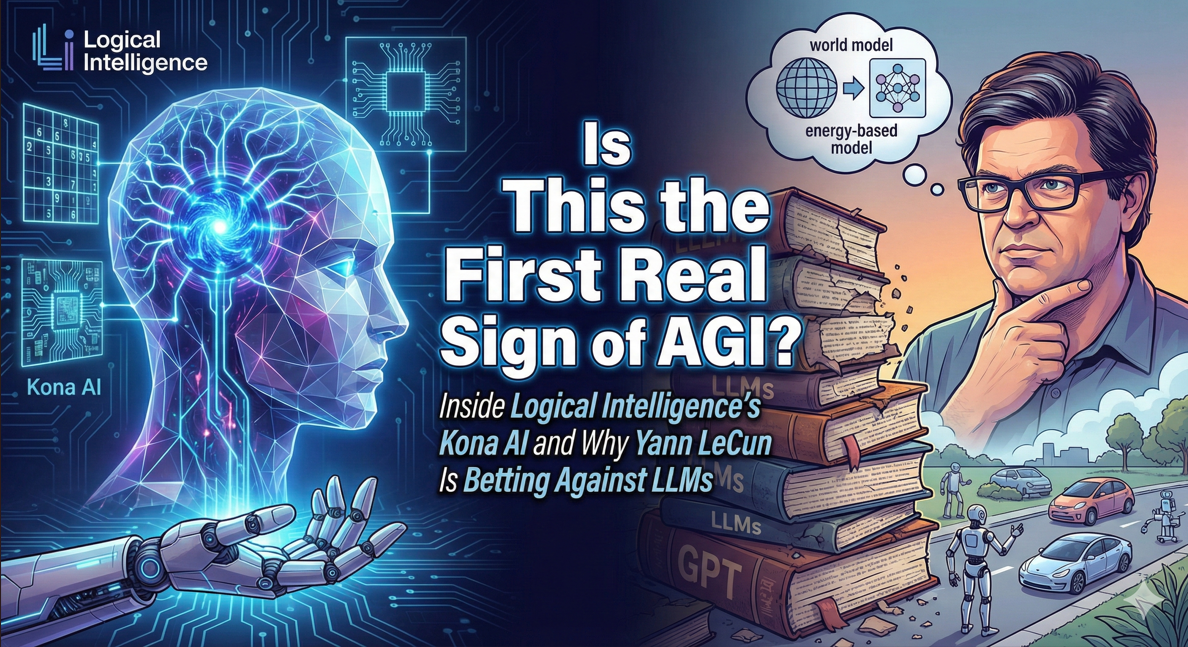
Is This the First Real Sign of AGI? Inside Logical Intelligence’s Kona AI and Why Yann LeCun Is Betting Against LLMs
A New AI Startup Claims “First Credible Signs of AGI” Using Energy-Based ModelsBut Is It Revolutionary Science or Just the Latest Hype?
Last Updated: February 4, 2026 | Reading Time: 13 minutes
“If general intelligence means the ability to reason across domains, learn from error, and improve without being retrained for each task, then we are seeing in Kona the first credible signs of AGI.”
That’s not a random tech blogger or overhyped founder making this claim. It’s Eve Bodnia, CEO of Logical Intelligence, a San Francisco-based AI startup that just unveiled Kona 1.0the world’s first energy-based reasoning model designed for real-world deployment.
And she’s not alone in her conviction. Yann LeCun, the 2018 Turing Award winner and former chief AI scientist at Meta, has joined as founding chair of the company’s Technical Research Board. His message is clear: “Everyone has been LLM-pilled,” and the industry’s obsession with making language models bigger is a dead end.
But is Kona really the breakthrough that finally gets us to AGI? Or is this just another example of AI companies redefining “intelligence” to match whatever their technology happens to do well?
This is the story of how a completely different approach to AIone that’s been researched for decades but never successfully commercializedis now challenging the entire foundation of modern artificial intelligence. And why the outcome matters far more than just another startup success story.
What Is Kona AI? Understanding Energy-Based Models
The Core Concept: Optimization Instead of Prediction
Every AI system you’ve usedChatGPT, Claude, Gemini, Copilotis built on the same fundamental architecture: Large Language Models (LLMs) that predict the next most likely word in a sequence.
When you ask ChatGPT “What’s 2+2?”, it doesn’t actually calculate anything. It predicts that after the sequence “What’s 2+2? The answer is” the most probable next token is “4” based on patterns it learned from billions of text examples.
This works remarkably well for many tasks. But it has fundamental limitations:
- No true reasoning – The model doesn’t understand why 2+2=4, it just knows this pattern appears frequently in training data
- Can’t verify correctness – It outputs whatever seems statistically likely, not what’s provably correct
- Struggles with constraints – Problems requiring multiple simultaneous conditions to be satisfied confuse probabilistic systems
- Energy inefficient – Massive models consuming gigawatts of power to essentially make educated guesses
Energy-Based Models (EBMs) work completely differently.
Instead of predicting “what comes next,” EBMs frame problems as optimization challenges. They define an “energy function” where lower energy states represent better solutions, then search for the configuration that minimizes energy while satisfying all constraints.
Think of it like a ball rolling down a hillit naturally settles at the lowest point (minimum energy). EBMs find solutions the same way: by navigating the landscape of possibilities until they reach provably optimal answers.
How Kona Solves Problems: The Sudoku Example
Logical Intelligence’s live demo lets you watch Kona compete against leading LLMs in Sudokuand the results are striking.
How LLMs approach Sudoku:
- Generate a likely-looking number for the first empty cell
- Generate another likely-looking number for the next cell
- Continue until the grid is filled
- Hope the probabilistic guesses happen to satisfy all constraints
Result: LLMs frequently violate Sudoku rules, place duplicate numbers in rows/columns, and generate invalid solutions.
How Kona approaches Sudoku:
- Map all constraints (each row, column, and box must contain 1-9 exactly once)
- Define energy function where valid solutions have low energy
- Search the solution space to find configurations that minimize energy
- Output only solutions that provably satisfy all constraints
Result: Kona consistently produces valid solutions, often faster and with dramatically lower energy consumption than LLMs.
One Reddit user who tested the demo reported: “Kona solves complex reasoning problems like Sudoku faster and with lower power consumption than its competitors, illustrating the practical advantages of energy-based reasoning.”
Why Yann LeCun Says “Everyone Has Been LLM-Pilled”
The Man Behind the Critique
Yann LeCun is not a random critic. He’s one of the “Godfathers of AI”the researcher who pioneered convolutional neural networks that power modern computer vision. He shared the 2018 Turing Award (computing’s Nobel Prize) with Geoffrey Hinton and Yoshua Bengio for foundational work in deep learning.
After leaving Meta in November 2025, LeCun has become increasingly vocal about what he sees as Silicon Valley’s dangerous groupthink around LLMs.
His Core Argument: Scaling LLMs Won’t Get Us to AGI
In recent interviews with the Financial Times and New York Times, LeCun argued that the industry’s strategymake models bigger, feed them more data, add more computehas fundamental limits:
“LLMs are not capable of reasoning in the way humans reason,” LeCun stated. They perform statistical pattern matching, not logical deduction.
“True reasoning should be framed as an optimization problem”exactly what energy-based models do by minimizing an energy function.
“Logical Intelligence is the first company to move EBM-based reasoning from theory to real-world products,” LeCun said, “paving the way for more reliable and trustworthy AI systems.”
The Technical Difference: Prediction vs. Optimization
LLMs:
- Output the most probable next token
- Cannot guarantee correctness
- Scale quadratically with sequence length (expensive)
- Learn from massive datasets through pattern recognition
Energy-Based Models:
- Find configurations that minimize energy functions
- Can provide provable correctness guarantees
- Scale more efficiently for constraint-satisfaction problems
- Learn by mapping valid solution spaces, not just memorizing patterns
As one researcher explained on Reddit: “EBMs can predict the energy of an entire sequence together, unlike LLMs which only output probabilities for single tokens.”
This difference becomes critical in domains where being right matters more than sounding plausibleexactly the use cases Logical Intelligence is targeting.
The AGI Claim: Revolutionary or Overblown?
What the Company Is Actually Claiming
Eve Bodnia’s statement deserves careful parsing:
“If general intelligence means the ability to reason across domains, learn from error, and improve without being retrained for each task, then we are seeing in Kona the first credible signs of AGI.”
Note the conditional: “If general intelligence means…”
She’s not claiming Kona is AGI. She’s claiming it demonstrates capabilities that align with one definition of general intelligence:
- Cross-domain reasoning – Same system works for Sudoku, chess, Go, and real-world constraint problems
- Learning from errors – Identifies mistakes and corrects them without human retraining
- Transfer learning – Improves on new tasks without task-specific training
Bodnia added a crucial caveat: “Kona is not the final form of AGI, but it marks a significant departure from narrow AI and represents a foundational step toward a broader ecosystem of complementary AI systems.”
The Skeptical View: AGI Claims Are Marketing
Critics argue that every AI company redefines “AGI” to match whatever their product happens to do well.
Gizmodo recently asked: “Will 2026 Be the Year That the AI Industry Stops Crowing About AGI?” highlighting how:
- Salesforce CEO Marc Benioff called AGI “marketing hypnosis” and said he’s “extremely suspect” of anyone hyping it
- Anthropic CEO Dario Amodei said he “always disliked” the term AGI; his President called it “outdated”
- Microsoft CEO Satya Nadella said “AGI as defined… is never going to be achieved anytime soon” and any self-declared achievement is just “benchmark hacking”
AI skeptic Gary Marcus has long argued that “pure scaling will not get us to AGI.” Recent research supports this:
- Apple paper concluded LLMs likely cannot achieve AGI
- Data Mining and Machine Learning Lab study found “chain of thought reasoning” in LLMs is “a mirage”
The Measured View: It Depends on Your Definition
The truth is AGI has no consensus definition. Different researchers emphasize different capabilities:
- Human-level performance across all cognitive tasks
- Transfer learning without task-specific retraining
- Self-improvement through autonomous learning
- Common sense reasoning about the physical world
- Consciousness or self-awareness (philosophical definition)
By some definitions (transfer learning, constraint satisfaction, provable correctness), Kona represents genuine progress. By others (human-level performance across all domains, consciousness), it clearly falls short.
One commenter on Reddit captured the nuance well: “Kona addresses a more fundamental challenge: building AI systems that can reason with logical constraints rather than probabilistic approximations.”
The Technology Deep Dive: How Kona Actually Works
The Core Innovation: Energy-Based Reasoning Models (EBRMs)
Logical Intelligence has published technical details explaining how Kona differs from both traditional LLMs and earlier EBM research.
Traditional EBMs:
- Primarily used for perception tasks (image recognition, pattern detection)
- Difficult to train at scale
- Slow inference speeds
- Limited to well-defined, structured problems
Kona’s Energy-Based Reasoning Models:
- Designed specifically for constraint-satisfaction and optimization problems
- Trained to map solution spaces, not just recognize patterns
- Fast inference through efficient energy minimization algorithms
- Applicable to open-ended reasoning challenges
The key breakthrough is making EBMs practical for real-world deployment in domains where correctness is non-negotiable.
Real-World Applications: Where Kona Excels
Logical Intelligence is initially targeting sectors where errors have serious consequences:
Energy Infrastructure
- Grid optimization with hard constraints (can’t overload circuits, must maintain voltage)
- Renewable energy balancing (intermittent supply, fluctuating demand)
- Failure mode prediction (must provably avoid dangerous states)
Semiconductor Design
- Circuit verification (must mathematically prove designs are correct before fabrication)
- Chip layout optimization (minimize power/heat while maximizing performance)
- Manufacturing process control (tight tolerances, complex interdependencies)
Advanced Manufacturing
- Robotic motion planning (collision avoidance, multi-robot coordination)
- Supply chain optimization (multiple constraints, real-time adjustments)
- Quality control (defect prediction, process optimization)
These domains share common traits:
- Multiple constraints must be simultaneously satisfied
- Probabilistic “guesses” are unacceptable
- Energy efficiency matters (both computation cost and real-world energy)
- Provable correctness is required
The Aleph Agent: Already in Production
While Kona 1.0 is just entering pilot programs, Logical Intelligence’s earlier productAlephis already commercially available.
Aleph specializes in:
- Formal verification of software code
- Automated code generation with machine-checkable proofs
- Ensuring software correctness in high-stakes, regulated environments
Think of Aleph as the “narrow AI” proving ground where Logical Intelligence refined techniques that now enable Kona’s broader reasoning capabilities.
The All-Star Team: Who’s Behind Logical Intelligence?
Eve Bodnia – Founder & CEO
Bodnia brings both technical depth and commercial focus to the company. Her vision centers on building AI systems that are certifiable, auditable, and safenot just high-performing.
Yann LeCun – Founding Chair, Technical Research Board
LeCun’s involvement lends enormous credibility. His expertise in energy-based models dates back decadeshe’s not opportunistically jumping on a trend, he’s returning to a research direction he pioneered.
Patrick Hillmann – Chief Strategy Officer
Hillmann previously served as Chief Strategy Officer at Binance and held executive roles at General Electric and Edelman. He emphasizes: “AI is entering domains where failure has real-world consequences. We’re engaging early with policymakers and industry leaders to ensure responsible deployment and scalable governance.”
Michael Freedman – Chief of Mathematics
Freedman is a Fields Medalistthe highest honor in mathematicsbringing deep theoretical expertise to the company’s formal verification work.
Vlad Isenbaev – Chief of AI
Isenbaev is an ICPC World Champion (competitive programming) and former engineer at Facebook and Nuro. His expertise in algorithms and optimization is central to Kona’s architecture.
This isn’t a team of hype merchantsit’s a collection of world-class researchers and engineers focused on provably correct AI systems.
The Energy Consumption Advantage: Why This Matters
LLMs Are Power-Hungry
Training GPT-3 (175 billion parameters) consumed approximately 1,287 MWhequivalent to an average American household’s energy consumption over 120 years.
Inference (actually using the model) also requires substantial energy. Researchers at the University of Michigan developed the ML.ENERGY Leaderboard showing that different LLMs can vary by orders of magnitude in energy efficiency for similar tasks.
As AI adoption explodes, energy consumption has become a critical bottleneck. Some projections show AI data centers consuming up to 10% of global electricity by 2030.
Kona’s Efficiency Advantage
Early demonstrations show Kona solving Sudoku puzzles with “dramatically lower power consumption than competitors,” according to users who tested the live demo.
This efficiency comes from architectural differences:
LLMs:
- Must process every token sequentially
- Activate billions of parameters for each prediction
- Often require multiple passes (chain-of-thought reasoning) to solve complex problems
Kona (EBMs):
- Navigate solution space directly toward optimal answers
- Activate only relevant portions of the model for specific constraints
- Converge to solutions without redundant computation
For deployment at scaleespecially in energy infrastructure, manufacturing, and semiconductor designthis efficiency advantage could be transformative.
The Industry Response: Debate and Cautious Optimism
Supportive Voices
Reddit user rhillery commented: “Excellent – not using the ‘bigger and bigger’ dead-end of LLMs but shifting to an ecosystem of linked tools better mimics the orbitofrontal+visual+Broca’s+Wernicke’s+hippocampus reality. ‘Cognition’ doesn’t lie in any one place or in one module(model), but is a consequence of the interactions among them.”
This echoes Bodnia’s vision of “a broader ecosystem of complementary AI systems” rather than a single monolithic AGI.
Skeptical Voices
Reddit user AI_SKEPTIC wrote: “AI based off of the human brain, but zero mention of the human brain or scientists that study the brain. More grifting.”
This reflects broader skepticism about AGI claims and concerns that companies oversell capabilities to attract funding and attention.
The Wait-and-See Contingent
Many industry watchers are taking a “show me” approach:
- Performance benchmarks beyond Sudoku will be critical
- Real-world deployments in energy, semiconductor, and manufacturing sectors will prove whether the technology delivers
- Peer-reviewed research establishing the theoretical foundations and limitations
- Independent validation from organizations using Kona in production
As one observer noted: “It’s easy to claim breakthroughs with carefully selected demos. The proof will be whether Kona can handle the messy, unpredictable complexity of real-world problems.”
Five Reasons to Be Excited About Kona
1. A Genuine Alternative to Scaling LLMs
For the first time in years, a well-funded company with world-class talent is pursuing a fundamentally different approach to AI. Even if Kona doesn’t achieve AGI, it could unlock capabilities LLMs simply cannot provide.
2. Provable Correctness in High-Stakes Domains
Energy grids, semiconductor fabs, and autonomous systems need guarantees, not probabilities. EBM-based systems can provide mathematical proofs of correctnessa game-changer for regulated industries.
3. Energy Efficiency at Scale
If Kona delivers on efficiency promises, it could make AI deployment viable in contexts where LLM energy costs are prohibitive.
4. Cross-Domain Transfer Learning
Kona’s ability to apply the same reasoning system to Sudoku, chess, Go, and real-world constraint problems suggests genuine generalizationnot just memorizing task-specific patterns.
5. Serious Talent and Research Pedigree
Yann LeCun, Michael Freedman, and the rest of the team bring decades of foundational research. This isn’t vaporware built on hypeit’s commercialization of deeply established science.
Five Reasons to Remain Skeptical
1. AGI Claims Are Almost Always Premature
Every few years, a company claims breakthrough progress toward AGI. Google DeepMind’s AlphaGo, OpenAI’s GPT-3, Meta’s LLaMAall were hyped as “steps toward AGI” but proved to be narrow systems excelling at specific tasks.
2. Demos Are Carefully Curated
Sudoku is a perfect showcase for constraint-satisfaction approaches. It doesn’t prove Kona can handle ambiguous, open-ended problems with conflicting objectives and incomplete informationthe hallmarks of real-world complexity.
3. EBMs Have Struggled with Scale for Decades
Energy-based models aren’t new. Researchers have explored them for 40+ years. The fact that they’ve never achieved widespread deployment suggests fundamental challenges Logical Intelligence must overcome.
4. No Independent Validation Yet
Kona 1.0 just launched. There are no peer-reviewed papers, independent benchmarks, or real-world deployments to evaluate. Early claims should be treated as hypotheses, not proven results.
5. The AGI Definition Is Conveniently Narrow
Bodnia defines AGI as “the ability to reason across domains, learn from error, and improve without being retrained”a definition that emphasizes exactly what Kona does well while downplaying capabilities it lacks (natural language understanding, common sense reasoning, creativity).
What This Means for the AI Industry
A Challenge to the Scaling Paradigm
For five years, the AI industry’s strategy has been simple: make models bigger, feed them more data, add more compute, repeat.
Logical Intelligence represents a direct challenge to this paradigm. If Kona succeeds, it proves that architectural innovationnot just scalecan unlock new capabilities.
This could redirect billions in investment and research toward alternative approaches that have been overshadowed by LLM dominance.
The Return of Symbolic AI?
Energy-based models share philosophical roots with symbolic AI and logic-based reasoning systems that dominated AI research before neural networks.
Kona may represent a synthesis: the pattern-learning power of neural networks combined with the provable correctness of symbolic reasoning.
If successful, this could revive research directions that were abandoned as “dead ends” when deep learning took over.
New Business Models for Enterprise AI
LLMs are primarily sold as general-purpose tools (ChatGPT, Claude, Gemini) that organizations adapt to specific use cases.
Kona targets the opposite end of the market: specialized, high-stakes domains where correctness and efficiency matter more than conversational fluency.
This could establish a two-tier AI ecosystem:
- LLMs for creative, open-ended, language-intensive tasks
- EBMs for optimization, verification, and constraint-satisfaction problems
How Organizations Should Prepare
For Technology Leaders
Watch the pilot programs closely. Logical Intelligence is deploying Kona with select partners in energy, manufacturing, and semiconductors this quarter. Results from these deployments will reveal whether the technology delivers on its promises.
Assess your constraint-heavy problems. If your organization faces optimization challenges with hard constraints and high costs of failure, energy-based reasoning could be transformative.
Don’t abandon LLMs. Even if Kona succeeds spectacularly, LLMs will remain superior for many tasks. The future is likely multi-modal AI portfolios, not winner-take-all.
For Developers and Data Scientists
Learn the fundamentals of EBMs. Energy-based models have been underexplored in modern AI education. Resources like LeCun’s lectures on JEPA (Joint-Embedding Predictive Architecture) provide excellent foundations.
Experiment with constraint-satisfaction problems. Understanding where probabilistic systems struggle helps identify opportunities for optimization-based approaches.
Follow the research. Logical Intelligence has published technical papers on energy-based reasoning. Reading these will reveal strengths, limitations, and open research questions.
For Business Leaders
Understand the energy-efficiency implications. As AI deployment scales, energy costs become strategic considerations. Solutions with 10x-100x efficiency advantages could fundamentally change cost structures.
Evaluate use cases by risk profile. High-stakes decisions requiring provable correctness may justify specialized AI architectures even if they’re less flexible than general-purpose LLMs.
Prepare for heterogeneous AI ecosystems. The future likely involves multiple AI architectures working togetherLLMs for language, EBMs for optimization, specialized models for perception, etc.
The Verdict: Promising But Unproven
Logical Intelligence’s Kona AI represents one of the most interesting developments in artificial intelligence in years. The combination of world-class talent, a fundamentally different technical approach, and focus on provable correctness sets it apart from the endless parade of “bigger LLMs.”
What we know:
- Energy-based models are theoretically sound and have strong research foundations
- Kona demonstrates impressive performance on constraint-satisfaction problems like Sudoku
- The team has genuine expertise and credibility
- Target domains (energy, semiconductors, manufacturing) align well with EBM strengths
What remains uncertain:
- Can Kona scale to real-world complexity beyond carefully selected demos?
- Will pilot programs validate the efficiency and correctness advantages?
- Can EBMs be trained and deployed economically at enterprise scale?
- Does Kona truly represent progress toward AGI, or just a sophisticated optimization tool?
The AGI question specifically:
Kona is not AGI by most definitions. It doesn’t have human-level performance across all cognitive domains. It doesn’t possess consciousness, creativity, or common sense reasoning.
But it does demonstrate capabilities that LLMs lack: cross-domain transfer, learning from errors, and provable correctness. If these capabilities are “credible signs of AGI,” then Bodnia’s claim has merit.
More likely, Kona represents progress on specific dimensions of intelligence while remaining narrow in othersexactly like every AI system before it.
The real question isn’t whether Kona is AGI. It’s whether energy-based reasoning will prove valuable enough to reshape how we build and deploy AI systems.
On that question, the answer will arrive in the coming months as pilot programs progress and real-world deployments either validate or refute the technology’s promise.
How Kersai Can Help You Navigate the AI Architecture Revolution
At Kersai, we help organizations cut through AI hype and identify technologies that deliver real business value.
AI Strategy & Technology Assessment
- Evaluate emerging AI architectures – Understand which approaches (LLMs, EBMs, hybrid systems) align with your use cases
- Benchmark performance vs. cost – Compare efficiency, accuracy, and total cost of ownership across AI solutions
- Identify high-value applications – Find problems where specialized AI architectures offer significant advantages
Content & Thought Leadership
- Expert analysis of AI breakthroughs – We translate complex technical developments into strategic insights
- Authority building – Position your brand as a trusted voice on AI and emerging technology
- SEO-optimized content – Drive organic traffic with comprehensive, data-driven articles
Implementation Support
- Proof-of-concept projects – Test new AI architectures on your real-world problems before full deployment
- Vendor evaluation – Assess claims from AI companies with technical rigor and healthy skepticism
- Integration strategy – Design AI portfolios that leverage multiple architectures for optimal results
Ready to explore whether energy-based reasoning, LLMs, or hybrid AI systems are right for your organization? Contact us to discuss your AI strategy, or subscribe to our newsletter for weekly insights on AI breakthroughs, hype checks, and practical implementation guidance.
Key Takeaways
✅ Logical Intelligence’s Kona AI uses Energy-Based Models (EBMs) instead of LLMs, framing problems as optimization challenges
✅ Yann LeCun argues “everyone has been LLM-pilled” and that scaling language models won’t achieve AGI
✅ Kona demonstrates impressive performance on constraint-satisfaction problems with dramatically lower energy consumption
✅ The company claims “first credible signs of AGI” based on cross-domain reasoning and learning from errors
✅ Skeptics note AGI claims are frequently premature and definitions are conveniently tailored to match product capabilities
✅ Kona targets high-stakes domains (energy, semiconductors, manufacturing) where provable correctness is essential
✅ The technology represents a genuine alternative to LLM scaling, potentially redirecting AI research and investment
✅ Real-world validation through pilot programs in Q1 2026 will determine whether promises translate to practical value
FAQ
What are Energy-Based Models and how do they differ from LLMs?
LLMs predict the most likely next word in a sequence based on patterns in training data. Energy-Based Models define an “energy function” where lower energy represents better solutions, then search for configurations that minimize energy while satisfying constraints. EBMs optimize to find provably correct answers; LLMs generate statistically plausible outputs.
Has Kona actually achieved AGI?
No, by most definitions. Kona demonstrates specific capabilities (cross-domain reasoning, learning from errors, constraint satisfaction) that align with some aspects of general intelligence, but it doesn’t have human-level performance across all cognitive domains. The CEO acknowledges Kona is “not the final form of AGI” but represents “first credible signs” of progress.
Why does Yann LeCun think LLMs can’t achieve AGI?
LeCun argues LLMs perform statistical pattern matching rather than true reasoning. They cannot guarantee correctness, struggle with logical constraints, and scale inefficiently. He believes reasoning should be framed as optimization problems that EBMs are naturally suited to solve.
Can I try Kona myself?
Logical Intelligence has a live demo on their website featuring Sudoku challenges where you can watch Kona compete against leading LLMs. However, full access to Kona 1.0 is currently limited to pilot program partners in energy, manufacturing, and semiconductor sectors.
What’s the practical advantage of EBMs over LLMs?
EBMs can provide provable correctness guarantees, essential for high-stakes applications in regulated industries. They also demonstrate significantly better energy efficiency for constraint-satisfaction problems. For domains where being right matters more than sounding plausible, EBMs offer fundamental advantages.
Is this just another overhyped AI startup?
Logical Intelligence has more credibility than typical AI startups due to world-class talent (Yann LeCun, Fields Medalist Michael Freedman), focus on provable correctness rather than vague capabilities, and targeting specific high-stakes domains. However, the technology remains unproven at scale, and AGI claims should be treated skeptically until validated by independent research and real-world deployments.
Should organizations adopt Kona instead of LLMs?
Not necessarily. LLMs excel at language tasks, creative work, and open-ended problems. EBMs like Kona are specialized for optimization and constraint-satisfaction challenges. Most organizations will benefit from using both technologies for their respective strengths rather than choosing one over the other.
About the Author: This analysis was prepared by Kersai’s AI research team, combining technical assessment with industry trend analysis and strategic implications. We help organizations navigate rapidly evolving AI technologies with expert guidance on strategy, evaluation, and implementation.