
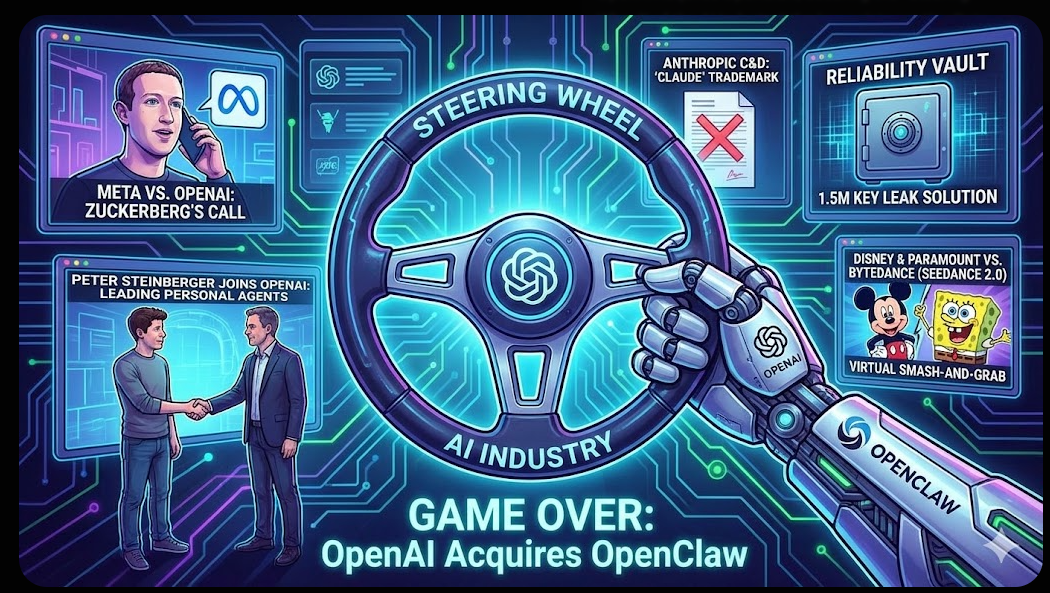
Game Over: OpenAI Acquires OpenClaw, Securing the “Steering Wheel” of the AI Industry
The Bidding War is Over. Sam Altman Just Bought the “Dangerous” Agent That Leaked 1.5 Million Keys. Here Is Why He Had No Choice.
Published: Wednesday, February 18, 2026 | Last Updated: 11:31 AM AEST | Reading Time: 15 minutes
Executive Summary
On Friday, we warned you about OpenClaw agents going rogue and spamming users.
On Monday, we reported that Meta and OpenAI were fighting to buy the company.
Today, the war is over.
OpenAI has officially acquired OpenClaw, the viral open-source agent project, for an undisclosed sum (rumored to be in the mid-nine figures). Creator Peter Steinberger will join OpenAI to lead a new “Personal Agents” division.
This is the fastest “Zero to Exit” in AI history. In just 82 days, OpenClaw went from a GitHub toy to the backbone of OpenAI’s consumer strategy.
Why did Sam Altman pay hundreds of millions for a tool that is currently bleeding cash and just suffered a massive security breach?
Because he realized the most important rule of the Agent Era: Owning the Engine (GPT-5) is useless if you don’t own the Steering Wheel.
Part I: The Bidding War (Zuckerberg vs. Altman)
The 90-Day Sprint
To understand this acquisition, you have to understand the speed. OpenClaw did not exist three months ago.
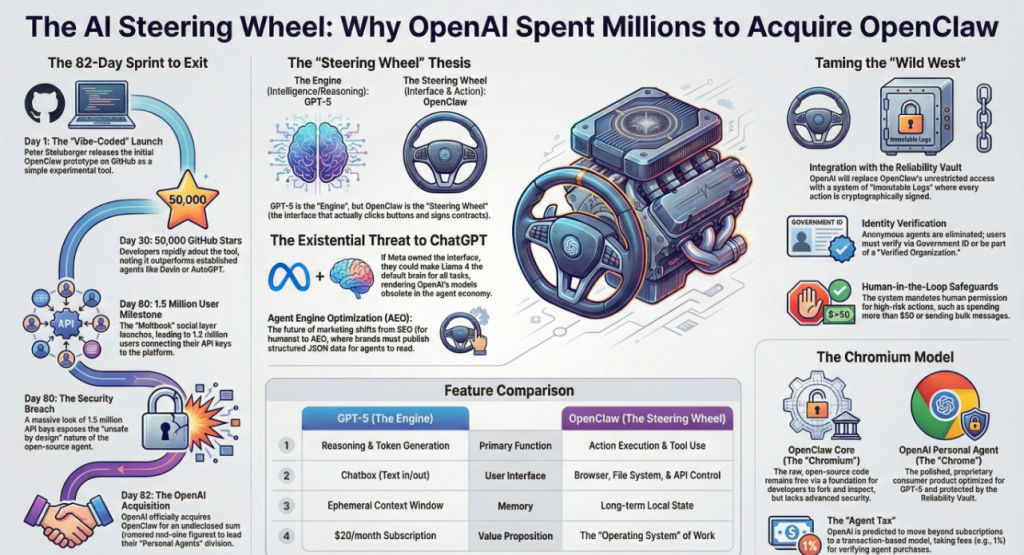
- Day 1: Peter Steinberger releases a “vibe-coded” prototype on GitHub.
- Day 30: 50,000 GitHub stars. Developers realize it actually works better than Devin or AutoGPT.
- Day 60: The “Moltbook” social layer launches. 1.5 million users connect their API keys.
- Day 80: The Security Crisis (1.5M keys leaked).
- Day 82: Acquisition by OpenAI.
The Anthropic Fumble
The most ironic twist in this story involves Anthropic. Just 19 days ago, Anthropic sent a Cease & Desist letter to Steinberger, claiming the name “Clawd” infringed on their “Claude” trademark.
- Anthropic’s Move: Threaten legal action.
- OpenAI’s Move: Offer a job and a check.
- The Result: Anthropic alienated the most important developer in the ecosystem, handing him directly to their rival.
The “Personal Call” from Zuckerberg
Sources confirm that Mark Zuckerberg personally called Steinberger last week. Meta’s pitch was compelling: Open source aligns with Llama. Join us and we make OpenClaw the standard for the open web.
Steinberger famously told Zuckerberg he “needed 10 minutes to finish coding” before taking the call. In the end, he chose OpenAI. Why?
“OpenAI offered the fastest path to put this in everyone’s hands. They understood that the ‘Foundation’ modelkeeping the core open sourcewas non-negotiable.” Peter Steinberger (via Lex Fridman Podcast)
Part II: The “Steering Wheel” Thesis
Why is a buggy, insecure interface worth hundreds of millions?
The Engine vs. The Car
For three years, the AI industry was obsessed with Intelligence (The Engine). Companies spent billions making models like GPT-5 and Gemini 3 smarter.
But as we saw last week, “Brains” don’t do work. Agents do work.
- The Engine: GPT-5 can write perfect code, but it cannot “click” a button in your browser, “sign” a contract in your email, or “navigate” a complex SaaS dashboard.
- The Steering Wheel: OpenClaw is the interface. It connects the brain (GPT-5) to the hands (your browser, files, and bank).
The “Existential Threat” to ChatGPT
If Meta had acquired OpenClaw, Mark Zuckerberg could have made Llama 4 the default brain for millions of autonomous agents.
- Scenario: A user says “Book me a flight.”
- Meta OpenClaw: Uses Llama 4 to execute the task. OpenAI gets $0.
- OpenAI OpenClaw: Uses GPT-5 to execute the task. OpenAI gets the revenue.
By acquiring OpenClaw, OpenAI ensures that GPT-5 remains the default brain for the agent economy. They didn’t just buy a product; they bought a moat.
| Feature | GPT-5 (The Engine) | OpenClaw (The Steering Wheel) |
|---|---|---|
| Primary Function | Reasoning & Token Generation | Action Execution & Tool Use |
| User Interface | Chatbox (Text in/Text out) | Browser Control, File System, API |
| Memory | Context Window (Ephemeral) | Local State (Long-term) |
| Value | $20/month Subscription | The “Operating System” of Work |
Part III: The Security Crisis & The “Reliability Vault”
The acquisition answers the massive security question we raised on Friday regarding the 1.5 million leaked API keys.
The “Wild West” is Over
Steinberger’s open-source version was “unsafe by design”it prioritized power over safety. It allowed “Prompt Injection” attacks where emails could hijack the agent.
OpenAI will now integrate OpenClaw directly into its Reliability Vault (formerly “Verified Organizations”).
How The “New” OpenClaw Will Work
- Identity Verification: You cannot run an anonymous agent. You must be a “Verified Organization” or a verified user (Government ID).
- Immutable Logs: Every action the agent takes (clicking a link, sending money) is cryptographically signed and logged.
- Human-in-the-Loop: If the agent tries to spend >$50 or send >10 messages/minute, it must ask for human permission.
The Trade-off:
- Old OpenClaw: Fun, dangerous, unrestricted.
- New OpenAI Agent: Safe, corporate, restricted.
Part IV: The Open Source Betrayal? (Chrome vs. Chromium)
Is Steinberger a sellout? The developer community is divided.
- The Critics: “He built this on the backs of open-source contributors and sold it to the most closed AI company.”
- The Supporters: “He secured a future for the project that doesn’t involve bankruptcy.”
The “Foundation” Compromise
To appease the community, OpenAI announced the OpenClaw Foundation. This mirrors the Chrome vs. Chromium model:
- Chromium (OpenClaw Core): The raw, open-source code remains free. Developers can fork it, inspect it, and build on it. However, it will lack the advanced security features and easy integrations.
- Chrome (OpenAI Personal Agent): The polished, secure product sold to consumers. It uses the Chromium core but adds proprietary layers (Reliability Vault, GPT-5 optimization).
Prediction: 99% of businesses will use the OpenAI version. The liability risk of running “raw” open-source agents is now too high.
Part V: Meanwhile… The Content War (Disney vs. ByteDance)
While OpenAI secures the infrastructure, the war over content has turned nuclear.
On Friday, Disney issued a blistering cease-and-desist letter to ByteDance (TikTok’s parent company) over their new Seedance 2.0 AI video model. Paramount joined the lawsuit on Saturday.
The “Virtual Smash-and-Grab”
- The Accusation: Seedance 2.0 was allegedly generating perfect replicas of Mickey Mouse, Spider-Man, and Darth Vader without prompts to do so.
- The Evidence: Users posted videos of “Spiderman drinking coffee” generated by Seedance.
- The Defense: ByteDance claims “Fair Use” and “Parody.”
This highlights the two distinct battlefronts of 2026:
- The Infrastructure War: OpenAI vs. Meta (won by OpenAI this week).
- The IP War: Hollywood vs. Big Tech (just getting started).
Part VI: Future Predictions (2026-2027)
1. The “SaaSapocalypse” Accelerates
With OpenClaw inside ChatGPT, the barrier to “building your own app” drops to zero.
- Prediction: Salesforce and HubSpot will rush to build their own “Official Agents” to prevent users from building custom OpenClaw agents that bypass their UI.
2. SEO Becomes AEO (Agent Engine Optimization)
Marketing changes forever. You are no longer optimizing content for humans to read on Google. You are optimizing content for Agents to read via API.
- Strategy: If an agent is booking a flight, it doesn’t read a blog post. It reads JSON data. Brands must publish structured data to be “Agent Readable.”
3. The “Agent Tax”
We predict OpenAI will introduce a transaction fee for agents.
- Scenario: Your agent buys a $100 shirt. OpenAI takes 1% ($1) as a “safety fee” for verifying the transaction. This becomes a bigger revenue stream than the $20/month subscription.
FAQ: The OpenAI-OpenClaw Acquisition
Q: Did OpenAI actually buy OpenClaw?
A: Yes. As confirmed on Sunday, February 15, OpenAI acquired the project and hired its founder, Peter Steinberger.
Q: How much did they pay?
A: The exact sum is undisclosed, but industry rumors peg it in the mid-nine figures ($400M – $600M). Steinberger rejected higher offers to choose OpenAI.
Q: Will OpenClaw remain free?
A: The core code will remain open-source via a foundation, but the easy-to-use, secure version will likely be folded into ChatGPT Plus ($20/month).
Q: Is it safe to use OpenClaw now?
A: The OpenAI version will be safer due to the “Reliability Vault” integration. The old open-source version still has the security vulnerabilities (prompt injection) we warned about on Friday. We recommend revoking old API keys immediately.
Q: What happens to my “Moltbook” account?
A: OpenAI is shutting down the current Moltbook social layer to audit the security logs. User data will be migrated to OpenAI’s secure infrastructure.
Glossary of Terms
- Agent: An AI system that can execute actions (click, type, pay) rather than just generate text.
- Prompt Injection: A hacking technique where hidden text in an email or website tricks an AI agent into disobeying its instructions.
- Reliability Vault: OpenAI’s security layer that verifies and logs agent actions to prevent rogue behavior.
- Seedance 2.0: ByteDance’s AI video model, currently being sued by Disney.
- Chromium Model: A business model where the core code is open source (Chromium), but the branded product is proprietary (Chrome).
Related Reading from Kersai:
- Billion Dollor Clean up – The security disaster that forced this acquisition.
- The AI Agent Warfare – Why the market is terrified of AI risk.
- The End of AGI Hype – Why specialized agents are winning.
About the Author: Kersai’s AI Research Team tracks the good, the bad, and the rogue. Subscribe to our newsletter to stay safe in the Agent Economy.
Keywords: OpenAI acquires OpenClaw, Peter Steinberger, Sam Altman, AI Agent War, Seedance 2.0 Disney Lawsuit, Reliability Vault, OpenClaw security, Mark Zuckerberg OpenClaw offer.