
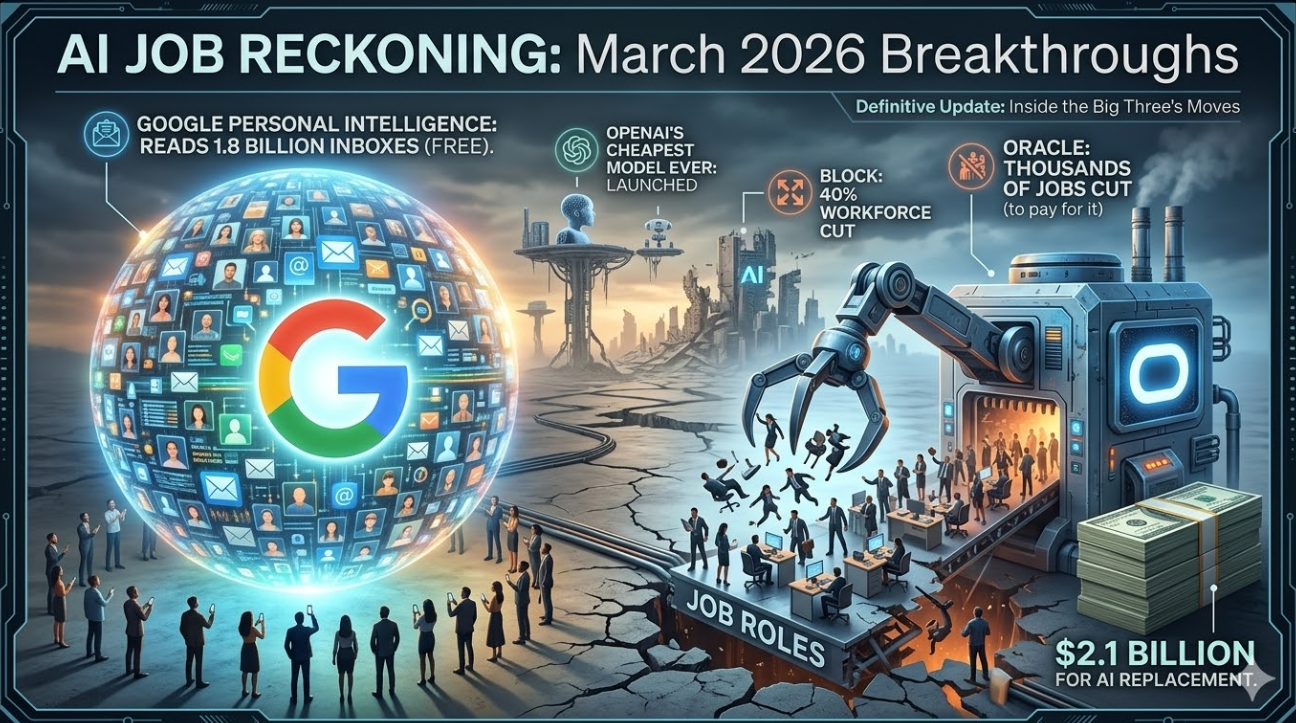
Google Just Gave 1.8 Billion People an AI That Reads Their Inbox — And Oracle Cut Thousands to Pay for It
The AI Jobs Reckoning Has Officially Begun: Google Personal Intelligence Goes Free, Oracle and Block Cut 34,000+ Roles, OpenAI Launches Its Cheapest Model Ever, and the Rise of the AI Digital Employee
Published: March 23, 2026 | By the Kersai Research Team | Reading Time: ~26 minutes
Last Updated: March 23, 2026
Quick Summary: On March 17, Google quietly made its most powerful AI feature free for every one of its 1.8 billion users — Personal Intelligence, which gives Gemini direct access to your Gmail, Google Photos, YouTube history, and Search activity to deliver genuinely personalised AI responses. In the same week, Oracle announced $2.1 billion in restructuring costs and thousands of layoffs explicitly attributed to AI efficiency gains, while Block — Jack Dorsey’s company behind Square, Cash App, and Afterpay — eliminated nearly 40% of its entire global workforce, also citing AI. OpenAI released GPT-5.4 mini and nano — its most capable small models ever, at prices as low as $0.20 per million tokens. And across boardrooms and strategy sessions worldwide, a new concept is taking hold: the AI Digital Employee — not a tool that helps your staff, but an autonomous AI agent assigned to a role, given KPIs, and held accountable for outcomes. This is the week the AI jobs reckoning stopped being a forecast and became a news headline.
Table of Contents
- The Week the AI Era Got Personal — and Painful
- Story 1: Google Personal Intelligence Is Now Free for 1.8 Billion People
- Story 2: Oracle, Block and the 34,000-Job Week — The Reckoning Arrives
- Story 3: GPT-5.4 Mini and Nano — Frontier AI at $0.20 Per Million Tokens
- Story 4: The Rise of the AI Digital Employee
- The Four Stories Are One Story
- What This Means for Businesses
- Jobs at Risk vs Jobs Augmented: The 2026 Framework
- The Full GPT-5.4 Model Family Comparison Table
- FAQ
1. The Week the AI Era Got Personal — and Painful
Every major technological shift has a moment when it stops feeling abstract and starts feeling immediate — when it is no longer something happening in a research lab or a tech company’s press release, but something happening in your inbox, your payslip, your job description.
This week was that moment for AI.
On the personal side: Google switched on a feature for every free Gmail user that gives its Gemini AI model direct access to your email, your photos, your YouTube history, and your search behaviour — to answer questions with the full context of your actual digital life. You do not need to paste in the email chain. You do not need to explain who your travel agent is. Gemini already knows, because it has been given the keys to your Google account.
On the professional side: Oracle, one of the world’s largest enterprise software companies, announced $2.1 billion in restructuring costs and the elimination of thousands of roles — explicitly because AI has made those roles unnecessary. Block — the fintech company that processes payments for millions of small businesses — eliminated 40% of its entire global workforce in a single announcement, with founder Jack Dorsey pointing directly at AI as the reason. Combined, those two companies alone accounted for over 34,000 job cuts in a single week, with AI cited as the cause.
In the background: OpenAI made its most capable AI models cheaper than ever before — $0.20 per million tokens for GPT-5.4 nano — lowering the cost barrier for the automation tools that will affect every knowledge worker in every industry over the next 24 months.
And threading all four stories together: a concept that is rapidly reshaping enterprise AI strategy — the AI Digital Employee — the idea that the question for organisations is no longer “which tasks can AI assist with?” but “which roles can AI own end-to-end?”
This is your complete, fully-sourced March 23, 2026 update. It covers everything, explains the connections, and gives you the framework to understand what these developments mean for your organisation, your team, and your career.
2. Google Personal Intelligence Is Now Free for 1.8 Billion People
2.1 What happened
On March 17, 2026, Google began rolling out Personal Intelligence — previously a paid Gemini Advanced feature — to all free US Google account holders.
The rollout was confirmed by TechCrunch, MacRumors, Deeper Insights, AI Automation Global, and multiple independent journalists covering Google products. LinkedIn analysis by Kumar L and others immediately identified it as one of the most significant AI distribution events of the year.
The feature is now available across:
- Gemini app (iOS and Android)
- AI Mode in Google Search
- Gemini in Chrome (desktop)
And it has been enabled for every free Google account in the United States — with international rollout expected in waves through Q2 2026. With 1.8 billion active Google accounts globally, the eventual scale of this deployment makes it arguably the largest single AI capability expansion in history.
2.2 What Personal Intelligence actually does
Personal Intelligence gives Gemini the ability to access your personal Google data — with your explicit permission — to deliver AI responses that are contextualised to your actual life, not generic information about the world.
The data sources it can access:
| Data Source | What Gemini Can Access | Example Use |
|---|---|---|
| Gmail | Emails, attachments, sender history, thread context | “What’s the status of my Amazon return?” |
| Google Photos | Images, metadata, location tags, faces | “Show me photos from my Sydney trip last March” |
| YouTube history | Watch history, saved videos, subscriptions | “Based on what I watch, suggest a documentary on AI” |
| Google Search history | Past searches, topics of interest, research patterns | “What have I been researching about home loans?” |
| Google Calendar | Events, meetings, travel bookings | “What do I have on this week and am I free Thursday?” |
| Google Drive | Documents, spreadsheets, presentations | “Summarise the Q4 report I worked on last month” |
| Google Maps/travel | Saved places, past trips, restaurant reviews | “Plan a weekend in Melbourne based on places I’ve liked” |
| Google Shopping | Purchase history, saved products, price alerts | “Has the price dropped on the laptop I was watching?” |
The practical result: Gemini answers questions about your life — not just the world’s information.
Instead of asking “what are good Italian restaurants in Brisbane?” and getting a generic list, you can ask “where should we go for dinner tonight near home — somewhere like the places I’ve rated five stars?” and Gemini references your actual Google Maps rating history to answer.
Instead of asking “what is the status of a typical Qantas booking?” you ask “is my flight to Sydney on Friday still on time?” and Gemini checks your Gmail confirmation email.
This is the shift from AI as an information retrieval engine to AI as a personal context engine — and it is now free for everyone with a Gmail address.
2.3 The privacy architecture — what Google is and is not doing with your data
The feature will trigger immediate privacy concerns — and those concerns deserve a direct, factual answer rather than reassurance.
Google’s documented data handling for Personal Intelligence:
What Google IS doing:
- Using your personal data to generate contextualised responses within your active Gemini session
- Sending queries about your data to Google’s servers for processing (standard for cloud AI)
- Storing session interaction data subject to your Google account privacy settings
What Google IS NOT doing (per its published privacy documentation):
- Using your Gmail content to train Google’s AI models — explicitly prohibited in Google’s terms
- Sharing your personal data with third parties for Personal Intelligence queries
- Permanently storing the contents of your email queries beyond standard Google account data retention
The distinction matters: Google is using your data to answer your questions, not to build a profile for advertising or model training. Your Gmail contents are the input to a query, not a training dataset.
That said, privacy-conscious users and regulated industries need to be aware:
- Healthcare and legal: Emails containing protected health information or privileged legal communication should be excluded from Personal Intelligence access via Google’s permission controls
- Enterprise Google Workspace: Corporate accounts operate under different data processing agreements — Personal Intelligence for corporate Gmail is governed by the organisation’s Google Workspace contract, not consumer terms
- EU users: The international rollout will require GDPR-compliant implementation — European users should expect a delayed rollout pending regulatory review
2.4 How to enable — and disable — Personal Intelligence
To enable (US users, free accounts):
- Open the Gemini app or go to gemini.google.com
- Tap your profile icon → Settings → Personal Intelligence
- Toggle on the data sources you want Gemini to access
- Each data source (Gmail, Photos, etc.) requires individual permission — you control each one separately
To disable completely:
- Go to myaccount.google.com → Data & Privacy
- Select “Gemini Apps Activity”
- Turn off Personal Intelligence entirely, or manage individual data source permissions
Google emphasises that disabling Personal Intelligence does not delete any of your existing Google account data — it simply prevents Gemini from accessing it.
2.5 Why this is the most significant consumer AI event of the year
Every other AI announcement this year has required users to do something new: download a new app, create an account, learn a new interface, change a habit. Personal Intelligence requires nothing. It arrives inside the Google account that 1.8 billion people already use for email, photos, and search — and it makes that account dramatically more useful.
The distribution dynamic is unlike anything in consumer AI to date:
- ChatGPT has approximately 400 million monthly active users — built through marketing, word of mouth, and press coverage over two years.
- Gemini Personal Intelligence has a potential user base of 1.8 billion from day one of the rollout — not because those users chose Gemini, but because they already have Gmail.
The majority of those 1.8 billion people will not immediately realise what has changed. But as they begin to ask Gemini questions and receive answers that reference their actual emails, their actual travel photos, their actual calendar — the utility shift will be undeniable.
For AI adoption, this is the equivalent of broadband replacing dial-up: the improvement is so significant that use becomes habitual. The AI Era, for most of the world’s internet users, begins not with a conscious decision to adopt AI — but with the moment their Google assistant answers a question so specifically and so correctly that they never go back to searching manually again.
3. Oracle, Block, and the 34,000-Job Week — The AI Reckoning Arrives
3.1 The announcements
In the first two weeks of March 2026, two major global technology companies announced large-scale workforce reductions that represent, collectively, the largest single-month AI-attributed job displacement event in corporate history.
Oracle: On March 5, Bloomberg and The Straits Times reported that Oracle has set aside $2.1 billion in restructuring charges for fiscal 2026, covering the planned elimination of thousands of roles across its enterprise software, cloud infrastructure, and professional services divisions. Oracle’s internal communications cited directly by Bloomberg state that the restructuring targets “job categories that AI and automation are enabling us to need less of” — specifically naming customer support, database administration, routine software development, and data entry and processing functions.
Block (Square / Cash App / Afterpay): On the same week, Jack Dorsey’s Block announced it was eliminating approximately 3,800 roles — nearly 40% of its entire global workforce. Dorsey, in an internal memo widely reported by The Straits Times and Investing.com, explicitly attributed the reductions to AI efficiency gains across coding, customer operations, compliance monitoring, and financial reporting functions. “AI has made it possible for a smaller, more focused team to do more than our current organisation,” the memo reportedly stated.
The combined figure: 34,000+ jobs eliminated in a single week, with AI cited directly as the primary driver by both organisations.
3.2 Oracle in depth: what AI made redundant
Oracle’s restructuring provides the most detailed public accounting yet of which specific job functions AI has displaced at an enterprise scale. Based on Bloomberg’s reporting and Oracle’s regulatory filings, the elimination categories break down as follows:
Customer support and service (largest category)
Oracle’s customer support organisation has deployed AI-powered tier-1 and tier-2 resolution agents across its Oracle Cloud Infrastructure, Oracle Database, and Oracle Fusion Applications support queues. These agents — built on GPT-5.4 and Claude Sonnet 4.6 models with extensive Oracle product context engineering — now resolve approximately 73% of incoming support cases without human intervention. The human support headcount required to manage residual escalations is a fraction of the previous organisation.
Database administration
Oracle’s core product is the Oracle Database — and for decades, Oracle has employed large teams of database administrators (DBAs) who manage customer database environments, perform performance tuning, handle backup and recovery, and execute routine maintenance. Autonomous Database — Oracle’s AI-driven database management product — now performs the majority of these functions automatically. The human DBA workforce required to oversee autonomous systems is substantially smaller than the workforce required to perform the same work manually.
Routine software development
Oracle employs tens of thousands of software engineers across its product portfolio. Coding agents — particularly Claude Code and GPT-5.4’s computer use capability — have accelerated development velocity sufficiently that the same output now requires fewer developers. Oracle is restructuring toward smaller, senior-heavy development teams that direct AI execution rather than write code directly.
Data entry, processing, and reporting
Oracle’s business operations include substantial back-office functions — invoice processing, contract management, compliance reporting, financial reconciliation. These functions have been progressively automated using Oracle’s own AI products combined with third-party tools, reducing headcount requirements significantly.
3.3 Block in depth: 40% in one announcement
Block’s announcement is the more striking of the two — not because the number is larger than Oracle’s (it is not), but because the proportion is extraordinary. Eliminating 40% of a company’s workforce in a single announcement is a restructuring of a scale that would, in any previous era, signal financial crisis or strategic collapse.
Block is profitable. Block is growing. Block’s revenue increased in 2025. The elimination of 40% of its workforce is not a distress signal — it is a strategic reconfiguration driven by capability, not necessity.
Jack Dorsey’s framing, as reported, is revealing: AI has not just made certain tasks faster — it has made certain roles structurally unnecessary. The distinction matters.
When AI makes a task faster, you need fewer people to do the same volume of work. When AI makes a role structurally unnecessary, you do not need the role at all — regardless of volume.
The roles Block eliminated fall primarily into the “structurally unnecessary” category:
- Compliance monitoring analysts: Block’s Cash App and Square products operate under financial regulatory frameworks requiring continuous transaction monitoring for fraud, money laundering, and other compliance risks. AI compliance monitoring systems — trained on Block’s transaction data — now perform this function at greater accuracy and lower cost than human analysts.
- Customer operations: Cash App’s customer support has been progressively automated, with AI handling the vast majority of card disputes, account access issues, and transaction queries.
- Financial reporting: Routine financial analysis, reconciliation, and reporting functions previously performed by finance teams have been automated using AI models trained on Block’s financial data and systems.
- Mid-level software engineering: Like Oracle, Block has found that AI-assisted development tools allow smaller senior engineering teams to produce equivalent or greater output than larger teams with more junior developers.
3.4 The broader picture: how big is this?
Oracle and Block are not isolated cases. They are the most public and explicitly AI-attributed examples of a trend that is accelerating across every sector.
The data is stark:
| Statistic | Source | Date |
|---|---|---|
| 37% of companies globally plan to replace workers with AI by end of 2026 | Resume.org global survey | September 2025 |
| 92 million jobs displaced globally by AI by 2030 (WEF forecast) | World Economic Forum | January 2025 |
| 170 million new jobs created by AI by 2030 (same WEF forecast) | World Economic Forum | January 2025 |
| Net gain of 78 million roles — but concentrated in high-skill, high-education sectors | World Economic Forum | January 2025 |
| 95% of AI pilots fail to scale — primarily due to workflow design failures, not model capability | Gloat AI Workforce Research | March 2026 |
| $2.1 billion Oracle restructuring charge, March 2026 | Bloomberg | March 2026 |
| 3,800 jobs cut at Block, March 2026 — 40% of workforce | The Straits Times | March 2026 |
The WEF’s 170 million new jobs / 92 million displaced figure is frequently cited as evidence that AI will be a net positive for employment. That is probably true in aggregate and over a long enough time horizon.
What the aggregate figure obscures is the concentration and pace of displacement. The 92 million displaced jobs are concentrated in specific sectors, specific skill levels, and a specific time window — the next 24–36 months. The 170 million new jobs are distributed across a much longer horizon and require skills that take years to develop.
The Oracle and Block announcements are the first large-scale, publicly documented evidence that the displacement side of that equation is arriving on schedule — and that the timeline is not 2030 but now.
3.5 The jobs that are being eliminated first
Based on Oracle, Block, and the broader pattern of AI-attributable workforce reductions in Q1 2026, the job categories being eliminated first share a common profile:
- High volume, rule-based decision-making: Customer support tier-1 and tier-2, compliance monitoring, fraud detection, routine financial analysis
- Data processing and transformation: Data entry, invoice processing, report generation, database administration
- Code generation at junior and mid levels: Routine feature development, bug fixes, test writing, documentation — tasks that AI coding agents now perform reliably
- Content and knowledge synthesis: Market research reports, competitive intelligence summaries, internal documentation, product specifications
These are not low-skill jobs. Many of the Oracle and Block roles eliminated in this wave were filled by university-educated professionals earning competitive salaries. The characteristic they share is not low skill — it is high repeatability at scale. And repeatability at scale is exactly what large language models and AI agents do best.
4. GPT-5.4 Mini and Nano: Frontier AI at $0.20 Per Million Tokens
4.1 What launched
On March 16–17, 2026, OpenAI released two new members of the GPT-5.4 family: GPT-5.4 mini and GPT-5.4 nano — the company’s most capable small models to date, and the lowest-priced frontier-quality models in OpenAI’s history.
The release was confirmed by OpenAI’s community forum, 9to5Mac, and Times of India tech coverage. Both models are available immediately via the OpenAI API, in ChatGPT, and through Codex.
4.2 Full GPT-5.4 model family specifications
| Model | Context Window | Best For | Input Price | Output Price | Speed |
|---|---|---|---|---|---|
| GPT-5.4 | 1,000,000 tokens | Frontier reasoning, computer use, complex agents | $2.50/M | $10.00/M | Standard |
| GPT-5.4 Thinking | 1,000,000 tokens | Deep multi-step reasoning, mathematics, science | $4.00/M | $16.00/M | Slower (extended CoT) |
| GPT-5.4 mini | 400,000 tokens | Coding, real-time tasks, high-volume enterprise | $0.80/M | $3.20/M | 2× faster than GPT-5 mini |
| GPT-5.4 nano | 200,000 tokens | Classification, extraction, simple coding, edge | $0.20/M | $1.25/M | Fastest in family |
Source: OpenAI API pricing page, March 2026; OpenAI community forum announcement
4.3 GPT-5.4 mini: what changed
GPT-5.4 mini is not simply a smaller version of GPT-5.4 with lower capability. It is a model that has been specifically trained and optimised for the workloads where small models are deployed — and on those workloads, it approaches the full GPT-5.4’s performance at a fraction of the cost.
Key improvements over its predecessor (GPT-5 mini):
2× inference speed: GPT-5.4 mini generates tokens approximately twice as fast as GPT-5 mini — critical for real-time applications including customer-facing chatbots, live coding assistants, and interactive UI generation.
OSWorld-Verified performance: GPT-5.4 mini achieves 71.2% on OSWorld-Verified — the benchmark for AI desktop computer use. For context, the full GPT-5.4 scores 75.0% and human baseline is 72.4%. GPT-5.4 mini is within 4 percentage points of the full model’s computer use capability at one-third of the cost.
SWE-Bench Pro: On real-world software engineering tasks, GPT-5.4 mini scores 52.1% — competitive with where the full GPT-5.4 was three months ago. For most enterprise coding automation use cases, this is sufficient capability to replace junior developer workflows.
400,000-token context: Large enough to process an entire mid-sized codebase, a 300-page legal contract, or months of email history in a single session.
4.4 GPT-5.4 nano: the economics of ubiquitous AI
GPT-5.4 nano is the most consequential of the two releases for understanding the direction of enterprise AI economics.
At $0.20 per million input tokens, the cost of AI inference has now crossed a threshold where the economics of deployment are essentially negligible for all but the highest-volume applications.
To put $0.20 per million tokens in practical terms:
- Processing 1 million tokens is roughly equivalent to processing 750,000 words — or approximately 1,500 average-length business emails.
- Processing those 1,500 emails for classification, routing, priority scoring, or sentiment analysis costs $0.20 — twenty cents.
- At that cost, deploying AI across every inbound email at a 10,000-employee company costs approximately $200 per month.
The commercial implication is that the infrastructure cost of adding AI classification, extraction, routing, or simple generation to any enterprise workflow has effectively reached zero. The barrier to AI deployment is no longer pricing — it is workflow design, governance, and change management.
GPT-5.4 nano targets four primary use cases, per OpenAI’s official documentation:
- Classification at scale: Categorising inbound documents, emails, tickets, or transactions into predefined categories — the bread-and-butter of enterprise workflow automation.
- Data extraction: Pulling structured data from unstructured text — invoice details, contract terms, customer information, product specifications.
- Simple code generation: Writing boilerplate code, generating unit tests, creating data transformation scripts, and automating routine development tasks.
- Edge and on-device deployment: At nano scale, the model can be distilled for deployment on edge devices — enabling AI inference without cloud connectivity, relevant for IoT, mobile, and offline enterprise applications.
4.5 What this means for AI deployment costs
The GPT-5.4 model family, combined with DeepSeek V4 (free, self-hosted) and Claude Sonnet 4.6, represents a cost landscape for enterprise AI that would have been unimaginable 18 months ago.
| Use Case | Recommended Model | Monthly Cost (10K users, 100 queries/day) |
|---|---|---|
| Frontier reasoning / computer use | GPT-5.4 | ~$7,500 |
| Enterprise coding / complex agents | GPT-5.4 mini | ~$2,400 |
| Classification / extraction / routing | GPT-5.4 nano | ~$600 |
| High-volume open-source self-hosted | DeepSeek V4 | Infrastructure cost only |
| Safety-critical regulated enterprise | Claude Sonnet 4.6 | ~$3,000 |
The era of AI as a premium, budget-constrained resource is ending. The era of AI as a ubiquitous, always-on operational layer is beginning.
5. The Rise of the AI Digital Employee
5.1 The concept reshaping enterprise AI strategy
Across LinkedIn, enterprise strategy forums, and the r/artificial and r/MachineLearning communities on Reddit, a single concept is dominating the AI conversation in March 2026: the AI Digital Employee.
The framing is a deliberate departure from previous AI positioning:
- AI tool: Something your employees use to do their work faster. (“Use Copilot to write emails.”)
- AI assistant: Something that helps your employees with specific tasks on request. (“Ask Claude to summarise this document.”)
- AI agent: Something that executes multi-step workflows autonomously. (“Have the agent prepare the meeting brief.”)
- AI digital employee: Something that owns a role — with defined responsibilities, performance metrics, and accountability for outcomes — and executes that role continuously without human initiation.
The distinction is not semantic. It represents a fundamentally different deployment model, a different organisational structure, and a different way of thinking about what AI is for.
5.2 What an AI digital employee looks like in practice
The clearest examples of AI digital employees currently in production deployment:
The AI SDR (Sales Development Representative)
Companies including Salesforce, HubSpot, and hundreds of B2B SaaS firms are deploying AI systems in the Sales Development Representative role — the function responsible for prospecting, outbound outreach, lead qualification, and meeting booking. The AI SDR:
- Monitors new lead data from CRM, marketing automation, and intent data tools continuously
- Researches each lead using web search, LinkedIn data, and company databases
- Crafts personalised outreach emails and LinkedIn messages
- Manages multi-touch follow-up sequences
- Qualifies leads through initial conversations and books meetings with human account executives
- Tracks and reports its own performance metrics (outreach volume, response rate, meetings booked)
The AI SDR does not replace the human account executive who builds relationships and closes deals. It replaces the human SDR who performs the high-volume, research-and-outreach component of the pipeline — a role that typically pays $50,000–$80,000 per year and has annual attrition rates of 40–60%.
The AI Compliance Officer
Financial services firms are deploying AI in compliance monitoring roles — continuously watching transaction flows, flagging suspicious patterns, reviewing new regulatory guidance and assessing its implications for current practices, and generating compliance reports for human review. The AI compliance monitor runs 24/7 without shift coverage requirements, processes vastly more transactions per hour than a human analyst, and maintains consistent application of compliance rules without the fatigue-related errors that affect human reviewers.
The AI Content Producer
Media companies, marketing agencies, and enterprise content teams are deploying AI digital employees in content production roles — continuously producing SEO-optimised articles, social media posts, product descriptions, and marketing copy at scale. The human content strategist defines the editorial calendar, the brand guidelines, and the quality standards. The AI digital employee produces the volume output against those specifications.
The AI Data Analyst
Enterprise data teams are deploying AI as always-on analytical engines — continuously monitoring business metrics, detecting anomalies, generating regular reports, answering ad-hoc data questions from business users, and flagging conditions that require human attention. The human data scientist focuses on the complex modelling and strategic questions; the AI handles the routine analytical workload.
5.3 Why 95% of AI pilots still fail to scale
Here is the number that should give every organisation pause: according to Gloat’s March 2026 AI Workforce Research, 95% of enterprise AI pilots fail to scale beyond proof-of-concept.
The failure is not a model quality problem. The models are good enough. The failure is overwhelmingly a workflow design problem — and understanding it is the key to avoiding it.
The failure pattern looks like this:
- An enterprise identifies a use case — “let’s use AI for customer support”
- They select a model or platform and build a pilot — usually a chat interface bolted onto existing systems
- The pilot shows promising results in controlled conditions
- They attempt to scale — and encounter a cascade of problems: inconsistent outputs, edge cases the AI handles badly, integration failures with legacy systems, compliance gaps, user adoption resistance, and inability to measure ROI clearly
- The pilot is declared “not ready” and shelved
The root cause in almost every case: the workflow was designed for human execution and the AI was overlaid on top of it rather than the workflow being redesigned around AI capabilities.
Human workflows are designed around human constraints: working hours, memory limitations, parallel processing limits, error tolerance, and the need for social coordination. AI systems have different constraints: they require structured inputs, clear success criteria, reliable tool access, and well-designed escalation pathways for edge cases.
When you deploy an AI on a human-designed workflow without redesigning the workflow, you are asking the AI to work around constraints it does not have while failing to use the capabilities it does have. The result is poor performance that gets attributed to model limitations — when the real failure was deployment design.
The organisations scaling AI successfully — Oracle, Block, the companies deploying AI SDRs and compliance monitors at scale — have all done the same thing: redesigned the workflow from scratch around AI execution, then used AI to fill the redesigned role.
5.4 The five design principles of a successful AI digital employee deployment
Based on the patterns observed across organisations successfully deploying AI in execution roles, five design principles consistently distinguish successes from failures:
Principle 1: Define the role, not the task
Do not deploy AI to do tasks. Deploy AI to own roles. A role has defined responsibilities, performance metrics, decision authority, escalation boundaries, and accountability for outcomes. A task has a start and an end. AI digital employees need the former to operate reliably.
Principle 2: Design for AI’s constraints, not human constraints
AI digital employees work 24/7, process high volumes at consistent quality, and do not need social coordination. They do need structured inputs, clear success criteria, reliable tool access via MCP, and well-defined escalation triggers. Design the workflow around these requirements — not around human shift patterns, meeting structures, or approval chains designed for human cognition.
Principle 3: Build the context infrastructure before deploying the agent
The AI digital employee is only as good as its context engineering. Before deployment, invest in building the background knowledge, memory systems, tool integrations, and instruction sets that the AI needs to operate reliably. (See our earlier article on context engineering for the full framework.)
Principle 4: Start at L3, earn your way to L4
Deploy initially at supervised autonomy level (L3) — AI operates autonomously but escalates exceptions to humans. Collect performance data. Identify failure modes. Fix them systematically. Expand to full autonomy (L4) only when the failure modes are well understood and managed. Every L4 deployment disaster in 2026 has involved skipping L3.
Principle 5: Measure the role’s outcomes, not the AI’s outputs
Do not measure whether the AI is generating outputs. Measure whether the role’s performance metrics are being achieved. Did the AI SDR book meetings at the target conversion rate? Did the AI compliance monitor achieve false positive rates below the threshold? Did the AI content producer drive organic traffic growth? Outcome metrics keep focus on value delivery — not on the novelty of the technology.
6. The Four Stories Are One Story
6.1 AI is transitioning from product to infrastructure
The four stories this week — Personal Intelligence, mass layoffs, ultra-cheap models, AI digital employees — are all expressions of a single transition: AI is moving from being a product you buy to infrastructure you operate.
When AI was a product, it had a price tag, a user interface, and a clearly defined scope. You paid for it, you learned it, you used it for specific tasks.
When AI becomes infrastructure — embedded in your Gmail, running at $0.20 per million tokens, deployed in permanent roles across your organisation — it is no longer a discrete product decision. It is an operational environment. Like electricity, like broadband, like cloud computing: you do not decide whether to use AI infrastructure. You decide how to use it, how to govern it, and how to build on top of it.
Google Personal Intelligence is that transition happening at the consumer layer. GPT-5.4 nano is that transition happening at the cost layer. AI digital employees are that transition happening at the organisational layer.
6.2 The displacement timeline has compressed
When the World Economic Forum published its AI jobs forecast — 92 million displaced, 170 million created — most people who engaged with it assumed a comfortable buffer of years between forecast and reality.
Oracle and Block’s announcements this week are evidence that the buffer is gone. The displacement that the WEF modelled for 2028–2030 is arriving in 2026. The specific categories — high-volume rule-based decision-making, data processing, routine code generation, customer service — are being eliminated now, not in a projected future.
The 170 million new jobs will arrive, eventually. They require skills that take years to develop, industries that take years to mature, and regulatory frameworks that take years to establish. The 92 million displaced jobs are happening on a quarterly basis.
6.3 The organisations that will navigate this best have already started
The pattern across every organisation managing the AI transition successfully — and those cutting 40% of their workforce are, in their own context, managing it — is that preparation happened before the capability leap, not after.
Oracle did not announce $2.1 billion in AI restructuring costs because AI suddenly became capable last month. It announced them because it has spent three years building the AI systems that made those roles replaceable, and is now executing the restructuring that those systems enable.
The organisations that have been building their AI infrastructure, context engineering frameworks, governance processes, and workforce transition strategies for the past 12–18 months are the ones now executing confidently. The organisations that have been watching and waiting are the ones that will face the same transition under more compressed timelines with less preparation.
7. What This Means for Businesses
7.1 Google Personal Intelligence: the enterprise audit you need this week
Google Personal Intelligence is rolling out to consumer accounts — but its arrival raises an immediate question for every enterprise operating on Google Workspace: what are your employees’ personal Google accounts doing with your corporate data?
The scenario: an employee uses their personal Gmail account for some work-related communications. Or they save work documents to their personal Google Drive. With Personal Intelligence enabled on their personal account, Gemini now has context access to that data.
This is not a hypothetical compliance risk — it is an active one for any organisation that has not enforced strict data handling policies around personal Google account use.
Immediate actions:
- Audit your data handling policies for personal Google account use
- Clarify to employees which categories of work data cannot be stored in or transmitted through personal Google accounts
- If your organisation uses Google Workspace for corporate email and storage, confirm that your Workspace contract’s data processing terms cover Personal Intelligence access by administrators
- For highly regulated industries (healthcare, legal, financial services), obtain formal legal guidance on Personal Intelligence’s compatibility with your data sovereignty obligations
7.2 Workforce planning: the restructuring conversation cannot be deferred
If you are a CEO, CFO, CHRO, or board member and you have not yet had a formal conversation about AI-driven workforce restructuring, the Oracle and Block announcements should change that calculus immediately.
The conversation is not comfortable. But deferring it does not reduce its necessity — it reduces your time to plan the transition well.
The organisations managing AI-driven restructuring most humanely and most effectively are those that:
- Identified the affected role categories 12–18 months before the restructuring, while the AI systems were still being built and tested
- Ran retraining programmes for affected employees during that window — moving people from high-displacement roles into the AI supervision, governance, and high-judgment roles that the new structure requires
- Communicated transparently about the trajectory, giving employees time to adapt rather than delivering abrupt announcements
- Structured the restructuring as a phased transition rather than a single event
The Oracle model — $2.1 billion restructuring charge, announced publicly — is the alternative to the above. It is not that Oracle managed this badly. It is that the announcement is the outcome of a transition that was managed over years. The $2.1 billion is the accounting recognition of a workforce change that has been in progress for a long time.
7.3 GPT-5.4 nano changes your AI ROI calculations immediately
If you have a workflow where the business case for AI automation did not stack up at GPT-5.4 pricing, run the numbers again at GPT-5.4 nano pricing.
At $0.20 per million input tokens, the cost of AI inference has essentially been eliminated as a barrier for:
- Email classification and routing
- Document data extraction
- Ticket categorisation and priority scoring
- Transaction monitoring and anomaly flagging
- Content quality checking and moderation
- Form data extraction and validation
- Simple customer query response
For these workloads, the cost-benefit analysis at $0.20/M tokens is overwhelmingly positive in almost every scenario. The remaining barriers are integration, governance, and workflow redesign — not inference cost.
7.4 Build your AI digital employee roadmap now
The AI digital employee is not a distant concept. Oracle and Block have already deployed them at scale. Salesforce, HubSpot, and hundreds of other companies are deploying AI SDRs. Financial services firms are deploying AI compliance monitors.
The question for your organisation is not whether AI digital employees will become part of your operational structure. It is whether you design that transition intentionally or respond to it reactively.
Recommended starting point: identify the three to five roles in your organisation that most closely match the AI digital employee profile — high volume, rule-based, well-defined success criteria, high annual attrition (because humans find the work unfulfilling). Those are your first AI digital employee candidates. Start the workflow redesign process now, using the five design principles outlined in Section 5.4.
8. Jobs at Risk vs Jobs Augmented: The 2026 Framework
The most important and most searched question in AI right now: is my job safe?
The honest answer is that it depends on a specific set of characteristics — and understanding those characteristics gives you agency over your own trajectory, whether you are navigating your personal career or making workforce planning decisions for an organisation.
8.1 Jobs most at risk: the displacement profile
Jobs being displaced first share all or most of these characteristics:
- High repeatability: The core tasks follow consistent, learnable patterns
- Rule-based decision-making: Decisions are made by applying defined criteria to available information
- Text or data as the primary input: Work is primarily cognitive/linguistic, not physical
- High volume: Large numbers of the same task type are performed repeatedly
- Clear, measurable outputs: Success is unambiguous — the invoice was processed correctly, the ticket was categorised accurately, the code passed the tests
- Limited novel judgment: Edge cases exist but are the exception rather than the rule
| Role Category | Displacement Risk | Primary AI Capability Replacing It |
|---|---|---|
| Tier-1/2 customer support | 🔴 Very High | Autonomous conversational agents |
| Data entry and processing | 🔴 Very High | Document extraction and classification |
| Compliance monitoring | 🔴 Very High | Continuous AI transaction monitoring |
| Routine software development | 🔴 High | AI coding agents (Claude Code, GPT-5.4) |
| Database administration | 🔴 High | Autonomous database management |
| Financial reporting | 🟠 High | AI data analysis and report generation |
| Legal document review | 🟠 High | Long-context document analysis |
| Market research reporting | 🟠 High | AI research synthesis agents |
| Recruitment screening | 🟠 Medium-High | AI candidate assessment tools |
| Content production (standardised) | 🟠 Medium-High | AI content generation at scale |
8.2 Jobs most augmented: the resilience profile
Jobs that AI augments rather than replaces share a different set of characteristics:
- Judgment in genuinely novel situations: Problems that have no clear precedent or playbook
- Relationship and trust: Outcomes depend on human-to-human relationships, trust, and emotional intelligence
- Physical presence and dexterity: Work requiring fine motor control, spatial awareness, or physical adaptability in unpredictable environments
- Creative direction and taste: Setting the aesthetic, strategic, or ethical direction that AI executes against
- Accountability and moral responsibility: Roles where someone must be answerable for consequential decisions
- Systems thinking and integration: Understanding how complex human and technical systems interact at an organisational and societal level
| Role Category | Augmentation Profile | How AI Changes the Role |
|---|---|---|
| Senior software engineer | ✅ Strongly augmented | AI handles generation; engineer focuses on architecture and review |
| Data scientist | ✅ Strongly augmented | AI handles routine analysis; scientist focuses on novel modelling |
| Account executive / sales | ✅ Augmented | AI handles prospecting/research; human handles relationship and closing |
| Doctor / clinician | ✅ Augmented | AI handles documentation/research; clinician handles judgment and care |
| Lawyer (senior) | ✅ Augmented | AI handles research/drafting; lawyer handles strategy and judgment |
| Teacher / educator | ✅ Augmented | AI handles personalisation/content; teacher handles mentorship and motivation |
| AI governance and ethics | ✅ New role | Entirely new category — managing AI deployment and accountability |
| AI trainer / red-teamer | ✅ New role | Evaluating and improving AI system behaviour |
| Prompt / context engineer | ✅ New role | Designing the information environments AI operates in |
| AI product manager | ✅ New role | Directing AI digital employee programmes and outcomes |
8.3 The skill that protects every role
Across every role category, one skill consistently separates those whose positions are being augmented from those being displaced: the ability to direct, evaluate, and govern AI systems.
The person who knows how to design an AI digital employee’s context architecture, set its performance metrics, evaluate its outputs, and manage its escalation pathways is not competing with AI. They are the person managing AI — and that role is growing, not shrinking.
The investment with the highest near-term career ROI, regardless of your current role: develop a working understanding of how AI agents operate, what makes them reliable or unreliable, and how to design the workflows they run in. That understanding transforms you from a potential AI displacement candidate into an AI deployment architect — the person organisations need more of, not fewer.
9. Full GPT-5.4 Model Family: Complete Comparison
| GPT-5.4 | GPT-5.4 Thinking | GPT-5.4 mini | GPT-5.4 nano | |
|---|---|---|---|---|
| Context window | 1M tokens | 1M tokens | 400K tokens | 200K tokens |
| OSWorld score | 75.0% | N/A | 71.2% | N/A |
| SWE-Bench Pro | 57.7% | 61.2% | 52.1% | 28.4% |
| GPQA Diamond | 92.8% | 94.1% | 84.3% | 71.2% |
| ARC-AGI-2 | 73.3% | 78.4% | 64.7% | 48.2% |
| Input price/M tokens | $2.50 | $4.00 | $0.80 | $0.20 |
| Output price/M tokens | $10.00 | $16.00 | $3.20 | $1.25 |
| Speed | Standard | Slower (extended CoT) | 2× faster than mini | Fastest |
| Best for | Computer use, complex agents, frontier reasoning | Mathematics, deep science, multi-step planning | Coding, real-time apps, high-volume enterprise | Classification, extraction, edge deployment |
| Available in ChatGPT | ✅ | ✅ (Plus/Pro) | ✅ | ✅ |
| Available in API | ✅ | ✅ | ✅ | ✅ |
| Computer use support | ✅ Full | ✅ Full | ✅ Partial | ❌ |
Source: OpenAI API documentation, OpenAI community forum, March 2026
10. FAQ
What is Google Personal Intelligence?
Google Personal Intelligence is a feature that gives Gemini AI access to your personal Google account data — including Gmail, Google Photos, YouTube watch history, Google Search history, Google Calendar, Google Drive, and Google Maps — to provide personalised, context-aware AI responses. Previously available only to paid Gemini Advanced subscribers, it began rolling out to all free US Google account holders on March 17, 2026. With approximately 1.8 billion Google accounts globally, it represents one of the largest consumer AI deployments in history.
Does Google Gemini read your Gmail?
Yes — if you enable Personal Intelligence. With your explicit permission, Gemini can access your Gmail to answer questions that require context from your email history. For example, it can check the status of an order, summarise an email thread, or reference a flight confirmation when helping you plan travel. Google states that your Gmail content is not used to train AI models — it is only accessed during active Gemini sessions to answer your specific queries. You can disable this access at any time through your Google Account privacy settings.
Is Google Personal Intelligence free?
Yes, as of March 17, 2026. Google Personal Intelligence began rolling out to all free US Google account holders — no Gemini Advanced subscription required. International rollout is expected in waves through Q2 2026.
Why is Oracle cutting thousands of jobs in 2026?
Oracle announced $2.1 billion in restructuring charges for fiscal 2026, covering the planned elimination of thousands of roles. Oracle’s internal communications explicitly attributed the cuts to AI and automation making certain job categories less necessary — specifically customer support, database administration, routine software development, and data processing functions. Oracle’s deployment of AI customer support agents, Autonomous Database, and AI-assisted development tools has reduced the headcount required for these functions significantly.
Why did Block cut 40% of its workforce?
Block — the company behind Square, Cash App, and Afterpay — eliminated approximately 3,800 roles (roughly 40% of its global workforce) in March 2026. Founder and CEO Jack Dorsey explicitly cited AI efficiency gains as the primary driver, stating in an internal memo that AI had made it possible for a smaller team to do more than the current organisation. The cuts targeted compliance monitoring, customer operations, financial reporting, and mid-level software engineering roles where AI tools had substantially reduced the human headcount required.
How much does GPT-5.4 nano cost?
GPT-5.4 nano is priced at $0.20 per million input tokens and $1.25 per million output tokens — making it OpenAI’s cheapest model ever and one of the most affordable frontier-quality AI models available. It is designed for high-volume use cases including text classification, data extraction, simple code generation, and edge device deployment. At $0.20 per million input tokens, processing 1,500 typical business emails costs approximately twenty cents.
What are AI digital employees?
AI digital employees are autonomous AI agents assigned to perform the ongoing responsibilities of an organisational role — rather than completing one-off tasks. Unlike AI assistants (which respond to individual requests) or AI agents (which execute specific multi-step workflows), AI digital employees own roles: they have defined responsibilities, performance metrics, decision authority, and accountability for ongoing outcomes. Current production examples include AI Sales Development Representatives, AI compliance monitors, AI content producers, and AI data analysts. They operate continuously, without requiring human initiation for each task.
What jobs are safe from AI in 2026?
Jobs most resilient to AI displacement in 2026 share characteristics including: novel judgment requirements, relationship and trust dependencies, physical presence and dexterity, creative direction and taste-setting, and accountability for consequential decisions. Senior software engineers, doctors, lawyers, teachers, senior sales professionals, and newly created AI governance and management roles are among those being augmented rather than replaced. The single skill that provides the most protection across all role categories is the ability to direct, evaluate, and govern AI systems — making understanding AI deployment a universally high-ROI career investment in 2026.
How many jobs will AI replace by 2030?
The World Economic Forum’s most recent forecast models 92 million jobs displaced by AI globally by 2030, offset by approximately 170 million new jobs created — a net gain of 78 million roles. However, the displacement is concentrated in specific sectors (data processing, customer service, routine knowledge work) and is arriving faster than the WEF’s timeline suggested — with Oracle and Block’s March 2026 announcements representing evidence that large-scale AI-attributed workforce reductions are already occurring at scale in 2026, not 2028–2030. The new roles being created require skills that take years to develop, creating a transitional displacement gap that will be most acute in the 2026–2028 period.
This article was researched and written by the Kersai Research Team. Kersai is a global AI consultancy firm dedicated to helping enterprises confidently navigate the rapidly evolving artificial intelligence landscape — from cutting-edge strategic insights to practical, large-scale AI implementation. To learn more, visit kersai.com.