Will AI Replace Business Analyst Roles?
Introduction
The question of whether artificial intelligence will displace business analysts has become increasingly prevalent as organisations across Australia implement sophisticated automation technologies and machine learning systems. This concern reflects broader anxieties about technological disruption, but also reveals fundamental misunderstandings about what business analysis truly involves and how intelligent systems actually function. While AI excels at processing vast datasets, identifying patterns, and automating repetitive analytical tasks, the nuanced human capabilities that define effective business analysis—stakeholder management, contextual understanding, change facilitation, and strategic thinking—remain distinctly human domains.
For Australian businesses evaluating how AI will reshape their analytical workforce, understanding this distinction is crucial. Companies like Kersai specialise in helping organisations navigate these transitions, implementing AI technologies that augment rather than replace human expertise. This article examines the realistic future of business analysis in an AI-enhanced world, exploring which capabilities machines can replicate, which remain uniquely human, and how forward-thinking organisations are creating powerful synergies between technological tools and analytical professionals.
The Current Landscape of Business Analysis in Australia
Business analysts occupy critical positions within Australian organisations, serving as bridges between technical teams and business stakeholders. They translate strategic objectives into functional requirements, document processes, identify improvement opportunities, facilitate stakeholder consensus, and ensure technology implementations deliver intended business value. The Australian Small Business and Family Enterprise Ombudsman has highlighted how effective business analysis contributes substantially to successful digital transformation initiatives across small and medium enterprises.
The profession has evolved considerably over recent decades. Early business analysts primarily focused on requirements documentation for software projects. Contemporary practitioners engage in strategic planning, data analytics, process optimisation, change management, and organisational transformation. They work across industries—from healthcare organisations implementing new patient management systems to financial institutions redesigning customer experience journeys to manufacturers optimising supply chain operations.
Australian businesses increasingly recognise that successful technology adoption depends on thorough analysis of current state operations, clear articulation of future state visions, and structured pathways between the two. Business analysts provide this critical function, ensuring technology investments align with organisational capabilities, stakeholder needs, and strategic priorities. This foundation makes the question of AI displacement particularly interesting—if business analysis is fundamentally about ensuring technology serves business needs, how does introducing AI into analytical work itself change that dynamic?
Understanding AI Capabilities in Analytical Tasks
Artificial intelligence demonstrates remarkable capabilities across specific analytical functions. Machine learning algorithms excel at pattern recognition within large datasets, identifying correlations human analysts might miss. Natural language processing can extract insights from unstructured text—customer feedback, support tickets, social media commentary—at scales impossible for manual review. Predictive models forecast trends, anticipate customer behaviour, and flag potential risks with impressive accuracy when properly trained.
These capabilities enable automation of numerous tasks traditionally performed by business analysts. AI systems can generate reports automatically, monitor key performance indicators continuously, identify anomalies in real-time, and even suggest potential process improvements based on operational data patterns. Some organisations have implemented intelligent systems that analyse user behaviour data to recommend interface improvements, identify bottlenecks in customer journeys, or predict which features will drive engagement.
The efficiency gains are substantial. Tasks requiring days of manual data processing can complete in minutes. Analysis that previously demanded specialised statistical expertise becomes accessible through user-friendly interfaces. Continuous monitoring replaces periodic reviews, enabling faster responses to emerging issues. For Australian businesses competing in fast-moving markets, these capabilities represent significant competitive advantages.
However, these impressive capabilities operate within defined parameters. AI systems perform specific analytical tasks exceptionally well, but struggle with the broader contextual understanding, stakeholder navigation, and strategic thinking that characterise effective business analysis. Understanding this distinction is essential for organisations planning their analytical future.
The Irreplaceable Human Elements of Business Analysis
Business analysis involves numerous dimensions that resist automation despite rapid technological advancement. Consider stakeholder management—the ability to navigate organisational politics, build consensus among competing interests, facilitate productive discussions between technical and non-technical participants, and manage resistance to change. These fundamentally interpersonal activities require emotional intelligence, cultural awareness, and nuanced communication that AI cannot replicate.
Contextual understanding represents another distinctly human capability. Experienced business analysts bring industry knowledge, organisational history, and strategic awareness that inform their recommendations. They recognise when apparently rational solutions conflict with unwritten cultural norms, when technically optimal approaches prove politically infeasible, or when historical attempts at similar initiatives failed for reasons not evident in current documentation. This institutional memory and contextual sensitivity cannot be extracted from data alone.
Creative problem-solving in ambiguous situations remains a human strength. Business analysts regularly encounter ill-defined problems where stakeholders struggle to articulate needs, where competing objectives require careful balancing, or where innovative thinking is needed to break through apparent constraints. While AI can optimise within defined parameters, true innovation—reconceptualising problems, identifying non-obvious solution approaches, or challenging fundamental assumptions—requires human creativity and strategic thinking.
Ethical judgment and values-based decision making also distinguish human analysts. Business decisions often involve tradeoffs between efficiency and employee wellbeing, between short-term profits and long-term sustainability, between automation and employment, or between data-driven optimisation and privacy concerns. These questions require human judgment grounded in organisational values, ethical frameworks, and societal expectations—dimensions where algorithmic decision making proves inadequate or inappropriate.
The Emerging Model: AI-Augmented Business Analysis
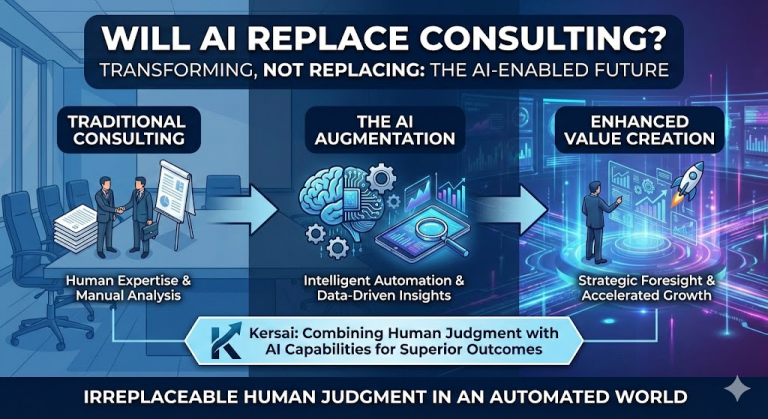
Rather than displacement, the realistic future involves business analysts leveraging AI tools to enhance their effectiveness. Forward-thinking Australian organisations are creating hybrid models where intelligent systems handle data-intensive, repetitive analytical tasks while human analysts focus on stakeholder engagement, strategic thinking, and complex decision support. This augmentation model multiplies analytical productivity without sacrificing the human judgment essential for effective business outcomes.
In this model, AI systems serve as powerful analytical assistants. They process large datasets, generate preliminary insights, identify patterns warranting further investigation, and automate routine reporting. Business analysts then interpret these findings within organisational context, validate recommendations against strategic objectives, facilitate stakeholder discussions around implications, and guide implementation approaches. The combination delivers both the speed and scale of automation and the contextual wisdom of experienced professionals.
This transformation requires business analysts to develop new capabilities. Understanding how AI systems work, what their limitations are, and how to interpret their outputs becomes essential. Analysts must become proficient at prompting AI tools effectively, validating automated insights critically, and integrating technological capabilities into their workflows strategically. Professional development around these skills represents a critical investment for organisations and individuals alike.
The Australian Digital Economy Strategy emphasises this augmentation approach, encouraging businesses to view technology as enabler rather than replacement for human expertise. Organisations that successfully integrate AI into their analytical practices report that business analysts become more strategic, focusing on higher-value activities while automation handles routine tasks. Rather than reducing headcount, many find they can tackle more ambitious analytical initiatives or serve stakeholder needs more responsively.
Comparison of Analytical Approaches
ApproachStrengthsLimitationsBest ApplicationsHuman InvolvementTraditional Manual AnalysisDeep contextual understanding and stakeholder relationshipsTime-intensive and limited by human processing capacityComplex strategic decisions requiring nuanced judgmentHigh throughout processFully Automated AI AnalysisRapid processing of large datasets with pattern identificationLacks contextual awareness and struggles with ambiguityRoutine reporting and anomaly detection in structured dataMinimal after initial setupAI-Augmented Human AnalysisCombines machine efficiency with human strategic thinkingRequires investment in training and integrationMost analytical scenarios requiring both speed and contextStrategic oversight and interpretationExpert SystemsCodified domain expertise with consistent applicationCannot handle novel situations outside programmed parametersRepetitive decisions within defined domainsDesign and exception handling
This comparison illustrates how different analytical approaches suit different contexts, with the question “will AI replace business analyst” answered more accurately as “AI will transform how business analysts work.”
How Kersai Supports Business Analysis Transformation
Kersai helps Australian organisations navigate the evolution of business analysis through comprehensive AI consulting, training programmes, and implementation support that position analytical teams for success in technology-augmented environments. The company understands that effective transformation requires both technological capability and human skill development—ensuring businesses leverage AI’s strengths while maintaining the strategic thinking and stakeholder management that drive real business value.
The firm’s AI training programmes specifically address how business professionals can work effectively with intelligent systems. With extensive video content covering practical AI tool usage, prompt engineering techniques, analytical workflow optimisation, and strategic technology integration, Kersai empowers business analysts to become more productive and valuable rather than displaced by automation. Training emphasises hands-on applications across research, data analysis, communication, strategic planning, and decision support—precisely the activities central to business analysis.
Beyond training, Kersai’s consulting services help organisations implement AI-enhanced analytical capabilities strategically. This includes assessing which analytical tasks offer highest automation returns, selecting appropriate technologies for specific business contexts, designing workflows that leverage both human and machine capabilities effectively, and managing change processes that help analytical teams embrace augmentation opportunities. The company’s custom software development capabilities enable creation of tailored analytical tools that address unique organisational requirements.
Kersai’s approach recognises that the question “will AI replace business analyst” reflects legitimate concerns about technological disruption. Rather than dismissing these anxieties or offering unrealistic reassurances, the company helps organisations chart practical paths forward where technology amplifies human capabilities. With proven experience across healthcare, finance, manufacturing, and professional services sectors, Kersai delivers measurable improvements in analytical productivity, decision quality, and strategic outcomes. Contact Kersai to explore how AI-augmented business analysis can strengthen your organisation’s competitive positioning while developing rather than displacing your analytical talent.
Preparing for the AI-Augmented Future
Organisations and individuals can take concrete steps to prepare for the evolution of business analysis. For businesses, this begins with honest assessment of current analytical capabilities—identifying which tasks consume disproportionate time relative to value delivered, which analytical needs go unmet due to capacity constraints, and which decisions would benefit from more timely or comprehensive insights. This assessment reveals high-value automation opportunities while highlighting where human judgment remains essential.
Investment in training represents a critical success factor. Business analysts need exposure to AI tools, practice integrating them into workflows, and frameworks for evaluating when automation adds value versus when human analysis proves superior. Professional development should emphasise complementary skills that become more valuable as routine tasks automate—stakeholder facilitation, strategic thinking, creative problem-solving, and ethical reasoning. Queensland and other state governments offer digital skills programmes that Australian businesses can leverage alongside commercial training options.
For individual business analysts, proactive skill development creates career resilience. Learning to work effectively with AI tools, understanding machine learning fundamentals, and developing expertise in translating between technical and business contexts positions professionals as valuable bridges in AI-augmented organisations. Deepening domain expertise in specific industries or business functions provides differentiation that resists commodification through automation.
Cultural shift also matters tremendously. Organisations that frame AI as threat foster anxiety and resistance. Those that position intelligent systems as tools that enable analytical professionals to work more strategically and deliver greater value create environments where teams embrace augmentation enthusiastically. Leadership communication, change management approaches, and performance management systems should all reinforce this augmentation mindset rather than displacement narrative.
Conclusion: Collaborative Intelligence as Competitive Advantage
The realistic answer to whether AI will replace business analysts is nuanced: intelligent systems will automate specific analytical tasks while human professionals remain essential for strategic thinking, stakeholder management, contextual judgment, and complex decision support. Rather than displacement, the future involves collaborative intelligence where technological capabilities and human expertise combine to deliver analytical outcomes neither could achieve independently. Australian organisations that embrace this model—investing in both AI implementation and human capability development—will outperform those pursuing either pure automation or technology resistance.
As you consider your organisation’s analytical future, reflect on these critical questions: Are you investing equally in AI capabilities and in developing your analytical team’s ability to leverage those tools effectively? Does your organisation recognise and value the uniquely human dimensions of business analysis—stakeholder management, strategic thinking, ethical judgment—or has focus narrowed exclusively to technical skills that automation can potentially replicate? How are you helping business analysts evolve from task executors to strategic advisors who orchestrate combinations of human insight and machine capabilities?
For Australian businesses seeking practical guidance on implementing AI-augmented analytical capabilities while developing rather than displacing their talented professionals, explore how comprehensive consulting, training, and implementation support from specialists like Kersai can position your organisation for success in this transforming landscape.